Yunnan Botanee Bio-Technology (300957)

Search documents
贝泰妮参投新10亿级基金
Sou Hu Cai Jing· 2025-10-17 15:06
Core Viewpoint - Betaini plans to invest 50 million yuan as a limited partner in the establishment of the Wuxi Jinyu Maowu Medical Health Industry Investment Partnership, aiming to deepen cooperation in the health ecosystem and enhance its competitive edge and profitability [1][5]. Investment Details - The total committed capital for the Jinyu Fund is 1 billion yuan, with Betaini holding a 5% partnership share after the investment [1]. - The fund's primary investment focus includes consumer healthcare, national health quality improvement, pharmaceuticals, medical devices, and AI in pharmaceuticals [2][6]. Historical Investment Background - Jinyu Maowu Investment Management Co., Ltd., the fund manager, has previously invested over 100 million yuan in Betaini since 2015 [6]. - Betaini has established and invested in nine fund companies since its listing in 2021, with planned investments exceeding 700 million yuan across various sectors including AI and consumer healthcare [7]. Financial Performance of Fund Manager - Jinyu Maowu reported a revenue of 84.46 million yuan in 2024, a year-on-year increase of 4.51%, while its net profit decreased by 68.21% to 51.61 million yuan [6]. - For the first half of 2024, the company achieved a revenue of 42.97 million yuan, a decrease of 2.36%, but its net profit rose by 75.35% to 44.24 million yuan [6]. Industry Trends - The medical beauty market in China is projected to grow significantly, reaching 399.8 billion yuan by 2026, indicating a strong growth potential in this sector [10]. - Betaini has formed a strategic partnership with Lumenis Group to develop home medical beauty devices, integrating its R&D capabilities with Lumenis' technology [11]. Recent Developments - Betaini's brand AOXMED has seen rapid growth, achieving a revenue of 51.47 million yuan in the first half of 2025, a year-on-year increase of 93.90% [11]. - The company has actively engaged in the medical beauty sector, with multiple investments and product launches aimed at enhancing its market presence [12].

业绩不佳,194亿护肤品龙头盯上产业基金
2 1 Shi Ji Jing Ji Bao Dao· 2025-10-17 12:24
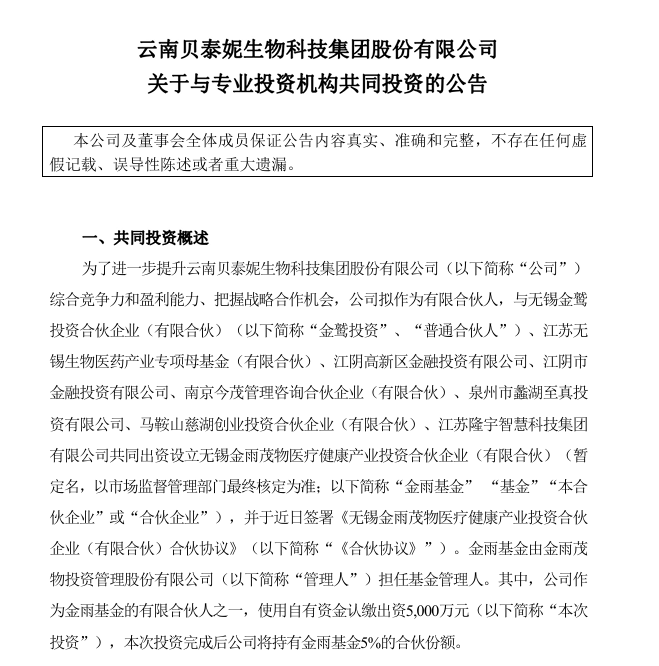
Core Viewpoint - Betaini (300957.SZ), known as the "first stock in functional skincare," is intensifying its capital market strategy by investing in a new healthcare fund, aiming to diversify its business beyond its core beauty segment [1][11]. Investment Strategy - On October 13, Betaini announced plans to invest as a limited partner in the Wuxi Jinyu Maowu Medical Health Industry Investment Partnership (referred to as "Jinyu Fund"), with a total fund size of CNY 1 billion [1][7]. - The fund will focus on sectors such as consumer healthcare, medical aesthetics, specialty foods, pharmaceuticals, medical devices, and AI-driven drug development [1][7]. Financial Commitment - Betaini intends to contribute CNY 50 million, which will account for a 5% stake in the Jinyu Fund [1][7]. - Other partners in the fund include Jiangsu Wuxi Biomedical Industry Special Mother Fund (CNY 300 million), and Jiangyin High-tech Zone Financial Investment Co., Ltd. (CNY 250 million) [7]. Previous Investments - Over the past few years, Betaini has invested in several funds, including Sequoia Fund, San Zheng Fund, and Jinguo Fund, totaling approximately CNY 280 million across various sectors [1][11]. - Specific investments include CNY 100 million in the Sequoia Fund in June 2022, CNY 100 million in the San Zheng Fund in April 2023, and CNY 30 million in the Jinguo Fund in October 2023 [6][8]. Business Performance - Betaini's revenue growth has been declining, with revenues of CNY 40.22 billion, CNY 50.14 billion, CNY 55.22 billion, and CNY 57.36 billion from 2021 to 2024, showing a decreasing growth rate [11]. - The net profit has also decreased significantly, from CNY 8.63 billion in 2021 to CNY 5.03 billion in 2024, indicating a trend of increasing revenue but declining profitability [11]. Market Context - The beauty industry is witnessing a trend where major brands, including Betaini, are increasingly investing in capital markets to seek growth opportunities amid slowing core business performance [11][12]. - Competitors like Proya and Marubi are also exploring similar investment strategies to enhance their market positions and seek new growth avenues [12][13].
业绩不佳,194亿护肤品龙头贝泰妮盯上产业基金
2 1 Shi Ji Jing Ji Bao Dao· 2025-10-17 10:29
Core Viewpoint - Betaini, known as the "first stock in functional skincare," is increasing its capital investments to explore new business opportunities amid declining performance in its core skincare segment [1][9]. Investment Strategy - On October 13, Betaini announced plans to invest as a limited partner in the Wuxi Jinyu Maowu Medical Health Industry Investment Partnership, with a total fund size of 1 billion CNY, focusing on consumer healthcare, pharmaceuticals, medical devices, and AI in drug development [1][5]. - Betaini will contribute 50 million CNY, holding a 5% stake in the fund, which aims to enhance the company's competitive edge and profitability through strategic partnerships in the health ecosystem [5][9]. Financial Performance - Betaini's revenue from 2021 to 2024 showed a declining growth trend, with revenues of 40.22 billion CNY, 50.14 billion CNY, 55.22 billion CNY, and 57.36 billion CNY, reflecting year-on-year growth rates of 52.57%, 24.65%, 10.14%, and 3.87% respectively [9][10]. - The net profit during the same period was 8.63 billion CNY, 10.51 billion CNY, 7.57 billion CNY, and 5.03 billion CNY, with year-on-year growth rates of 58.77%, 21.82%, -28.02%, and -33.53%, indicating a trend of increasing revenue but decreasing profit [10]. Brand Dependency - The company's revenue heavily relies on its core brand "Winona," which contributed 48.85 billion CNY, 51.92 billion CNY, and 49.09 billion CNY from 2022 to 2024, accounting for approximately 97%, 94%, and 86% of total revenue respectively [10]. Diversification Efforts - To mitigate risks associated with reliance on a single brand, Betaini is developing a multi-brand strategy, acquiring stakes in other brands such as "Za" and "PURE&MILD" to expand its business portfolio [10][11]. - The company has invested approximately 280 million CNY in various funds over the past three years, indicating a proactive approach to diversify its investment portfolio beyond its primary beauty business [5][9]. Market Trends - The beauty industry is witnessing a trend where leading brands, including Betaini, are increasingly investing in capital markets to seek growth opportunities amid slowing sales in their core businesses [9][12].
业绩不佳,194亿护肤品龙头盯上产业基金
21世纪经济报道· 2025-10-17 10:18
Core Viewpoint - Betaini (300957.SZ), known as the "first stock in functional skincare," is intensifying its capital market strategy by investing in a new healthcare fund, aiming to diversify its business beyond its core beauty segment [1]. Investment Strategy - On October 13, Betaini announced plans to invest as a limited partner in the Wuxi Jinyu Maowu Medical Health Industry Investment Partnership (referred to as "Jinyu Fund"), with a total fund size of 1 billion CNY, focusing on consumer healthcare, pharmaceuticals, medical devices, and AI drug development [1][4]. - Betaini will contribute 50 million CNY, acquiring a 5% stake in the Jinyu Fund, which is part of a broader strategy to deepen cooperation with professional funds and enhance its presence in the health ecosystem [4]. Historical Investments - Over the past three years, Betaini has invested approximately 280 million CNY in various funds, including the Sequoia Fund and the San Zheng Fund, indicating a strategic shift towards capital investments to seek growth opportunities [3][9]. - The company has made several notable investments: 100 million CNY in the Sequoia Fund in June 2022, another 100 million CNY in the San Zheng Fund in April 2023, and 30 million CNY in the Jinguo Fund in October 2023 [5][9]. Financial Performance - Betaini's revenue growth has been declining, with reported revenues of 4.022 billion CNY in 2021, 5.014 billion CNY in 2022, 5.522 billion CNY in 2023, and 5.736 billion CNY in 2024, showing a decreasing growth rate from 52.57% to 3.87% [9]. - The net profit has also seen a downward trend, with figures of 863 million CNY in 2021, 1.051 billion CNY in 2022, 757 million CNY in 2023, and 503 million CNY in 2024, reflecting a significant decline in profitability [9]. Market Position and Competition - Betaini's core brand, Winona, has been a major revenue driver, contributing approximately 97% of total revenue in 2022, which decreased to around 86% in 2024, indicating a heavy reliance on a single brand [9]. - Other beauty brands, such as Proya and Marubi, are also increasing their capital investments to seek growth, highlighting a trend among leading beauty companies to diversify and enhance their market positions [10][11].

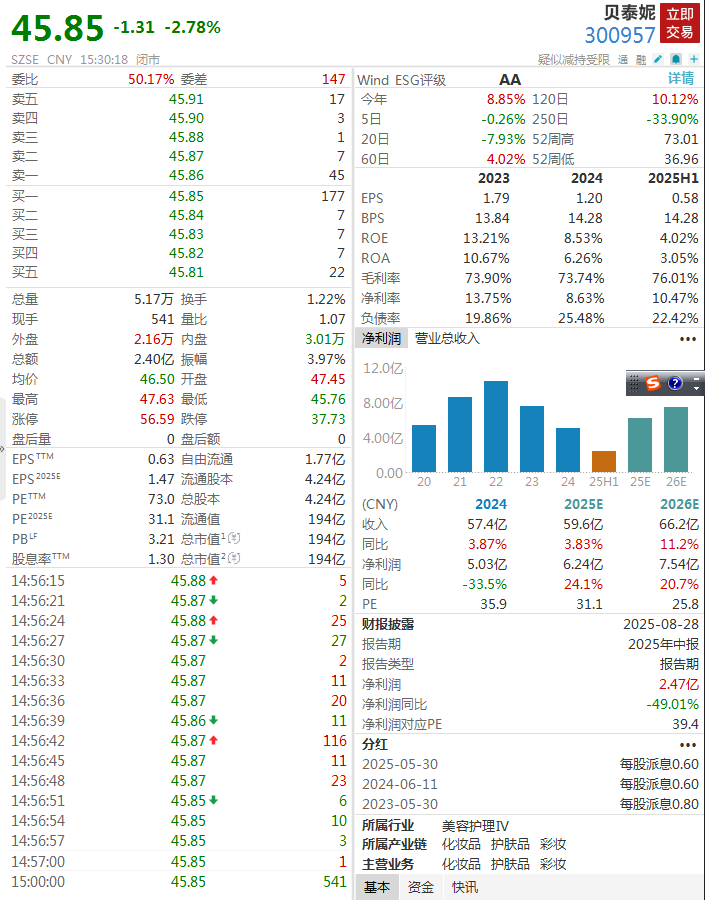
贝泰妮跌2.12%,成交额1.41亿元,主力资金净流出979.09万元
Xin Lang Cai Jing· 2025-10-17 03:29
Core Viewpoint - The stock of Betaini has experienced fluctuations, with a recent decline of 2.12%, reflecting a total market value of 19.55 billion yuan and a year-to-date increase of 9.66% [1] Financial Performance - For the first half of 2025, Betaini reported a revenue of 2.372 billion yuan, a year-on-year decrease of 15.43%, and a net profit attributable to shareholders of 247 million yuan, down 49.01% compared to the previous year [2] - Since its A-share listing, Betaini has distributed a total of 1.289 billion yuan in dividends, with 844 million yuan distributed over the past three years [3] Shareholder Information - As of August 29, 2025, the number of shareholders for Betaini increased to 37,700, with an average of 11,237 circulating shares per person, a slight decrease of 0.53% [2] - The top ten circulating shareholders include Hong Kong Central Clearing Limited and E Fund's ChiNext ETF, with significant increases in their holdings [3]
上半年业绩不佳,贝泰妮靠投资过冬?
Guan Cha Zhe Wang· 2025-10-16 11:03
Core Insights - Yunnan Betaini Biotechnology Group Co., Ltd. announced an investment of 50 million yuan as a limited partner in the establishment of a 1 billion yuan Wuxi Jinyu Maowu Medical Health Industry Investment Partnership [1] - The fund will focus on investment areas including consumer healthcare, wellness, medical aesthetics, special medical and functional foods, pharmaceuticals, medical devices, and AI pharmaceuticals [1][3] - Betaini's investment strategy is aimed at addressing the slowdown in its main business growth, as evidenced by a projected decline in net profit of around 30% for 2023 and 2024 [5][6] Investment Activities - Since 2022, Betaini has participated in multiple industry investment funds, including a 100 million yuan investment in Hangzhou Sequoia Shengheng Equity Investment Partnership in June 2022 and another 100 million yuan in Nanjing Jianye Sanzheng Equity Investment Partnership in April 2023 [3] - The company has made at least 12 investment events covering various fields such as pharmaceuticals, medical devices, and skincare since 2022 [3] Financial Performance - As of June 30, 2023, Betaini reported a decline in both revenue and net profit, with total revenue of 236.77 million yuan and a net profit of 44.06 million yuan, reflecting a negative growth trend [6] - The company's net profit is projected to decline by approximately 30% in both 2023 and 2024, indicating challenges in maintaining profitability [5][6] Industry Context - The beauty and cosmetics industry is increasingly engaging in investment activities, with major companies like Proya, Marubi, and Water Sheep also establishing investment funds and making substantial investments [6] - The competitive landscape in the beauty industry is evolving, with a focus on building an ecosystem for sustainable growth through capital strategies [7]

贝泰妮5000万元押注10亿级产业基金,意图何在?
2 1 Shi Ji Jing Ji Bao Dao· 2025-10-16 08:54
Core Viewpoint - Betaini, known as the "first stock in efficacy skincare," is intensifying its capital market strategy by investing in a new healthcare fund, aiming to enhance its presence in the health and wellness sector [1][3]. Investment Strategy - On October 13, Betaini announced plans to invest as a limited partner in the Wuxi Jinyu Maowu Medical Health Industry Investment Partnership, with a total fund size of 1 billion yuan, focusing on areas such as consumer healthcare, pharmaceuticals, and AI in drug development [1][3]. - Betaini will contribute 50 million yuan, acquiring a 5% stake in the fund, which is part of a broader strategy to deepen collaboration with professional funds and enhance its competitive edge in the health ecosystem [3]. Historical Investments - Over the past three years, Betaini has invested approximately 280 million yuan across various funds, including the Sequoia Fund and the San Zheng Fund, indicating a strategic shift towards capital investments beyond its core beauty business [2][3]. - The timeline of investments includes: - 100 million yuan in the Sequoia Fund in June 2022 [4] - 100 million yuan in the San Zheng Fund in April 2023 [5] - 30 million yuan in the Jin Gao Fund in October 2023 [5] - A planned 300 million yuan investment in the Yun Zhong Fund, which was later terminated due to policy changes [6][7]. Financial Performance - Betaini's revenue growth has been declining, with reported revenues of 4.022 billion yuan in 2021, 5.014 billion yuan in 2022, 5.522 billion yuan in 2023, and 5.736 billion yuan in 2024, reflecting a decreasing growth rate [8]. - The net profit attributable to shareholders has also shown a downward trend, with figures of 863 million yuan in 2021, 1.051 billion yuan in 2022, 757 million yuan in 2023, and 503 million yuan in 2024, indicating a pattern of increasing revenue but declining profitability [8]. Market Context - The beauty industry is witnessing a trend where major players like Betaini, Proya, and Marubi are increasingly investing in capital markets to seek growth opportunities amid slowing core business performance [9][10].
贝泰妮5000万元押注10亿级产业基金,意图何在?丨美妆变局
2 1 Shi Ji Jing Ji Bao Dao· 2025-10-16 08:41
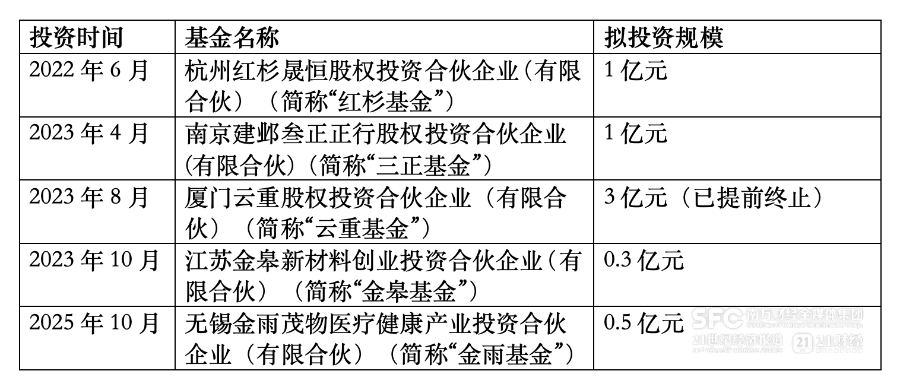
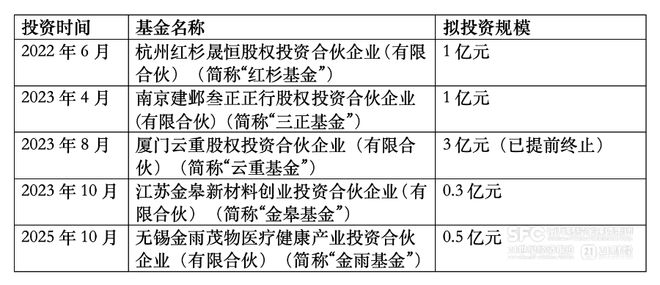
Core Viewpoint - Betaini, known as the "first stock in functional skincare," is intensifying its capital market strategy by establishing a new investment fund focused on healthcare and medical industries [1][3]. Investment Fund Overview - Betaini plans to invest as a limited partner in the Wuxi Jinyu Maowu Medical Health Industry Investment Partnership, with a total fund size of 1 billion yuan, focusing on consumer healthcare, pharmaceuticals, medical devices, and AI in drug development [1][3]. - The company will contribute 50 million yuan, acquiring a 5% stake in the fund, which has a 10-year partnership duration [2][3]. Historical Investment Activities - Over the past three years, Betaini has invested approximately 280 million yuan across various funds, including Sequoia Fund and San Zheng Fund, indicating a strategic shift towards capital investments beyond its core beauty business [2][4]. - Specific investments include 100 million yuan in Sequoia Fund in June 2022, 100 million yuan in San Zheng Fund in April 2023, and 30 million yuan in Jiangsu Jinguo New Materials Fund in October 2023 [2][4]. Financial Performance and Strategic Concerns - Betaini's revenue growth has been declining, with revenues of 4.022 billion yuan in 2021, 5.014 billion yuan in 2022, 5.522 billion yuan in 2023, and 5.736 billion yuan in 2024, showing a decreasing growth rate from 52.57% to 3.87% [6]. - The company's net profit has also decreased significantly, from 8.63 billion yuan in 2021 to 5.03 billion yuan in 2024, reflecting a trend of increasing revenue but declining profitability [6]. Brand Diversification Efforts - To mitigate reliance on its core brand Winona, which accounted for approximately 86% of total revenue in 2024, Betaini is expanding its brand portfolio by acquiring stakes in other brands and developing a multi-brand strategy [6][7]. - The company has invested 536 million yuan to acquire a 51% stake in Yuejiang (Guangzhou) Investment Co., aiming to integrate brands like Za and Pure&Mild into its offerings [6]. Industry Trends - Other major beauty brands, such as Proya and Marubi, are also increasing their capital investments to seek growth opportunities amid slowing sales, indicating a broader trend in the beauty industry towards capital market engagement [7][8].
化妆品板块10月15日涨3.35%,水羊股份领涨,主力资金净流入2.19亿元
Zheng Xing Xing Ye Ri Bao· 2025-10-15 08:33
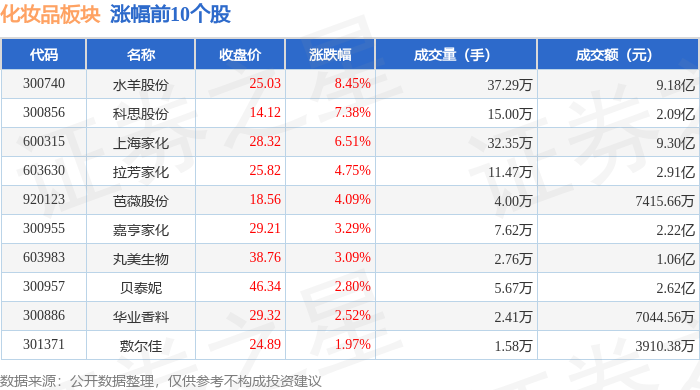
Group 1 - The cosmetics sector experienced a significant increase of 3.35% on October 15, with Shuiyang Co., Ltd. leading the gains [1] - The Shanghai Composite Index closed at 3912.21, up 1.22%, while the Shenzhen Component Index closed at 13118.75, up 1.73% [1] - Major stocks in the cosmetics sector showed notable price increases, with Shuiyang Co., Ltd. rising by 8.45% to a closing price of 25.03 [1] Group 2 - The net inflow of main funds in the cosmetics sector was 219 million yuan, while retail investors saw a net outflow of 222 million yuan [1] - Shanghai Jahwa's main fund net inflow was 85.02 million yuan, with a retail net outflow of 66.90 million yuan [2] - Shuiyang Co., Ltd. had a main fund net inflow of 46.76 million yuan, but a retail net outflow of 69.20 million yuan [2]





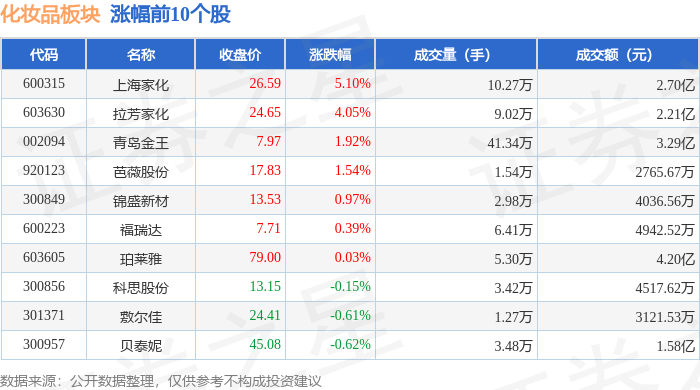
化妆品板块10月14日涨0.31%,上海家化领涨,主力资金净流出1328.42万元
Zheng Xing Xing Ye Ri Bao· 2025-10-14 08:46
Core Insights - The cosmetics sector experienced a slight increase of 0.31% on October 14, with Shanghai Jahwa leading the gains [1] - The Shanghai Composite Index closed at 3865.23, down 0.62%, while the Shenzhen Component Index closed at 12895.11, down 2.54% [1] Company Performance - Shanghai Jahwa (600315) closed at 26.59, up 5.10%, with a trading volume of 102,700 shares and a transaction value of 270 million yuan [1] - Lafang (603630) closed at 24.65, up 4.05%, with a trading volume of 90,200 shares and a transaction value of 221 million yuan [1] - Qingdao Kingway (002094) closed at 7.97, up 1.92%, with a trading volume of 413,400 shares and a transaction value of 329 million yuan [1] - Other notable performers include Bawei (920123) at 17.83 (+1.54%) and Jinsong New Materials (300849) at 13.53 (+0.97%) [1] Fund Flow Analysis - The cosmetics sector saw a net outflow of 13.28 million yuan from institutional investors, while retail investors experienced a net outflow of 46.69 million yuan [2] - Conversely, speculative funds recorded a net inflow of 59.98 million yuan [2] Individual Stock Fund Flow - Shanghai Jahwa had a net inflow of 29.86 million yuan from institutional investors, while retail investors saw a net outflow of 24.90 million yuan [3] - Lafang recorded a net inflow of 21.89 million yuan from institutional investors, with retail investors experiencing a net outflow of 21.61 million yuan [3] - Qingdao Kingway had a net inflow of 16.80 million yuan from institutional investors, while retail investors saw a net outflow of 18.67 million yuan [3]