BYD(BYDDY)

Search documents
比亚迪10月销售44.17万辆
Mei Ri Jing Ji Xin Wen· 2025-11-01 10:27
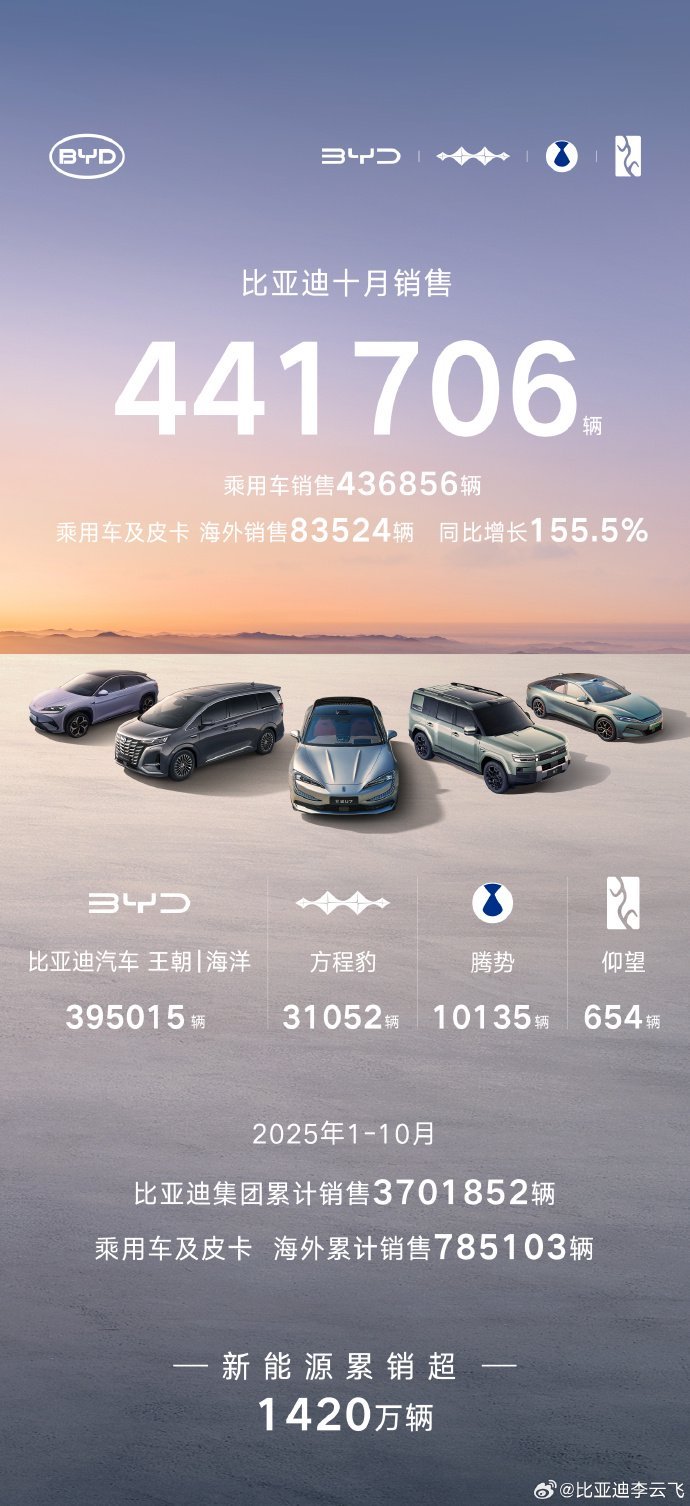
Core Insights - BYD achieved a record high in October sales, reaching 441,706 vehicles, marking the highest monthly sales for the year [1] - Cumulatively, from January to October 2025, BYD has sold 3,701,852 vehicles [1] - The total sales of new energy vehicles by BYD have exceeded 14.2 million units [1]
比亚迪10月份销售441706辆,创年内新高
Ge Long Hui A P P· 2025-11-01 10:20
Group 1 - The core point of the article is that BYD achieved a record high in sales for October, with a total of 441,706 vehicles sold [1] - Cumulative sales from January to October 2025 reached 3,701,852 vehicles [1][3] - The total sales of new energy vehicles exceeded 14.2 million units [1][3] Group 2 - BYD's overseas sales of passenger cars and pickups amounted to 785,103 vehicles [3]

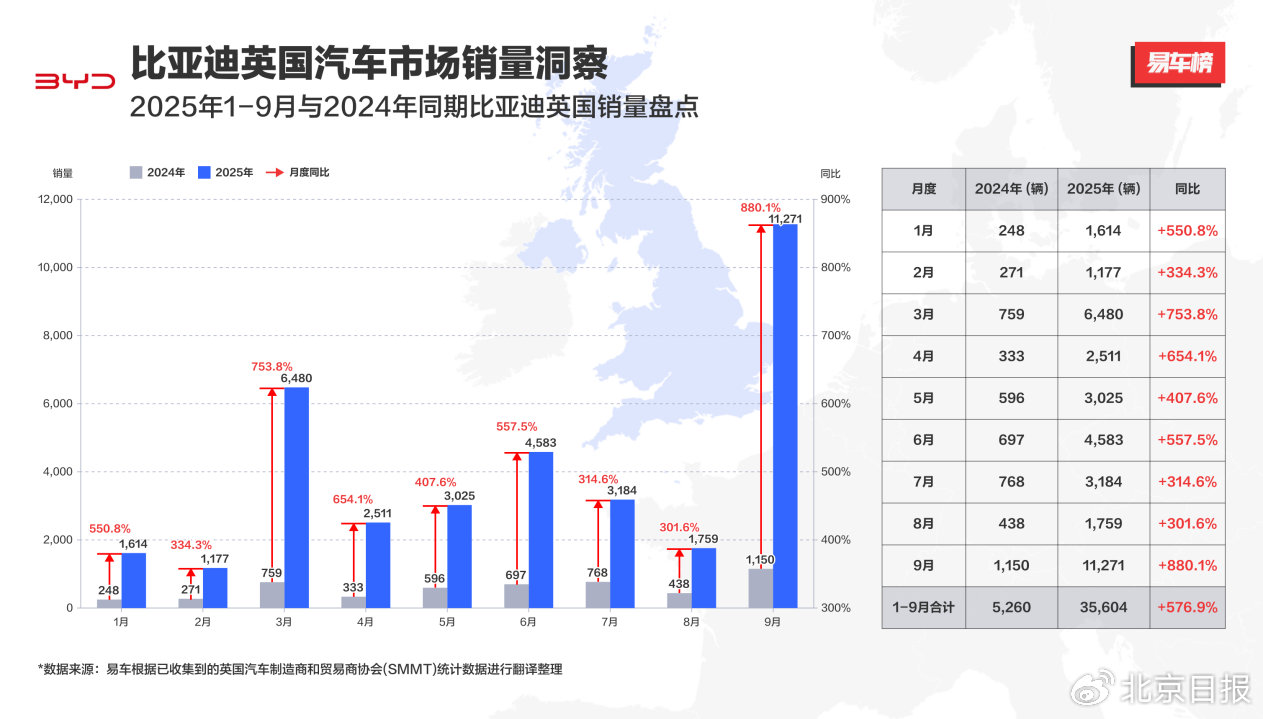
9月销量同比激增880% 英国成比亚迪最大海外单一市场
Bei Jing Ri Bao Ke Hu Duan· 2025-11-01 09:58
Core Insights - BYD has achieved significant growth in the UK market, with passenger car sales reaching 11,271 units in September 2025, marking an 880% year-on-year increase and a 541% month-on-month increase [1] - In the first nine months of the year, BYD's cumulative sales in the UK reached 35,604 units, reflecting a year-on-year growth of 576.9% [1] Group 1 - The rapid growth of BYD in the UK has garnered attention from major UK media outlets, with reports highlighting BYD's record sales and its rise over traditional UK automotive brands [3] - Two years ago, BYD was relatively unknown in the UK market, but through a multi-faceted strategy involving frequent dealer visits and promotional activities, the company successfully established a strong channel system [3] - BYD has expanded from four initial stores to over a hundred locations across the UK in just two years, transforming the relationship with dealers from seeking partnerships to dealers actively wanting to collaborate [3] Group 2 - BYD's success in the UK is part of a broader global strategy, with its electric vehicles now sold in 117 countries and regions as of October 2025 [5] - The company has upgraded its global production and logistics systems, including the inauguration of its 14 millionth electric vehicle in Brazil, witnessed by the Brazilian president [5] - BYD's experience in the UK serves as a model for other Chinese automotive companies, emphasizing the importance of channel development and localized operations in international markets [5]
泰国EV产业升级,比亚迪带动本地供应链
Shang Wu Bu Wang Zhan· 2025-10-31 16:40
Core Insights - The Thai Industrial Federation (FTI) is urging large Chinese automotive manufacturers to further open their supply chain systems to allow more local participation from Thai companies [1] - The local automotive and parts industry in Thailand has seen a significant reduction in workforce, dropping from over 600,000 to approximately 400,000 due to the heavy reliance on imported components [1] Group 1: BYD's Operations in Thailand - BYD's electric vehicle production in Thailand has rapidly increased, with cumulative output exceeding 55,000 units since production began in July 2024, and an expected annual output of over 40,000 units [1] - The current workforce at BYD's factory is around 5,800 employees, with 92% being Thai nationals, an increase from 80% last year, and this is expected to rise to 95% by the end of the year [1] - BYD collaborates with over 20 educational institutions to train a new generation of technical talent for the Thai electric vehicle industry [1] Group 2: Local Sourcing and Employment - The localization rate of BYD's production in Thailand has reached 54%, up from 45% last year, with over 35 local parts suppliers and a total of 529 types of locally sourced components [1] - The emphasis on local parts manufacturing is seen as a way to enhance social trust, promote employment, and build a positive corporate image despite slightly higher production costs in Thailand [1]
三季度卖车超111万辆,比亚迪要“求稳”
Guo Ji Jin Rong Bao· 2025-10-31 16:25
Core Viewpoint - BYD maintains its global leadership in electric vehicle sales, but faces challenges from intensified domestic competition, cost pressures, and increased R&D investments, while overseas business growth serves as a crucial support for its performance [1][3]. Sales Performance - In Q3, BYD's total new energy vehicle sales reached 1.1142 million units, with pure electric vehicle sales at 582,500 units, surpassing Tesla's 497,100 units by over 80,000 units for the fourth consecutive quarter [3]. - Cumulatively, sales for the first three quarters reached 3.2601 million units, a year-on-year increase of 18.64%, with overseas markets contributing significantly, exporting 701,600 units, a 132% increase year-on-year, accounting for 21.52% of total sales [3]. - However, there are signs of slowing sales growth, with monthly sales growth rates declining to 0.56% in July, 0.15% in August, and a 5.52% decrease in September, leading to high inventory levels of 152.973 billion yuan, a 31.83% year-on-year increase [3][6]. Financial Performance - In Q3, BYD reported revenue of 194.985 billion yuan and a net profit attributable to shareholders of 7.823 billion yuan, with a basic earnings per share of 0.85 yuan. For the first three quarters, total revenue reached 566.266 billion yuan, a year-on-year growth of 12.75% [6]. - The revenue growth of 12.75% contrasts with the 18.64% sales growth, primarily due to declining unit revenue amid intense industry competition, with price cuts from competitors like Tesla and Geely affecting profit margins [6]. - R&D investments increased to 43.748 billion yuan, a 31.3% year-on-year rise, impacting profitability but aimed at strengthening market position in smart driving and solid-state battery technologies [6][9]. Industry Dynamics - The gradual reduction of domestic new energy subsidies has diminished profit support for automakers, while potential risks from EU carbon tariffs and increased competition from joint venture brands add uncertainty to the market [7]. - BYD's breakthroughs in overseas markets and substantial R&D investments are expected to lay a solid foundation for future growth, focusing on local production and adapting to regional policies [9]. - The key challenge for BYD will be to maintain its sales leadership while enhancing profitability through cost reduction and premium pricing in overseas markets [9].
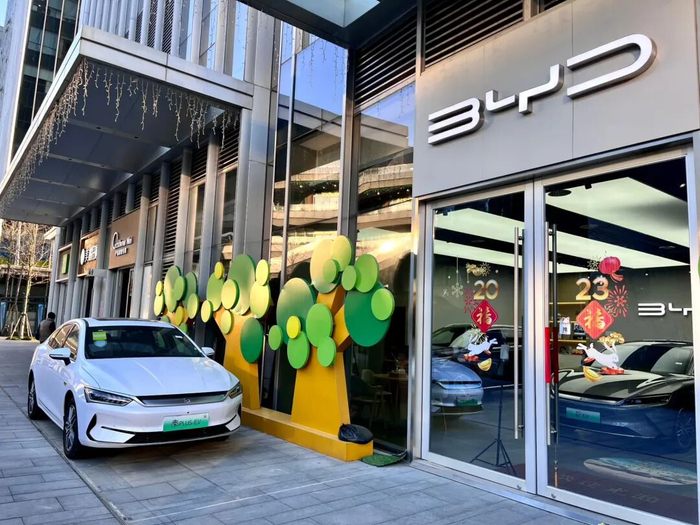
三季度卖车超111万辆 比亚迪要“求稳”
Guo Ji Jin Rong Bao· 2025-10-31 16:18
Core Viewpoint - BYD maintains its global leadership in electric vehicle sales, but faces challenges from intensified domestic competition, cost pressures, and increased R&D investments, leading to a divergence in revenue and profit growth, while rapid overseas business expansion supports overall performance [2]. Sales Performance - In Q3, BYD's total new energy vehicle sales reached 1.1142 million units, with pure electric vehicle sales at 582,500 units, surpassing Tesla's 497,100 units by over 80,000 units for the fourth consecutive quarter [3]. - Cumulatively, BYD sold 3.2601 million units in the first three quarters, a year-on-year increase of 18.64%, with overseas markets contributing significantly, exporting 701,600 units, a 132% increase year-on-year, accounting for 21.52% of total sales [3]. - However, there are signs of slowing sales growth, with monthly sales growth rates declining to 0.56% in July, 0.15% in August, and a 5.52% decrease in September, leading to high inventory levels of 152.973 billion yuan, a 31.83% year-on-year increase [3]. Financial Performance - In Q3, BYD reported revenue of 194.985 billion yuan and a net profit attributable to shareholders of 7.823 billion yuan, with a basic earnings per share of 0.85 yuan. For the first three quarters, total revenue reached 566.266 billion yuan, a year-on-year growth of 12.75% [5]. - The revenue growth of 12.75% contrasts with the 18.64% sales growth, primarily due to declining unit revenue amid intense industry competition, with price cuts of 10%-15% from competitors like Tesla and Geely [5]. - R&D investments increased to 43.748 billion yuan, a 31.3% year-on-year rise, impacting profit margins, resulting in a net profit of 23.33 billion yuan for the first three quarters, showing a year-on-year decline [5]. Industry Dynamics - Changes in industry policies and competitive landscape are introducing new variables, such as the gradual reduction of domestic new energy subsidies and potential risks from EU carbon tariffs affecting export business [6]. - Despite these challenges, BYD's breakthroughs in overseas markets and substantial R&D investments are laying a solid foundation for future growth, with a focus on local production and adapting to regional policies [6]. - The key challenge for BYD will be to maintain its sales leadership while enhancing profitability through cost reduction and premium pricing in overseas markets [6].
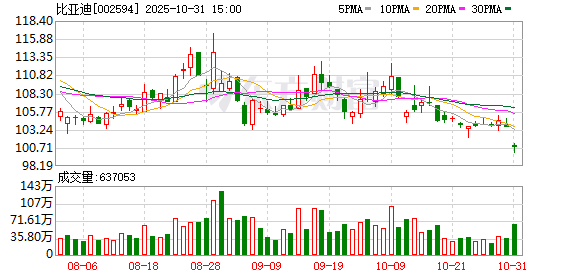
汽车行业“千亿元营收阵营”扩容 比亚迪前三季度以5662.66亿元营收稳居首位
Zheng Quan Ri Bao· 2025-10-31 15:59
Core Insights - The automotive industry in China is experiencing a significant transformation, with a total revenue of 3.23 trillion yuan and a net profit of 131.56 billion yuan for the first three quarters of 2023, reflecting a year-on-year growth of 8.19% and 3.36% respectively [1] - The new energy vehicle (NEV) sector continues to drive growth, with NEV production and sales reaching 11.24 million and 11.22 million units, marking a year-on-year increase of 35.2% and 34.9% [2] - The industry is witnessing a pronounced differentiation among companies, with some experiencing significant sales declines while others report substantial growth [3] Industry Performance - The overall automotive production and sales in China for the first three quarters reached 24.33 million and 24.36 million units, showing year-on-year growth of 13.3% and 12.9% respectively [2] - The passenger vehicle market outperformed the commercial vehicle market, with passenger vehicle production and sales at 21.24 million units, reflecting a growth of 13.9% and 13.7% [2] Company Performance - BYD led the industry with sales of 3.26 million units, a year-on-year increase of 18.64%, while SAIC Group followed closely with 3.19 million units, growing by 20.53% [3] - Some companies, such as GAC Group and JAC Motors, reported significant sales declines of 11.34% and 10.66% respectively [3] - BYD's revenue for the first three quarters was 566.27 billion yuan, a 12.75% increase, while SAIC Group reported 461.22 billion yuan, growing by 9.91% [4] Profitability Trends - BYD maintained its position as the industry's profit leader with a net profit of 23.33 billion yuan, although this represented a decline of 7.55% year-on-year [5] - Several traditional automakers, including GAC Group and BAIC Blue Valley, faced losses, indicating challenges during the industry's transition [5] - Commercial vehicle manufacturers like Foton Motor and China National Heavy Duty Truck reported significant profit recoveries, with Foton's net profit increasing by 1764.21% in the third quarter [5] Market Dynamics - The automotive industry is currently characterized by intense competition and price wars, which have pressured profit margins despite rising sales and revenue [6] - The demand for commercial vehicles has surged, contributing to the profitability of commercial vehicle manufacturers [6]



比亚迪(002594):三季度利润韧性显现 环比展望向上可期
Xin Lang Cai Jing· 2025-10-31 12:41
Core Viewpoint - The company reported its Q3 2025 performance, showing a revenue increase of 12.75% year-on-year, but a decline in net profit by 7.6% year-on-year, indicating mixed results in financial performance [1] Financial Performance - For the first three quarters of 2025, the company achieved a revenue of 566.27 billion yuan, with a net profit attributable to shareholders of 23.33 billion yuan [1] - Q3 revenue was 194.99 billion yuan, reflecting a decrease of 3.1% year-on-year and 3.0% quarter-on-quarter, while net profit for Q3 was 7.82 billion yuan, down 32.6% year-on-year but up 23.1% quarter-on-quarter [1] - Excluding profits from BYD Electronics, Q3 net profit was 6.87 billion yuan, showing a decline of 35.1% year-on-year but an increase of 22.1% quarter-on-quarter [1] Sales Performance - Total sales volume for Q3 2025 was 1.114 million vehicles, down 1.8% year-on-year and 2.5% quarter-on-quarter [1] - Sales figures for various models included 567,000 for Ocean, 446,000 for Dynasty, 46,000 for Fangchengbao, 36,000 for Tengshi, and 2,000 for Yangwang, with Fangchengbao showing significant growth of 282.5% year-on-year [1] - Export and overseas sales reached 232,800 vehicles in Q3, marking a 146.4% increase year-on-year, with overseas sales accounting for 20.9% of total sales [1] Profitability and Cost Management - Q3 gross margin improved by 1.3 percentage points quarter-on-quarter, attributed to one-time factors and cost control measures [2] - The total expense ratio for Q3 was 13.0%, down 1.4 percentage points year-on-year, with significant reductions in R&D and management expense ratios [2] - The average selling price (ASP) for vehicles in Q3 was 137,700 yuan, showing a decline compared to previous quarters, while net profit per vehicle (excluding BYD) was 6,200 yuan, indicating resilience in profitability [2] Future Outlook - Revenue projections for 2025-2027 are 898.15 billion yuan, 996.54 billion yuan, and 1,101.29 billion yuan, with year-on-year growth rates of 15.6%, 11.0%, and 10.5% respectively [3] - Expected net profits for the same period are 36.82 billion yuan, 46.28 billion yuan, and 55.02 billion yuan, with a projected decline in 2025 followed by growth in subsequent years [3]
比亚迪秦L DM-i上市:定位中级轿车,起售价依旧低于10万元
Guan Cha Zhe Wang· 2025-10-31 12:15
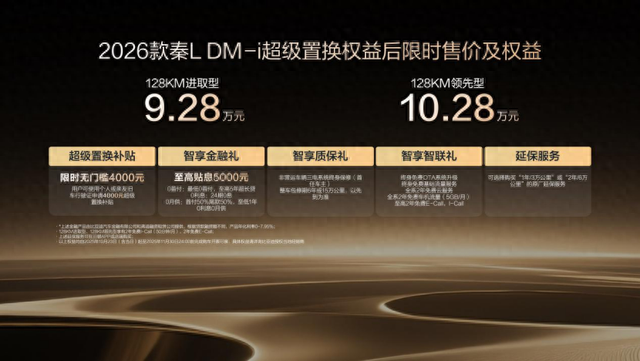
Core Insights - The 2026 model of the Qin L DM-i has been officially launched, featuring two variants with prices ranging from 96,800 to 106,800 yuan, and a promotional subsidy of 4,000 yuan available until November 30, 2023, effectively lowering the price to 92,800 to 102,800 yuan [1][3] - The new model boasts an improved electric range of 128 km, a reduction in fuel consumption to 2.79 L per 100 km, and an overall range increase to 2,148 km [1][6] - The Qin L DM-i has achieved significant market success, with over 280,000 units sold since its initial launch in May 2024, establishing itself as a key product in BYD's lineup [6] Product Features - The 2026 model introduces an electronic gear shift and enhanced cabin technology, including DiLink 100, which supports various smart features such as voice control and cloud services [3] - The vehicle is equipped with the "Heavenly Eye-C" system, providing advanced driver assistance features, including autonomous speed control and intelligent parking capabilities [5][6] - New functionalities have been added to the driver assistance system, enhancing driving efficiency and safety [6] Market Positioning - The Qin L DM-i plays a crucial role in BYD's hybrid strategy, bridging the gap between high-end models like Han and Tang and more affordable options, thus expanding BYD's market presence in the mid-range sedan segment [6] - The model's competitive pricing and scale have allowed BYD to penetrate the traditional fuel vehicle market effectively [6]
比亚迪召回部分唐、元Pro汽车 超11万辆车受影响
Xi Niu Cai Jing· 2025-10-31 11:47
Core Points - BYD Auto Industry Co., Ltd. has filed a recall plan with the State Administration for Market Regulation, involving over 110,000 vehicles including certain Tang and Yuan Pro models [2] Group 1: Recall Details - The recall includes two specific numbers: S2025M0165I and S2025M0166I [4] - Recall number S2025M0165I pertains to 44,535 units of the 2015 Tang series produced between March 28, 2015, and July 28, 2017, due to design defects in components that may cause the drive motor controller to malfunction, posing safety risks [4] - Recall number S2025M0166I involves 71,248 units of Yuan Pro electric vehicles produced between February 6, 2021, and August 5, 2022, with manufacturing issues that may lead to inadequate sealing of the battery, risking water ingress and insulation failure under extreme conditions [4]