Deutsche Bank AG(DB)

Search documents
英镑:政治担忧或拖累,预算案难消风险溢价
Sou Hu Cai Jing· 2025-11-14 14:45
Core Viewpoint - Political concerns may continue to weigh on the British pound, despite potential positive market reactions to the budget announcement on November 26 [1] Group 1: Political Risks - The leadership challenge to Prime Minister Starmer poses significant political risks that could affect the pound [1] - Uncertainty regarding potential successors who may not adhere to fiscal discipline could further widen the risk premium [1] Group 2: Economic Implications - While avoiding negative surprises in the budget could benefit the pound's recovery, the underlying political risks are likely to prevent a complete elimination of the fiscal risk premium [1]

经历股价七倍反弹后的德银(DB.US)即将公布三年计划 聚焦“更强劲盈利+控成本”
智通财经网· 2025-11-14 08:09
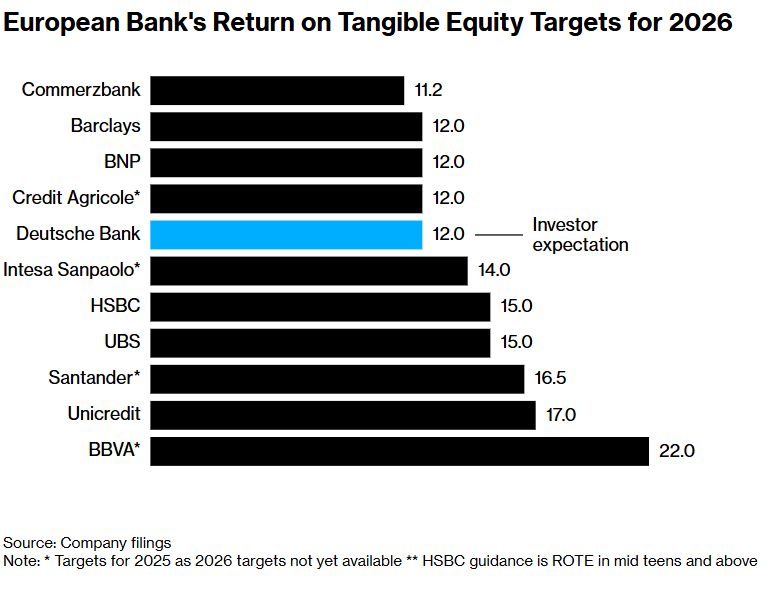
Core Viewpoint - Deutsche Bank is preparing for a significant strategic update under CEO Christian Sewing, focusing on cost savings in retail banking and targeted long-term investments in investment banking to strengthen profitability [1][2]. Group 1: Strategic Planning - Christian Sewing will announce a three-year core strategic plan, with expectations for more ambitious financial targets, particularly in profitability, while overall strategic changes are not anticipated [1]. - The upcoming strategic update will be the last for outgoing CFO James von Moltke, who played a crucial role in restoring confidence in Deutsche Bank [3]. Group 2: Financial Performance - Deutsche Bank's stock has surged nearly sevenfold from five years ago, with a 130% increase in its ADR this year, outperforming major U.S. bank indices [2]. - Despite strong performance, maintaining similar growth rates may be challenging due to the waning benefits of the previous high-interest rate environment and uncertain economic conditions in Europe [2]. Group 3: Return on Tangible Equity (ROTE) Goals - Investors expect Deutsche Bank to raise its ROTE target to 12% or higher, with executive compensation linked to achieving this goal between 2025 and 2027 [4]. Group 4: Investment Banking Focus - Investment banking will remain a key pillar of Deutsche Bank's strategy, with plans for continued investment in personal investment products and advisory teams [7]. - The bank aims to rebuild its M&A advisory business and related equity and debt issuance activities, while avoiding major acquisitions due to past integration challenges [7]. Group 5: Retail Banking Challenges - Retail banking continues to be a significant challenge for Deutsche Bank, with high operating costs and relatively low profitability, prompting a focus on ensuring strong returns on capital [8][11]. - The bank plans to exit unprofitable customer relationships while advancing into higher-margin wealth management [8].

Deutsche Bank's DWS to buy 40% stake in Nippon Life India Asset Management
Reuters· 2025-11-13 10:21
Core Viewpoint - Deutsche Bank's DWS is set to acquire a 40% stake in Nippon Life India Asset Management, indicating a significant investment in the Indian asset management sector [1] Company Summary - Nippon Life India Asset Management will see a strategic partnership with Deutsche Bank's DWS through this stake acquisition, which may enhance its market position and operational capabilities [1] - The acquisition reflects DWS's commitment to expanding its footprint in the Indian market, which is experiencing growth in asset management [1] Industry Summary - The Indian asset management industry is attracting foreign investments, as evidenced by DWS's decision to invest in Nippon Life India Asset Management [1] - This move may signal increased competition and innovation within the industry, as global players seek to capitalize on India's growing financial market [1]

尼米兹号连坠2机,美军锐气受挫,全球资本紧盯中国4000点A股
Sou Hu Cai Jing· 2025-11-12 10:39
Group 1 - The recent ADP data indicates that 42,000 jobs were added in October, surpassing expectations, which has led to market optimism [1] - President Trump reassured Republican senators that the government shutdown has impacted the stock market, but he believes the U.S. stock market can still reach new highs [1][3] - The new Federal Reserve board member, Milan, stated that despite the positive ADP employment data, continuing interest rate cuts remains reasonable, suggesting that Trump's plan to push for rate cuts is still viable [3] Group 2 - Concerns are rising in the financial market regarding whether the Federal Reserve will continue to lower interest rates, potentially inflating the AI bubble [5] - Deutsche Bank is reportedly considering shorting AI stocks to hedge against risks associated with data center loans, indicating a cautious approach towards the AI sector [5][10] - The current situation is reminiscent of the 2008 financial crisis, where Deutsche Bank was one of the first to short the U.S. subprime market [8] Group 3 - The U.S. capital market's reliance on AI capital expenditures for growth raises questions about sustainability, as it mirrors the previous real estate market bubble [11] - While the U.S. stock market appears to be reaching new highs, the bond market is signaling risks, leading to skepticism among seasoned investors [13] - The shift in international capital flows indicates that China is becoming a new safe haven for investors, as they reassess asset values in light of perceived U.S. decline [16][18] Group 4 - The performance of the Chinese market and the renminbi's trajectory are increasingly influencing global capital decisions, contrasting with the U.S. market's reliance on policy support [20] - A consensus is forming in global capital markets regarding the comprehensive decline of the U.S., with implications across trade, military, and financial sectors [22] - The trend of global asset pricing power shifting eastward is becoming evident, with the importance of renminbi assets in the global market expected to rise [24]

每日机构分析:11月11日
Xin Hua Cai Jing· 2025-11-11 08:44
Group 1 - Deutsche Bank's Chief Investment Officer for emerging markets indicates that the dollar remains attractive for arbitrage due to the Federal Reserve's cautious approach to interest rate cuts, but there is uncertainty regarding the policy path next year, especially if the new Fed chair adjusts the rate cut pace [2] - Goldman Sachs warns that the onset of a Fed rate cut cycle may fuel asset bubbles, with credit spreads recently widening from 2.76% to 3.15%, reflecting a decrease in risk appetite. Tech investment spending is nearing its peak, with the five major tech companies expected to spend $349 billion in capital expenditures by 2025 [2] - The Committee for a Responsible Federal Budget (CRFB) cautions that President Trump's proposed "tariff dividend" of at least $2,000 per person will significantly increase the deficit, potentially adding $6 trillion over ten years, which is double the expected tariff revenue during the same period [2] Group 2 - Morgan Stanley notes that the end of quantitative tightening (QT) by the Fed does not equate to a restart of quantitative easing (QE), as it involves optimizing asset structure without expanding the balance sheet. The key factor affecting market duration and liquidity is the U.S. Treasury's debt issuance strategy, not the Fed's bond-buying actions [1] - Bank of America highlights that the surge in AI capital expenditures and off-balance-sheet financing is masking future profit pressures, with the actual lifespan of AI hardware being only 3-5 years, posing a depreciation risk that may impact financial reports post-2026 [1] - JPMorgan warns that global investment in AI data centers will require at least $5 trillion over the next five years, far exceeding the capacity of any single financing channel. The investment-grade bond market can provide $1.5 trillion, while there remains a $1.4 trillion gap that will need to be filled by private credit and government funding [1]


Deutsche Bank on MP Materials upgrade: Stock finally trading on fundamental value
Youtube· 2025-11-10 18:54
Core Viewpoint - The upgrade for MP Materials is based on the belief that the stock is now trading on its fundamental value, presenting a good entry point for investors in a strong sector [2][5]. Company Insights - MP Materials is expected to experience a significant inflection point in cash flow and production capabilities, particularly in the current quarter [3]. - The company will benefit from a government deal that establishes a price floor of $110 per kilo, nearly double the current market price, which is anticipated to positively impact cash flow starting this quarter and continuing through 2026 [4][5]. - MP Materials is recognized as the only fully integrated company in the sector, managing the entire process from mining to refining and magnet production, with future plans for recycling [7]. Industry Context - There is considerable excitement and hype surrounding rare earths and critical minerals, particularly in the context of U.S. government support for companies like MP Materials [5][9]. - The unique deal between MP Materials and the U.S. government is seen as a significant template for future investments in critical minerals, although similar deals may not be replicated to the same extent due to the unique circumstances surrounding the U.S.-China trade tensions [10][11].
X @Bloomberg
Bloomberg· 2025-11-10 11:00
Risk Transfer - Deutsche Bank is nearing completion of a significant risk transfer deal [1] Partnerships - The deal involves the European Investment Fund [1]
德意志银行:预计美联储将在第一季度开始扩表。
Sou Hu Cai Jing· 2025-11-07 18:39
Core Viewpoint - Deutsche Bank anticipates that the Federal Reserve will begin expanding its balance sheet in the first quarter [1] Group 1 - The expectation of balance sheet expansion by the Federal Reserve indicates a shift in monetary policy [1]
警惕泡沫!德银考虑做空AI股票进行风险对冲
美股研究社· 2025-11-07 11:30
Core Viewpoint - The article discusses the increasing scrutiny and risk management strategies being adopted by Deutsche Bank in response to the AI-driven investment boom in the data center industry, highlighting concerns over potential asset bubbles and market corrections [4][7][12]. Group 1: Deutsche Bank's Position - Deutsche Bank has significantly invested in financing data centers, particularly those serving major tech giants like Alphabet, Microsoft, and Amazon, with loans estimated to be in the billions [6]. - The bank is considering hedging strategies, including shorting a basket of AI-related stocks and utilizing synthetic risk transfer (SRT) derivatives to protect its loan portfolio from potential defaults [4][6]. Group 2: Market Concerns and Regulatory Warnings - There is a growing concern in the market regarding an AI bubble, with comparisons being made to the dot-com bubble of the early 2000s, as significant funds flow into an untested industry [8]. - Regulatory bodies, such as the Monetary Authority of Singapore, have issued warnings about the "relatively tight valuations" in the tech and AI sectors, indicating that a reversal in market sentiment could lead to sharp corrections [8]. Group 3: Investor Sentiment and Shorting Strategies - Notable investors, including Michael Burry, have taken substantial short positions against leading AI companies like Nvidia and Palantir, reflecting a bearish outlook on the AI hype [10]. - Hedging against AI risks is challenging due to high costs associated with shorting stocks in a booming market and the complexities involved in SRT transactions, which require a diversified loan pool for effective risk rating [10]. Group 4: Internal Contradictions at Deutsche Bank - There appears to be a lack of consensus within Deutsche Bank regarding the risks associated with AI, as some analysts previously downplayed concerns about an AI bubble [12]. - This internal contradiction highlights the complex situation faced by large financial institutions, balancing the pursuit of historic opportunities presented by AI against the need to remain vigilant about potential risks [12][13].

SCOTUS ruling tariffs illegal would be positive for equities, says Deutsche Bank's Binky Chadha
Youtube· 2025-11-06 19:47
Core Insights - The potential ruling by the Supreme Court on tariffs could lead to a short-term positive impact on equities, particularly for consumer companies that have not yet recovered from pandemic-related challenges [2][10] - The current bond yields are perceived to be low, with expectations that they should be closer to 4.5% for the 10-year yield, raising concerns about government revenue from tariffs and the overall deficit [4][8] - The contribution of tariff revenue to the government budget is considered overstated, as the impact on corporate profits and subsequent tax revenues must also be taken into account [5][8] Tariffs and Market Impact - The removal of tariffs could be viewed as a tax cut, potentially benefiting the market and consumer companies significantly [6][10] - There is skepticism regarding the sustainability of tariff revenue, especially in light of the overall government spending of $7 trillion, indicating that the tariffs may not significantly affect the budget [7][8] - The discussion around tariffs has been ongoing for several months, with indications that the Supreme Court may rule them illegal, which could drastically change the market landscape [9][10] Job Market and Economic Indicators - Recent job market data indicates the largest drop in layoffs in October in 20 years, suggesting a significant slowdown in the job market [11] - Despite the negative job market indicators, some high-frequency data suggests that the economy may be moving past the worst phase and approaching slightly positive conditions [12][13] - The overall assessment of the American economy indicates a prolonged slowdown, with revisions and measurement issues complicating the understanding of the current state [12][13]