JP MORGAN CHASE(JPM)

Search documents
Wall Street’s Macro Traders Eye Biggest Haul in 16 Years
Yahoo Finance· 2025-11-25 18:02
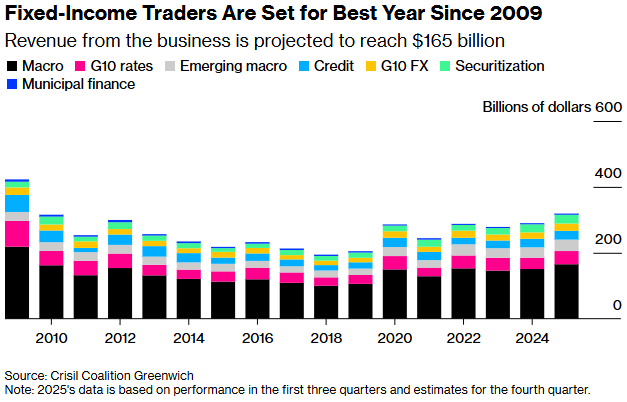
Core Insights - Wall Street's macro traders are on track for their best year since 2009, driven by client interest in changing global interest rate policies [1] - Major firms like Goldman Sachs, JPMorgan, and Citigroup are projected to generate $165 billion in revenue from trading activities, marking a 10% increase from 2024 [1][2] Revenue Projections - The Group-of-10 rates business is expected to achieve a five-year high in revenue, reaching $40 billion [2] - The overall industry revenue is anticipated to be $162 billion in 2026, only 2% lower than the projected revenue for this year [2] Market Conditions - Central banks are normalizing policy rates and balance sheets, but the level of issuance remains high, suggesting sustained trading activity [3] - Emerging-market macro traders are expected to earn $35 billion, while credit traders are projected to make $27 billion and commodities traders $11 billion [4] Compensation Trends - The compensation pool for fixed income, currencies, and commodities (FICC) is expected to rise by about 3% on average, with rates traders seeing a 7% increase [5] - Stock traders are set to receive a 14% higher payout compared to last year, attributed to strong performance in AI stocks [5]


FDIC-Insured Banks' Q3 Earnings Rise, Asset Quality Improves
ZACKS· 2025-11-25 15:56
Core Insights - The Federal Deposit Insurance Corporation (FDIC)-insured commercial banks and savings institutions reported third-quarter 2025 earnings of $79.4 billion, reflecting a 21.4% year-over-year increase [1] Earnings Overview - Banks with assets over $10 billion, which represent only 3% of FDIC-insured institutions, accounted for approximately 80% of the industry's earnings [2] - Community banks, making up 91% of all FDIC-insured institutions, reported a net income of $8.4 billion, up 26.2% year over year, primarily due to increases in net interest income (NII) and non-interest income [6] Revenue and Expenses - Net operating revenues reached $275.1 billion, an 8.5% year-over-year increase [8] - NII was reported at $189.6 billion, a 7.5% increase year over year, with a net interest margin (NIM) of 3.34%, up 9 basis points from the previous year [8] - Non-interest income grew by 11% to $85.5 billion, while total non-interest expenses rose by 5.2% to $144.8 billion [10] Credit Quality - Net charge-offs (NCOs) for loans and leases decreased to $20.1 billion, down 3.8% year over year, with an NCO rate of 0.61% [11] - Provisions for credit losses were $20.8 billion, down 11.7% year over year [11] Loans and Deposits - Total loans and leases amounted to $13.2 trillion, reflecting a 1.2% increase from the prior quarter, with an annual loan growth rate of 4.7% [12] - Total deposits reached $19.7 trillion, marking the fifth consecutive quarter of increase [13] Industry Health - The number of 'problem' banks decreased to 57, with no new banks added during the quarter [14] - The Deposit Insurance Fund (DIF) balance increased by 3.3% to $150.1 billion, driven by an assessment income of $3.3 billion [13] Conclusion - Strong growth in NII and non-interest income, along with reduced provisions, contributed to the quarterly earnings increase, while asset quality metrics remained generally favorable despite some weaknesses [15]



华尔街迎重大胜利!美国监管机构放松杠杆率要求 减轻美国银行(BAC.US)等大行资本压力
智通财经网· 2025-11-25 15:53
Core Viewpoint - The U.S. regulatory agencies are moving to relax bank capital requirements, which have been criticized for limiting financial institutions' ability to act as intermediaries in the U.S. Treasury market during periods of market stress, marking a significant victory for large banks on Wall Street and reflecting a return to the deregulatory policies of the Trump administration [1][2]. Group 1: Regulatory Changes - The Federal Deposit Insurance Corporation (FDIC) has voted to approve a final plan to relax the enhanced supplementary leverage ratio (eSLR), which will reduce the capital that the largest U.S. banks, including Bank of America, JPMorgan Chase, and Goldman Sachs, are required to hold relative to their total assets [1]. - The final version of the eSLR is expected to be largely consistent with the draft released in June [1]. - The relaxation of the eSLR is seen as a significant victory for the banking industry, especially in the context of new tariff measures announced by President Trump in April that caused market turbulence [1]. Group 2: Market Implications - Analysts suggest that relaxing leverage requirements may enhance the ability of large banks to absorb and distribute assets in the Treasury market, potentially helping to stabilize volatility during periods of market stress [2]. - There are concerns that the new measures could weaken the capital buffers of the banking system, posing new risks in the event of an economic downturn [2].
Buy 5 Old Economy Stocks on a Rally in 2025 for More Gains in 2026
ZACKS· 2025-11-25 14:56
Core Insights - The AI-driven bull run of 2023 and 2024 has continued into 2025, with stock prices of AI-centric companies increasing by 300-500% during this period [1] - Old economy stocks from sectors such as industrials, finance, auto, materials, and construction have also seen significant gains, indicating a broad-based market rally [2] Old Economy Stocks - Five old-economy stocks have rallied over 15% year to date and have favorable Zacks Ranks indicating further upside potential in 2026: Comfort Systems USA Inc. (FIX), The Travelers Companies Inc. (TRV), General Motors Co. (GM), JPMorgan Chase & Co. (JPM), and Crane Co. (CR) [3][9] - Each of these stocks carries a Zacks Rank of 1 (Strong Buy) or 2 (Buy) [3] Comfort Systems USA Inc. (FIX) - FIX operates primarily in the HVAC markets and is benefiting from the data center boom driven by AI and cloud computing [6][7] - The company has an expected revenue growth rate of 14.7% and earnings growth rate of 16.4% for the next year, with a 20.1% improvement in the Zacks Consensus Estimate for next year's earnings over the last 30 days [8] The Travelers Companies Inc. (TRV) - TRV has a strong market presence in auto, homeowners' insurance, and commercial property-casualty insurance, with a high retention rate and positive renewal premium changes [10][11] - The expected revenue growth rate is 3.4% and earnings growth rate is 6.7% for the next year, with a 2% improvement in the Zacks Consensus Estimate for next year's earnings over the last 30 days [12] General Motors Co. (GM) - GM holds a 17% market share in the U.S. automotive market, supported by strong demand for its brands and a 10% year-over-year sales increase in China [13][14] - The expected revenue growth rate is -0.8% and earnings growth rate is 11.5% for the next year, with a 6.5% improvement in the Zacks Consensus Estimate for next year's earnings over the last 30 days [15] JPMorgan Chase & Co. (JPM) - JPM is expected to see net interest income growth driven by business expansion initiatives and high interest rates, with a projected CAGR of 3.3% by 2027 [16] - The expected revenue and earnings growth rate for the next year is 3.7%, with a slight improvement in the Zacks Consensus Estimate for next year's earnings [18] Crane Co. (CR) - Crane manufactures engineered industrial products across various regions and has an expected revenue growth rate of 6.1% and earnings growth rate of 9.5% for the next year [19] - The Zacks Consensus Estimate for next year's earnings has improved by 2.5% over the last 30 days [19]




摩根大通:美债多头比例升至4月以来最高
Sou Hu Cai Jing· 2025-11-25 14:18
【11月25日消息,摩根大通美国国债客户调查有新动态】截至11月24日当周,摩根大通的美国国债客户 调查结果出炉。多头比例上升4个百分点,达4月以来最高水平。 同时,空头比例下降1个百分点,中性 比例下降3个百分点,净多头占比为2010年10月以来最高。 本文由 AI 算法生成,仅作参考,不涉投资建议,使用风险自担 ...
强强联合!Payful整合摩根大通Kinexys区块链支付方案,推动全球支付效率提升
Sou Hu Cai Jing· 2025-11-25 13:53
Core Viewpoint - The partnership between Payful and Kinexys Digital Payments represents a significant technological advancement in cross-border payment systems, leveraging blockchain technology for multi-currency instant settlement and enhancing corporate payment and treasury management innovation [1][5]. Group 1: Partnership Details - Payful has announced a strategic collaboration with Kinexys Digital Payments, a subsidiary of JPMorgan Chase, to utilize blockchain technology for real-time multi-currency settlements [1][3]. - The integration of Kinexys Digital Payments' digital payment network into Payful's solutions aims to provide automated clearing and secure data exchange for near-instant cross-border payments [3][4]. Group 2: Technological Innovations - The collaboration will enable Payful to implement blockchain technology in the Payful Card, enhancing the efficiency of debit repayments and ensuring real-time balance replenishment [3][4]. - The payment process involves immediate processing by Kinexys Digital Payments, which includes a whitelist verification for debit authorization, ensuring risk control and secure fund transfers [3][4]. Group 3: Strategic Goals - The partnership aims to offer more flexible and efficient real-time payment and treasury management solutions for corporate clients, facilitating rapid responses to market changes and improving overall operational efficiency [4]. - The collaboration highlights the synergy of fintech in enhancing agility and resilience, with a focus on solidifying blockchain's role in cross-border payments and accelerating the digital transformation of payment and treasury management [4][5]. Group 4: Company Background - Payful, formerly known as Global E-Payment, has over ten years of experience in the international payment industry and holds payment licenses in multiple countries, establishing a strong compliance and operational foundation [4]. - The rebranding to Payful reflects the company's commitment to expanding its global payment and multi-currency settlement capabilities, aiming to create a comprehensive, flexible, and secure payment network tailored to meet the treasury management needs of global corporate clients [4].

华尔街宏观交易员16年最强财年:全球利率波动驱动三大交易业务
智通财经网· 2025-11-25 13:53
Group 1 - Wall Street macro traders are on track for their best performance since 2009, driven by clients betting on global central bank interest rate policy shifts [1] - Major financial institutions like Goldman Sachs, JPMorgan, and Citigroup are expected to generate $165 billion in revenue from fixed income, credit, and commodity trading, a 10% increase from 2024 [1] - The income from G10 interest rate businesses is projected to reach $40 billion, marking a five-year high [1] Group 2 - Emerging market macro traders are expected to achieve their largest revenue of $35 billion in 20 years, while credit traders anticipate $27 billion and commodity traders $11 billion [2] - The average bonus pool for FICC is expected to grow by about 3%, with interest rate traders seeing a 7% increase [2] - Stock traders are projected to have a 14% higher bonus than last year, benefiting from a surge in AI stock investments [2] Group 3 - Nomura's interest rate business is benefiting from the Bank of Japan's interest rate hikes, despite the Federal Reserve and European Central Bank cutting rates [3] - Nomura is focusing on helping Asian clients invest more easily in Western interest rate markets and utilizing interest rate derivatives for hedging [3]
Is JPMorgan Chase Stock Underperforming the Nasdaq?
Yahoo Finance· 2025-11-25 10:44
Company Overview - JPMorgan Chase & Co. is the largest and most diversified bank in the United States, with a market cap of $811.3 billion, operating in consumer banking, commercial and investment banking, and asset and wealth management [1] - The company was formed through the merger of J.P. Morgan & Co. and Chase Manhattan in 2000 and serves millions of consumers and global institutions [1] Financial Performance - In Q3, JPMorgan reported net revenue of $46.4 billion, an 8.8% year-over-year increase, driven by strength in consumer banking, markets, and investment banking [5] - Earnings per share (EPS) rose 16% from the prior-year quarter to $5.07, supported by strong trading revenue, resilient consumer spending, and healthy fee generation [5] Stock Performance - JPM stock has decreased 7.5% from its 52-week high of $322.25, while shares have increased marginally over the past three months, trailing the broader Nasdaq Composite's 5.9% rise [3] - Year-to-date, JPMorgan's stock has jumped 24.3%, outperforming the NASDAQ's 15.3% rise, but over the past 52 weeks, its 19.9% gain trails the NASDAQ's stronger 20% advance [4] - The stock has spent most of the past year above its 200-day moving average, indicating steady strength, but a recent slip below the 50-day moving average suggests a short-term cooling in momentum [4] Market Position - JPMorgan is classified as a "mega-cap" stock, known for its "fortress balance sheet," strong capital position, and broad revenue streams, consistently delivering industry-leading profitability [2] - The bank's scale, global reach, and technological investments make it a bellwether for the financial sector and one of the most influential banks in the world [2]
15 Best Stocks to Buy for Medium Term
Insider Monkey· 2025-11-25 10:23
Market Overview - The market is attempting to recover from recent losses, particularly in tech and crypto sectors, as investors await upcoming U.S. data before the Thanksgiving holiday [1] - Historically, Thanksgiving week has been positive for stocks, with the S&P 500 showing a median gain of 0.76% since 1945 [2] - Money markets indicate a 75% chance of the Federal Reserve cutting rates in December, influenced by dovish comments from policymakers [2] Investment Strategy - Lower interest rates typically reduce borrowing costs, encouraging business expansion and consumer spending, which is favorable for medium-term investments [3] - Investors should consider several factors when selecting companies, including stock performance, profitability, sales trends, debt levels, price-to-earnings ratio, and dividend payments [4] Methodology for Stock Selection - A Finviz screener was used to identify dividend stocks with over 10% average revenue growth over the past five years, focusing on companies with consistent sales growth [6] - Stocks with a five-year average payout ratio under 60% were selected, indicating a strong cash position [6] Company Highlights Merck & Co., Inc. (NYSE:MRK) - Merck has a 5-year average annual revenue growth rate of 10.5% and reported Q3 2025 revenue of $17.3 billion, up 4% year-over-year [9][11] - KEYTRUDA sales grew 10% to $8.1 billion, and the company expects worldwide revenue to reach between $64.5 billion and $65 billion [11] - New product approvals and a robust pipeline with over 80 active clinical trials support growth, with notable sales from Winrevair and Capvaxive [12][13] Arthur J. Gallagher & Co. (NYSE:AJG) - Arthur J. Gallagher has a 5-year average annual revenue growth rate of 10.54% and reported Q3 2025 revenue of $3.3 billion, up nearly 20% year-over-year [14][15] - The company has completed significant acquisitions, including Tompkins Insurance Agencies and AssuredPartners for approximately $13.8 billion [16][17] JPMorgan Chase & Co. (NYSE:JPM) - JPMorgan Chase has a 5-year average annual revenue growth rate of 10.65% and reported Q3 2025 revenue of $47.1 billion, up 10.4% year-over-year [18][19] - The company achieved a 20% return on tangible common equity (ROTCE), indicating strong profitability [19] - Recent agreements with fintech companies will enhance its data access capabilities [20][21]



聪明钱动向:美国对冲基金现在都在做空哪些股票?
Feng Huang Wang· 2025-11-25 08:11
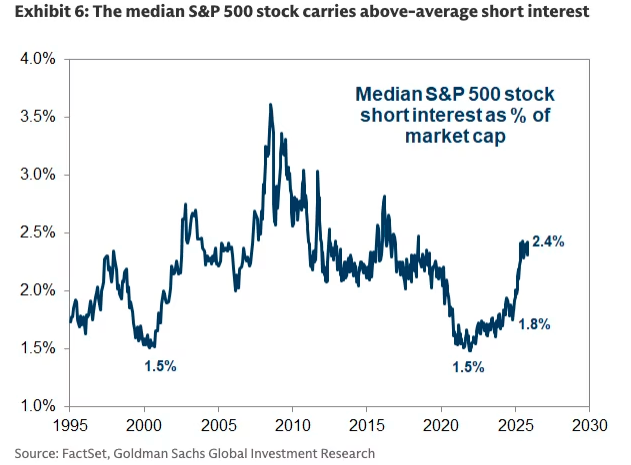
Market Overview - The recent volatility in the US stock market has led to a surge in Oracle CDS trading, with hedge funds focusing on when and where to short the market [1] - Goldman Sachs' latest hedge fund positioning report reveals that "smart money" is not yet ready to short major AI companies, but some institutions are targeting weaker players in the sector [1] Short Selling Trends - The short position in the S&P 500 is currently at 2.4% of total market capitalization, placing it in the 99th percentile over the past five years, significantly above the long-term average since 1995 [1] - The Nasdaq 100 index has a slightly higher short ratio of 2.5%, while small-cap stocks in the Russell 2000 index have a median short ratio of 5.5% [3] Sector Analysis - The utilities sector has seen a notable increase in short positions, rising by 0.3 percentage points to 3.2%, marking one of the highest levels in its history [5][6] - The demand for utility stocks has increased due to their attractiveness in supporting AI data centers, which require high energy consumption [8] Individual Stocks of Interest - Tesla remains the most shorted stock, with JPMorgan surprisingly appearing as the fourth most shorted [10] - Oracle has a short position of $5.4 billion, Intel at $4.6 billion, and General Electric at $4.1 billion, although these amounts represent a small percentage of their overall market capitalizations [12] Emerging Short Opportunities - Bloom Energy is highlighted as the most shorted stock among US companies with a market cap of at least $25 billion, with its stock price having surged significantly before recent declines [12] - Other heavily shorted stocks include Strategy, CoreWeave, Coinbase, Live Nation, Robinhood, and Apollo [14] Hedge Fund Positioning - Goldman Sachs' report is based on data from 982 hedge funds, with total equity positions amounting to $4 trillion, including $2.6 trillion in long positions and $1.4 trillion in short positions [14] - Major long positions among hedge funds include Amazon, Microsoft, Meta, Nvidia, and Alphabet [14]