Coca-Cola(KO)

Search documents
Forget the 2.8% Social Security Increase. These Aristocrats Pay You 4% to 7% More Annually
247Wallst· 2025-12-14 14:51
Core Insights - The Social Security Administration announced a 2.8% cost-of-living adjustment (COLA) for 2026, following a 2.5% increase in 2025, impacting 71 million Americans [1][2] - Dividend growth stocks have historically provided higher annual increases compared to Social Security adjustments, with several blue-chip companies consistently outperforming these adjustments [1][2] Dividend Growth Companies - **Caterpillar**: Achieved a 10-year compound annual dividend growth rate of 7.2%, with a quarterly dividend increase of 7.1% to $1.51 in December 2025, marking 32 consecutive years of increases [3][4] - **Coca-Cola**: Raised its dividend for 62 consecutive years, with a 10-year compound annual growth rate of 4.5% and a quarterly dividend increase of 5.2% to $0.51 in 2025 [6][8] - **Johnson & Johnson**: Also increased its dividend for 62 consecutive years, with a 10-year compound annual growth rate of approximately 6.5% and a quarterly dividend increase of 4.8% to $1.30 in 2025 [9][10] - **PepsiCo**: Maintained a 52-year dividend increase streak, with a 10-year compound annual growth rate of 7.1% and a quarterly dividend increase to $1.4225 in 2025 [12][14] - **Procter & Gamble**: Holds the longest streak with 68 consecutive years of dividend increases, averaging annual growth of 5-7% [15][17] Financial Performance - **Caterpillar**: Projected annual dividend increase from $1.84 in 2012 to $6.04 in 2026, a 228% increase over 14 years, with Q3 2025 operating cash flow of $3.7 billion [4][5] - **Coca-Cola**: Quarterly dividend increased from $0.16 in 1999 to $0.51 in 2025, a 219% increase, with Q3 2025 dividends totaling $2.108 billion [7][8] - **Johnson & Johnson**: Quarterly dividend increased from $0.25 in 1999 to $1.30 in 2025, a 420% increase, with Q3 2025 dividends of $3.132 billion [10][11] - **PepsiCo**: Annual dividend growth from $2.15 in 2012 to $5.55 in 2025, a 158% increase, with Q3 2025 dividends of $1.949 billion [13][14] - **Procter & Gamble**: Paid $2.549 billion in dividends in Q1 2026, with a current dividend yield of 2.93% and a 60% payout ratio [16][17]


Netflix计划收购华纳兄弟;迪士尼投资OpenAI;星巴克联名哈利波特...| 刀法周报
Sou Hu Cai Jing· 2025-12-14 04:37
Group 1 - Netflix plans to acquire Warner Bros. for $72 billion, including HBO and HBO Max [3] - Paramount quickly proposed a $108.4 billion cash offer to join the bidding war [3] - Concerns about market concentration and antitrust issues have been raised, with concentration estimates between 28% and 45% [4] Group 2 - Disney announced a $1 billion investment in OpenAI, allowing users to create videos using Disney characters on the Sora platform [6] - This partnership signifies a shift towards AI-driven content creation in the entertainment industry [6] - Disney's CEO emphasized the importance of responsible AI use while collaborating with top IPs [6] Group 3 - Starbucks launched a Harry Potter-themed winter celebration series in China, featuring three limited-edition drinks [9] - The collaboration aims to create an immersive cultural experience and enhance consumer engagement [10] - This partnership reflects Starbucks' strategy of leveraging popular IPs for brand marketing [10] Group 4 - The Dream Ice Cream Company announced its listing in Amsterdam, London, and New York, with a market value of 64 billion yuan on its first day [12] - This marks the company's independence from Unilever, allowing for more agile market responses [13] - The listing is expected to lead to adjustments in product strategy and supply chain in China [14] Group 5 - ChatGPT released version 5.2, focusing on creating more economic value for users [16] - The update reflects OpenAI's ambition in the vertical application field for businesses [16] - The new version is seen as a strong model but is now more aligned with competitors like Google and Microsoft [17] Group 6 - The Chinese snack retailer "Mingming Hen Mang" received approval for its overseas listing, achieving retail sales of 41.1 billion yuan in the first half of the year [20] - The company operates in 28 provinces and 1,327 counties across China [20] - Its business model emphasizes low margins and high sales volume [22] Group 7 - "Kids King" submitted its listing application to the Hong Kong Stock Exchange, aiming for a dual capital platform [24] - The company has shown steady revenue growth, with projected revenues of 85.2 billion yuan in 2022 and 93.37 billion yuan in 2024 [25] - The expansion strategy includes entering the hair care market through acquisitions [25] Group 8 - Nova Coffee announced its global store count surpassed 10,000, with rapid expansion in China and overseas [28] - The coffee market is growing as more consumers adopt coffee-drinking habits [29] - Nova's early focus on low-sugar products aligns with rising health-conscious consumer trends [30] Group 9 - Coca-Cola announced a management change, with Henrique Braun set to become CEO in March 2026 [32] - The transition is seen as a strategic continuation rather than a crisis response [33] - The new CEO's experience in the Chinese market is expected to enhance Coca-Cola's growth in that region [33] Group 10 - Wu Yue from LVMH joined the board of Pop Mart, aiming to enhance the brand's international expansion and marketing strategies [36] - His experience in luxury brand management is expected to benefit Pop Mart's brand positioning [37] - The appointment reflects Pop Mart's ambition to diversify its IP and elevate its brand [37]


X @Bloomberg
Bloomberg· 2025-12-13 16:08
Coca-Cola is holding last-ditch talks with TDR Capital this weekend as its proposed sale of Costa Coffee faces the risk of collapse, the Financial Times reported, citing people with knowledge of the matter. https://t.co/aiNdgLkeqW ...
Coca-Cola holds last-ditch talks in bid to salvage Costa Coffee sale, FT reports
Reuters· 2025-12-13 15:30
Core Viewpoint - The proposed sale of Costa Coffee by Coca-Cola is facing significant challenges, with last-minute negotiations taking place with private equity firm TDR Capital to salvage the deal [1] Group 1 - Coca-Cola is in discussions with TDR Capital to prevent the collapse of the Costa Coffee sale [1]
What to Watch With KO Stock in 2026
The Motley Fool· 2025-12-12 20:14
Core Viewpoint - Coca-Cola is positioned as a reliable dividend and free cash flow grower for investors in 2026, despite challenges in the consumer packaged goods sector in 2025 [1][2]. Company Performance - Coca-Cola's shares performed well in 2025, making it one of the best consumer defensive stocks amid economic uncertainties [2][4]. - The company is expected to maintain or slightly exceed its performance in 2026 due to its dependable cash flow generation and strong operating margins [5][12]. Macroeconomic Environment - CEO James Quincey indicated that 2026 may present more macroeconomic headwinds, but emphasized the company's focus on controllable factors like execution, innovation, and pricing [7][8]. - Quincey acknowledged the importance of being prudent with pricing strategies, considering consumer sensitivity to rising input costs [8][9]. Financial Strength - Coca-Cola has a strong cash position, with $14 billion in cash and cash equivalents as of the end of Q3, which may have increased following a recent $2.4 billion share sale [12]. - The company's leverage is low, within the desired range of 2x to 2.5x net debt/EBITDA, and it holds an A+ credit rating from S&P Global, allowing access to capital markets at favorable rates [12][13]. Investment Outlook - While Coca-Cola may not deliver explosive growth in 2026, it is seen as a durable and reliable investment option for those seeking stability in their portfolios [13].

Proven Income Generators: Ranking the Most Reliable Dividend Growth Stocks
247Wallst· 2025-12-12 12:22
Core Insights - The article emphasizes the importance of dividend investing, highlighting that the best dividend stocks not only provide consistent payouts but also increase their dividends over time, benefiting long-term shareholders [1] Group 1: Dividend Growth Leaders - Johnson & Johnson (JNJ) has a 2.54% yield and has increased dividends for 62 consecutive years, supported by a diversified portfolio in healthcare [5][6] - Coca-Cola (KO) boasts a 2.87% yield with 63 years of dividend increases, demonstrating strong operational performance and pricing power [8][9] - Procter & Gamble (PG) leads with 68 consecutive years of dividend increases, offering a 2.96% yield and showcasing operational excellence [11][12] - AbbVie (ABBV) has the fastest dividend growth in this ranking, with a recent 5.5% increase, bringing its yield to 2.94% [15][16] - Realty Income (O) offers a unique monthly dividend structure with a 5.62% yield, supported by a strong rent recapture rate and a long history of dividend increases [18][19] Group 2: Financial Performance - JNJ reported Q3 2025 EPS of $2.80, with revenue of $24.0 billion, and raised its full-year guidance, indicating confidence in growth [6][7] - Coca-Cola's Q3 2025 EPS was $0.86, with revenue of $12.5 billion and a stable operating margin of 32%, reflecting its ability to pass costs to consumers [9][10] - Procter & Gamble's Q1 fiscal 2026 EPS was $1.95, with revenue of $22.4 billion and a free cash flow of $5.4 billion, indicating strong cash generation [12][13] - AbbVie's Q3 2025 EPS was $1.86, with revenue of $15.8 billion, and management raised its EPS guidance for the full year [16][17] - Realty Income's Q3 2025 AFFO reached $1.08 per share, with a full-year guidance increase and a quarterly revenue growth of 10.3% year-over-year [19][20]



Coca-Cola announces its new CEO, company veteran Henrique Braun
Fastcompany· 2025-12-12 12:11
Core Insights - The article discusses the leadership transition at Coca-Cola as CEO James Quincey steps down, highlighting his transformative impact on the company and the challenges it faces moving forward [1][3]. Group 1: Leadership and Achievements - James Quincey, who served as CEO for nine years, is recognized for adding over 10 billion-dollar brands to Coca-Cola, including BodyArmor and Fairlife [1]. - Quincey also expanded Coca-Cola's portfolio into the alcoholic beverage market with the launch of Topo Chico Hard Seltzer in 2021 [1]. - In 2020, Quincey led a significant restructuring that halved the number of brands and resulted in thousands of layoffs, aiming to streamline operations and focus on fast-growing products like Simply and Minute Maid juices [2]. Group 2: Challenges Ahead - As Quincey departs, Coca-Cola is confronted with challenges such as weak demand for its products in the U.S. and Europe, along with increasing scrutiny from customers regarding its ingredients [3]. - Following a suggestion from President Donald Trump, Coca-Cola announced plans to release a version of its classic Cola made with cane sugar instead of high-fructose corn syrup [3]. - The board expresses confidence in Henrique Braun, Quincey's successor, to leverage the company's strengths and pursue global growth opportunities [3].
可口可乐即将迎来新CEO,系中国市场“老熟人”
2 1 Shi Ji Jing Ji Bao Dao· 2025-12-12 11:33
Core Viewpoint - Coca-Cola announced that Henrique Braun will succeed James Quincey as CEO starting March 31, 2026, while Quincey will become the Executive Chairman of the Board [2][3] Leadership Transition - James Quincey, who has served as CEO since 2017, has led Coca-Cola through significant transformations, including its shift to a "total beverage company" and navigating challenges posed by the pandemic, resulting in a nearly 63% increase in stock price since he took over [2][3] - Henrique Braun, currently COO, has been with Coca-Cola for 30 years and is expected to focus on global growth opportunities, consumer needs, and technology applications to enhance business performance [2][3] Market Expectations - Analysts believe Braun's experience in emerging markets and international operations makes him a suitable candidate for CEO, especially as the beverage industry faces declining soda demand [3][4] - Coca-Cola's Q3 report indicated a 1% increase in global case volume and a 5% revenue growth to $12.455 billion, although sales in the Asia-Pacific region declined due to weakened consumer spending and industry performance [3][4] Braun's Background - Braun has held various positions across North America, Europe, Latin America, and Asia, including leadership roles in supply chain, marketing, and innovation [4][5] - He previously served as President of the Greater China and Korea region, where he oversaw significant restructuring and acquisitions that shaped the company's future business landscape [4][5] Strategic Focus - Coca-Cola China is focusing on core categories such as soda, juice, premium ready-to-drink coffee, and ready-to-drink tea, emphasizing long-term potential in the Chinese market [5] - The beverage industry is undergoing significant changes, with a shift towards health-oriented products and rapid development in instant retail and bulk snack stores [5]
柏瑞凯将于明年3月底出任美国可口可乐公司CEO
Sou Hu Cai Jing· 2025-12-12 11:09
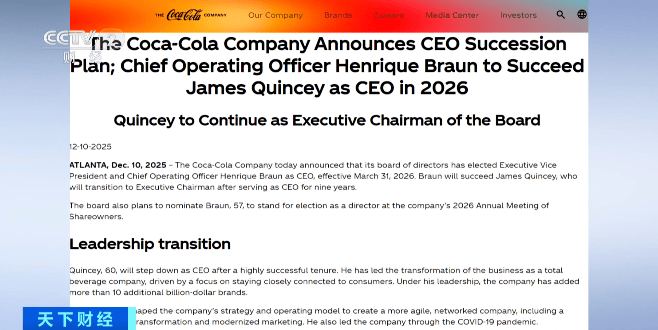
(央视财经《天下财经》)当地时间10日,全球饮料巨头——美国可口可乐公司宣布,公司执行副总裁 兼首席运营官柏瑞凯明年将接替现任首席执行官、也就是CEO詹鲲杰的职位。 编辑:令文芳 现年57岁的柏瑞凯于1996年加盟可口可乐,起初在位于美国亚特兰大的总部工作,随后在北美、欧洲、 拉美及亚洲地区担任多个重要职务,职责覆盖供应链、新业务开发、市场营销、综合管理及装瓶业务等 领域。2013至2016年,柏瑞凯担任可口可乐大中华区及韩国业务部门总裁,深度参与中国市场经营。今 年年初,升任公司首席运营官。 即将卸任的詹鲲杰现年60岁,2017年5月起出任首席执行官,此前,詹鲲杰曾在全球多地担任管理职 务。在其任期内,可口可乐优化品牌和产品组合,砍掉旗下200多个效益不佳的子品牌,增加了10多个 价值10亿美元的品牌。詹鲲杰重塑了公司的战略和运营模式,重点推进数字化转型和营销现代化。 有分析指出,可口可乐目前面临着行业竞争加剧、消费者支出减弱等挑战。中国是可口可乐在全球的第 三大市场,面对当前亚太等多个市场消费疲软的挑战,即将出任首席执行官的柏瑞凯有望凭借在中国市 场的丰富经验调整公司战略,以应对市场激烈竞争。 转载请注明 ...
如何看待高成长与经典价值?柏基“传奇基金经理”2019年深度撰文 | 思考汇
高毅资产管理· 2025-12-12 07:03
Core Viewpoint - The article discusses the evolving landscape of investment strategies, particularly the tension between growth and value investing, emphasizing the need for a nuanced understanding of these concepts in the context of modern economic changes [6][8][9]. Group 1: Growth vs. Value Investing - James Anderson acknowledges a widening divide between growth and value investing, suggesting that traditional value metrics may not suffice in a changing economic landscape dominated by tech giants like Microsoft and Google [8]. - The article highlights that while growth and value investing appear divergent, they share fundamental principles, such as the importance of honest long-term cash flow estimation and risk awareness [9]. - Anderson emphasizes the need for a longer time perspective and serious company research, valuing patience and governance sensitivity inherent in value investing [9][10]. Group 2: Historical Context and Literature - The article notes a lack of literature supporting growth investing compared to the extensive documentation of value investing, which has a rich tradition and numerous classic texts [11][13]. - It references Benjamin Graham's views on growth stocks, indicating that while he recognized their potential, he also warned of their speculative nature and preferred investing in larger, less popular companies [13][14]. - The article argues that the realities of the past decade have diverged from Graham's observations, with growth stocks outperforming traditional value stocks [15]. Group 3: Future Investment Landscape - The article posits that future returns are highly uncertain, urging a reevaluation of investment beliefs and strategies in light of complex market dynamics [18][30]. - It suggests that understanding structural changes in the global economy is crucial for predicting long-term investment outcomes, rather than focusing solely on short-term financial metrics [33][34]. - The piece warns against relying on historical volatility to forecast future performance, advocating for a mindset open to exploring various possibilities [38][39]. Group 4: Case Studies - The article compares Coca-Cola and Facebook, illustrating how traditional value metrics may misrepresent the potential of high-growth companies [64][69]. - It highlights that Coca-Cola's growth has stagnated, while Facebook has shown significant growth potential, challenging the notion of which company represents true value [66][70]. - The automotive industry is used as a case study, showcasing how different companies within the sector exhibit varying growth and value characteristics, with General Motors and Ferrari serving as contrasting examples [82][88].