LI AUTO(LI)

Search documents
理想彻底“去华为化”,华为系高管全离场
程序员的那些事· 2025-11-18 00:44
Core Insights - The article discusses the transition of Li Auto from adopting Huawei's management model to reverting to a centralized management approach led by its founder, Li Xiang, due to internal conflicts and declining sales performance [1][8]. Group 1: Background and Initial Strategy - In September 2022, Li Auto adopted a "learn from Huawei" strategy to enhance its management system and achieve significant growth, leading to a remarkable increase in vehicle deliveries and revenue [3]. - By 2023, Li Auto achieved an annual delivery of 376,000 vehicles, a year-on-year increase of 182.2%, and revenue exceeding 120 billion yuan, becoming the first profitable new energy vehicle company in China [3]. Group 2: Challenges Faced - Over time, the Huawei management model began to conflict with Li Auto's corporate culture, leading to issues such as unhealthy competition among sales teams and an inefficient decision-making process [4][5]. - By 2024, Li Auto's sales growth stagnated, with cumulative deliveries of 329,000 vehicles by October, only 51.4% of its annual target, and a significant year-on-year decline of 38% in October deliveries [4]. Group 3: Organizational Changes - In July 2025, Li Auto abandoned the Huawei-inspired PBC performance management model and reintroduced the OKR management system, marking the beginning of significant organizational adjustments [6][7]. - The internal restructuring culminated in November 2025, with the integration of the organization and human resources departments, and the departure of key Huawei-affiliated executives [7]. Group 4: Industry Implications - The experience of Li Auto illustrates that management models must align with a company's unique culture and operational needs, as the rigid processes of a mature enterprise like Huawei may not suit a rapidly evolving company [8][9]. - The shift back to a centralized management approach reflects a strategic response to market pressures and a return to the company's foundational principles [9].

昨夜科技股大跌,道指下挫超500点
Zheng Quan Shi Bao· 2025-11-18 00:27
Market Overview - On November 17, US stock indices collectively declined, with the Dow Jones falling over 500 points, a drop of 1.18% [1][4] - The S&P 500 index decreased by 0.92%, and the Nasdaq Composite index fell by 0.84% [1][4] Technology Sector Performance - Major technology stocks mostly declined, with Dell Technologies dropping over 8%, AMD falling over 6%, and Intel down over 2% [1][6] - Nvidia, a key player in AI, fell by 1.88% ahead of its earnings report scheduled for Wednesday [6] - Other notable declines included Micron Technology, ON Semiconductor, Apple, and META, all down over 1% [1][6] Federal Reserve Insights - Federal Reserve Vice Chairman Jefferson indicated rising downside risks to employment, suggesting caution in further rate cuts as rates approach neutral levels [4] - The Federal Reserve has implemented two 25 basis point rate cuts in September and October, lowering the target range to 3.75% to 4.00% [4] - Market expectations for a December rate cut have decreased from nearly 100% to about 40% following hawkish comments from some Fed officials [4] Investment Sentiment - Jeffrey Gundlach, CEO of DoubleLine Capital, warned that many asset prices are extremely overvalued and recommended investors allocate about 20% of their portfolios to cash to guard against significant market corrections [4] - Gundlach described the current US stock market as exhibiting dangerous speculative characteristics, labeling it one of the most unhealthy markets he has seen in his career [4] Notable Stock Movements - Berkshire Hathaway increased its stake in Alphabet, purchasing 17.85 million shares valued at approximately $4.93 billion, marking a rare bet on a tech stock by Warren Buffett's firm [7][8] - In contrast, Peter Thiel's Thiel Macro Fund sold approximately 537,000 shares of Nvidia, representing nearly 40% of its portfolio, and also significantly reduced its position in Tesla [6][8] - Chinese concept stocks mostly declined, with the Nasdaq Golden Dragon China Index falling by 1.21%, and notable drops in stocks like Yatsen and XPeng [2][8]


昨夜,科技股大跌!道指下挫超500点!
证券时报· 2025-11-18 00:12
Market Overview - On November 17, US stock indices collectively declined, with the Dow Jones falling over 500 points, a drop of 1.18% [1][5] - The S&P 500 index decreased by 0.92%, and the Nasdaq Composite index fell by 0.84% [2][5] - Major technology stocks mostly experienced declines, with Dell Technologies dropping over 8% and AMD falling over 6% [2][11] Federal Reserve Insights - Federal Reserve Vice Chairman Jefferson indicated that the risks to employment are increasing, suggesting caution in further rate cuts as interest rates approach neutral levels [6] - The Fed implemented two rate cuts of 25 basis points each in September and October, lowering the federal funds rate target range to 3.75% to 4.00% [7] - Despite a significant slowdown in US job growth prompting the Fed to restart rate cuts, some officials are cautious about further reductions due to a current inflation rate of 3% [8] Investment Sentiment - Market expectations for a rate cut in December have dropped from nearly 100% to about 40% following hawkish statements from some Fed officials [9] - Jeffrey Gundlach, a seasoned investor, warned that many asset prices are extremely overvalued and recommended investors allocate about 20% of their portfolios to cash to mitigate major market correction risks [9] - Gundlach described the current US stock market as exhibiting dangerous speculative characteristics, labeling it one of the most unhealthy markets he has seen in his career [9] Technology Sector Performance - Nvidia, a key player in AI stocks, is set to announce its earnings after the market closes on Wednesday, with its stock down 1.88% prior to the announcement [11] - Notably, Peter Thiel's Thiel Macro Fund sold approximately 537,000 shares of Nvidia in Q3, representing nearly 40% of its portfolio, cashing out around $100 million [11] - Berkshire Hathaway acquired 17.85 million shares of Alphabet, valued at approximately $4.93 billion, marking a rare bet on a tech stock by Warren Buffett's firm [12] Chinese Stocks Performance - The Nasdaq Golden Dragon China Index fell by 1.21%, with significant declines in several Chinese stocks, including a drop of over 20% for Yatsen and over 10% for Xpeng [3][13] - Alibaba was one of the few gainers, rising over 2% amidst the overall downturn in Chinese stocks [13]

美股三大指数收跌,多数中概股下跌,逸仙电商跌近21%,小鹏跌10%
2 1 Shi Ji Jing Ji Bao Dao· 2025-11-17 23:49
Core Points - The U.S. stock market experienced a significant decline, with the Dow Jones dropping over 500 points, marking a decrease of approximately 1.2% [1] - The S&P 500 index has fallen over 2% in November, ending a six-month streak of gains, and is down more than 3% from its historical peak [1] - The Nasdaq index has also retreated over 5% from its record high [1] Group 1: Major Tech Stocks - Most large tech stocks saw declines, with Micron Technology down nearly 2%, Nvidia and Apple dropping over 1.8%, and Meta down 1.2% [2] - Tesla was an exception, rising by 1.1%, while Google saw a notable increase, initially rising 6% to reach a historical high before closing with a gain of just over 3% [2] - Berkshire Hathaway, led by Warren Buffett, established a position in Google during the third quarter [2] Group 2: Chinese Concept Stocks - The Nasdaq Golden Dragon China Index fell by 1.21%, with notable declines in several Chinese concept stocks: Yatsen E-commerce down nearly 21%, Manbang down over 11%, and XPeng down over 10% [2] - Other Chinese stocks like Li Auto and NIO also experienced declines, while Alibaba saw a gain of 2.5% [2] Group 3: Commodities and Cryptocurrencies - The FTSE China A50 index futures fell by 0.52%, and precious metals, including gold and silver, saw significant declines, with gold dropping nearly 2% to a low of $4006.80 per ounce [3] - Bitcoin experienced a sharp decline, falling below $92,000, while Ethereum also dropped below $3,000, leading to over 160,000 liquidations worth $851 million in the past 24 hours [3] - The tightening liquidity of the U.S. dollar and changing Federal Reserve policy expectations are cited as key factors impacting high-volatility assets like cryptocurrencies [3][4]



热门中概股收盘多数下跌 小鹏跌超10%
Xin Lang Cai Jing· 2025-11-17 22:33
Group 1 - The majority of popular Chinese stocks closed lower on Monday, with the Nasdaq Golden Dragon China Index falling by 1.21% [1] - Alibaba saw an increase of over 2%, while Pinduoduo, NetEase, Ctrip, and Baidu experienced declines of over 1% [1] - Xpeng dropped by over 10%, Li Auto fell by over 4%, Manbang decreased by over 11%, and New Oriental declined by over 1% [1]


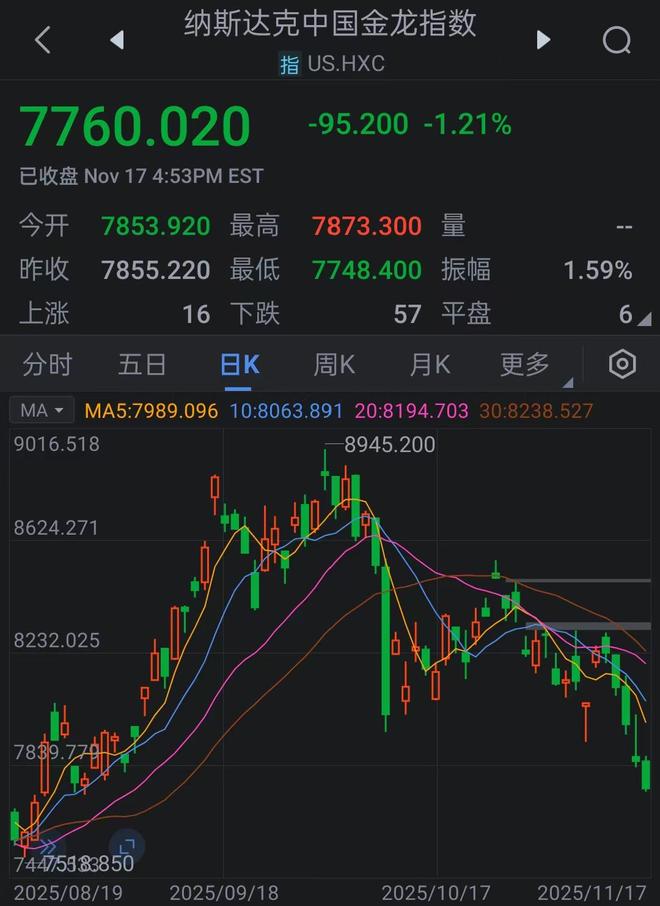
纳斯达克中国金龙指数收跌1.21%
Mei Ri Jing Ji Xin Wen· 2025-11-17 21:11
Group 1 - The Nasdaq China Golden Dragon Index declined by 1.21% on November 18, indicating a downward trend in popular Chinese concept stocks [1] - Xpeng Motors experienced a significant drop of over 10%, while Li Auto fell by more than 4% [1] - Other companies such as NetEase, Baidu, and NIO also saw declines of over 1%, whereas Alibaba recorded an increase of over 2% [1]

李想详细阐述理想未来3-6年战略核心思路
理想TOP2· 2025-11-17 13:00
Core Insights - The company emphasizes that its strategic core is based on three key variables: user demand, technology products, and organizational capability [1][5][30] - The company plans to expand its product offerings to include sedans and more diverse MPVs while effectively controlling SKU [1][6] - The realization of autonomous driving is expected to lead to revenue exceeding the combined income of all mobile phone manufacturers in China [1][7] User Demand - The company recognizes the need to expand its user base significantly to achieve higher revenue targets, moving beyond its current focus on SUVs [6][7] - There is a strategic shift towards developing family-oriented sedans and spacious MPVs to cater to a broader audience [6][7] Technology Products - The company identifies four essential characteristics for AI terminals: 360-degree perception of the physical world, cognitive decision-making ability, action execution capability, and self-reflection [1][8] - The transition from traditional automotive products to AI terminals is seen as a necessary evolution rather than a change in direction [2][15] Organizational Capability - The company has adopted various methodologies from industry leaders like Toyota, GM, and Huawei to enhance its organizational capabilities [10][11] - The focus is on learning from Apple to develop core competencies that will support future growth and scalability [12][13] Revenue Goals - The company aims to achieve $100 billion in revenue within a year, building on its previous success of $14.5 billion [5][11] - The potential for AI-driven efficiency could allow the company to generate significant revenue with a reduced workforce compared to traditional automotive companies [28] Future Vision - The company aspires to become a leading global player in AI terminals by 2030, emphasizing the importance of aligning its capabilities with user needs and technological advancements [14][15] - The company acknowledges that failure to meet user demands, technological standards, or organizational capabilities could lead to its downfall [4][30]
理想汽车:10月新开21家门店
Zheng Quan Shi Bao Wang· 2025-11-17 09:28
Core Insights - Li Auto plans to open 21 new stores by October 2025, expanding its retail presence significantly [1] - As of October 31, 2025, Li Auto will have a total of 551 retail centers, 165 delivery centers, and 554 service centers (including authorized body and paint shops) across 227 cities [1] Group 1 - Li Auto's expansion strategy includes the opening of 21 new stores by October 2025 [1] - The total number of retail centers will reach 551, enhancing the company's market coverage [1] - The company will also have 165 delivery centers and 554 service centers, indicating a robust service network [1]
恒生科技指数收跌近1%,携程联想领跌超3%



Cai Jing Wang· 2025-11-17 08:38
Core Viewpoint - The Hang Seng Index closed down approximately 0.71%, while the Hang Seng Tech Index fell by about 0.96%, indicating a negative trend in the Hong Kong stock market [1] Group 1: Company Performance - Lenovo Group and Trip.com Group both experienced declines of over 3% [1] - Baidu Group and Li Auto saw declines exceeding 2% [1] - Bilibili and Tongcheng Travel dropped by more than 1% [1] - Semiconductor Manufacturing International Corporation (SMIC) and Tencent Holdings had slight decreases [1] - Hua Hong Semiconductor and Meituan experienced slight increases [1]
盘点最年轻金鸡奖影帝商业价值
第一财经· 2025-11-17 07:35
Core Viewpoint - The article highlights the recent achievement of Yi Yang Qianxi, who won the Best Actor award at the 38th China Golden Rooster Awards for his role in "Little Me," making him the youngest recipient of this award at the age of 24 [1][3]. Group 1: Awards and Recognition - Yi Yang Qianxi has been nominated four times for the Best Actor award at the Golden Rooster Awards, with this win marking a significant milestone in his career [1][3]. - The Central Academy of Drama congratulated Yi Yang Qianxi on his achievement, emphasizing his status as the youngest Golden Rooster Best Actor [1][3]. Group 2: Box Office Performance - The total box office revenue for films starring Yi Yang Qianxi has reached 19.7 billion [5]. Group 3: Business Associations - Yi Yang Qianxi is directly associated with two companies: Beijing Jiumude Cultural Development Co., Ltd. and Beijing Jiumude Cultural Media Center, the latter of which has been deregistered [6]. - Beijing Jiumude Cultural Development Co., Ltd. was established in December 2018, with Yi Yang Qianxi and Yi Shangjie each holding a 50% stake; Yi Shangjie is identified as Yi Yang Qianxi's father [6]. - Yi Yang Qianxi's associated company, Beijing Yangzhizhu Cultural Media Co., Ltd., has registered multiple trademarks and websites, although he does not hold direct shares in this company [6]. Group 4: Endorsements - Yi Yang Qianxi endorses over ten brands, including Li Xiang Automobile, Proya, Luckin Coffee, Huawei Nova, and Fila [6].