LI AUTO(LI)

Search documents
理想下一步的重点:从数据闭环到训练闭环
自动驾驶之心· 2025-12-14 02:03
Core Insights - The article discusses the evolution of autonomous driving technology, highlighting the transition from data closed-loop systems to training closed-loop systems, marking a new phase in autonomous driving development [18][21]. Group 1: Development of Autonomous Driving Technology - The development trajectory of Li Auto's intelligent driving has evolved from rule-based systems to AI-driven E2E+VLM dual systems and VLA, with a focus on navigation as a key module [6]. - Li Auto has accumulated 1.5 billion kilometers of driving data, utilizing over 200 triggers to produce 15-45 second clip data [11]. - The end-to-end mass production version MPI has increased to over 220, representing a 19-fold increase compared to the version from July 2024 [13]. Group 2: Data Closed-Loop and Its Limitations - The data closed-loop process includes shadow mode validation, data mining in the cloud, automatic labeling of effective samples, and model training, with data return achievable in one minute [9][10]. - Despite the effectiveness of the data closed-loop, it cannot address all issues, particularly long-tail scenarios such as traffic control and sudden lane changes [16]. Group 3: Transition to Training Closed-Loop - The core of the L4 training loop involves VLA, reinforcement learning (RL), and world models (WM), optimizing trajectories through diffusion and reinforcement learning [23]. - Key technologies for closed-loop autonomous driving training include regional simulation, synthetic data, and reinforcement learning [24]. Group 4: Advances in Reconstruction and Generation - Li Auto has made significant advancements in reconstruction and generation, with multiple top conference papers published in the past two years [28][34]. - The company has developed a feedforward 3D generation system that eliminates the need for point cloud initialization, directly producing results from visual inputs [29]. Group 5: Challenges and System Capabilities - The interactive agent is identified as a key challenge in the training closed-loop [40]. - System capabilities are enhanced by the world model providing simulation environments, diverse scene construction, and accurate feedback from reward models [41].


何小鹏立“赌约”:明年8月底前达到特斯拉FSD效果
Mei Ri Jing Ji Xin Wen· 2025-12-13 06:46
Core Viewpoint - Xiaopeng Motors is set to release its VLA 2.0 (Vision-Language-Action) model in the next quarter, with significant pressure on its first version [1] - A bet was placed by Xiaopeng's chairman with the autonomous driving team, aiming to match Tesla's FSD V14.2 performance by August 30, 2026, or face a challenge [1] Group 1: VLA Model and Industry Perspectives - The VLA model is seen as an advanced end-to-end solution, integrating visual perception (V), action execution (A), and a language model (L) to enhance decision-making and environmental understanding [5][11] - The industry has shifted from relying on LiDAR and high-precision maps to adopting AI-driven models like VLA, with a notable divergence in development paths emerging by 2025 [4][11] - Li Auto's VP emphasized the importance of real-world data over model architecture, asserting that VLA is the best solution due to their extensive data collection from millions of vehicles [6][8] Group 2: Diverging Technical Approaches - Huawei's approach focuses on the World Action (WA) model, which bypasses the language processing step, aiming for direct control through visual inputs [8][10] - The World Model concept allows AI systems to simulate the physical world, enhancing predictive capabilities and decision-making in autonomous driving [9][11] - Companies like NIO and SenseTime are also exploring the World Model approach, indicating a broader industry trend [10] Group 3: Future Integration and Evolution - There is a growing trend towards integrating VLA and World Models, with both technologies not being mutually exclusive but rather complementary [11][12] - Xiaopeng's second-generation VLA model aims to combine VLA and World Model functionalities, enhancing data training and decision-making processes [14][15] - The automotive industry anticipates further iterations in autonomous driving technology architecture over the next few years, potentially stabilizing by 2028 [15]

何小鹏立“赌约”:明年8月底前达到特斯拉FSD效果!理想高管回应宇树王兴兴质疑,多家车企押注的VLA,靠谱吗?
Mei Ri Jing Ji Xin Wen· 2025-12-13 06:31
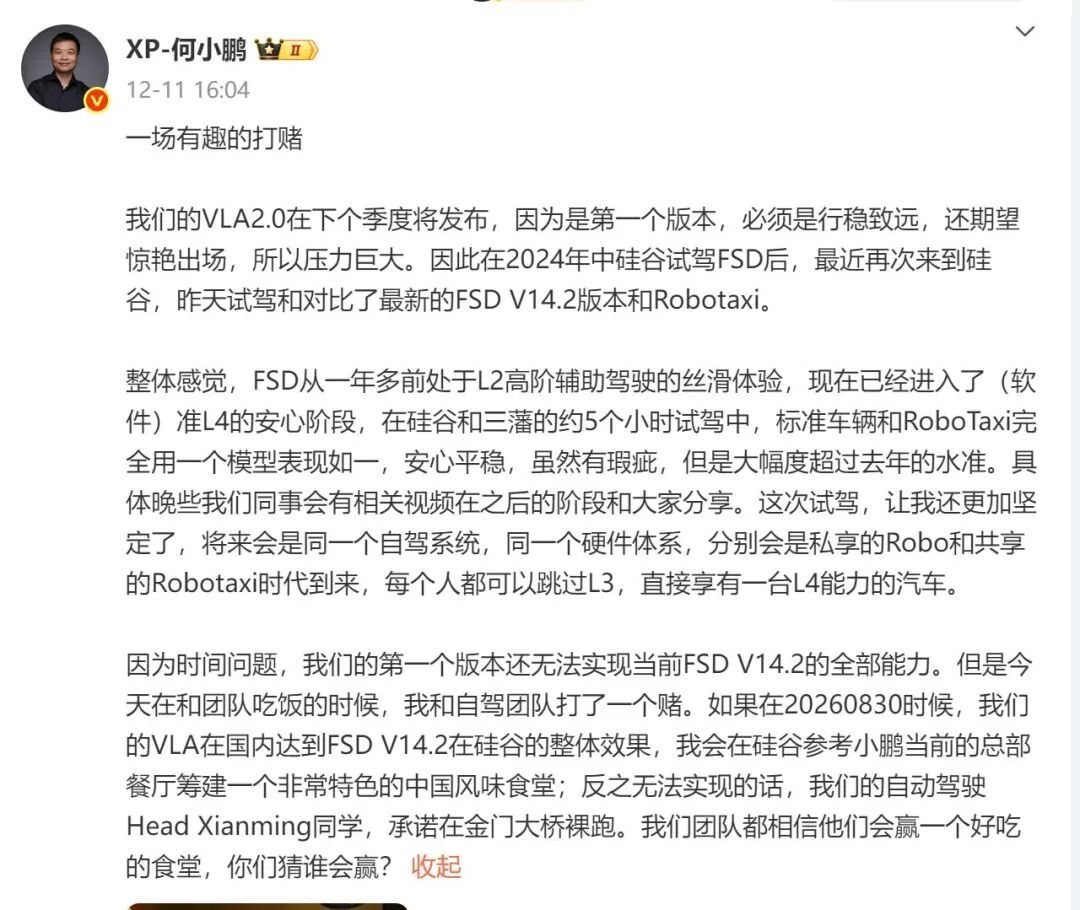
Core Viewpoint - Xiaopeng Motors is set to release its VLA 2.0 (Vision-Language-Action) model in the next quarter, with significant pressure on its development as it is the first version [1] Group 1: VLA Model Development - Xiaopeng's chairman, He Xiaopeng, has made a special bet with the autonomous driving team, promising to establish a Chinese-style cafeteria in Silicon Valley if the VLA system matches Tesla's FSD V14.2 performance by August 30, 2026 [3] - The VLA model is seen as an advanced end-to-end solution, integrating visual perception, action execution, and language processing to enhance decision-making capabilities [7][12] - The VLA model aims to overcome traditional model limitations by incorporating a reasoning chain through language models, enhancing its adaptability to complex driving environments [7][12] Group 2: Industry Perspectives - There is a divergence in the industry regarding the development paths of VLA and world models, with companies like Li Auto and Xiaopeng favoring the VLA approach [6][12] - Li Auto's VP, Lang Xianpeng, emphasizes the importance of real-world data in developing effective autonomous driving systems, arguing that the VLA model is superior due to its data-driven approach [8][9] - Huawei and other companies are pursuing a world model approach, which focuses on direct control through visual inputs without the intermediary language processing [9][10][11] Group 3: Future Integration and Trends - Despite differing opinions, VLA and world models are not mutually exclusive and may increasingly integrate as both technologies evolve [12][17] - The future of autonomous driving technology is expected to see further iterations and stabilization by 2028, with a potential convergence of VLA and world model methodologies [17]

美股三大指数集体收跌,纳指、标普500指数跌逾1%,博通跌超11%
Ge Long Hui· 2025-12-12 22:26
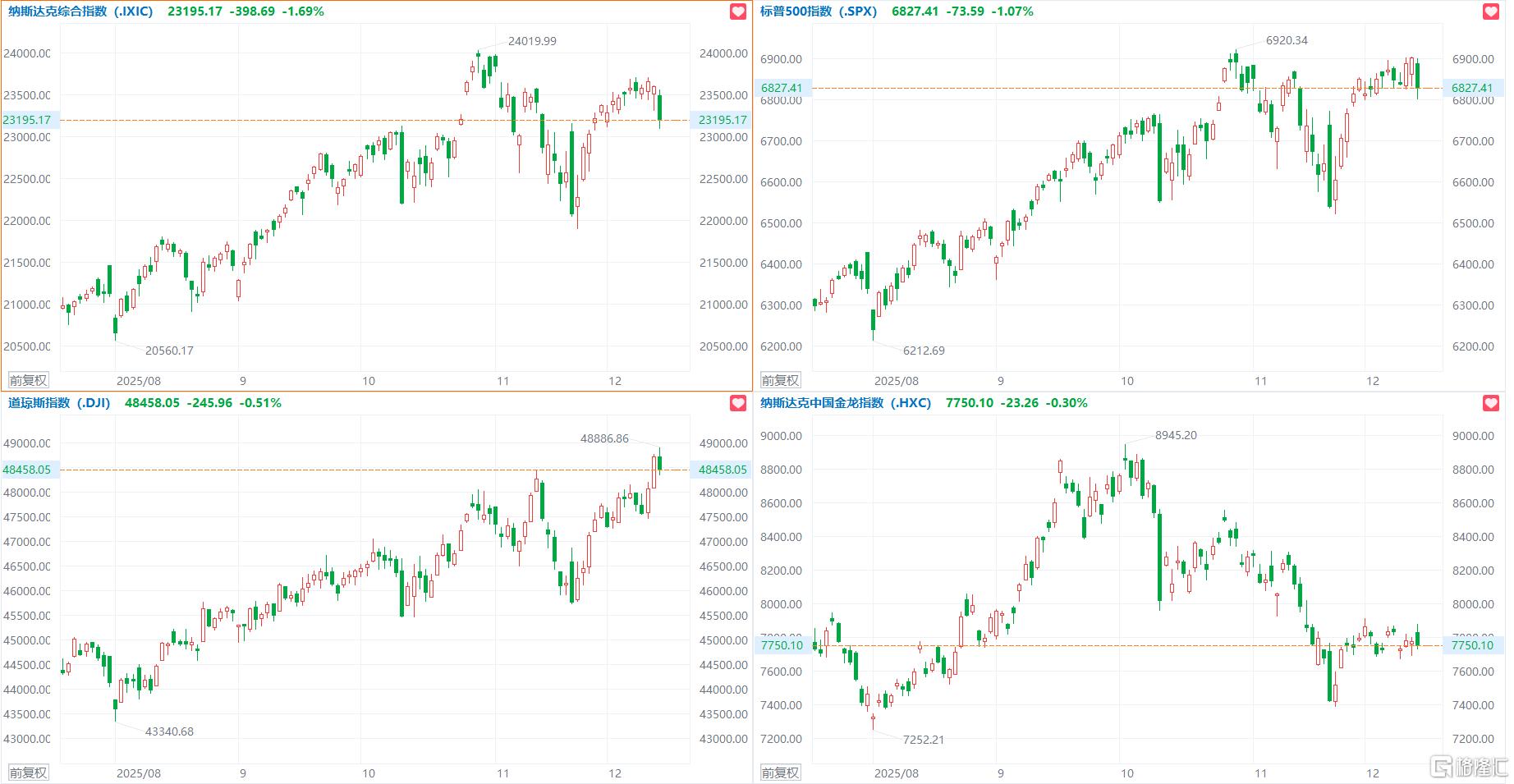
Market Overview - The three major U.S. stock indices closed lower, with the Dow Jones down 0.51%, the Nasdaq down 1.69%, and the S&P 500 down 1.07% [1] - Popular tech stocks experienced declines, with Broadcom falling over 11%, Nvidia down over 3%, and Google, Microsoft, Meta, and Amazon all dropping over 1%. Tesla, however, saw an increase of over 2% [1] Sector Performance - The storage sector, cryptocurrency mining companies, and semiconductor stocks faced significant declines, with Corning down nearly 8%, Quantum down over 7%, and Micron Technology, Dell Technologies, and Logitech all dropping over 6%. AMD fell nearly 5%, Intel was down over 4%, and HP dropped over 2% [1] - The automotive manufacturing sector saw gains, with Polestar rising over 19%, Rivian up over 12%, and Toyota increasing by over 2% [1] Chinese Stocks - The Nasdaq Golden Dragon China Index fell by 0.30%. Among popular Chinese stocks, Pony.ai dropped 5.6%, WeRide fell 3.2%, and Baidu and NIO both declined over 2%. XPeng was down 1.1%, Alibaba fell 0.9%, and Pinduoduo remained flat. However, Li Auto rose 0.3%, Yum China increased by 1.8%, and New Oriental and NetEase both gained 2.1% [1]



晚间重磅!35龙头集体跳水,阿里拼多多破位,美股7巨头大跌
Sou Hu Cai Jing· 2025-12-12 17:01
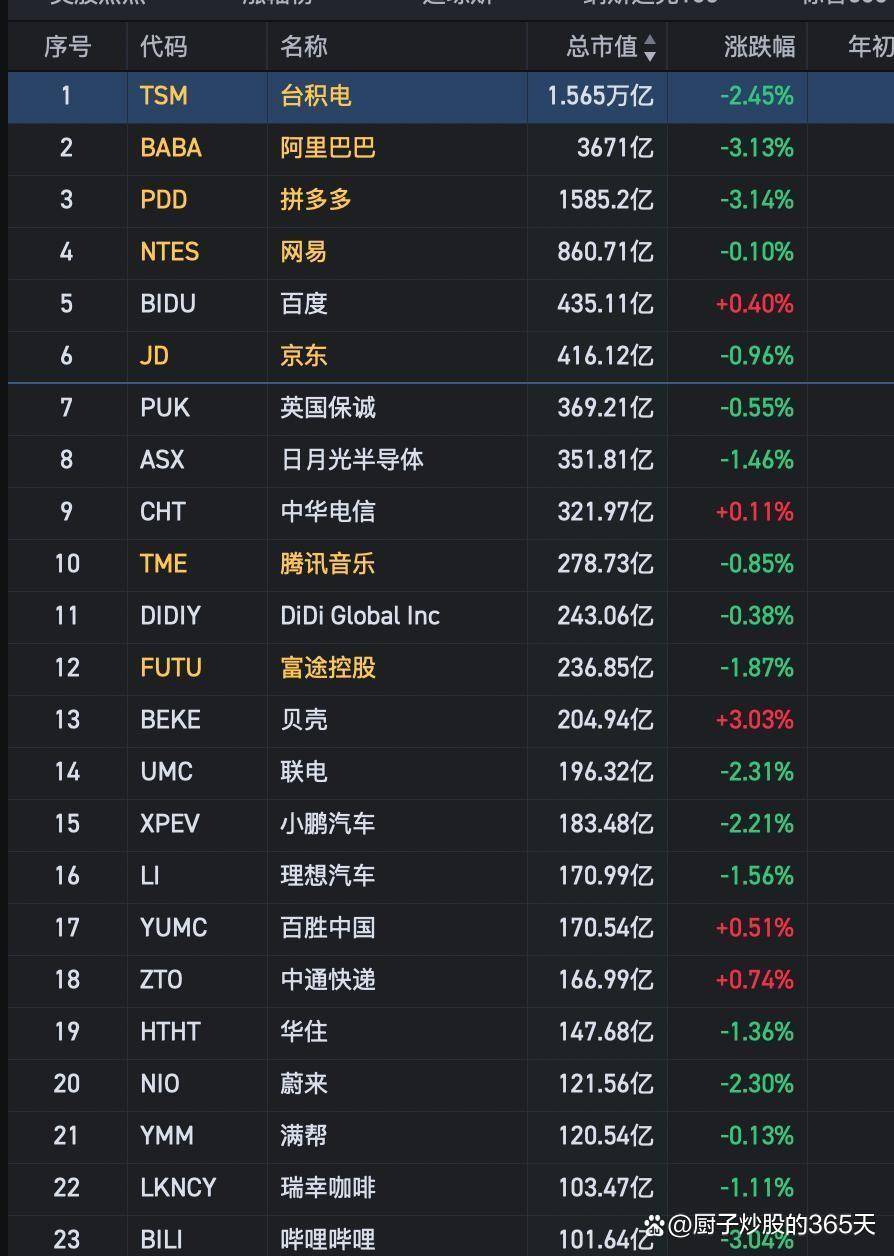
Core Viewpoint - The U.S. stock market experienced a significant capital flight on December 11, 2025, with Chinese concept stocks plummeting, including major players like Alibaba and Pinduoduo, alongside declines in the seven major U.S. tech giants [1][3]. Group 1: Market Performance - The Nasdaq China Golden Dragon Index fell by 0.43%, with 35 leading Chinese concept stocks experiencing substantial declines [1]. - Major U.S. tech stocks also faced losses, with Nvidia down 3.29%, Broadcom down 3.31%, and Tesla down 1.82%, while only Visa saw an increase of 2.88% [3][5]. - Alibaba's market value decreased by 3.13%, and Pinduoduo dropped by 3.14%, reflecting a broader trend of capital avoidance of high-volatility assets as year-end approaches [3][4]. Group 2: Contributing Factors - The tightening of U.S. chip policies has become a primary factor suppressing tech-related Chinese concept stocks, with Nvidia required to pay 25% of revenue from sales to Chinese companies, increasing operational costs and uncertainty for these firms [4]. - The anticipated tightening of regulations on Chinese concept stocks under the Trump administration has further contributed to market fears, particularly regarding audit scrutiny and potential delisting risks [4]. - The Bank of Japan's interest rate hike has added pressure on Chinese concept stocks, as capital flows shifted, leading to liquidity issues and a sell-off of these stocks [5][6]. Group 3: Institutional Behavior - As the year-end approaches, institutions are rebalancing their portfolios, leading to reduced liquidity and a preference for locking in profits, which has resulted in a withdrawal from high-volatility Chinese concept stocks [6][8]. - The uncertainty surrounding the Federal Reserve's interest rate decisions has also prompted investors to exit riskier assets, with expectations for rate cuts diminishing significantly [6][8]. Group 4: Cross-Market Impact - The decline in U.S. tech stocks has negatively impacted Chinese concept stocks, with the Nasdaq index down 0.86% and the S&P 500 down 0.20%, while only the Dow Jones index saw a slight increase [8][9]. - Historical trends indicate that when the Nasdaq China Golden Dragon Index performs poorly, it often drags down the Hang Seng Index and A-shares, highlighting the interconnectedness of global capital flows [12]. Group 5: Market Sentiment and Future Outlook - The significant drop in Chinese concept stocks has led to increased interest in safe-haven assets, with silver prices surging by 73% year-to-date, contrasting sharply with the decline in Chinese stocks [14]. - The market's volatility is seen as a self-correcting mechanism, with the recent downturn viewed as a necessary adjustment following substantial gains earlier in the year [14]. - Companies that have completed secondary listings in Hong Kong, such as Alibaba and JD.com, are perceived to have stronger risk resilience due to their enhanced liquidity options [14].


美股异动 新能源车股走高 特斯拉(TSLA.US)一度涨超3%
Jin Rong Jie· 2025-12-12 15:52
Group 1 - The core viewpoint of the article highlights a significant increase in the stock prices of various electric vehicle companies, indicating positive market sentiment towards the sector [1] Group 2 - Tesla (TSLA.US) saw its stock rise over 2%, with an intraday increase exceeding 3% [1] - Xpeng Motors (XPEV.US) experienced a stock increase of over 1% [1] - Li Auto (LI.US) reported a stock rise of over 2% [1] - NIO (NIO.US) had a stock increase of over 1.6% [1] - Rivian Automotive (RIVN.US) showed a remarkable stock increase of over 16% [1]
新能源车股价走高 特斯拉(TSLA.US)一度涨超3%
Mei Ri Jing Ji Xin Wen· 2025-12-12 15:31
Core Viewpoint - The stock prices of electric vehicle companies have risen significantly, indicating positive market sentiment towards the sector [1] Group 1: Stock Performance - Tesla (TSLA.US) saw an increase of over 2%, with a peak rise of more than 3% after market opening [1] - Xpeng Motors (XPEV.US) rose by over 1% [1] - Li Auto (LI.US) experienced a gain of over 2% [1] - NIO (NIO.US) increased by over 1.6% [1] - Rivian Automotive (RIVN.US) surged by over 16% [1]
美股异动 | 新能源车股走高 特斯拉(TSLA.US)一度涨超3%
智通财经网· 2025-12-12 15:20
Core Viewpoint - The news highlights a significant increase in the stock prices of various electric vehicle companies, indicating a positive market sentiment towards the sector [1] Company Performance - Tesla (TSLA.US) saw its stock rise over 2%, with an intraday increase exceeding 3% [1] - Xpeng Motors (XPEV.US) experienced a stock increase of over 1% [1] - Li Auto (LI.US) reported a stock rise of over 2% [1] - NIO (NIO.US) had a stock increase of over 1.6% [1] - Rivian Automotive (RIVN.US) showed a remarkable stock increase of over 16% [1]
万马科技(300698.SZ):公司全资子公司优咔科技是国内领先的第三方车联网服务商
Ge Long Hui· 2025-12-12 14:16
Core Viewpoint - The company, Wanma Technology, is a leading third-party IoT service provider in the automotive sector, offering a comprehensive global vehicle connectivity solution through its subsidiary, Youka Technology [1] Group 1: Business Overview - Wanma Technology's global vehicle connectivity solution, ONESIM, utilizes proprietary eSIM and 5G dual-card technologies to enhance automotive networking capabilities [1] - The company provides services including connection management, vehicle operation maintenance, traffic operation, global insights, and compliance management, aimed at simplifying supply chain management and reducing operational costs for automotive manufacturers [1] Group 2: Market Presence - As of now, the company's vehicle connectivity business has connected over 17 million vehicles globally, with more than 1.1 million connections overseas [1] - Wanma Technology has established close partnerships with over 10 well-known automotive manufacturers, including Geely, Zeekr, Li Auto, SAIC, Dongfeng, Lantu, and Zhiji, and provides overseas connectivity services for several major automotive brands [1]




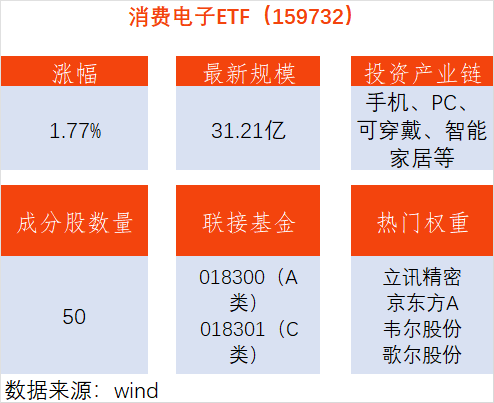
AI眼镜的“车机联动”新模式,消费电子ETF(159732.SZ)上涨1.77%
Sou Hu Cai Jing· 2025-12-12 05:24
Group 1 - The A-share market saw a collective rise in the three major indices, with the Shanghai Composite Index increasing by 0.18%, driven by strong performances in the electronics, power equipment, and non-ferrous metals sectors [1] - The Consumer Electronics ETF (159732.SZ) rose by 1.77%, with notable gains from component stocks such as Dongshan Precision (+6.91%), Jinghe Integrated (+6.57%), Desay SV (+4.81%), OmniVision (+4.49%), and Rockchip (+3.65%) [1] Group 2 - Li Auto officially launched its AI accessory, the Livis smart glasses, in collaboration with Zeiss, marking a strategic move to enhance its brand ecosystem and explore new interaction methods beyond traditional mobile and internet companies [3] - The cross-industry integration may prompt more automotive companies to focus on similar devices, potentially impacting the competitive landscape and driving technological advancements in upstream optical and acoustic sensors [3] - The smart glasses industry chain is expected to have long-term development potential, possibly becoming the next major consumer electronics category after smartphones, warranting continued attention to investment opportunities within the industry chain [3]