
Lilly(LLY)

Search documents
Roche, Lilly's blood test for Alzheimer's diagnosis gets US approval
Reuters· 2025-10-13 14:47
Core Insights - Roche Diagnostics and Eli Lilly received clearance from the U.S. Food and Drug Administration for their blood test, which aids in the initial assessment of Alzheimer's disease [1] Company Summary - Roche Diagnostics is collaborating with Eli Lilly on the development of a blood test for Alzheimer's disease [1] - The FDA's clearance represents a significant advancement in diagnostic tools for Alzheimer's, potentially impacting early detection and treatment strategies [1] Industry Summary - The approval of the blood test highlights the growing importance of innovative diagnostic solutions in the healthcare sector, particularly for neurodegenerative diseases like Alzheimer's [1] - This development may lead to increased investment and research in Alzheimer's diagnostics and therapeutics, reflecting a broader trend in the industry towards personalized medicine [1]


Healthcare Opportunities And Risks Collide For Direxion's Eli Lilly-Focused ELIL, ELIS ETFs
Benzinga· 2025-10-13 14:10
Core Insights - Eli Lilly & Co. has shown significant growth potential, with its stock price increasing from approximately $360 to around $960 in late summer 2023, reflecting strong investor confidence [1] - The company has established itself as a leader in medical innovations, particularly in diabetes, obesity, and cancer treatments, contributing to its robust financial performance [2][3] Financial Performance - In the most recent quarter, Eli Lilly reported earnings of $6.31 per share, surpassing analysts' expectations of $5.60 and significantly higher than last year's $3.92 [3] - The company generated $15.56 billion in revenue, exceeding expectations by 5.83% and representing a 38% increase from the previous year's $11.3 billion [4] Market Position and Challenges - Despite positive financial results, Eli Lilly faces challenges, particularly in the growth of its Zepbound prescription and potential risks associated with its Mounjaro medication [7] - The stock has experienced volatility, with a year-to-date gain of 10.8%, which is lower than the S&P 500's increase of 14.51% during the same period [5][8] Competitive Landscape - Eli Lilly is under pressure from competitors and faces uncertainties related to health policies, which have contributed to stock volatility [8]
Lilly to present new clinical data for Verzenio (abemaciclib) and multiple novel pipeline programs at the 2025 European Society for Medical Oncology (ESMO) Annual Meeting
Prnewswire· 2025-10-13 10:45
Core Insights - Eli Lilly and Company is presenting new data from its oncology portfolio at the ESMO Annual Meeting, highlighting advancements in cancer care and the efficacy of its investigational therapies [1][7]. Group 1: Verzenio (abemaciclib) - The company will present results from the seven-year analysis of the Phase 3 monarchE study, focusing on overall survival and disease-free survival in high-risk early breast cancer patients [2][10]. - An in-depth analysis of the Ki-67 index's prognostic and predictive value will also be shared, examining its role before and after neoadjuvant chemotherapy [2]. Group 2: Investigational Therapies - Olomorasib, a KRAS G12C inhibitor, will have its intracranial efficacy results presented for patients with KRAS G12C-mutant non-small cell lung cancer [3]. - LY4064809, a pan-mutant-selective PI3Ka inhibitor, will showcase updated results from the Phase 1/2 PIKALO-1 trial in PIK3CA-mutant advanced breast cancer [4]. - Vepugratinib, an FGFR3 inhibitor, will present updated results from the FORAGER-1 study in FGFR3-altered urothelial cancer [5]. - LY4170156, an investigational antibody-drug conjugate targeting folate receptor alpha, will share updated safety and efficacy results in patients with platinum-resistant ovarian cancer [6]. Group 3: Company Commitment - The presentations reflect Lilly's commitment to advancing cancer care and improving patient outcomes, with a focus on strengthening its oncology portfolio [7].
Aspen wins approval to market Lilly's Mounjaro for weight loss in South Africa
Reuters· 2025-10-13 09:26
Core Insights - Aspen Pharmacare has received regulatory approval to market Eli Lilly's Mounjaro for chronic weight management in South Africa [1] Company Summary - Aspen Pharmacare is expanding its product offerings by securing the rights to market a significant diabetes and obesity drug, Mounjaro, in South Africa [1] - The approval indicates a strategic move to tap into the growing market for weight management solutions in the region [1] Industry Summary - The approval of Mounjaro highlights the increasing focus on chronic weight management and obesity treatment within the pharmaceutical industry [1] - This development may signal a competitive landscape as companies seek to address the rising prevalence of obesity and related health issues [1]
立项只是FIC,已经不够用了?
Tai Mei Ti A P P· 2025-10-13 02:37
Core Insights - The article emphasizes that being the "first" in the biopharmaceutical industry does not guarantee long-term commercial success, as evidenced by the rapid evolution and competition in the market [1][3] - There is a growing recognition that "Best in Class" (BIC) products, which are iterations of existing drugs, may offer better commercial viability compared to "First in Class" (FIC) products [1][5] - The article highlights the importance of strategic innovation, particularly in the context of established mechanisms and pathways, to meet clinical needs and market demands [1][7] Group 1: Innovation Dynamics - The rapid iteration of drugs is compressing their lifecycle, forcing companies to maximize the value of new drugs within limited timeframes [1][9] - The success of atorvastatin, which became a blockbuster despite being a later entrant in the statin class, illustrates that FIC advantages can diminish over time as BIC products emerge [3][4] - Companies like Eli Lilly have successfully adopted a strategy focused on "me better" drugs, which are improvements on existing therapies rather than entirely new innovations [5][6] Group 2: Market Trends - The trend towards BIC products is evident in various therapeutic areas, including oncology and autoimmune diseases, where companies are focusing on improving established targets rather than pursuing new ones [7][9] - The competitive landscape is shifting as more Chinese pharmaceutical companies leverage their advantages in speed and cost-effectiveness to innovate rapidly, challenging established players [10] - The urgency to fill gaps left by patent expirations is leading to a preference for iteratively developed products based on validated mechanisms [9][10]
美股市场速览:贸易冲突再起,全风格恐慌下跌
Guoxin Securities· 2025-10-12 05:14
Investment Rating - The report maintains a "Weaker than Market" rating for the U.S. stock market [1] Core Insights - The report highlights a significant market downturn due to renewed trade conflicts, with the S&P 500 dropping by 2.4% and the Nasdaq by 2.5% [3] - Only three sectors experienced gains, while 21 sectors saw declines, indicating widespread market fear [3] - The semiconductor sector attracted substantial capital inflows, contrasting with the overall outflow from the market [4] Summary by Sections Price Trends - The S&P 500 fell by 2.4%, and the Nasdaq decreased by 2.5% due to trade tensions [3] - The performance of sectors varied, with the Food, Beverage & Tobacco sector increasing by 1.7%, while Durable Goods & Apparel dropped by 8.4% [3] Capital Flows - The estimated capital flow for S&P 500 components was -$40.6 billion, indicating a significant outflow compared to the previous week [4] - The semiconductor products and equipment sector saw a capital inflow of $83.2 million, while the automotive sector experienced a $25.7 million outflow [4] Earnings Forecast - The report indicates a 0.3% upward adjustment in the earnings per share (EPS) forecast for S&P 500 components, with 21 sectors seeing an increase in earnings expectations [5] - The materials sector led the upward revisions with a 1.0% increase, while the energy sector faced a downward adjustment of 0.5% [5]




辉瑞,不想认输
Ge Long Hui· 2025-10-11 16:02
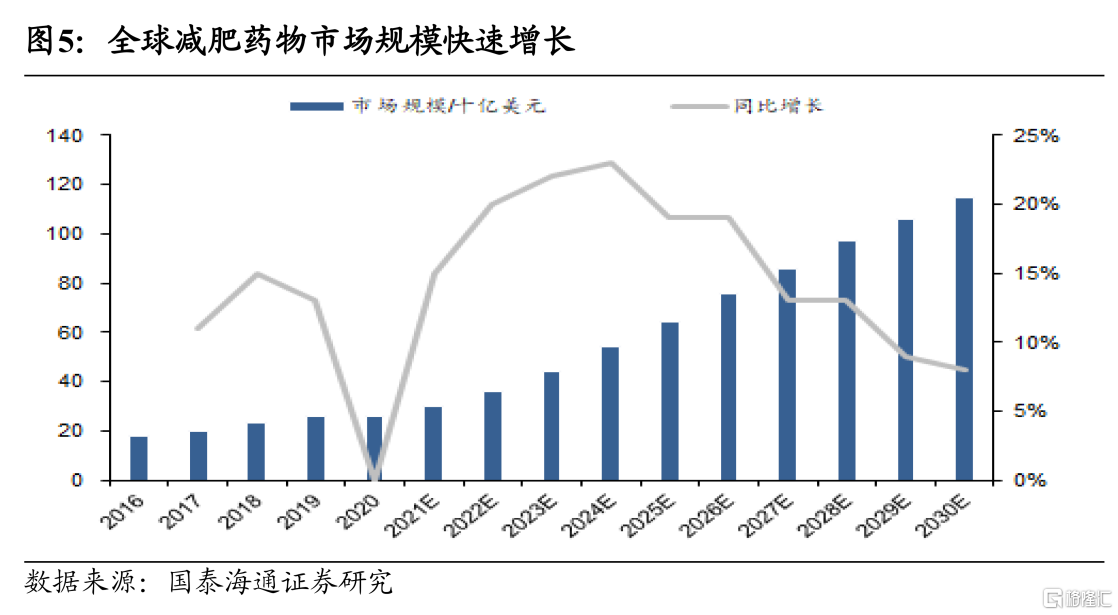
Core Viewpoint - Pfizer's recent acquisition of Metsera for over $7.2 billion marks its strong re-entry into the weight loss market, despite previous setbacks in its GLP-1 pipeline. The company aims to capture a share of the lucrative obesity and cardiometabolic disease treatment market, which is projected to grow significantly in the coming years [1][4]. Group 1: Market Potential and Competition - The global GLP-1 market is expected to reach approximately $52.83 billion in 2024, with a year-on-year growth of 46%. The sales of semaglutide products are projected to be around $29.3 billion, holding a 55.5% market share, while tirzepatide products are expected to generate nearly $16.5 billion, accounting for 32.23% [1]. - In 2024, sales of the weight loss version of semaglutide (Wegovy) are anticipated to grow by 86% to about $8.448 billion, while tirzepatide (Zepbound) is expected to see a staggering 2702% increase to $4.926 billion [2]. - The global anti-obesity drug market is forecasted to exceed $150 billion by 2030, indicating a robust growth trajectory for the sector [2]. Group 2: Pfizer's Strategy and Pipeline - Pfizer had previously halted its GLP-1 pipeline development, which included three small molecule agonists, leaving only one GIPR antagonist in Phase II clinical trials. However, the company has now pivoted back into the obesity market by acquiring Metsera, which has several promising obesity drug candidates [4][6]. - Pfizer plans to invest $10-15 billion in mergers and acquisitions by 2025 to counteract the impending patent cliff, with eight major products set to lose patent protection in the next three years, contributing to 40% of the company's total revenue in 2024 [5]. Group 3: Metsera's Drug Pipeline - Metsera's pipeline includes MET-097i, a novel long-acting GLP-1 receptor agonist with a half-life of 380 hours, allowing for monthly dosing. It also features MET-233i, a long-acting amylin analog currently in Phase I trials, which aims to reduce weight while preserving muscle mass [9][10]. - Recent Phase IIb studies for MET-097i showed promising results, with participants losing an average of 14.1% of their body weight over 28 weeks, and some individuals achieving weight loss of up to 26.5% [9][10]. Group 4: Competitive Landscape - The weight loss drug market is becoming increasingly competitive, with major players like Eli Lilly and Novo Nordisk leading the charge. Pfizer's challenge will be to differentiate its offerings in a market where many companies are pursuing similar therapeutic targets [17][21]. - Recent developments include Eli Lilly's successful Phase III trials for its oral GLP-1RA, which demonstrated an average weight loss of 7.3 kg, and Novo Nordisk's advancements in multi-target therapies [18][21]. Group 5: Future Outlook - Pfizer's acquisition of Metsera is not just a pipeline enhancement but a strategic move to secure a foothold in the evolving landscape of next-generation weight loss therapies. The market is shifting from a "duopoly" to a "multitude of competitors," indicating a new phase of competition in the obesity treatment sector [24].


Should Investors Buy Eli Lilly Stock?
The Motley Fool· 2025-10-11 11:00
Core Insights - Investors are enthusiastic about the company's weight loss treatments but may be neglecting the promising pipeline of new therapies [1] Company Performance - Eli Lilly's shares experienced a significant increase over the last month as investor confidence in its product pipeline grew [1]

Next medicine deal after Pfizer? Analysts, shares point to AstraZeneca, Eli Lilly
Reuters· 2025-10-10 14:15
Group 1 - Wall Street is focusing on U.S. drugmaker Eli Lilly and Anglo-Swedish rival AstraZeneca as potential beneficiaries following Pfizer's agreement with the Trump administration to reduce drug prices [1]

礼来(LLY.US)FRα ADC启动III期临床研究
Zhi Tong Cai Jing· 2025-10-10 13:03
Core Insights - Eli Lilly (LLY.US) has initiated the first Phase III clinical trial (FRAmework-01) for its FRαADC drug LY4170156, which is developed by Mablink Bioscience, a company acquired by Eli Lilly [1] - LY4170156 utilizes a payload of the topoisomerase I inhibitor irinotecan, with a drug-to-antibody ratio (DAR) of 8 [1] - According to NextPharma database, there are currently 27 FRαADC drugs in development globally, with 11 in clinical stages [1] - Apart from the already marketed drug somatuzumab, LY4170156, Rinatabart sesutecan (Genmab), and BAT8006 (Baiyoutai) are the three fastest progressing drugs, all having initiated Phase III clinical trials [1]