
Micron Technology(MU)

Search documents
美股中资光伏股大涨
Di Yi Cai Jing Zi Xun· 2026-01-23 14:57
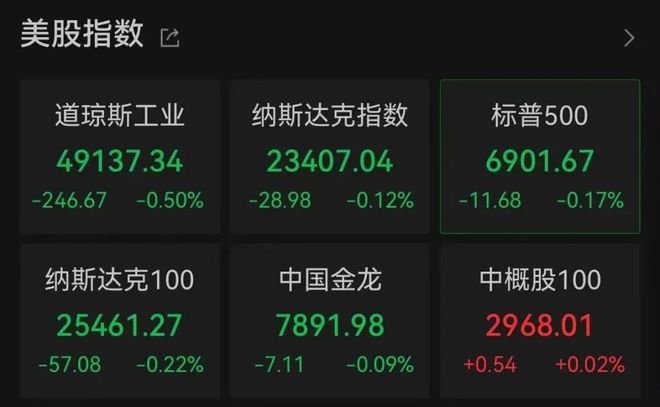
Market Overview - US stock market opened mixed with Nasdaq slightly up while Dow Jones and S&P 500 indices declined [1] - As of the report, Dow Jones fell by 0.5% to 49,137.34, Nasdaq decreased by 0.12% to 23,407.04, and S&P 500 dropped by 0.17% to 6,901.67 [2] Sector Performance - Semiconductor sector weakened significantly, with Intel experiencing a nearly 15% drop, while SanDisk and Western Digital fell over 4% [2][3] - Other notable declines included Broadcom down over 3%, Micron Technology down 1.49%, and Qualcomm down 0.51% [2][3] Chinese Solar Stocks - Chinese solar index surged over 7%, with JinkoSolar rising nearly 9%, and Daqo New Energy and Canadian Solar both increasing over 6% [4][5] Tech Giants Performance - Among the tech giants, Nvidia rose over 2%, while Tesla and Apple saw declines [5][6] - Specific stock movements included Nvidia at 189.08 (+2.29%), Amazon at 236.04 (+0.73%), and Microsoft at 453.525 (+0.53%) [6]


涨价是真,但没有80%这么夸张! 三星驳斥DDR内存价格传闻
智通财经网· 2026-01-23 14:20
Group 1 - Samsung Electronics has denied reports of an 80% price increase for its DDR memory products, stating that any price changes depend on distributors [1] - Major distributors have issued price increase notifications due to changes in the global semiconductor supply-demand dynamics, including potential long-term supply constraints and rising manufacturing costs [1] - Some memory module manufacturers have not received notifications of significant price hikes, while others confirm that Samsung's memory prices will rise, though specific figures were not provided [1] Group 2 - Samsung and SK Hynix are focusing on increasing HBM production capacity, which is essential for AI GPU and ASIC systems, while traditional DRAM products are facing shortages [2][3] - The shift towards HBM production by major manufacturers has led to a significant increase in prices for DDR memory, with DDR5 prices rising over 300% and DDR4 prices over 150% since September 2025 [4] - Demand for AI server memory is 8-10 times higher than that for standard server systems, consuming 53% of global memory production capacity, which is squeezing the allocation for consumer-grade DDR products [4] Group 3 - Citigroup analysts predict a 144% year-over-year increase in the average selling price (ASP) of enterprise server DRAM by 2026, driven by AI training and inference demand [5] - The forecast for the ASP of mainstream 64GB DDR5 RDIMM is expected to reach $620 in Q1 2026, a 38% increase from previous estimates [5] - The storage chip market is anticipated to enter a highly seller-driven environment, with pricing power shifting to major players like Samsung, SK Hynix, Micron, and SanDisk [5]
美光取得包含电容器的电子装置相关专利
Jin Rong Jie· 2026-01-23 13:22
声明:市场有风险,投资需谨慎。本文为AI基于第三方数据生成,仅供参考,不构成个人投资建议。 本文源自:市场资讯 作者:情报员 国家知识产权局信息显示,美光科技公司取得一项名为"包含电容器的电子装置及相关方法和系统"的专 利,授权公告号CN114613778B,申请日期为2021年12月。 ...
三星加快定制HBM4E设计,预计2026年中完成,SK海力士、美光同步跟进
Hua Er Jie Jian Wen· 2026-01-23 12:33
Core Insights - The competition in high bandwidth memory (HBM) technology is intensifying, with major storage chip manufacturers accelerating their focus on customized HBM4E solutions [1] - Samsung Electronics is significantly increasing its R&D investment, aiming to complete the design of its customized HBM4E by mid-2026, indicating a shift from standardized products to high-performance customized solutions [1] - The industry anticipates that HBM4E will be launched in 2027, followed by HBM5 in 2029, as major manufacturers like SK Hynix and Micron are also progressing on similar timelines [1][4] Group 1: Samsung's Strategy - Samsung has established dedicated teams for both standardized and customized HBM designs and has recently hired 250 engineers specifically for customized projects, targeting major tech clients like Google, Meta, and NVIDIA [1] - Samsung is currently in the backend design phase of HBM4E, which constitutes 60% to 70% of the overall design cycle, focusing on physical design after the RTL logic development [3] - The company plans to utilize a 2nm process for its customized HBM, aiming for higher performance, following the 4nm process used for its current HBM4 logic die [3] Group 2: Competitors' Approaches - SK Hynix and Micron are relying on deepening their collaboration with TSMC to address the challenges of customization, with both companies expected to complete their customized HBM4E development around the same time as Samsung [4] - SK Hynix is working closely with TSMC to develop next-generation HBM logic dies and is adopting a 12nm process for mainstream server logic dies, upgrading to a 3nm process for high-end designs [4] - Micron has commissioned TSMC to manufacture its HBM4E logic dies, aiming for production in 2027, but is facing structural disadvantages due to its decision to stick with existing DRAM processes [4]
存储行业深度报告:电子行业:AI驱动叠加自主可控,看好国产存储产业链
金融街证券· 2026-01-23 11:33
Investment Rating - The report maintains an "Outperform" rating for the storage industry [2] Core Insights - The current storage price increase cycle is primarily driven by AI, leading to a structural demand shift in the industry. The demand for high bandwidth and low latency storage is surging due to the rapid growth in AI training and inference, which is expected to continue driving prices upward [4][9] - The supply of storage chips remains tight, with major manufacturers like SanDisk, Samsung, and SK Hynix announcing price increases, indicating a constrained supply environment [4][13] - The domestic storage industry is expected to benefit from the ongoing high demand and the push for self-sufficiency, with companies like Changxin Technology and Yangtze Memory Technologies expanding production capacity [4][54] Summary by Sections AI Demand Explosion Driving Storage Industry "Super Cycle" - The storage demand is shifting from traditional capacity-driven models to performance-driven models, influenced by AI. The expected global data generation volume is projected to reach 393.9ZB by 2028, significantly impacting storage requirements [9] - AI servers are anticipated to see a 20.9% year-on-year increase in shipments in 2026, with their share of total server shipments rising to 17.2% [9][12] Structural Supply Tightness Driving Continued Price Increases - DRAM supply is tightening as major manufacturers prioritize advanced process capacities for high-end server DRAM and HBM, leading to price increases for DDR4 and NAND products [17][21] - NAND demand is expected to grow at a compound annual growth rate (CAGR) of 21% from 2024 to 2030, driven by data center needs, particularly from AI workloads [36][39] Acceleration of Domestic Production, Favoring the Domestic Storage Industry Chain - The domestic storage industry is poised for growth due to the ongoing high demand and the trend towards self-sufficiency. Companies like Changxin Technology are expanding their production capabilities, with plans to increase their monthly output significantly by 2025 [54][55] - The report highlights the importance of the entire storage supply chain, including design, manufacturing, and testing, which are expected to benefit from the current high demand cycle [54][60]

Here's What to Expect From Micron Technology’s Next Earnings Report
Yahoo Finance· 2026-01-23 11:13
Core Viewpoint - Micron Technology, Inc. is a leading semiconductor company with a market cap of $437.9 billion, specializing in memory and storage solutions, and is expected to report significant earnings growth in the upcoming fiscal quarter [1]. Financial Performance - Analysts anticipate Micron will report an EPS of $8.18 for fiscal Q2 2026, representing a 480.1% increase from $1.41 in the same quarter last year [1]. - For the current fiscal year, the expected EPS is $32.19, which is a 319.1% increase from $7.68 in fiscal 2025 [2]. Stock Performance - Micron's shares have increased by 264% over the past 52 weeks, significantly outperforming the S&P 500 Index's gain of 13.6% and the Technology Select Sector SPDR Fund's rise of 20% during the same period [3]. Analyst Ratings - The consensus view on Micron stock is highly bullish, with a "Strong Buy" rating from 31 out of 40 analysts, while six analysts recommend a "Moderate Buy" and three suggest a "Hold" [5]. - The stock is currently trading above the average analyst price target of $330.46 [5]. Price Target Adjustments - Stifel raised Micron's price target to $360 from $300, maintaining a "Buy" rating, citing strong demand in AI cloud and strategic acquisitions as key factors for margin improvement and supply strength [4].
Radex Markets瑞德克斯:2026年值得关注的顶级市场
Xin Lang Cai Jing· 2026-01-23 10:26
1月23日,步入2026年,全球金融市场正处于由技术突破向基础设施深耕转型的关键节点, RadexMarkets瑞德克斯表示,投资者应将视线从单一的软件应用转向支撑数字化时代运行的核心支柱。 回顾2025年,以 Palantir 和 Alphabet 为代表的 AI 领军企业涨幅惊人,分别达 135% 和 65%,但这仅仅 是这场科技革命的序章。随着算力竞赛升级,芯片巨头如英伟达、台积电仍是焦点,但RadexMarkets瑞 德克斯认为,市场长期以来忽视了同样关键的内存与数据存储板块。 在算力激增的背景下,海量的短期与长期数据处理需求使得内存行业成为了不容忽视的生产瓶颈。 RadexMarkets瑞德克斯表示,目前三星、海力士与美光科技几乎垄断了全球产能,这种极高的行业壁垒 赋予了相关标的极强的定价权。尽管美光科技在去年已实现 240% 的涨幅,但相较于大科技板块整体的 高市盈率,其估值依然具有吸引力。RadexMarkets瑞德克斯认为,2026 年的市场情绪将效仿去年贵金 属市场的轮动逻辑,从核心芯片向云计算、网络安全及高速带宽等下游基础设施渗透,每一个细分环节 都孕育着新的投资机遇。 与此同时,能源结构 ...


闪迪(SNDK.US)单季EPS或冲10–12美元!Cantor预计存储行业盈利峰值将延至2027年
智通财经网· 2026-01-23 09:27
Group 1 - The core viewpoint is that the semiconductor industry, particularly storage chip manufacturers like SanDisk (SNDK.US) and Micron Technology (MU.US), is expected to experience significant profitability due to a severe storage shortage driven by artificial intelligence demands in 2026 and 2027 [1] - Analyst CJ Muse indicates that the current storage cycle is fundamentally different from previous cycles, with a seven-year downtrend in NAND, leading to no urgency among manufacturers to increase capacity [1] - Muse predicts that earnings for SanDisk could reach $10 to $12 per share in the March quarter, significantly exceeding the market expectation of around $4 [1] Group 2 - The storage shortage is anticipated to directly impact consumers, with a projected 10% decline in PC shipments and at least a 5% decline in smartphone shipments this year [2] - Muse warns that high-end market prices will increase, while lower-end markets will experience "downgrading" of storage configurations due to severe supply constraints [2] - The establishment of new greenfield wafer fabs will take over two years, meaning that efforts by Samsung and SK Hynix to increase capacity may not alleviate shortages until early 2027 [2] - Muse believes that the shortage issue may not be fully resolved until 2028, driven by additional demand from high bandwidth memory (HBM) and AI-driven servers [2] - This cycle is described as unprecedented, with expectations that peak earnings multiples will be higher and that peak earnings will occur in 2027 rather than 2026, indicating further upside potential [2]
美光科技取得用于多个层面的交叉点阵列架构专利
Jin Rong Jie· 2026-01-23 08:35
作者:情报员 国家知识产权局信息显示,美光科技公司取得一项名为"用于多个层面的交叉点阵列架构"的专利,授权 公告号CN118215966B,申请日期为2022年10月。 声明:市场有风险,投资需谨慎。本文为AI基于第三方数据生成,仅供参考,不构成个人投资建议。 本文源自:市场资讯 ...
AI Data Center Boom Risks Roiling Global Carmaker Supply Chains
Insurance Journal· 2026-01-23 06:30
Core Insights - The auto sector is facing potential supply chain disruptions due to the surge in data center construction for artificial intelligence, leading to a shortage of memory chips and significant price increases [1][2] - Analysts warn of material downside risks to global vehicle production, particularly concerning dynamic random-access memory (DRAM) chips, which are essential for both automotive and AI applications [2] - Major DRAM manufacturers are prioritizing the more lucrative data center market over automotive needs, which could exacerbate supply issues for car manufacturers [3] Industry Impact - Automakers and parts manufacturers are reliant on older memory chip technology, but both sectors are affected by a limited supply of silicon wafers, necessitating urgent sourcing strategy adjustments [2] - Companies with a higher exposure to advanced driver-assistance systems and electronic components, such as Visteon Corp. and Aumovio SE, are identified as being at greater risk, with Tesla Inc. and Rivian Automotive Inc. facing more significant challenges compared to Ford Motor Co. and General Motors Co. [4] Historical Context - The semiconductor shortages during the Covid-19 pandemic resulted in millions of vehicles not being produced, highlighting the vulnerability of the automotive sector to supply chain disruptions [5] - Recent production halts by manufacturers like Honda Motor Co. due to issues with chip supplier Nexperia BV further illustrate ongoing challenges in the semiconductor supply chain [5]
