
NIKE(NKE)

Search documents
透视3年天猫大促榜,我们发现落榜选手们有几个共同特征……
Di Yi Cai Jing· 2025-11-19 08:54
Group 1: Tmall Sales Trends - Tmall's sales rankings during major promotions serve as a window to observe consumer trends, industry changes, and brand performance [1] - Strong brands like Uniqlo have consistently topped the rankings, while emerging players like Songmont have shown significant growth [1] - Brands that have fallen behind exhibit common characteristics related to path dependence and market cycles [1] Group 2: Ralph Lauren and Teenie Weenie - Ralph Lauren and its counterparts, known as the "middle-class three treasures," gained popularity among urban middle-class consumers for their classic designs and comfort [2][4] - However, Ralph Lauren's presence has diminished in recent rankings, indicating a shift in consumer preferences [4] - Teenie Weenie, once seen as a perfect alternative to Ralph Lauren, has also experienced a significant decline in rankings and overall performance [5][7] Group 3: Old Puh Gold's Rise - Old Puh Gold has emerged as a significant player in the jewelry market, achieving remarkable growth despite the decline of traditional brands like Chow Tai Fook [11][12] - The brand's strategy focuses on positioning gold as a luxury item and targeting high-net-worth consumers [12][13] - Old Puh Gold's success is attributed to its selective expansion strategy and strong brand presence in high-end commercial centers [13][15] Group 4: Nike and Fila Competition - Nike, once dominant in the sportswear market, has faced challenges from Fila, which has recently taken the top spot in Tmall's sports category [16][18] - Fila's strategy emphasizes a complete outfit approach, while Nike's focus has shifted towards direct-to-consumer channels [20] - The structural misalignment in strategies has allowed Fila to capitalize on current consumer trends, leading to Nike's decline in rankings [20] Group 5: Outdoor Brands' Decline - The outdoor brands that gained popularity during the pandemic have seen a decline in rankings, highlighting the seasonal and cyclical nature of these products [21][23] - The registration of outdoor-related companies peaked in 2023, but growth has slowed in subsequent years, indicating a market correction [23] - Brands must innovate and deepen community engagement to sustain interest beyond initial trends [23] Group 6: Arc'teryx's Crisis - Arc'teryx experienced a sudden drop in rankings due to a controversial marketing event that contradicted its brand values [25][27] - The incident damaged consumer trust, which is crucial for premium brands that rely on their reputation for quality and expertise [27] - This situation serves as a warning for brands about the importance of aligning with consumer values and maintaining brand integrity [27]




安利股份(300218.SZ):目前公司与安踏有少量订单跨境交付
Ge Long Hui A P P· 2025-11-19 08:01
Core Viewpoint - The company is expanding its partnerships with major sports brands, indicating a strategic growth in its supply chain and product development capabilities [1] Group 1: Partnerships and Collaborations - The company will become a supplier for New Balance by 2025, with current collaboration in the product development phase [1] - The company is a strategic partner of Anta, co-establishing a technology research center for membrane technology [1] - The company upgraded its partnership status with Nike to a strategic partner starting January 2025 [1] Group 2: Order Fulfillment and Production - Currently, the company has a small volume of cross-border orders being delivered in collaboration with Anta [1] - Orders from Li Ning are primarily being produced and delivered domestically at this stage [1]

Nike: Strong Brand And Solid Business, But Unlikely To Outperform The Benchmark (NYSE:NKE)
Seeking Alpha· 2025-11-19 07:28
Core Viewpoint - The stock of NIKE (NKE) has declined by 9%, indicating that the company's premium valuation is affecting its outlook, and a rebound may take more time [1] Group 1: Company Performance - NIKE's stock has experienced a significant decline of 9% following the previous analysis [1] - The premium valuation of NIKE is seen as a cloud over its future performance, suggesting potential challenges ahead [1] Group 2: Analyst Background - The analyst has over 10 years of experience in asset management, focusing on equity analysis, macroeconomics, and risk-managed portfolio construction [2] - The analyst emphasizes the importance of understanding macro trends and their influence on asset prices and investor behavior [2] - The goal of sharing insights is to empower investors and promote confidence in long-term investing [2]
机制之争:双十一,FILA把耐克“赶下”王座
2 1 Shi Ji Jing Ji Bao Dao· 2025-11-18 12:42
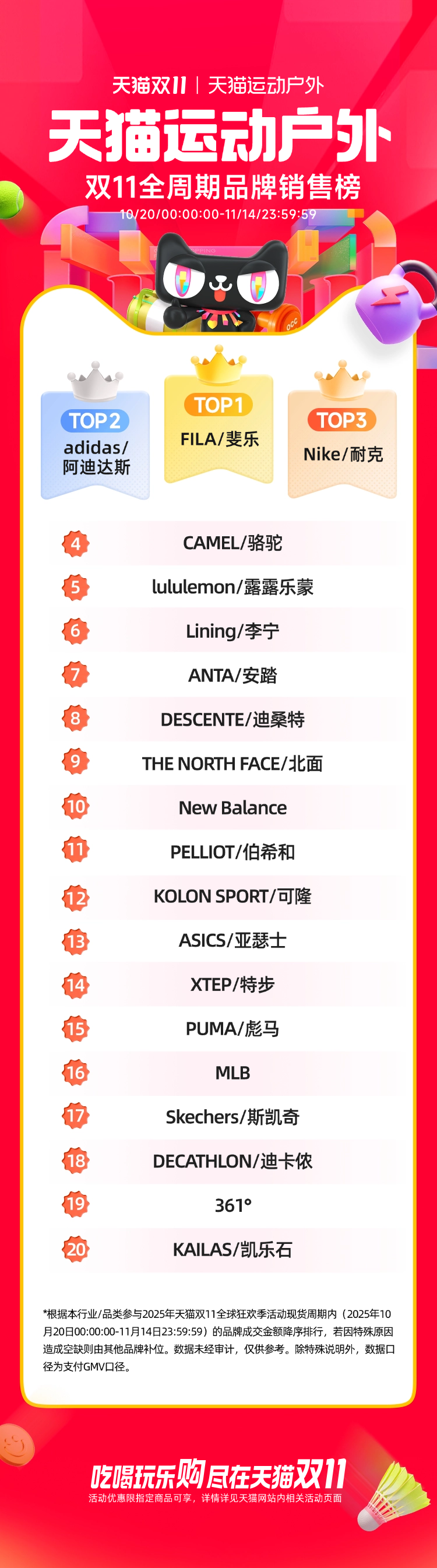
Core Insights - The sports market is undergoing significant reshuffling, with FILA ranking first in Tmall's Double Eleven sales, followed by Adidas and Nike, marking Nike's first drop from the top position in years [1][4][10] Brand Performance - In the 2023 Double Eleven sales, the top three brands were Nike, FILA, and Anta, while in 2024, the rankings shifted to Nike, FILA, and Adidas, indicating a competitive landscape [1][10] - FILA's sales strategy includes a "customer service integration" project, enhancing the customer experience from pre-purchase to post-sale [4][5] - Nike's revenue in Greater China has been declining, with a 10% drop to $1.512 billion (approximately 10.775 billion RMB) for the latest fiscal quarter [10][11] Market Dynamics - The competition is intensifying, with domestic brands like Anta and Li Ning gaining market share, while overseas brands face declining premium pricing [10][11] - Nike's market share in China decreased from 18.1% to 16.2%, while Anta's increased from 9.8% to 10.5% [10][11] - The overall market is under pressure, with reports of losses in domestic sales for brands like Peak and Li Ning [11][12] Strategic Adjustments - FILA is focusing on strategic investments in tennis and golf, with significant sales growth in these categories during the Double Eleven period [6][13] - Nike is recognizing the importance of localized operations, appointing local executives and establishing creative centers in China to enhance market engagement [7][10] - The need for Nike to adapt its strategies in China is critical, especially after its drop to third place in sales rankings [14]
机制之争:双十一,FILA把耐克“赶下”王座丨小贺说
2 1 Shi Ji Jing Ji Bao Dao· 2025-11-18 12:36
Core Insights - The sports market is undergoing significant reshuffling, with FILA ranking first in the Tmall Double Eleven sales, marking Nike's first drop from the top position in recent years [1] - FILA's operational strategies and flexible mechanisms have contributed to its success, while Nike is facing challenges in maintaining its market position [4][6] Group 1: Market Performance - In the 2023 Double Eleven sales, FILA ranked first, followed by Adidas and Nike, which is a notable shift in market dynamics [1] - Nike's revenue in the Greater China region has been declining, with a reported drop of 10% to $1.512 billion (approximately 10.775 billion RMB) for the latest fiscal quarter ending August 31, 2025 [8] - Despite the decline, Nike remains the largest sports brand in China, with a market share of 16.2%, although it has decreased from 18.1% [8] Group 2: Company Strategies - FILA has implemented a "customer service integration" project to enhance its operational efficiency, allowing for a seamless customer experience from pre-purchase inquiries to post-sale support [2] - The new CEO of FILA, Jiang Yan, has introduced the "ONE FILA" strategy, focusing on resource consolidation and strategic investments in tennis and golf [4] - Nike is also recognizing the importance of localized operations, appointing Dong Wei as the new CEO for Greater China, indicating a shift towards empowering local leadership [5] Group 3: Competitive Landscape - The rise of domestic brands is evident, with local companies like Anta and Li Ning gaining market share, while overseas brands face declining premium pricing [9] - The overall market environment in China is challenging, with reports of losses in domestic sales for brands like Peak and Li Ning [10] - FILA's strategy of leveraging its parent company Anta's resources has allowed it to create a closed-loop system, enhancing its competitive edge [10]
Nike: Progress Amid Tariff Headwinds, But Turnaround Still Needs Time, So I'll Be Patient
Seeking Alpha· 2025-11-18 11:53
In my previous coverage of NIKE, Inc. ( NKE ), I mentioned how the current macro environment was rapidly moving Nike into a Buy range thanks especially to all the uncertaintyAs of 2025, I've got over 10 years of researching companies. In total, throughout my investing life, I estimate that I researched (in depth) well over 1000 companies, from commodities like oil, natural gas, gold and copper to tech like Google or Nokia and many emerging market stocks, which I believe could help me provide useful content ...
Nike and Apple Both Went Public 45 Years Ago. Here's How Much $1,000 in Each Would Be Worth Today.
The Motley Fool· 2025-11-18 10:15
Core Insights - Nike's shares have significantly outperformed Apple's since their IPOs, with an initial investment of $1,000 in Nike's 1980 IPO now yielding $4,800 annually in dividends [1] - Nike experienced explosive growth prior to its IPO, with annual revenue increasing at an average rate of 85% and net income growing by 100% each year [2] - In contrast, Apple faced intense competition and market challenges in its early years, leading to a significant drop in its market share by the late 1990s [4][5] Company Performance - Nike maintained low capital investments and minimized risks through an innovative inventory system, allowing it to thrive without the struggles faced by Apple [6] - Nike's marketing strategy included endorsements from high-profile athletes, contributing to its brand strength and financial success [7] - As of November 14, Nike's stock has returned 35,550% since its IPO, turning an initial $1,000 investment into $356,500 [10] Dividend and Share Repurchase - Nike has consistently raised its dividends since 2001, while Apple did not pay dividends until 2012, despite both companies' significant capital appreciation [9][11] - In the previous year, Apple paid out $15.2 billion in dividends compared to Nike's $2.17 billion, highlighting the disparity in their dividend policies [12]


X @Bloomberg
Bloomberg· 2025-11-17 23:40
Nike’s new sneaker drop with rapper Travis Scott is among the most popular shoe releases ever, even as the secondary market for kicks cools off https://t.co/Za47zV6OOD ...
“Oh Buy NIKE (NKE),” Says Jim Cramer
Yahoo Finance· 2025-11-17 16:29
Core Insights - NIKE, Inc. (NYSE:NKE) is currently facing challenges in its turnaround efforts, particularly in the Chinese market, which accounted for 15% of its revenue in fiscal year 2025 [2] - Jim Cramer expresses confidence in CEO Elliott Hill's ability to lead the company through its difficulties, suggesting that any improvement in the Chinese market could aid in this turnaround [2][4] - Despite Cramer's optimism, he acknowledges that the turnaround process is difficult and may not yield immediate results, indicating that now may not be the right time to invest in NIKE [4] Company Performance - NIKE has been struggling against competition from cheaper domestic brands in China, impacting its revenue [2] - Cramer noted that the stock price of NIKE fell during his discussion, questioning the market's reaction to the company's ongoing turnaround efforts [2] - The company is undergoing a challenging transformation similar to other brands like Starbucks, but Cramer believes that success is possible in the future [4] Investment Perspective - While there is potential for NIKE as an investment, there is a belief that certain AI stocks may offer better returns with lower risk [4] - Cramer encourages investors to consider the long-term potential of NIKE, despite the current challenges [4]
X @Bloomberg
Bloomberg· 2025-11-17 11:34
Nike has a problem on roads, tracks and treadmills where its sneakers used to dominate. The world’s largest sportswear company knows it has fallen behind with runners and is trying to win them back https://t.co/omuJnxPaRv ...