
Nomura (NMR)

Search documents
Nomura bets on the dollar against the pound as U.K. fiscal predicament grabs spotlight
MarketWatch· 2025-09-11 12:21
Group 1 - The core argument is that Sterling's tail risks are increasing ahead of two significant dates in the economic calendar, while the dollar may experience a short-term bounce according to Nomura [1]



高债务遇上高通胀,英国有麻烦了
Hua Er Jie Jian Wen· 2025-09-04 03:35
Core Viewpoint - Inflation pressure in major developed economies is severe, with the UK facing significant challenges due to rising government debt-to-GDP ratios and limited room for further interest rate cuts, leading to almost inevitable tax increases [1][20]. Inflation Trends - The UK's inflation rate reached 3.8% in July, exceeding expectations, with service sector inflation at 5.0% [2][3]. - This marks the fourth consecutive month of inflation data surpassing forecasts, indicating persistent inflationary pressures [3]. Economic Context - Since the 2007 global financial crisis, the UK's government debt-to-GDP ratio has increased more than any other major developed economy, including the US [1][16]. - Current 10-year UK government bond yields have risen to 4.80%, the highest since January, increasing debt interest burdens [1][17]. Factors Driving Inflation - Weak productivity growth and imbalanced wage increases are key issues, with productivity growth averaging only 0.5% in the 2020s [8]. - The depreciation of the British pound, which has fallen over one-third since its peak in 2007, significantly contributes to inflation [9]. - The impact of Brexit has led to a decline in trade flow, increasing supply chain costs and domestic prices [11]. Monetary Policy Challenges - The persistence of inflation is reshaping the Bank of England's policy considerations, with potential pauses in interest rate cuts if inflation data continues to rise [15]. - Upcoming CPI data releases on September 17 and October 22 will be critical for the Bank's November meeting [15]. Fiscal Pressure - The combination of high inflation and high debt is intensifying fiscal challenges, with the government needing to raise taxes in the upcoming autumn budget [20]. - The Office for Budget Responsibility's optimistic growth forecasts may not align with market expectations, adding to fiscal strain [17].

野村集团暑期实习生投身社区公益服务、积极回馈社会
野村集团· 2025-08-22 09:01
Core Viewpoint - Nomura Group's summer internship program emphasizes community service and social contribution, allowing interns to engage in meaningful activities that give back to society [1][11]. Group 1: Internship Activities - In Singapore, interns collaborated with the social enterprise HeySprouts to support special needs groups, packaging and distributing fresh food to 200 families [3]. - In Hong Kong, interns participated in a soap recycling project with Soap Cycling, recovering over 1 kilogram of soap waste and handcrafting more than 50 bars of soap for OneSky-supported families, guided by disabled youth from the SOAPER Work training program [8][10]. Group 2: Personal Impact and Values - Interns expressed pride in Nomura Group's support for local community initiatives, with personal reflections on how these experiences resonate with their values and inspire future volunteer opportunities [6].

贝森特想要“美国降息、日本加息”,野村:有可能,但有前提
Hua Er Jie Jian Wen· 2025-08-18 01:08
Core Viewpoint - The U.S. Treasury Secretary's call for aggressive and contrasting monetary policies from the Federal Reserve and the Bank of Japan has caused significant market reactions, highlighting potential contradictions in current market narratives [1] Group 1: U.S. Monetary Policy - The U.S. Treasury Secretary advocates for the Federal Reserve to start cutting rates by 50 basis points in September, with a cumulative reduction of 150 to 175 basis points thereafter [1] - Current market expectations suggest that the Federal Reserve's target rate will not reach 3% until autumn next year, indicating a significant divergence from the Secretary's proposals [1] Group 2: Japanese Monetary Policy - The Secretary recommends that the Bank of Japan should raise interest rates to combat inflation and stabilize the yen [1] - The Japanese economy has shown resilience against U.S. tariffs, with a second-quarter GDP annualized growth rate of 1.0%, surpassing market expectations of 0.4% [3] Group 3: Market Reactions - The Japanese stock market experienced a significant surge, while the yen strengthened due to the dual expectations of U.S. rate cuts and Japanese rate hikes [1] - The market's response reflects a complex and divided sentiment regarding the implications of these contrasting monetary policies [1] Group 4: Feasibility and Risks - The feasibility of simultaneous U.S. rate cuts and Japanese rate hikes depends on key conditions, including the pace of U.S. rate cuts and the stability of Japan's economy and political landscape [2][3] - Political uncertainty in Japan, particularly the potential resignation of Prime Minister Kishida, poses a risk to the Bank of Japan's tightening expectations [4] Group 5: Macro Perspectives - A macro view suggests that the current interest rate scenario, with U.S. rates above 3% and Japanese rates below 1%, is "unnatural" and will likely require correction [6] - Two potential scenarios are identified: one where the Federal Reserve lags behind economic trends, necessitating aggressive rate cuts, and another where the Bank of Japan must accelerate rate hikes to keep pace with inflation [6][7]
日股新高背后:汇率与利率预期“双杀”下的估值陷阱?
Hua Er Jie Jian Wen· 2025-08-12 08:38
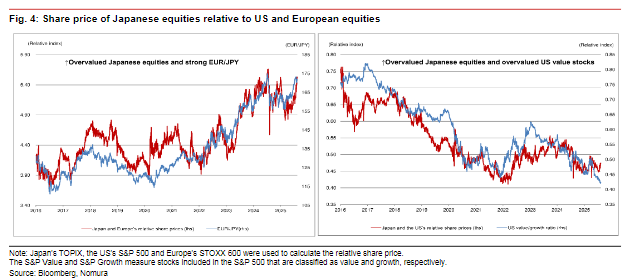
Group 1 - The core viewpoint of the articles suggests that the recent rise in the Japanese stock market is primarily a valuation correction relative to Western markets rather than a fundamentally driven bull market [1][3][4] - The report indicates that the market's expectation for the Bank of Japan (BOJ) to raise interest rates has weakened, with the probability of a rate hike this year currently at 57%, significantly lower than the peak of 84% following the US-Japan trade agreement [2][6] - Key sectors such as technology and banking are underperforming, which poses a significant constraint on the sustainability of the stock market rally [1][6][10] Group 2 - The report emphasizes that the recent stock market increase is more about correcting Japan's historically low valuations compared to the S&P 500 and the Stoxx 600, rather than signaling the start of a comprehensive bull market [3][4] - The absence of strong performance from key sectors, particularly technology, indicates that investors do not view the current rise as a sign of a broad cyclical recovery [6][10] - Speculative investors have reduced their long positions in the yen, with the scale of these positions dropping to 46% of the peak observed on April 29, which adds uncertainty to the outlook for the stock market [7][8][10]
野村证券:澳洲联储料将降息25基点 但鸽派指引可能性低
Xin Hua Cai Jing· 2025-08-11 23:57
Core Viewpoint - Nomura Securities economist Hannah Liu anticipates that the Reserve Bank of Australia (RBA) will unanimously agree to lower interest rates by 25 basis points, but is unlikely to provide dovish guidance [1] Economic Indicators - The second quarter Consumer Price Index (CPI) data suggests that the RBA's previous concerns about inflation may have been somewhat overstated [1] - The average unemployment rate for the second quarter was 4.2%, but it slightly increased to 4.3% in June [1] Economic Activity - Recent economic activity data has shown improvement, indicating that the current rationale for the RBA's interest rate cut is more about the policy space provided by falling inflation rather than a need for continuous rate cuts due to economic weakness [1]
野村证券:美联储年内降息次数≥4次的风险对冲需求正在上升
Sou Hu Cai Jing· 2025-08-06 07:52
Core Viewpoint - Nomura Securities indicates that the likelihood of two interest rate cuts by the end of December has significantly increased following the release of the U.S. non-farm payroll data for July, highlighting rising demand for hedging against the risk of four or more rate cuts within the year due to potential economic hard landing risks [1] Group 1 - The possibility of two interest rate cuts by the end of December has increased significantly [1] - There is a rising demand for hedging against the risk of four or more rate cuts within the year [1] - The concerns are driven by potential economic hard landing risks [1]
野村:泰国央行可能因美国关税变动而维持利率不变
Xin Hua Cai Jing· 2025-08-05 03:11
Core Viewpoint - Nomura Securities economists expect the Bank of Thailand to maintain its policy interest rate next week to assess the impact of the latest U.S. tariff dynamics [1] Group 1: Economic Conditions - Tightening credit standards and deteriorating loan quality in Thailand indicate a more pronounced negative feedback loop between a constrained financial environment and a sluggish economy [1] - Nomura Securities maintains its GDP growth forecast for Thailand at 1.8% for 2025, reflecting a cautious view on the negative feedback loop, vulnerability to U.S. tariffs, and rising domestic political uncertainty [1] Group 2: Monetary Policy Outlook - The firm anticipates that the Bank of Thailand will resume interest rate cuts in October and December of this year, as well as in the first quarter of 2026 [1]
金十整理:机构前瞻美联储利率决议(一)——7月会议只是“预热”,9月还是12月降息成争论焦点
news flash· 2025-07-30 05:21
Core Viewpoint - The Federal Reserve is expected to maintain interest rates unchanged in the near term, with varying opinions on the timing and extent of future rate cuts, particularly in September and December [1][2][3][4]. Group 1: Expectations for Rate Cuts - Goldman Sachs anticipates the Fed will keep rates unchanged but expects three consecutive rate cuts of 25 basis points in September, October, and December, with two additional cuts next year [1]. - Russell Investments believes the Fed will maintain rates but will have sufficient data to restart the rate-cutting cycle in September [1]. - Wells Fargo predicts the Fed will keep rates unchanged and begin cutting rates in the fall, totaling 75 basis points by year-end to alleviate political pressure [1]. - Danske Bank sees a significant possibility of a September rate cut if macroeconomic data falls below expectations [1][2]. Group 2: Divergent Views on Rate Stability - Societe Generale expects the Fed to maintain rates until it is confident that tariff-related uncertainties have been resolved [3]. - UBS forecasts only one rate cut in December, based on the belief that tariffs will push inflation higher while the economy avoids recession [3]. - Nomura Securities suggests the Fed will not cut rates before December due to rising inflation risks from tariffs [3]. - Barclays Bank predicts the next rate cut will not occur before December, with three cuts expected next year if inflation moderates [3]. Group 3: Other Perspectives - BlackRock anticipates the Fed will keep rates unchanged, with a greater likelihood of a rate cut in October compared to September [4].


三大股指期货齐涨,诺和诺德下调2025年展望
Zhi Tong Cai Jing· 2025-07-29 13:04
Market Overview - US stock index futures are all up, with Dow futures rising by 0.13%, S&P 500 futures by 0.30%, and Nasdaq futures by 0.47% [1] - European indices also show positive movement, with Germany's DAX up 1.17%, UK's FTSE 100 up 0.55%, France's CAC40 up 1.10%, and the Euro Stoxx 50 up 1.02% [2][3] - WTI crude oil increased by 0.07% to $66.76 per barrel, while Brent crude oil rose by 0.13% to $69.41 per barrel [3][4] Federal Reserve Insights - The Federal Reserve is not yet prepared to lower interest rates, with officials divided on the timing and evidence needed for such a decision [5] - The upcoming cryptocurrency policy report from the White House is anticipated to be a catalyst for the crypto market, alongside the Fed's interest rate decision [5] Company News - Oppenheimer raised its year-end target for the S&P 500 to 7100 points, citing easing trade tensions and strong corporate earnings, indicating an 11% upside from the latest closing price [6] - Novo Nordisk lowered its 2025 sales growth and profit expectations, projecting sales growth of 8%-14% compared to a previous forecast of 13%-21% [7] - UnitedHealth's second-quarter earnings guidance fell short of expectations, forecasting adjusted EPS of at least $16, significantly below the analyst consensus of $20.40 [8] - UPS refrained from providing earnings guidance due to market volatility, reporting Q2 revenue of $21.2 billion, a 2.8% year-over-year decline [8][9] - Stellantis restored its earnings guidance but warned of a €1.2 billion (approximately $1.4 billion) tariff impact in the second half of the year [9] - Nomura Holdings reported a 52% year-over-year increase in Q1 net profit, driven by strong trading and investment banking performance [10] - Barclays announced a 23% increase in first-half profits and a $1.3 billion stock buyback plan, benefiting from market trading activity [11] - Whirlpool's Q2 sales fell 5.4% to $3.77 billion, below market expectations, and it lowered its full-year EPS guidance [12] - Philips slightly raised its adjusted operating margin forecast for the year, indicating that the impact of trade tensions was less severe than previously feared [13] Economic Data and Events - Upcoming economic data includes the US wholesale inventory month-on-month change and the Conference Board Consumer Confidence Index [14][15] - Earnings reports are expected from Visa, Booking, Starbucks, UBS, Rio Tinto, UMC, New Oriental, and HSBC [17]


