
Nissan Motor(NSANY)

Search documents
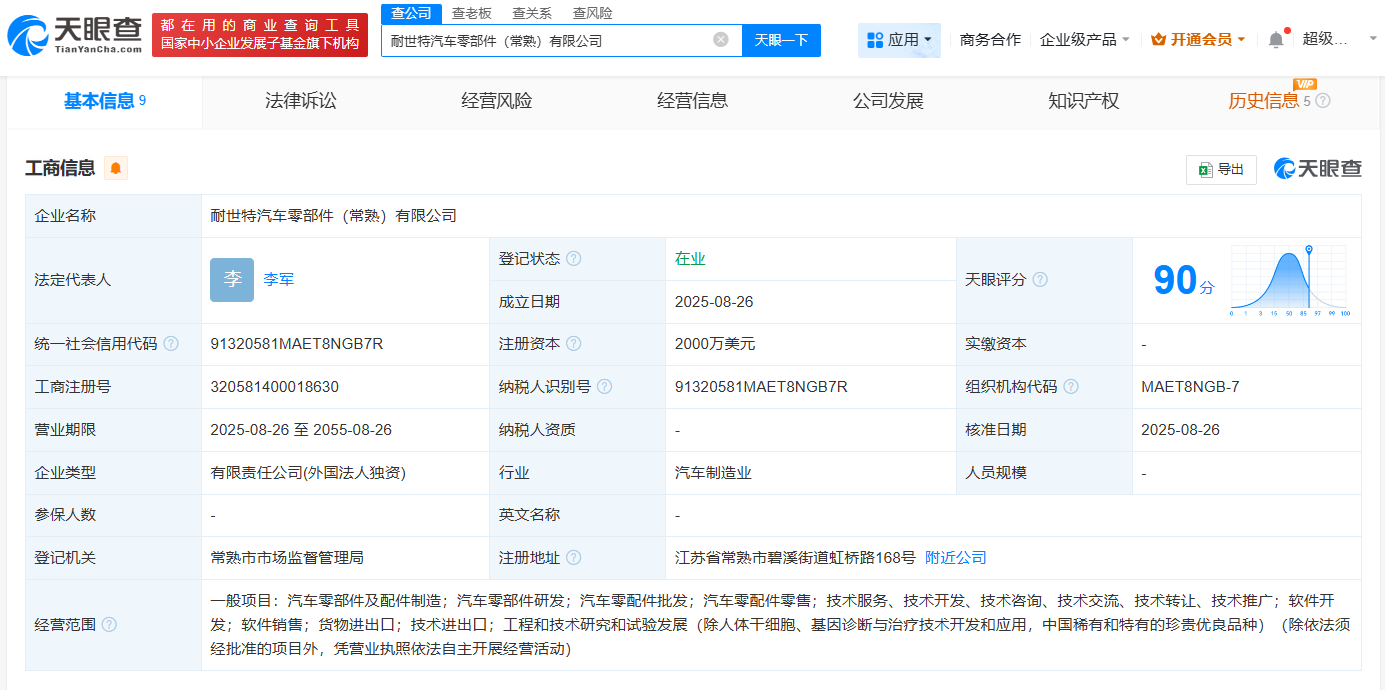
耐世特在常熟成立汽车零部件公司
Mei Ri Jing Ji Xin Wen· 2025-08-27 04:04
Group 1 - The establishment of NEXTEER Automotive Parts (Changshu) Co., Ltd. has been officially registered with a legal representative named Li Jun and a registered capital of 20 million USD [1][2] - The company's business scope includes manufacturing and research of automotive parts and components, as well as wholesale of automotive parts [1][2] - NEXTEER Automotive Parts (Changshu) Co., Ltd. is wholly owned by NEXTEER (China) Investment Co., Ltd. [1][2] Group 2 - The company is classified under the automotive manufacturing industry and is registered as a foreign-owned limited liability company [2] - The business registration was completed on August 26, 2025, with an operational period extending until August 26, 2055 [2] - The registered address is located at 168 Hongqiao Road, Bixi Street, Changshu City, Jiangsu Province [2]

何小鹏回应小鹏汽车人事大调整;梅赛德斯-奔驰计划抛售3.46亿美元股份,日产股价应声下跌6%丨汽车交通日报
创业邦· 2025-08-26 10:13
1.【 日产汽车宣布停止为日本市场生产R35 GT-R车型】8月26日,日产汽车宣布R35 GT-R车型正 式停产,因该车型最后销售区域日本国内市场的组装线已完成最终生产。日产汽车表示,该车型在18 年生产周期内累计产量约达4.8万台。(新浪财经) 2. 【梅赛德斯-奔驰计划抛售3.46亿美元股份,日产股价应声下跌6%】日产汽车的第二大股东梅赛德斯- 奔驰集团宣布将抛售其所持有的日产汽车3.8%的股份,价值约3.46亿美元,受此影响,周二日产股价下跌 约6%。日产在美国和中国等重要市场面临关税和销量下滑的困境,在截至6月的三个月里亏损5.35亿美 元。今年4月上任的日产首席执行官伊万·埃斯皮诺萨宣布了一项全面重组计划以恢复盈利。截至午盘,日 产股价报341日元,较周一363日元的收盘价下跌约6%,或将创下7月初以来的最大单日跌幅。日产拒绝置 评。(金融界) 3. 【何小鹏回应小鹏汽车人事大调整】《罗永浩的十字路口》视频播客8月26日发布了第二期,何小鹏讲 述从财富自由奔赴无尽地狱模式的创业故事。在播客中,罗永浩与何小鹏谈到了小鹏汽车去年的人事大 调整。当时何小鹏决定从一线开始全部亲自抓,在一年多的时间里替换了 ...


奔驰计划抛售约25亿元日产股份,致后者股价滑落6%
Guan Cha Zhe Wang· 2025-08-26 08:04
Group 1 - Mercedes-Benz plans to sell its approximately $346 million (about 2.47 billion RMB) stake in Nissan, leading to a significant drop in Nissan's stock price by about 6%, the largest decline since early July [1] - Nissan reported a loss of 79.1 billion yen (approximately 3.83 billion RMB) in the first quarter of fiscal year 2025, marking the fourth consecutive quarter of losses [1][3] - The sale of Nissan shares is not considered strategically important by Mercedes-Benz, which aims to clean up its investment portfolio [1] Group 2 - Under the new CEO Ivan Espinosa, Nissan has launched a cost-cutting plan called "Re:Nissan" to restore profitability and achieve positive free cash flow by fiscal year 2026 [3] - In the first fiscal quarter, Nissan achieved global sales of 707,000 units and consolidated net revenue of 2.7 trillion yen (approximately 130.71 billion RMB), with operating losses significantly lower than the previously forecasted 200 billion yen (approximately 9.68 billion RMB) [3] - Nissan has made progress in reducing fixed and variable costs, saving over 30 billion yen (approximately 1.45 billion RMB) in the first fiscal quarter alone [3] Group 3 - Nissan's new vehicle deliveries decreased by approximately 10.2% year-on-year in the first fiscal quarter, with sales declines observed in major markets including North America and Japan [4] - The company faces challenges in brand rebuilding and market restructuring amid global cost-cutting efforts, with some key models entering a replacement window [4] - The penetration rate of Nissan's new energy vehicles, based on pure electric and e-Power technology, has not yet reached stable growth levels in key markets like China and the U.S. [4]
全球上半年新车销量:两家中企超日产跻身前10
日经中文网· 2025-08-26 08:00
Core Viewpoint - Nissan's global new car sales have dropped significantly, leading to its first exit from the top ten rankings in 16 years, with a 6% year-on-year decrease to 1.61 million units [1][3][8]. Group 1: Sales Performance - Nissan's sales in the first half of 2025 reached 1.61 million units, marking a 6% decline compared to the previous year, the lowest level since 2009 [3][8]. - The company has been surpassed in sales by Chinese automakers BYD and Suzuki, with BYD's sales increasing by 33% to 2.14 million units [8][9]. - In the Chinese market, Nissan's sales fell by 18% to 270,000 units, a 60% decrease compared to its peak in 2018 [3][8]. Group 2: Financial Performance - Nissan reported a consolidated loss of 115.7 billion yen for the April to June 2025 period, a stark contrast to a profit of 28.5 billion yen in the same period of 2024, marking four consecutive quarters of losses [3][8]. - The decline in sales has put pressure on fixed costs, further exacerbating the company's financial difficulties [3]. Group 3: Market Challenges - In the U.S. market, Nissan's hybrid vehicle lineup is insufficient, and the company missed out on demand due to new tariffs on automobiles [6][9]. - The competitive landscape in China is intensifying, with price wars expected to escalate, impacting sales growth for companies like BYD [9]. - Nissan plans to launch a new version of its electric vehicle LEAF in Japan by the end of 2025, but many key models will not be available until 2026, indicating ongoing challenges in product offerings [9].

2025年上半年日产汽车跌出全球汽车销量前十
Cai Jing Wang· 2025-08-26 07:20
Core Insights - Nissan has fallen out of the top ten global best-selling automakers for the first time, indicating significant challenges for the company [1] Sales Performance - Nissan's global sales in the first half of the year decreased by 6% year-on-year to 1.61 million units, marking the lowest level in 16 years [1] - The company has been surpassed in rankings by Suzuki, BYD, and Geely [1] Market Specifics - In China, Nissan's sales dropped significantly, with 270,000 units sold in the first half of the year, a decline of 18% year-on-year [1] - This figure represents a staggering 60% decrease compared to the peak sales of 720,000 units in the first half of 2018 [1]
Nissan shares fall over 6% as Mercedes-Benz plans to shed 3.8% stake
CNBC· 2025-08-26 03:08
Core Viewpoint - Nissan Motor's shares have experienced a significant decline following Mercedes-Benz's announcement to divest its 3.8% stake, valued at approximately $346 million, which has raised concerns about the automaker's stability and future prospects [1][2]. Group 1: Shareholder Actions - Mercedes-Benz plans to sell its 3.8% stake in Nissan, which is not considered strategically significant, as part of a portfolio cleanup [2]. - The divestment represents 2.7% of Mercedes-Benz's total holdings, with the majority (93%) being in Daimler Truck [2]. Group 2: Market Pressures - Nissan's stock has been under pressure due to U.S. tariffs, declining sales, and competition from electric vehicle manufacturers, particularly from Chinese companies [3]. - The company has faced challenges in forming strategic partnerships, as evidenced by the failed discussions with Honda to create the world's third-largest carmaker [3]. Group 3: Company Restructuring - Nissan announced plans to cut 11,000 jobs and close seven plants as part of a major restructuring effort [4]. - The company is focusing on stabilizing its operations amid ongoing challenges, with recent adjustments to U.S. auto tariffs providing some relief [4]. Group 4: Stock Performance - Nissan shares have declined over 29% year-to-date, reflecting ongoing investor concerns about the company's future [5].

日产汽车股价下挫 遭第二大股东梅赛德斯奔驰出售3.46亿美元股份
Zhi Tong Cai Jing· 2025-08-26 01:56
Core Viewpoint - Nissan's stock price fell by 6.5% following the announcement that its second-largest shareholder, Mercedes-Benz, plans to sell its 3.8% stake, raising investor concerns about Nissan's ability to return to profitability [1] Group 1: Financial Performance - Nissan reported a loss of $535 million for the three months ending in June, highlighting ongoing financial struggles [1] - The company's stock price dropped to approximately 339 yen (about $2.30) from a previous closing price of 363 yen [1] Group 2: Strategic Actions - CEO Ivan Espinosa announced a comprehensive restructuring plan aimed at reducing global production capacity from 3.5 million units to 2.5 million units and decreasing production sites from 17 to 10 [1] Group 3: Shareholder Actions - Mercedes-Benz stated that the decision to sell its remaining shares in Nissan is not strategic but rather a portfolio cleanup, as the shares were added to its pension trust fund assets in 2016 [1]
梅赛德斯-奔驰出售3.46亿美元日产汽车股份
Ge Long Hui A P P· 2025-08-25 10:08
Group 1 - Mercedes-Benz is selling Nissan shares valued at $346 million at a price range of $345.0 to $337.5 per share [1]
日系车为何不赚钱了?
Hu Xiu· 2025-08-25 07:50
Core Viewpoint - Japanese automakers are experiencing significant profit declines in the first quarter of the fiscal year 2025, with all three major companies facing various levels of financial pressure due to external factors such as U.S. tariffs and internal challenges in adapting to market trends. Group 1: Financial Performance - Toyota reported a decrease in operating profit by 11% to 1.17 trillion yen, and net profit fell by 37% to 841.4 billion yen despite an increase in sales and revenue [2] - Honda's net profit was halved, with sales revenue at 5.34 trillion yen, down 1.2%, and operating profit decreased by 49.6% to 244.17 billion yen [3] - Nissan faced the worst situation, reporting a revenue of 2.7069 trillion yen, down from 2.9984 trillion yen, and a net loss of 115.7 billion yen compared to a net profit of 28.6 billion yen in the previous year [4] Group 2: Impact of U.S. Tariffs - The decline in profits for the Japanese automakers is largely attributed to the U.S. government's tariff measures, which increased tariffs on Japanese imports to 25% from 2.5% [4] - Toyota expects the tariffs to reduce its operating profit by 1.4 trillion yen for the fiscal year, with a reduction of 450 billion yen in the first quarter [5] - Honda indicated that the U.S. tariff policy led to a decrease of approximately 125 billion yen in its operating profit for the first fiscal quarter [5] Group 3: Market Challenges - The seven major Japanese automakers anticipate a combined operating profit reduction of about 2.67 trillion yen for the fiscal year 2025, which is over 30% of their previous year's operating profit [6] - The appreciation of the yen is also expected to significantly impact profits, with Toyota estimating a reduction of 725 billion yen due to currency fluctuations [6] - Japanese automakers are lagging in the electric vehicle sector, facing increasing competition in the Chinese market, which is the largest automotive market globally [7][8] Group 4: Sales Performance in China - Japanese brands' retail market share in China was 12.9% in July, remaining flat year-on-year but halved from peak levels, indicating a decline in brand influence [9] - Honda and Nissan continued to see sales declines in China, with Honda's sales down 24.2% to 315,200 units and Nissan's down approximately 17.6% to 279,600 units [10] - In contrast, Toyota's sales in China increased by 6.8% to 837,700 units, marking its first year-on-year growth in four years, attributed to government incentives and strong sales of hybrid and new electric models [11][12] Group 5: Strategic Adjustments - To adapt to market changes, Toyota is increasing its investment in electric vehicles in China, including establishing a wholly-owned electric vehicle and battery company [13] - Nissan launched its first self-developed electric model, the N7, in China, achieving significant sales shortly after its release [13] - Honda announced a significant reduction in its planned investment for electric vehicles, cutting it from 10 trillion yen to 7 trillion yen due to poor market response to its new electric models [13]


财报“透视”:日系车企三强的喜与忧
Zhong Guo Jing Ying Bao· 2025-08-22 21:13
Core Viewpoint - The Japanese automotive industry, particularly the "Big Three" (Toyota, Honda, Nissan), is facing significant profit contraction due to U.S. tariff pressures and the transition to electric vehicles, despite some revenue growth [1][2][3]. Financial Performance - Toyota's net profit for Q1 of FY2025 decreased by 36.9% to 841.4 billion yen (approximately 40.7 billion RMB), while operating profit fell by 11% to 1.17 trillion yen (approximately 56.6 billion RMB) [1][3]. - Honda's net profit dropped by 50.2% to 170.4 billion yen (approximately 8.24 billion RMB), with operating profit down by 49.6% to 244.2 billion yen (approximately 11.89 billion RMB) [1][4]. - Nissan reported a loss of 79.1 billion yen (approximately 3.83 billion RMB) in operating profit, a significant decline from a profit of 1 billion yen (approximately 48.1 million RMB) in the previous year [5]. Impact of U.S. Tariffs - The U.S. government's imposition of a 25% tariff on imported vehicles and additional tariffs on core components has severely impacted the profitability of Japanese automakers [4][7]. - Toyota estimated a loss of 450 billion yen (approximately 21.8 billion RMB) in operating profit due to tariffs for Q1, with an annual forecast of 1.4 trillion yen (approximately 67.7 billion RMB) [3][4]. - Honda also projected a loss of 450 billion yen (approximately 21.8 billion RMB) in operating profit for FY2025 due to U.S. tariffs [4]. Market Performance in China - Despite challenges in the U.S. market, Toyota's sales in China increased by 6.8% to 837,700 units in the first half of the year, marking its first year-on-year growth in nearly four years [8][11]. - Nissan's sales in China rose by 21.8% in July, driven by the success of its new electric model, the N7 [9][10]. - Honda's performance in China lagged behind, with a 14.75% decline in July sales, reflecting struggles in both traditional fuel and new energy vehicle segments [10][11]. Strategic Responses - Toyota is focusing on local partnerships and expanding its hybrid and electric vehicle offerings in China to adapt to market demands [8][11]. - Nissan plans to invest 10 billion RMB in electric vehicle development in China and aims to launch 10 new electric models over the next two years [6][9]. - Honda is attempting to strengthen its position in the electric vehicle market with new product launches, although initial sales have been underwhelming [10][11].