Qualcomm(QCOM)

Search documents
智能手机SoC市场,竞争加剧!
半导体行业观察· 2025-05-10 02:53
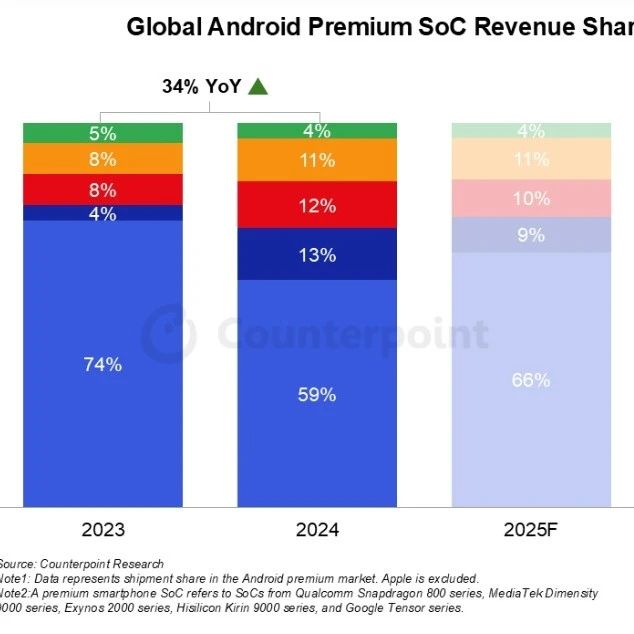
Core Viewpoint - The global high-end Android smartphone SoC revenue is projected to grow by 34% year-on-year in 2024, driven by strong consumer demand for high-end smartphones and the introduction of more powerful AI platforms [2][5]. Group 1: Market Trends - The high-end Android smartphone SoC segment is expected to account for 52% of total Android smartphone SoC revenue in 2024, indicating a significant market share [6]. - Qualcomm remains the market leader with a year-on-year growth rate of 6%, despite losing some market share to Samsung's Exynos in the Galaxy S24 series [5][6]. - MediaTek's high-end smartphone SoC revenue nearly doubled, attributed to the strong performance of the Dimensity 9300 series and the launch of Dimensity 9400 [5][7]. Group 2: Company Performances - Samsung's high-end smartphone revenue quadrupled in 2024, driven by strong sales of the Galaxy S24, but is expected to decline in 2025 due to the Galaxy S25 series not winning design awards [8]. - HiSilicon has made a strong return in the Chinese high-end market, achieving a revenue share of 12% in 2024, and is expected to maintain its position as the third-largest brand in the Android high-end market by revenue in 2025 [5][8]. - Qualcomm's exclusive partnership with Samsung for the Galaxy S25 series is expected to help it maintain its leading position in the high-end Android SoC market by 2025 [7]. Group 3: Competitive Landscape - The competition in the high-end SoC market is intensifying with the return of HiSilicon and the rise of MediaTek, which has established strategic partnerships with OEMs like vivo and OPPO [6][7]. - Qualcomm's Snapdragon 8 Elite introduces customized Oryon cores, enhancing its position in AI workload management and overall performance [7]. - MediaTek must focus on global flagship brands and developer partnerships to sustain its growth in the high-end SoC market [7].


2 Artificial Intelligence (AI) Stocks That Look Undervalued in Today's Market
The Motley Fool· 2025-05-09 15:31
Core Viewpoint - The recent tech sell-off presents both opportunities and warnings, particularly for AI stocks that are now trading at lower prices, suggesting potential for future gains as the AI revolution continues to unfold [1][2]. Group 1: Market Overview - The S&P 500 index has decreased by 9% from its all-time highs in February to May 7, while the Nasdaq Composite index has dropped by 12.7% during the same period [2]. - Many previously high-performing stocks have seen significant declines, making some AI stocks appear more affordable [3]. Group 2: Qualcomm Analysis - Qualcomm reported a 17% year-over-year increase in unadjusted sales and a 22% rise in earnings per share (EPS), surpassing analyst expectations [4]. - Despite strong headline numbers, management indicated that tariffs will constrain revenue and profit growth in the upcoming quarters, leading to an 8.9% drop in stock price following the earnings report [5]. - Qualcomm's stock is currently trading 38% below its record prices from last summer, with a valuation of 14.6 times earnings and 13.4 times free cash flow, compared to 27.0 and 26.0 for the average S&P 500 stock, indicating a significant discount [6]. - The company is diversifying its product offerings into areas like PC processors and Internet of Things sensors, with a notable growth opportunity in industrial automation [8]. - Qualcomm is viewed as a long-term investment despite current challenges, supported by a robust dividend yield of 2.5% [7][9]. Group 3: Adobe Analysis - Adobe's stock has fallen 39% from its peak in February 2024, trading at 25.4 times earnings and 17.9 times free cash flow, which is still below market averages [12]. - The company is heavily investing in AI, with numerous product announcements aimed at enhancing its content creation tools, indicating a strong focus on long-term growth [13]. - Despite potential short-term impacts from macroeconomic pressures, Adobe remains highly profitable and is expected to maintain its leadership in digital creation tools [13][14].


金十图示:2025年05月09日(周五)全球主要科技与互联网公司市值变化
news flash· 2025-05-09 03:02
Group 1 - The market capitalization of major global technology and internet companies has shown varied changes, with notable increases for companies like Tesla and Palantir [3][4][5] - Tesla's market cap reached $917.3 billion, reflecting a 3.11% increase, while TSMC's market cap was $908.7 billion, up by 0.39% [3] - Tencent's market cap increased by 3.04% to $592.8 billion, while Netflix saw a slight decline of 0.95%, bringing its market cap to $487 billion [3][4] Group 2 - Companies like Alibaba and ASML also experienced positive growth, with Alibaba's market cap at $304.8 billion (up 2.08%) and ASML at $278.3 billion (up 1.09%) [3][4] - Notable declines were observed in companies such as Arm Holdings, which dropped by 6.18% to $1.228 billion, and Uber, which fell by 1.61% to $172.1 billion [4][5] - The overall trend indicates a mixed performance across the technology sector, with some companies gaining significantly while others faced declines [3][4][5]



中国芯片上车:闯入英伟达和高通的舒适区 | 海斌访谈
Di Yi Cai Jing· 2025-05-07 07:33
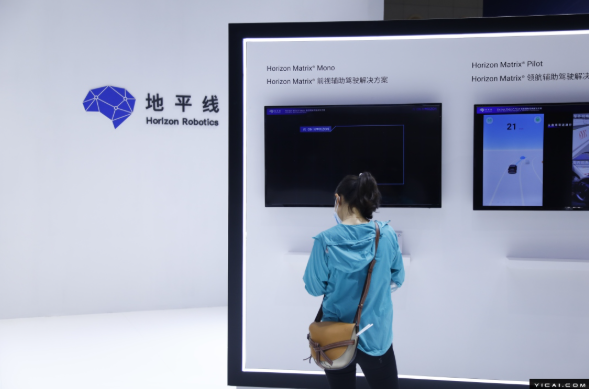
Core Viewpoint - The automotive industry is shifting towards localization in response to global market dynamics, with increasing competitiveness among domestic chip manufacturers in China [1][15]. Group 1: Collaboration and Competition - Chery Automobile and Horizon Robotics have expanded their collaboration, with plans for mass production of the Horizon SuperDrive (HSD) system in Chery's vehicles starting as early as September 2023 [5][4]. - The partnership aims to integrate Horizon's chip solutions across Chery's entire product line, including both fuel and new energy vehicles, while still utilizing NVIDIA's solutions for certain models [5][6]. - Domestic chip companies like Horizon and Black Sesame are gradually gaining market share from established players like NVIDIA, which has historically dominated the smart driving chip market in China [5][6]. Group 2: Market Dynamics and Localization - The automotive industry in China is experiencing a significant shift towards smart technology, with local manufacturers increasingly adopting domestic chip solutions to reduce reliance on foreign suppliers [6][9]. - Major suppliers like Aptiv are also working towards localizing their chip supply chains, although they acknowledge that achieving full localization remains a challenge [9][14]. - The market share of Qualcomm in the smart cockpit chip sector has increased significantly, from 65.4% to 77.0% within a year, indicating a strong competitive landscape [10]. Group 3: Strategic Responses to Geopolitical Challenges - U.S. chip companies are facing challenges in the Chinese market due to geopolitical tensions and trade disputes, prompting them to consider local production strategies [13][15]. - Companies like Texas Instruments are exploring local manufacturing options in China to mitigate risks associated with supply chain disruptions and tariffs [14][15]. - The automotive supply chain is expected to adapt to these challenges, focusing on cost adjustments rather than severe shortages, as companies enhance their local capabilities [14].

30多家半导体大厂Q1财报:谁开始好起来了?
芯世相· 2025-05-07 05:36
Core Viewpoint - The global semiconductor sales continue to grow in Q1 2025, but there is a significant performance divergence among major chip manufacturers, influenced by market and product differences, particularly in AI and storage sectors, while automotive chip manufacturers are struggling [1]. Chip Design (Including IDM) - Texas Instruments (TI) reported Q1 revenue of $4.07 billion, a year-over-year increase of 11% and a sequential increase of 2%. The company expects Q2 revenue between $4.17 billion and $4.53 billion [3]. - STMicroelectronics (ST) reported Q1 revenue of $2.52 billion, a year-over-year decline of 27.3%, with a net profit of $56 million, down 89.1% [5]. - NXP's Q1 revenue was $2.84 billion, down 9% year-over-year, with a significant decline in automotive market revenue [6]. - Qualcomm's Q1 revenue reached $10.98 billion, a year-over-year increase of 16.9%, driven by growth in mobile, automotive, and IoT sectors [8]. - MediaTek's Q1 revenue was NT$153.31 billion, up 14.9% year-over-year, exceeding operational targets due to increased market demand [9]. Semiconductor Manufacturing - TSMC's Q1 revenue was $25.53 billion, a year-over-year increase of 35.3%, with a gross margin of 58.8% [42]. - UMC reported Q1 revenue of NT$57.86 billion, a year-over-year increase of 5.9%, with a focus on 22/28nm process technology [46]. - World Advanced's Q1 revenue was NT$11.949 billion, a year-over-year increase of 24%, achieving a net profit of NT$2.414 billion [48]. Chip Distribution - WPG Holdings reported Q1 revenue of NT$248.83 billion, a year-over-year increase of 36.8%, driven by demand from AI and related sectors [58]. - Winstek Technology's Q1 revenue was NT$247.4 billion, a year-over-year increase of 28% [60]. - Arrow Electronics reported a 6% year-over-year decline in sales, totaling $5.3 billion [64]. Domestic Semiconductor Companies - Over 70% of semiconductor companies listed in A-shares reported year-over-year revenue growth in Q1 2025, with 60.63% of companies showing profit increases [35]. - Weir Shares reported a 14.68% year-over-year revenue increase in Q1, with a net profit increase of 55.25% [38]. - Zhaoyi Innovation's Q1 revenue was 1.909 billion yuan, a year-over-year increase of 17.32% [40].



金十图示:2025年05月07日(周三)全球主要科技与互联网公司市值变化



news flash· 2025-05-07 02:57
Market Capitalization Changes - Tesla's market capitalization is $902.7 billion, experiencing a decrease of 1.75% [3] - Tencent's market capitalization is $591.4 billion, with an increase of 2.03% [3] - Alibaba's market capitalization stands at $304.5 billion, showing an increase of 0.86% [3] - Palantir's market capitalization is $29.2 billion, reflecting a significant decrease of 12.05% [3] - AMD's market capitalization is $163.4 billion, with no percentage change reported [4] Notable Company Performances - Netflix's market capitalization is $48.41 billion, with a slight increase of 0.32% [3] - Shopify's market capitalization is $12.72 billion, showing a notable increase of 4.62% [4] - Uber's market capitalization is $17.94 billion, with a slight increase of 0.47% [3] - Airbnb's market capitalization is $7.70 billion, reflecting a decrease of 2.58% [5] Sector Trends - The technology sector shows mixed performance, with companies like Keyence and Adobe experiencing slight increases of 1.37% and 0.5% respectively [5][4] - Companies like Intel and AMD are showing stable market capitalizations, with Intel at $88.4 billion and AMD at $163.4 billion [4][5] - The semiconductor industry is highlighted with companies like Qualcomm and Texas Instruments showing slight increases in their market capitalizations [4]

RISC-V,席卷全球
半导体行业观察· 2025-05-07 01:46
Core Viewpoint - RISC-V architecture is an open international standard that facilitates collaboration and innovation in the semiconductor industry while enhancing the competitiveness of U.S. chip design companies [1][10]. Group 1: RISC-V Overview - RISC-V is an open standard ISA based on RISC principles, allowing chip design teams to access and implement it without licensing restrictions [6]. - The RISC-V International organization, managing RISC-V, has attracted 4,600 members from 70 countries, including major U.S. and Chinese companies [7]. Group 2: Market Position and Growth - RISC-V is gaining traction in various sectors, with over 2 billion chips currently based on its architecture, expected to grow to 20 billion by 2031 [8]. - The market revenue for RISC-V technology is projected to grow at a compound annual growth rate of 33.1% from 2022 to 2027 [12]. Group 3: Competitive Advantages - RISC-V offers a low-cost alternative to proprietary ISAs like x86 and ARM, allowing companies to customize their implementations without high licensing fees [9]. - The flexibility of RISC-V enables easier customization for performance advantages, making it attractive for both large enterprises and startups [13]. Group 4: Security and Intellectual Property - RISC-V does not require companies to disclose sensitive IP, ensuring a secure environment for collaboration and development [10]. - The open nature of RISC-V is believed to enhance security by allowing the community to identify vulnerabilities [10]. Group 5: Future Applications and Infrastructure - RISC-V is currently used in embedded technologies and has potential applications in AI, HPC, and consumer electronics [15]. - For RISC-V to become mainstream, a robust ecosystem of tools and support systems must be developed [16]. Group 6: Policy Implications and Strategic Opportunities - U.S. policymakers need to better understand RISC-V to maintain competitiveness and avoid ceding innovation to other countries [18]. - Active participation in RISC-V standard-setting is crucial for U.S. companies to influence its development and avoid fragmentation of the ecosystem [19]. Group 7: Recommendations for U.S. Leadership - The U.S. should invest in RISC-V training and education to cultivate a workforce skilled in this technology [24]. - Government support for RISC-V initiatives can accelerate its development and integration into the semiconductor ecosystem [26].




国泰海通|电子:AI手机的离线推理速度取决于内存带宽瓶颈的突破
国泰海通证券研究· 2025-05-06 15:53
Core Viewpoint - The current bottleneck in inference speed is primarily due to memory bandwidth rather than computing power, with the NPU+DRAM stacking technology showing significant improvements in memory bandwidth, indicating a clear industry trend [1][2]. Group 1: Inference Speed and Memory Bandwidth - The Qualcomm Snapdragon 8 GEN 3 has an NPU computing power of approximately 45 TOPs and a memory bandwidth of about 67 GB/s. When running a 7B large model, the calculation capability is limited to approximately 3215 tokens/s by computing power and 4.8 tokens/s by memory bandwidth, with the final speed being constrained by the lower of the two values, highlighting the significant memory bandwidth limitation [2]. - A practical test on a Xiaomi phone using the Qwen3-8B-MNN model showed a decoding speed of 222 tokens with an average response time of 32 seconds, indicating that a user-perceived inference speed should reach 40-50 tokens/s [2]. Group 2: 3D DRAM Solution - The memory limitation for edge AI can be addressed by 3D DRAM. By stacking DRAM and NPU through HB technology, if the memory bandwidth is increased to 800 GB/s, the memory limitation could rise to 57 tokens/s [3]. - Key players in this space include Chinese companies like Zhaoyi Innovation and its subsidiary Qingyun Technology, as well as Taiwanese storage IDM Winbond and mobile AP leader Qualcomm, all focusing on the 3D DRAM+NPU solution, indicating a clear technological trend [3]. Group 3: Hardware and Model Development - The current industry phase suggests that hardware is leading model development, with future growth expected to be driven by model advancements benefiting from hardware improvements. Hardware solutions require extensive stability testing before commercial deployment at scale [3]. - Qualcomm must adopt strategies suitable for AI large model devices to avoid risks associated with a potential "GPU" revolution in mobile AI by the end of 2025 or 2026, as companies prepared with the right hardware and models could experience a significant one-year window of opportunity [3].

美国芯片关税或高达100%!
国芯网· 2025-05-06 14:29
这也将对台积电、三星等产能集中在亚洲地区的晶圆制造大厂,以及NVIDIA、苹果、高通、联发科等 依赖于亚洲晶圆代工产能的芯片设计厂商带来负面影响。 今年4月14日,美国商务部下属部门工业与安全局(BIS)通过联邦公报官网宣布,根据《1962年贸易 扩展法》第"232条款"赋予的权力,对进口半导体及其衍生产品、进口药品及药用成分发起国家安全调 查,并征求公众意见。 针对进口半导体及其衍生产品的调查,主要聚焦外国补贴、供应链依赖风险、美国国内产能瓶颈等14项 调查细节,希望确定进口半导体及其衍生产品对美国国家安全的影响。 其中包括半导体基板和裸晶圆、传统芯片、尖端芯片、微电子和SME组件等产品。衍生产品包括含有 半导体的下游产品,例如构成电子供应链的产品。相关利益关系人可在5月7日结束调查前提交意见。 涵盖外国补贴、供应链依赖风险、美国国内产能瓶颈等核心议题,并希望在当地时间5月7日前征询完美 国大众意见后结束调查。这也意味着美国政府可能最快将于本周三以后公布半导体关税细节。 国芯网[原:中国半导体论坛] 振兴国产半导体产业! 不拘中国、 放眼世界 ! 关注 世界半导体论坛 ↓ ↓ ↓ 5月6日消息,美国特朗普政 ...



I Update My Buy Recommendation for Qualcomm Stock
The Motley Fool· 2025-05-06 13:30
Parkev Tatevosian, CFA has no position in any of the stocks mentioned. The Motley Fool has positions in and recommends Qualcomm. The Motley Fool has a disclosure policy. Parkev Tatevosian is an affiliate of The Motley Fool and may be compensated for promoting its services. If you choose to subscribe through his link, he will earn some extra money that supports his channel. His opinions remain his own and are unaffected by The Motley Fool. ...