Starbucks(SBUX)

Search documents
Wall Street Breakfast Podcast: Palantir's Big Gains, Bigger Drop
Seeking Alpha· 2025-11-04 11:44
Palantir Technologies (PLTR) - Palantir reported Q3 results with a revenue increase of 63% year-over-year, reaching $1.18 billion, driven by a 77% surge in U.S. revenue, including 121% growth in U.S. commercial and 52% growth in U.S. government segments [3][4] - The company closed 204 deals worth over $1 million, totaling $2.76 billion in contract value, and saw a 45% year-over-year increase in customer count [4] - Palantir raised its Q4 revenue guidance and lifted its full-year revenue outlook, along with higher forecasts for operating profit and free cash flow [4] Denny's (DENN) - Denny's will be taken private in a deal valued at approximately $620 million, including debt, with shareholders receiving $6.25 per share, representing a 52% premium to the closing stock price [5] - The acquisition is led by TriArtisan Capital Advisors, Treville Capital, and Yadav Enterprises, one of Denny's largest franchisees [5] Starbucks (SBUX) - Starbucks has agreed to sell a majority stake in its China business to Boyu Capital for an enterprise value of $4 billion, with Boyu expected to hold up to a 60% stake [6] - Starbucks anticipates that the total value of its China retail business will exceed $13 billion [6]




星巴克中国,卖了?
Xin Lang Cai Jing· 2025-11-04 11:37
Core Insights - Starbucks has announced a strategic partnership with Boyu Capital to establish a joint venture for operating its retail business in China [1][2] Group 1: Joint Venture Details - Boyu Capital will hold up to 60% equity in the joint venture, while Starbucks retains 40% and continues to own and license its brand and intellectual property [2] - The estimated total value of Starbucks' retail business in China exceeds $13 billion, comprising the equity transferred to Boyu, the retained equity value, and ongoing licensing revenue over the next decade [2] - The joint venture will be headquartered in Shanghai and manage approximately 8,000 Starbucks stores in China, with plans to expand to 20,000 stores in the future [2] Group 2: Market Potential and Strategy - Boyu Capital, founded in 2011, has a diversified investment management platform and aims to leverage its local market insights alongside Starbucks' global leadership in the coffee industry to accelerate growth [3] - Starbucks executives emphasize that this partnership will help unlock significant market potential, particularly in smaller cities and emerging regions in China [3] Group 3: Competitive Landscape - Starbucks China reported a revenue increase of 6% year-on-year to $831.6 million for the latest fiscal quarter ending September 28, 2025, and a projected annual revenue growth of 5% to $3.105 billion [4] - Despite positive growth, Starbucks faces intense competition from domestic brands like Luckin Coffee, which reported a 47% year-on-year revenue increase to $1.24 billion in Q2, along with a net profit growth of 44% [4] - Luckin Coffee continues to expand aggressively, with a total of 26,206 stores as of the end of Q2, reflecting a net increase of 2,109 stores [4]
星巴克中国易主,压力给到了瑞幸
3 6 Ke· 2025-11-04 11:24
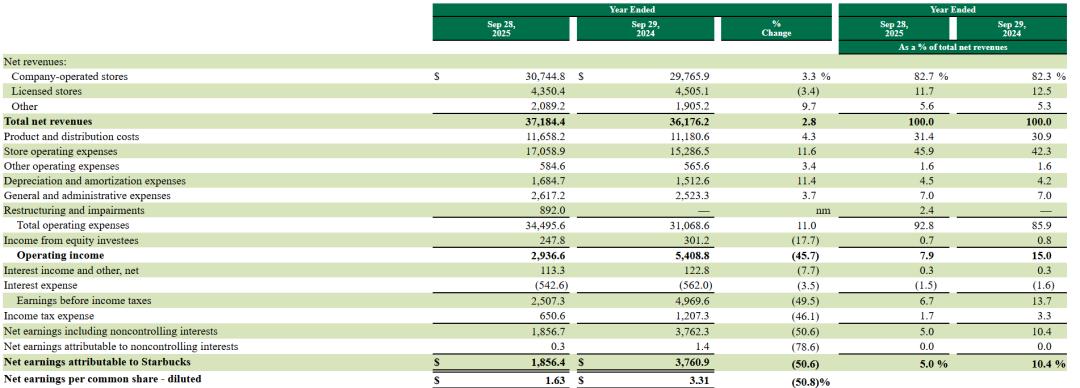
Core Viewpoint - Starbucks has officially announced a strategic partnership with Boyu Capital to establish a joint venture for operating its retail business in China, with Boyu holding up to 60% equity for approximately $4 billion, while Starbucks retains 40% [1][3]. Financial Performance - Starbucks reported a 5% year-over-year increase in global revenue for fiscal year 2025, with a notable 1% growth in same-store sales in Q4, marking the first positive growth in seven quarters [1][2]. - In fiscal year 2025, Starbucks' total revenue reached $37.18 billion, with net revenues from company-operated stores at $30.74 billion, reflecting a 3.3% increase [3]. - In China, Starbucks achieved total revenue of $3.105 billion for fiscal year 2025, a 5% increase year-over-year, with Q4 revenue at $831.6 million, up 6% [4][5]. Market Dynamics - The international segment of Starbucks performed well, with a 3% increase in same-store sales in Q4, driven by strong performances in markets like Japan, the UK, and Mexico [2]. - The Chinese market is seen as a crucial driver for overall growth, with significant contributions from product innovation, delivery service growth, and pricing optimization [4][6]. Competitive Landscape - Starbucks has engaged in aggressive pricing strategies, including a significant price reduction on several non-coffee products to compete in the "takeout war" among major delivery platforms [6][9]. - The company faces challenges from a competitive pricing environment, which may impact its premium brand positioning in China [8][9]. Operational Challenges - Despite the positive revenue growth, Starbucks' operating profit margin fell to 2.9% in Q4 from 14.4% a year earlier, primarily due to rising coffee bean prices [11]. - The company has been experiencing a decline in comparable store sales, with a 1% decrease attributed to a 5% drop in average transaction value [14]. Future Outlook - Starbucks aims to expand its store count in China to 20,000, focusing on lower-tier cities to capture a broader customer base [13]. - The company has entered 1,091 county-level markets in China, with a total of 8,011 stores, indicating a strategy to penetrate deeper into the market [14].
剑指20000家店,博裕资本控股星巴克中国,上半年“扫货”北京SKP、入股蜜雪冰城
3 6 Ke· 2025-11-04 11:19
Core Insights - Starbucks has established a strategic partnership with Boyu Capital to form a joint venture for its retail operations in China, marking a significant development in its 26-year history in the market [1][3][12] - Boyu Capital will hold up to 60% of the joint venture, while Starbucks retains 40% and continues to own the brand and intellectual property [1][3] - The total value of Starbucks' retail business in China is projected to exceed $13 billion, comprising the value from the joint venture, retained equity, and ongoing licensing revenue [1][3] Company Overview - The joint venture will be headquartered in Shanghai and aims to expand Starbucks' store count in China from 8,000 to 20,000 [3][12] - Starbucks' CEO Brian Niccol emphasized the importance of Boyu's local market expertise in accelerating growth, particularly in smaller cities and emerging regions [3][4] - Boyu Capital, founded in 2011, has a diverse investment portfolio and has previously invested in notable companies such as Alibaba and NetEase [5][9] Market Context - Starbucks reported a net revenue of 22 billion RMB in China for the fiscal year 2025, reflecting a nearly 5% growth, with same-store sales increasing by 2% and transaction volume by 9% in the fourth quarter [11][12] - The partnership is seen as a strategic move to enhance Starbucks' local market presence and adapt to the competitive coffee beverage landscape in China [12][13] - Historical precedents from other companies like Yum China and McDonald's China illustrate the potential benefits of local partnerships in accelerating market expansion [13]
以60%股权,换一个更懂中国的星巴克
Mei Ri Jing Ji Xin Wen· 2025-11-04 10:59
Core Insights - Starbucks has made a significant strategic decision by forming a joint venture with local capital, Boyu Capital, and relinquishing up to 60% of its controlling stake in China, marking a pivotal shift in its operational strategy in the Chinese market [2][3] - The move reflects a broader trend where multinational brands must deeply localize their operations to remain competitive in China, as evidenced by the aggressive pricing strategies of local competitors [2][4] Group 1: Strategic Shift - The relinquishment of operational control indicates Starbucks' recognition that local insights are more valuable than its global brand prestige in the current Chinese market [3][4] - Boyu Capital's involvement is not just about financial investment; it brings deep understanding and resources for expanding into smaller cities and emerging regions, which is a key focus for Starbucks moving forward [3][4] Group 2: Market Dynamics - The Chinese coffee market is undergoing a price reshuffle, with competitors offering significantly lower prices, challenging Starbucks' previous brand premium [2][4] - Starbucks aims to adapt its product, pricing, and marketing strategies to cater to the diverse consumer base across different regions in China, which presents a core challenge for the company [4][6] Group 3: Future Expansion Plans - The joint venture aims to expand Starbucks' store count in China from 8,000 to 20,000, highlighting the importance of the Chinese market in Starbucks' global strategy [5] - The potential shift to a franchise model could allow for rapid expansion while maintaining brand integrity and quality control, as Starbucks retains ownership of its brand and intellectual property [5][6] Group 4: Consumer Experience - The essence of competition in the coffee market will ultimately return to consumer experience, necessitating continuous product innovation and enhanced customer engagement to secure long-term loyalty [6]
每经热评︱以60%股权,换一个更懂中国的星巴克
Mei Ri Jing Ji Xin Wen· 2025-11-04 10:51
Core Insights - Starbucks has made a significant strategic decision by introducing local capital through a joint venture with Boyu Capital, relinquishing up to 60% of its controlling stake, marking a pivotal shift in its approach to the Chinese market [1][2] - The current coffee market in China is undergoing unprecedented price competition, with prices dropping to as low as 2.9 yuan per cup, challenging Starbucks' previous brand premium [1][2] - The move towards local partnerships reflects a broader trend where multinational brands must deeply localize their operations to thrive in the increasingly competitive Chinese market [3][4] Company Strategy - By ceding operational control, Starbucks aims for long-term survival and growth in China, recognizing that local insights are more valuable than global brand prestige in the current market [2][3] - Boyu Capital's involvement is not just about financial investment; it brings deep understanding and resources for expanding into smaller cities and emerging regions, indicating a strategic shift towards these markets [2][3] - Starbucks plans to expand its store count in China from 8,000 to 20,000, highlighting the importance of the Chinese market in its global strategy [4] Market Dynamics - The diverse consumer landscape in China presents challenges for Starbucks in maintaining brand identity while localizing products, pricing, and marketing strategies [3][4] - The competitive environment necessitates a balance between brand value, profitability, and rapid expansion, especially in the face of aggressive pricing strategies from local competitors [4][5] - The evolving rules of engagement for multinational companies in China emphasize the need for comprehensive localization, extending beyond product development to include ownership structures and decision-making processes [3][4] Future Outlook - Starbucks' strategy may include a franchising model in the future, allowing for rapid expansion while maintaining control over brand standards and quality [4] - The partnership with Boyu Capital is expected to enhance innovation and localized consumer experiences, which are crucial for maintaining market position as consumer preferences evolve [5] - The case of Starbucks in China serves as a reference point for other multinational brands navigating the complexities of the Chinese market [5]
星巴克中国易主,未来将再开1.2万家店
Hua Er Jie Jian Wen· 2025-11-04 10:35
Core Insights - Starbucks has announced a strategic partnership with Chinese alternative asset management firm Boyu Capital to establish a joint venture for its retail operations in China, marking the first time in 26 years that Starbucks has relinquished control of its Chinese business [2][6] - Boyu Capital will hold up to 60% of the joint venture, investing approximately $2.4 billion (about 173 billion RMB), while Starbucks retains 40% ownership and continues to own the brand and intellectual property [2][3] - The joint venture aims to expand Starbucks' store count in China from 8,000 to 20,000, with a current valuation of over $13 billion for Starbucks' retail business in China [3][5] Company Strategy - The partnership is seen as a strategic adjustment for Starbucks in response to increasing competition from local brands like Luckin Coffee and CoCo [6][10] - Starbucks' CEO Brian Niccol emphasized the need for a fundamental change in strategy to restore growth, particularly in the face of declining global comparable store sales [4][6] - The collaboration allows Starbucks to gain significant cash flow while still benefiting from future growth in the Chinese market through retained equity and ongoing licensing fees [6][10] Market Performance - Starbucks China reported a revenue of $831.6 million for Q4 of fiscal year 2025, a 6% year-over-year increase, marking four consecutive quarters of growth [5] - For the full fiscal year 2025, Starbucks China achieved a total revenue of $3.105 billion, reflecting a 5% increase, which is higher than the global average growth rate [5] - The joint venture comes at a time when Starbucks is experiencing a divergence in performance between its global and Chinese markets [4][5] Competitive Landscape - The deal attracted interest from over 20 capital firms and business giants, indicating a competitive environment for Starbucks' Chinese operations [7][8] - Boyu Capital's expertise in local market operations is expected to accelerate Starbucks' expansion, particularly in lower-tier cities [8][9] - The historical performance of Boyu Capital, with a net internal rate of return exceeding 25%, positions it as a strong partner for Starbucks in navigating the competitive landscape [9] Historical Context - This partnership is part of a broader trend where foreign brands in China seek local partnerships to enhance market penetration, similar to past collaborations like McDonald's with CITIC and Coca-Cola with COFCO [10] - The establishment of the joint venture signifies a new phase for Starbucks in China, referred to as the "2.0 era," aiming to unlock significant market potential [10]

博裕资本拿下星巴克中国60%股份 专家:资本加持下开2万家店并不难 或将是星巴克破局最好机会
Di Yi Cai Jing· 2025-11-04 10:25
Core Viewpoint - Starbucks has finalized a deal with Boyu Capital, which will acquire up to 60% of Starbucks' business in China, marking a significant shift in the company's strategy in the competitive Chinese coffee market [1] Group 1: Company Strategy - The partnership with Boyu Capital is viewed positively by Starbucks, indicating a strategic move to enhance its market position in China [1] - The collaboration is expected to provide the necessary capital to support Starbucks' ambitious expansion plans, including the opening of 20,000 new stores in the future [1] Group 2: Market Context - The deal comes in response to increasing competition in the domestic coffee market, suggesting that Starbucks is seeking to leverage external investment to navigate these challenges [1] - The involvement of Boyu Capital is seen as a potential turning point for Starbucks in China, providing a pathway to overcome competitive pressures [1]
Starbucks sells majority stake in China business for $4B
Yahoo Finance· 2025-11-04 10:17
This story was originally published on Restaurant Dive. To receive daily news and insights, subscribe to our free daily Restaurant Dive newsletter. Dive Brief: Starbucks sold a majority stake of its China business to Boyu Capital for $4 billion as it plans to form a joint venture managing operations in the country, the company said in a Monday press release. Boyu will acquire a 60% stake in the business while Starbucks will retain 40% and continue to own and license the brand and intellectual property ...
在华零售业务“交权”,一个更本土的星巴克要来了:下沉战场成焦点
Sou Hu Cai Jing· 2025-11-04 10:11
Core Insights - Starbucks has entered a strategic partnership with alternative asset management firm Boyu Capital to establish a joint venture for its retail operations in China, marking a significant capital restructuring since its entry into the Chinese market 26 years ago [2][3] - The joint venture will allow Boyu to hold up to 60% equity, while Starbucks retains 40% and continues to own and license its brand and intellectual property [3] - The partnership aims to expand Starbucks' store count in China from approximately 8,000 to 20,000, reflecting a new strategic focus on deepening its market presence [3][6] Retail Business Control - The core of the transaction is the transfer of control over Starbucks' retail business in China to Boyu, which will manage the joint venture [3] - The estimated enterprise value of the retail business is around $4 billion, excluding cash and debt, with Starbucks' retail business in China valued at over $13 billion [3] - The joint venture will be headquartered in Shanghai and will manage Starbucks' existing stores while pursuing aggressive expansion [3][6] Market Competition - The Chinese coffee market is becoming increasingly competitive, with local brands like Luckin Coffee rapidly gaining market share through lower price points and faster expansion [4][7] - Starbucks aims to maintain its high-end brand positioning and avoid price wars that could dilute its brand value, emphasizing the importance of its "third space" experience [4][5] - The partnership with Boyu is seen as crucial for navigating the competitive landscape, particularly in lower-tier cities where local brands are expanding aggressively [6][8] Expansion Strategy - Starbucks has reported steady growth in its Chinese operations, with revenues reaching $3.105 billion in the fiscal year 2025, a 5% year-on-year increase [6] - The company opened 183 new stores in the fourth fiscal quarter and entered 47 new county-level markets, with a total of 415 new stores for the fiscal year [6] - The focus on lower-tier markets is expected to drive future growth, with a projected CAGR of 24.7% for coffee shops in third-tier cities and below from 2023 to 2028 [7][8] Operational Challenges - Starbucks faces challenges in balancing its high-end brand identity with the need to adapt to local market conditions, particularly in terms of operational costs in lower-tier cities [8] - Suggestions for overcoming these challenges include developing smaller, more cost-effective store formats and potentially launching independent brands to capture market share in lower-tier markets [8]