Seek .(SKLTY)

Search documents
DeepSeek发布的这串符号,对国产芯片意味着什么
2 1 Shi Ji Jing Ji Bao Dao· 2025-09-02 15:36
Core Insights - The term "UE8M0 FP8" refers to a new model format specifically designed for the next generation of domestic chips in China, which has generated significant excitement in the capital market [2][8] - This format is seen as a strategic innovation to address the limitations of domestic chip technology and to build a more autonomous ecosystem in the AI and computing sectors [9][10] Technical Explanation - "FP" stands for "floating point," a fundamental unit in binary computing, with "FP8" representing 8-bit floating point. This format is suitable for applications like graphics processing, scientific computing, and deep learning [5][6] - "UE8M0" is designed to achieve a data range similar to FP32 while being faster, albeit at the cost of precision. It simplifies calculations to reduce computational load, making it more suitable for domestic chip manufacturers [6][9] Market Implications - The adoption of "UE8M0 FP8" is driven by the need for domestic chips to improve their performance in terms of manufacturing processes, speed, and power consumption, as they currently lag behind international standards [9][10] - The format is expected to facilitate the development of a new ecosystem for domestic chips, moving away from reliance on NVIDIA's CUDA ecosystem, which has historically dominated the AI field [9][10] Industry Developments - Following the release of DeepSeek V3.1, the stock price of domestic AI chip company Cambricon surged by 110% in August, indicating strong market interest in the new technology [12] - Companies like Alibaba are also entering the AI chip market, although it remains unclear if they will adopt the FP8 parameter format [12] Future Considerations - While "UE8M0 FP8" shows promise, there are uncertainties regarding its application in high-precision tasks, such as humanoid robotics and native Chinese language models [12][13] - Experts believe that domestic chips will ultimately succeed if they can demonstrate competitive performance advantages [13]




DeepSeek的一串“符号”背后:对国产芯片意味着什么?
2 1 Shi Ji Jing Ji Bao Dao· 2025-09-02 13:44
Core Viewpoint - The introduction of "UE8M0 FP8" represents a significant advancement in the domestic chip design tailored for the Chinese market, aiming to enhance computational efficiency and stability in AI applications, particularly in the context of the DeepSeek V3.1 model release [1][4][8]. Group 1: Understanding "UE8M0 FP8" - "FP" stands for "floating point," a fundamental unit in binary computing, with "FP8" indicating an 8-bit floating point format, which is suitable for various applications including graphics processing and deep learning [2]. - "UE8M0 FP8" signifies a parameter format with unsigned 8-bit exponent and 0-bit mantissa, allowing for a data range comparable to FP32 while being more efficient [3]. - The format sacrifices some precision for improved global stability, making it particularly suitable for AI models that rely on extensive floating-point ranges [3]. Group 2: Suitability for Domestic Chips - "UE8M0 FP8" is designed to be compatible with domestic chip manufacturers, addressing the current limitations in technology and performance in the Chinese chip industry [4][5]. - The format simplifies calculations, reducing computational load significantly, which is crucial given the existing gaps in advanced manufacturing processes compared to international standards [5]. - As an open-source format, "UE8M0" could help rebuild the ecosystem for domestic chips, which have historically been constrained by the dominance of NVIDIA's CUDA ecosystem [5][6]. Group 3: Market Impact and Future Prospects - Following the release of DeepSeek V3.1, companies like Cambricon have seen significant stock price increases, indicating strong market interest in chips that support FP8 calculations [8]. - The future of "UE8M0 FP8" in the market remains uncertain, with various companies yet to confirm their adoption of this mixed-parameter model [8]. - Experts believe that domestic chip manufacturers will ultimately succeed, provided they can achieve competitive performance advantages [9].
B站、微信、抖音、DeepSeek等接连公告
Nan Fang Du Shi Bao· 2025-09-02 10:47
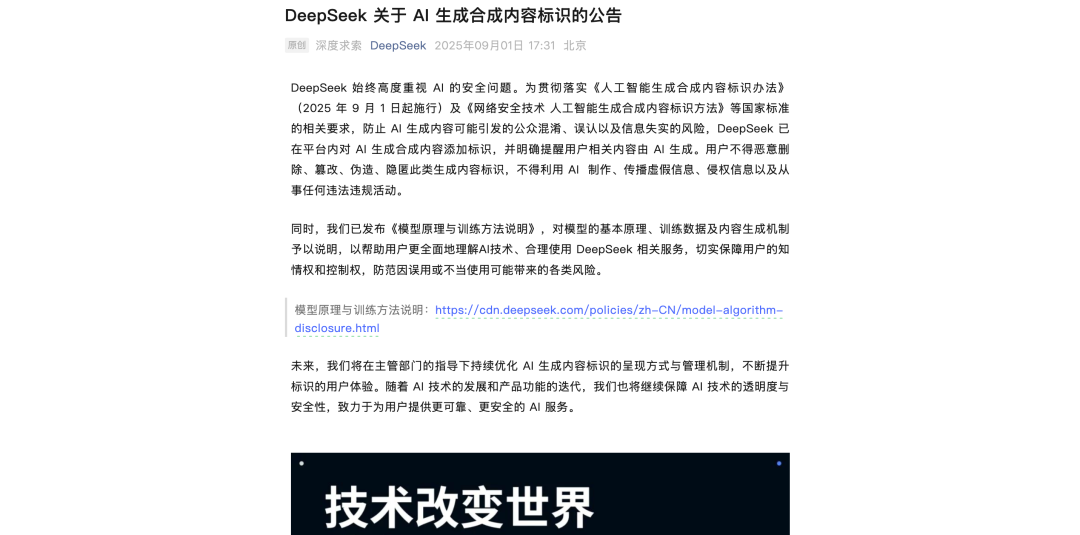
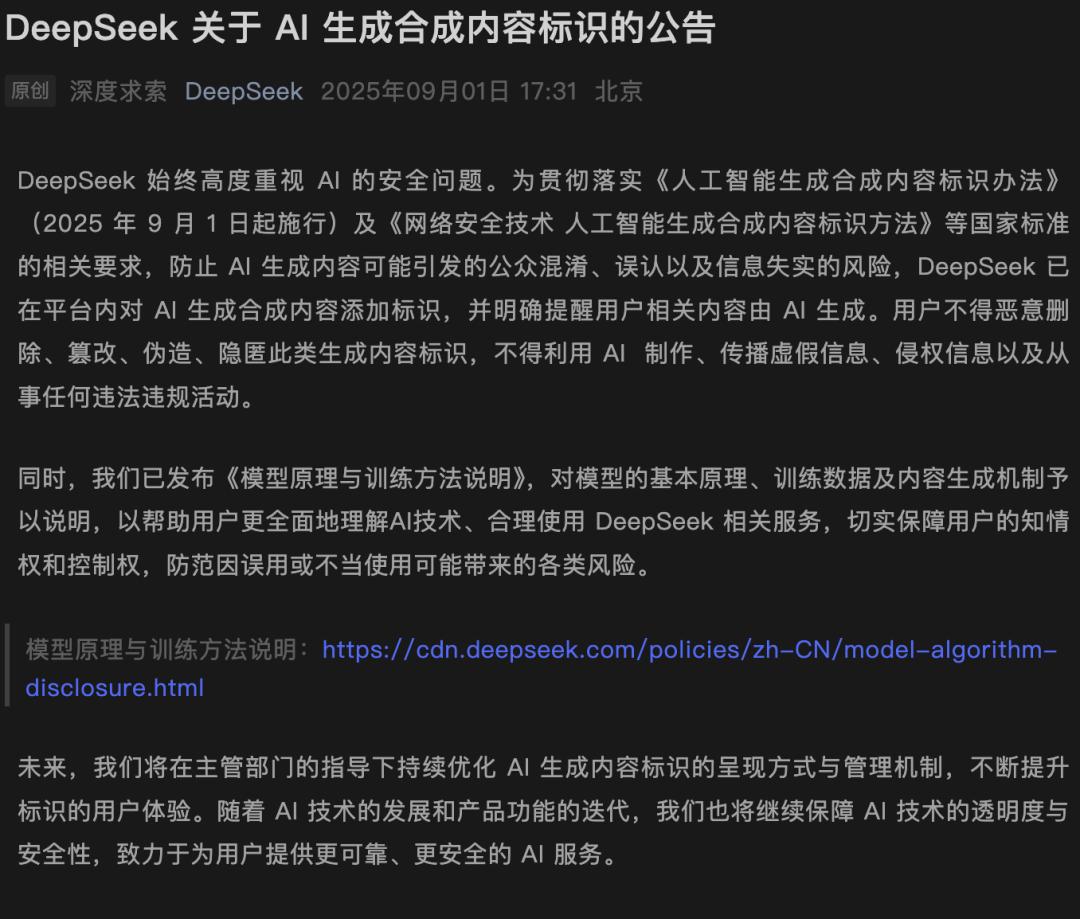
Core Points - The "Regulations on the Identification of AI-Generated Synthetic Content" officially took effect on September 1, requiring explicit and implicit identification of AI-generated content [1][2] - Major platforms such as DeepSeek, Douyin, WeChat, and Bilibili have announced measures to comply with these regulations, implementing identification features for AI-generated content [1][2] Group 1 - DeepSeek has added identification for AI-generated content on its platform, warning users against maliciously altering or hiding these identifiers [1] - Douyin has launched two key features: an AI content identification function to assist creators in labeling AI content and an AI content metadata identification function for content traceability [2] - WeChat and Bilibili are also implementing identification measures for AI-generated content, ensuring users can clearly distinguish such content [2][3] Group 2 - Douyin will verify and detect unmarked AI content, adding explicit identifiers where necessary, and will also provide implicit identifiers containing key information for content management [2] - Bilibili has introduced an identification option for creators to declare AI-generated content, with the platform ensuring compliance with legal requirements for unmarked content [2] - Previous investigations have highlighted issues with AI-generated content being used for misinformation and fraudulent activities, indicating ongoing challenges in content regulation [3]
DeepSeek等大模型集体“打标”,从此告别AI造假?
Hu Xiu· 2025-09-02 09:12
Core Viewpoint - The implementation of the "AI-generated content identification method" aims to ensure that all AI-generated content is clearly marked, enhancing transparency and protecting users from misinformation [7][30][51]. Group 1: Regulatory Developments - On September 1, the "Identification Method for AI-generated Synthetic Content" officially took effect, requiring all AI-generated content to be clearly identified [7]. - Major AI model companies, including Tencent and ByteDance, have updated their user agreements to comply with the new identification requirements [4]. - The regulation mandates that AIGC service providers, platforms, and users must adhere to both explicit and implicit identification of AI content [8][9][10]. Group 2: Impact on Users - The introduction of AI content identification is seen as a protective measure for users, particularly those with limited ability to discern AI-generated content from real content [30]. - There are concerns that even tech-savvy individuals may struggle to differentiate between AI-generated and real videos, leading to potential misinformation [41][49]. - Examples of misinformation due to AI content include elderly individuals being misled by AI-generated videos, highlighting the need for clear identification [23][24][30]. Group 3: Industry Response - Various internet platforms, such as Bilibili and Douyin, have introduced features allowing users to declare AI content, aligning with the new regulations [12]. - The AI content landscape is rapidly evolving, with a significant increase in AI-generated videos, raising concerns about the impact on human creators and the authenticity of content [61][80]. - The creator economy is projected to grow significantly, with AI-generated content becoming a substantial part of the market, indicating a shift in content creation dynamics [80].
DeepSeek 等大模型集体“打标”,从此告别 AI 造假?
3 6 Ke· 2025-09-02 08:00
Core Viewpoint - The implementation of the "AI-generated content identification method" aims to ensure that all AI-generated content is clearly marked, enhancing transparency and protecting users from misinformation [7][18][45]. Group 1: Regulatory Developments - On September 1, the "Identification Method for AI-generated Synthetic Content" officially took effect, requiring all AI-generated content to be clearly identified [7]. - Major AI model companies, including Tencent and ByteDance, have updated their user agreements to comply with the new identification requirements [4]. - The regulation mandates that AI content creators, platforms, and users must adhere to explicit and implicit labeling of AI-generated content [7]. Group 2: Industry Response - Various internet platforms, such as Bilibili, Douyin, and Kuaishou, have introduced features allowing users to declare AI content, accompanied by platform identification [8]. - The rise of AI content has led to concerns about its authenticity, with users increasingly unable to distinguish between real and AI-generated content [9][28]. Group 3: User Impact and Concerns - The proliferation of AI content has raised alarms, particularly among vulnerable groups like the elderly, who may be easily misled by AI-generated materials [18]. - Examples of misinformation include elderly individuals believing in AI-generated videos that misrepresent reality, leading to potential emotional and financial consequences [14][15]. - Young users also face challenges, as they may become victims of AI-generated content, such as manipulated videos used for social pressure [19][24]. Group 4: Global Context - The regulatory approach in China is noted to be more stringent compared to other countries, with similar initiatives emerging in South Korea and Spain, while the EU is working on a broader AI regulation [33][35]. - The lack of federal regulations in the U.S. contrasts with the mandatory measures in China, raising questions about the effectiveness of voluntary compliance by tech companies [33][40]. Group 5: Market Trends - The creator economy, including AI-generated content, is projected to grow significantly, with estimates suggesting it could reach $25 billion by 2025, up from $16.4 billion in 2022 [44]. - Despite the growth of AI content, human creators still earn significantly more, with AI influencers earning only 46% of what human influencers make [44].
抖音微信B站DeepSeek等上线AI标识!部分严禁篡改
Nan Fang Du Shi Bao· 2025-09-02 03:48
Core Viewpoint - The implementation of the "Artificial Intelligence Generated Synthetic Content Identification Measures" began on September 1, requiring explicit and implicit identification of AI-generated synthetic content across various platforms [1][4]. Group 1: Regulatory Compliance - DeepSeek has announced the addition of identification labels for AI-generated content on its platform to prevent public confusion and misinformation [4]. - Douyin has launched two core features: an AI content identification function to assist creators in labeling AI content, and an AI content metadata identification function for content traceability [4][5]. - WeChat has indicated that AI-generated content accessed through its platform may carry explicit or implicit labels to help users identify such content [5]. - Bilibili has upgraded its content governance capabilities to comply with the new regulations, providing options for creators to label AI-generated content [5]. Group 2: User Responsibilities - Users on Douyin must actively add explicit labels when creating or publishing AI content, and Douyin will verify and supplement labels for suspected AI-generated content [5]. - Users are prohibited from maliciously deleting, altering, or concealing identification labels for AI-generated content across platforms [4][5]. Group 3: Industry Concerns - Previous investigations have revealed illegal activities involving AI-generated content, such as deep forgery and misleading practices for profit [6].



刚刚,DeepSeek最新发文,V3/R1训练细节全公开,信息量巨大
3 6 Ke· 2025-09-01 12:06
Core Viewpoint - DeepSeek has proactively responded to the new regulations by marking all AI-generated content with an "AI-generated" label and has disclosed details about its V3/R1 model training process following the implementation of the "Identification Measures for AI-Generated Synthetic Content" by the Cyberspace Administration of China [1][2]. Group 1: Compliance with New Regulations - DeepSeek has announced that all AI-generated content will be clearly labeled as "AI-generated" to comply with the new regulations [2]. - The company has emphasized that users are strictly prohibited from maliciously deleting, altering, or concealing these labels, and from using AI to spread or create false information [2]. Group 2: Technical Disclosure - DeepSeek has released a document titled "Model Principles and Training Methods," providing insights into its technical approach [4]. - The training process of DeepSeek's models is divided into pre-training and optimization training phases, which include various stages such as data collection and model fine-tuning [6][17]. Group 3: Model Training Details - The latest DeepSeek V3-0324 model has a total parameter count of 685 billion, with parameters optimized through gradient descent during training [15]. - During the pre-training phase, the model learns general language understanding and generation capabilities using publicly available internet data and licensed third-party data, while ensuring no personal information is intentionally used [21]. - The optimization training phase involves constructing and annotating question-answer pairs, with some data potentially based on user input, while ensuring data privacy through encryption and anonymization [22][23]. Group 4: Model Deployment and Functionality - Once training is complete, the model enters the inference phase, where it can generate text and perform various tasks based on user input [25]. - DeepSeek has emphasized that the model does not store original training data but generates responses based on a deep understanding of language structure and semantics [27]. - The company has made its models open-source, allowing users to freely download and deploy them under a permissive MIT license [28]. Group 5: Addressing Limitations and Risks - DeepSeek acknowledges the limitations of AI, including the phenomenon known as "hallucination," where AI may generate incorrect or misleading content [30][31]. - The company is implementing various technical measures to reduce the hallucination rate, including high-quality training data and alignment strategies, although complete elimination is not currently feasible [32]. - DeepSeek has established internal risk management protocols and user rights, allowing users to opt-out of data usage for model training and delete their historical data [37][38].
DeepSeek-V3.1适配下一代国产芯片引爆市场,大模型这次和哪些国产芯一起“自主可控”?
3 6 Ke· 2025-09-01 11:37
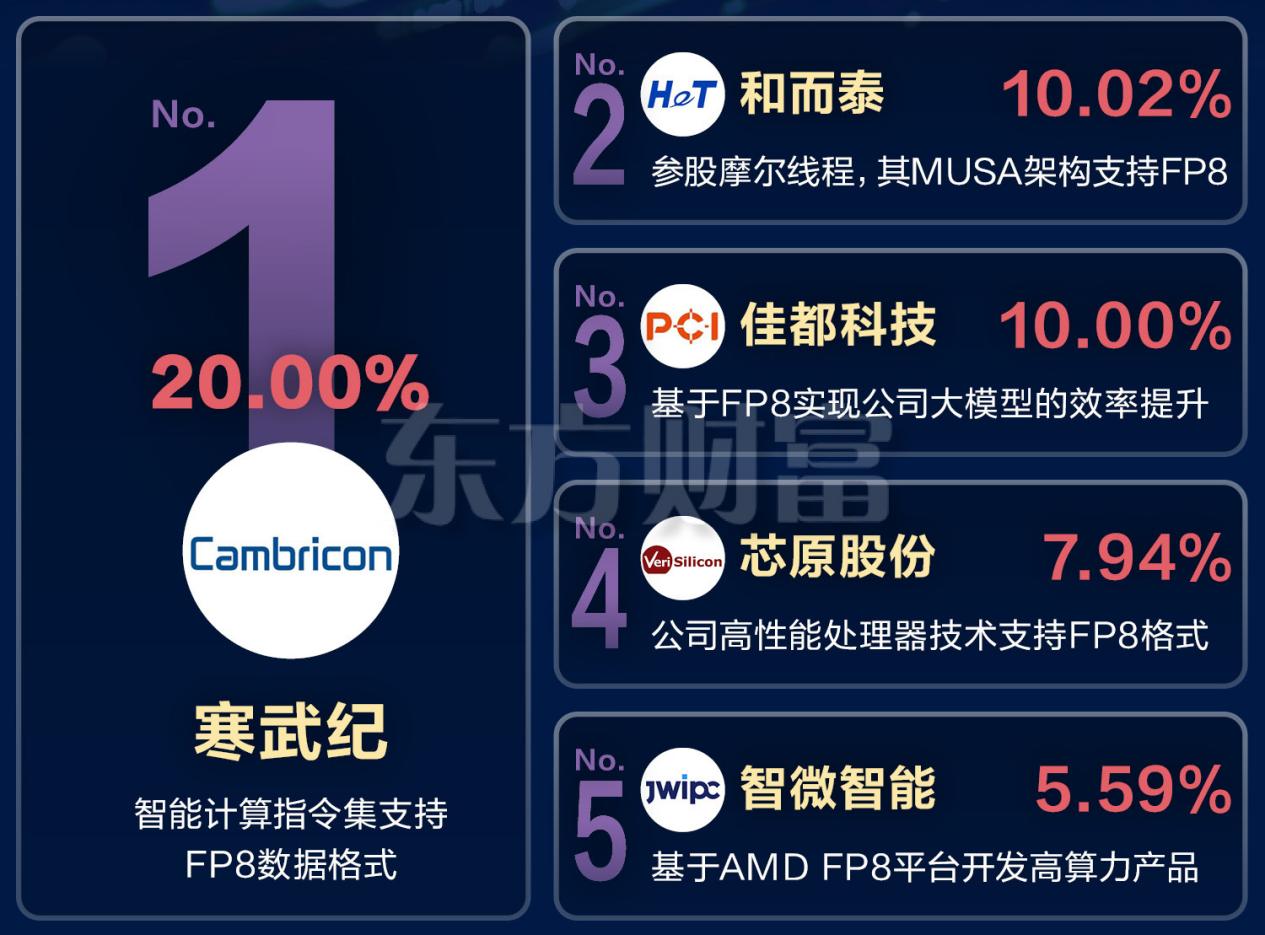
Core Insights - DeepSeek officially launched DeepSeek-V3.1 on August 21, featuring a hybrid reasoning architecture, improved thinking efficiency, and enhanced agent capabilities [1] - The release sparked significant market activity, with FP8 concept stocks surging, including companies like Cambricon, Hezhong Technology, and Jiadu Technology [1] Group 1: DeepSeek-V3.1 Features - The hybrid reasoning architecture allows the model to support both thinking and non-thinking modes [1] - DeepSeek-V3.1-Think demonstrates higher efficiency, providing answers in a shorter time compared to its predecessor, DeepSeek-R1-0528 [1] - Enhanced agent capabilities are achieved through post-training optimization, improving performance in tool usage and agent tasks [1] Group 2: FP8 and UE8M0 FP8 - FP8, or Floating-Point 8, is a format that uses 8 bits to balance range and precision, with the introduction of UE8M0 FP8 specifically designed for upcoming domestic chips [4][8] - UE8M0 FP8 prioritizes dynamic range while sacrificing some precision, making it suitable for stable training on non-NVIDIA architectures [22] - The shift to FP8 is driven by the need for lower precision formats to reduce memory usage and improve computational speed, especially in AI applications [9][15] Group 3: Market Impact and Collaboration - The announcement of DeepSeek-V3.1 and its FP8 capabilities led to a surge in interest from domestic chip manufacturers, indicating a collaborative effort between model developers and chip manufacturers [17][22] - The compatibility of UE8M0 FP8 with domestic chips is seen as a strategic move to enhance the stability and efficiency of AI model training in the context of export restrictions on NVIDIA technology [22] - The collaboration aims to establish a robust FP8 ecosystem within China, facilitating the development of AI infrastructure independent of foreign technology [22][23]


DeepSeek公告:强化AI内容标识,防止信息误导
Xin Lang Ke Ji· 2025-09-01 09:45
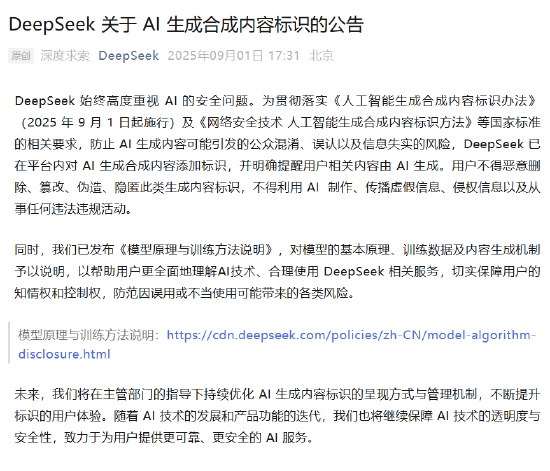
Group 1 - DeepSeek announced the implementation of content identification for AI-generated synthetic content to comply with national standards effective from September 1, 2025 [1] - The platform has added labels to AI-generated content to prevent public confusion and misinformation, and users are prohibited from maliciously deleting or altering these labels [1] - DeepSeek released a document detailing the principles and training methods of its AI models to ensure user awareness and control, aiming to mitigate risks associated with misuse [1] Group 2 - The company plans to continue optimizing its labeling mechanism to enhance user experience and provide more reliable and secure AI services [1]
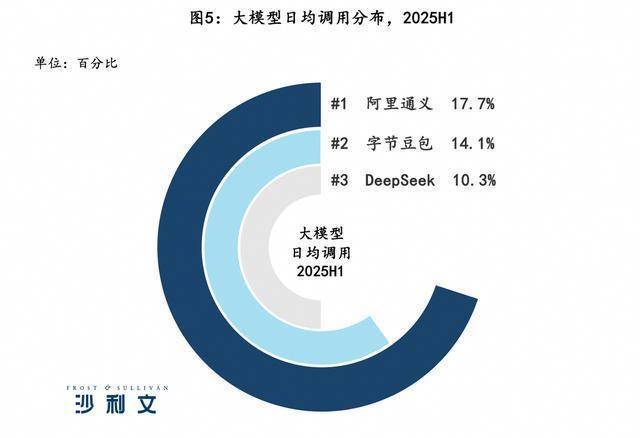
中国企业大模型日均调用量破10万亿Tokens,通义豆包DeepSeek领跑市场
Sou Hu Cai Jing· 2025-09-01 09:05
Core Insights - The Frost & Sullivan report highlights the rapid growth and adoption of generative AI in the Chinese enterprise market, with an astonishing daily consumption of 10.2 trillion tokens expected by the first half of 2025 [1] - The report indicates a significant increase of 363% in daily model invocation compared to the second half of 2024, surpassing the 10 trillion tokens mark [1] - Leading platforms in this market include Alibaba Tongyi, ByteDance Doubao, and DeepSeek, which collectively hold over 40% market share [1] Industry Trends - Public cloud has emerged as the preferred method for Chinese enterprises to deploy and invoke large models, with 70% of companies favoring this approach [3] - A notable 71% of enterprises plan to further increase their use of generative AI services in public cloud environments, indicating a shift towards seeking optimal solutions for specific business scenarios [3] - The rise of open-source models is becoming a key driver for market growth, with a significant reduction in performance gaps between domestic open-source models and top international closed-source models [3] Future Projections - It is predicted that over 80% of enterprises will adopt open-source large models, suggesting that open-source solutions will dominate enterprise-level applications in the future [3]