TSMC(TSM)

Search documents
日本搞2nm,比登月还难
半导体行业观察· 2025-12-06 03:06
Core Viewpoint - Rapidus, a newly established semiconductor manufacturer in Japan, aims to challenge TSMC's dominance by producing advanced 2nm chips, a task likened to the Apollo moon landing in terms of difficulty and significance for Japan's technological future [1][2]. Group 1: Rapidus' Ambitions and Challenges - Rapidus was founded only three years ago and seeks to leap directly to the production of 2nm logic chips, a move that raises skepticism due to the complexity and cost of the technology involved [1]. - If successful, this endeavor could significantly alter the trajectory of Japan's technology industry, which currently relies heavily on TSMC for advanced chip manufacturing [1]. - The Japanese government is increasingly aware of the risks associated with relying on Taiwan for critical chip production, prompting a push to rebuild domestic manufacturing capabilities [2]. Group 2: Supply Chain and Talent Issues - Rapidus faces significant challenges, including an insufficient supply chain, as TSMC has built a comprehensive local supply chain over decades, while Japan still needs to integrate a complete ecosystem [2]. - There is a projected shortage of at least 40,000 semiconductor engineers in Japan over the next decade, highlighting a critical talent gap that needs to be addressed [2][3]. Group 3: Building Support and Future Prospects - Gaining public support is crucial for Rapidus, as TSMC is viewed as a national symbol in Taiwan, while Rapidus must establish a clear political and national security narrative to justify substantial public investment [3]. - The article emphasizes that Japan's ability to capitalize on the current technological wave will determine its future in the semiconductor industry, with the potential for significant consequences if it fails to act [3].


中国大陆IC设计市占率,超越中国台湾
半导体行业观察· 2025-12-06 03:06
Group 1 - The core viewpoint of the article highlights the significant growth of the global semiconductor market, projected to reach $889 billion by 2026, driven by AI advancements and major players like NVIDIA and AMD [1] - IDC forecasts that by 2026, China's IC design market share will expand to approximately 45%, surpassing Taiwan's expected 40%, marking a shift in the competitive landscape [1] - The rapid expansion of China's IC design sector is attributed to domestic semiconductor policies and a strong internal market, with companies like Cambricon seeing increased AI chip shipments [1] Group 2 - Despite competitive pressures, Taiwan's critical position in the global semiconductor supply chain remains unchanged, with TSMC expected to achieve a revenue growth rate of 22% to 26% by 2026 [2] - The global wafer foundry market is projected to grow by about 20% by 2026, with TSMC maintaining a dominant market share of approximately 73% [2] - Taiwan's packaging and testing industry is anticipated to experience a compound annual growth rate of about 9.1% from this year to 2029, driven by strong AI orders [2]
IDC:晶圆代工市场明年估成长2成 台积电市占73.1%
Jing Ji Ri Bao· 2025-12-05 23:37
Core Insights - The global wafer foundry market is expected to grow by 20% next year, primarily driven by TSMC, which is projected to see revenue growth of 22% to 26%, while other companies will only see growth of 6% to 10%, indicating a trend of "the big get bigger" [1] - The global semiconductor market is anticipated to grow by 11% by 2026, reaching a size of $890 billion, with the potential to challenge the $1 trillion mark by 2028 [1] - The computing market is expected to grow by 18% by 2026, making it the largest growth area in the semiconductor sector, accounting for 46% of the overall semiconductor market [1] Group 1: Wafer Foundry Market - TSMC's market share is projected to reach 73.1% [1] - Other foundries are expected to grow at a rate of 6% to 10% [1] Group 2: Semiconductor Applications - The AI accelerator market is expected to surge by 78%, while application-specific integrated circuits (ASICs) may see a growth of 113%, surpassing the 66% growth of graphics processing units (GPUs) [1] - The global foundry market, including traditional foundry and non-memory integrated device manufacturing (IDM), is expected to grow by approximately 14% by 2026 [2] Group 3: Mature Process and Capacity Utilization - After two years of adjustment, mature process capacity utilization is expected to stabilize above 80% by 2026, supported by strong demand for high-speed transmission chips and efficient power management chips [2] - Chinese manufacturers are expected to exceed 90% capacity utilization due to domestic substitution policies [2] Group 4: IC Design and Market Trends - China's IC design output is projected to surpass Taiwan's by 2025, becoming the leader in the Asia-Pacific region [2] - The Asia-Pacific IC design market is expected to grow by 11% by 2026, with China's market share anticipated to expand to 45% [2] Group 5: Semiconductor Packaging and Testing - The global packaging and testing market is expected to grow by 11% by 2026, with advanced packaging capacity (CoWoS) projected to increase by 72% [2] - TSMC's annual capacity is estimated to expand to 1.1 million units, facing strong demand from companies like NVIDIA and AMD, leading to a supply-demand imbalance [2]
Taiwan Semiconductor Manufacturing (TSM): A Bull Case Theory
Yahoo Finance· 2025-12-05 22:01
We came across a bullish thesis on Taiwan Semiconductor Manufacturing Company Limited on Nikhs’s Substack. In this article, we will summarize the bulls’ thesis on TSM. Taiwan Semiconductor Manufacturing Company Limited's share was trading at $287.68 as of December 1st. TSM’s trailing and forward P/E were 29.81 and 23.92 respectively according to Yahoo Finance. Photo by JESHOOTS.COM on Unsplash TSMC has mastered the art of turning conservative guidance into a strategic advantage, consistently sandbagging ...
Here's Why I'm Loading Up on Taiwan Semiconductor Manufacturing Company and Never Selling
The Motley Fool· 2025-12-05 22:00
Without TSMC, the entire tech ecosystem would noticeably suffer.Semiconductors (chips) are the unsung heroes of the tech world, powering everything from smartphones to computers to TVs to car infotainment systems, and much more. Most of the time, these semiconductors are smaller than a grain of rice, yet they are to many electronics what a brain is to the human body.When it comes to bringing chips to life, no company does it better than Taiwan Semiconductor Manufacturing (TSM +0.51%) (also known as TSMC). T ...
12月6日美股成交额前20:英伟达称大模型厂商多是其间接客户
Xin Lang Cai Jing· 2025-12-05 21:48
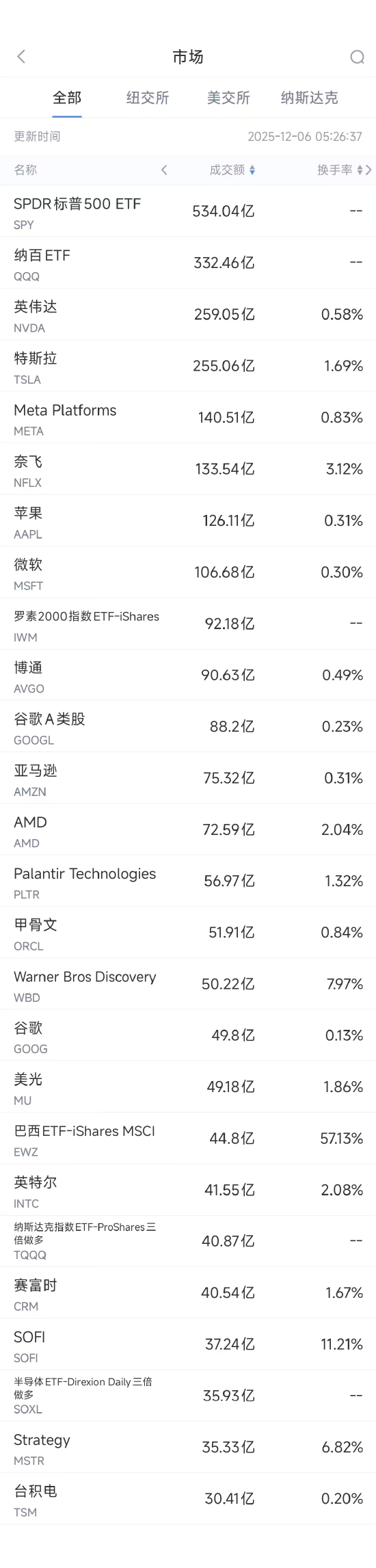
Group 1: Nvidia - Nvidia's stock closed down 0.53% with a trading volume of $25.905 billion, with CFO Colette Kress highlighting that over 50% of the company's revenue comes from large cloud service providers (CSPs) [1][9] - Kress emphasized the ongoing need for computational resources among model developers, who must consider profitability and funding while ensuring sufficient computational capacity for future demands [1][9] Group 2: Tesla - Tesla's stock increased by 0.10% with a trading volume of $25.506 billion, as CEO Elon Musk confirmed that the Full Self-Driving (FSD) system now allows users to send text messages while driving under certain conditions [1][10] Group 3: Meta Platforms - Meta Platforms' stock rose by 1.80% with a trading volume of $14.051 billion, following reports that the company plans to cut its metaverse department budget by up to 30%, which analysts view positively as a sign of financial discipline [2][10] - The potential layoffs may affect Meta's virtual reality division, indicating a focus on efficiency and growth [2][10] Group 4: Netflix and Warner Bros - Netflix's stock fell by 2.89% with a trading volume of $13.054 billion, as the company announced a deal to acquire Warner Bros, including its film and television studios, for a total enterprise value of approximately $82.7 billion [2][10][11] - The acquisition will be financed through cash and stock, with Warner Bros shares valued at $27.75 each, translating to an equity value of $72 billion [2][10] Group 5: Other Companies - Broadcom's stock increased by 2.42% with a trading volume of $9.063 billion, as Oppenheimer raised its target price from $400 to $435 [12] - Palantir's stock rose by 2.16% with a trading volume of $5.697 billion, marking a 7.9% increase over the week [13] - Micron's stock increased by 4.66% with a trading volume of $4.918 billion, announcing a complete exit from its Crucial consumer storage business by March 2026 [14] - TSMC's stock rose by 0.61% with a trading volume of $3.041 billion, with the U.S. Commerce Secretary stating that TSMC will increase investments in the U.S. [15]


Taiwan Semiconductor: I Don't Think Growth Is About To End (NYSE:TSM)
Seeking Alpha· 2025-12-05 19:02
My last article on Taiwan Semiconductor Manufacturing Company Limited ( TSM ) was right after DeepSeek day. My perception was that the selloff was just creating a buying opportunity. Since then, the stock has reached new heights and has risen more than 40%. InEquity Research Analyst with a broad career in the financial market, covered both Brazilian and global stocks. As a value investor, my analysis is primarily fundamental, focusing on identifying undervalued stocks with growth potential. Feel free to rea ...
Taiwan Semiconductor: I Don't Think Growth Is About To End
Seeking Alpha· 2025-12-05 19:02
My last article on Taiwan Semiconductor Manufacturing Company Limited ( TSM ) was right after DeepSeek day. My perception was that the selloff was just creating a buying opportunity. Since then, the stock has reached new heights and has risen more than 40%. InEquity Research Analyst with a broad career in the financial market, covered both Brazilian and global stocks. As a value investor, my analysis is primarily fundamental, focusing on identifying undervalued stocks with growth potential. Feel free to rea ...
Taiwan Semiconductor Manufacturing vs. ASML: Which Stock Will Outperform in 2026?
The Motley Fool· 2025-12-05 18:15
Core Viewpoint - Both Taiwan Semiconductor Manufacturing (TSMC) and ASML are positioned to benefit from the booming demand for chips driven by artificial intelligence (AI) data center buildout, but TSMC is expected to outperform in 2026 due to its pricing power and market position [2][14]. TSMC Overview - TSMC is the world's leading semiconductor contract manufacturer and one of only three companies capable of producing advanced chips at small node sizes, which enhances power efficiency [3][5]. - TSMC's market capitalization is $1,519 billion, with a current stock price of $296.51 and a gross margin of 57.75% [4][5]. - The company is expected to increase prices by 3% to 10% next year due to strong pricing power stemming from competitors' yield issues [6]. - TSMC projects a 40% compound annual growth rate (CAGR) for AI chip demand, particularly for graphics processing units (GPUs) [6]. ASML Overview - ASML holds a monopoly in the production of extreme ultraviolet (EUV) lithography machines, essential for manufacturing advanced chips, with no competitive alternatives available [8]. - ASML's market capitalization is $430 billion, with a current stock price of $1,107.46 and a gross margin of 52.70% [10][11]. - The company has developed next-generation High-NA EUV technology, which will further reduce node sizes, with new machines costing around $400 million each [11]. - A potential concern for ASML is the pull forward in demand for its older deep ultraviolet (DUV) machines from China, which may lead to fewer sales in 2026 [12]. Comparative Analysis - TSMC is trading at a forward price-to-earnings (P/E) ratio of under 23.5 times, while ASML's ratio exceeds 36.5 times, indicating TSMC is relatively cheaper [7]. - Both companies are expected to benefit from the proliferation of advanced chips, with AI being a current driver and future potential in areas like robotaxis and quantum computing [13]. - TSMC's stock is considered better positioned for 2026 due to its strong AI tailwind and competitive pricing, while ASML may face challenges due to earlier demand pull-forward [14].

Cerebras AI Inference Wins Demo of the Year Award at TSMC North America Technology Symposium
Businesswire· 2025-12-05 17:42
Core Insights - Cerebras Systems has been awarded Demo of the Year for its AI Inference technology at the 2025 TSMC North America Technology Symposium, highlighting its significant innovation in the AI infrastructure space [1][3]. Group 1: Technological Achievements - Cerebras has developed a wafer-scale processor, the CS-3, which is 50 times larger than conventional processors, enabling AI workloads to run over 20 times faster than GPUs [2][8]. - The company’s flagship technology, the Wafer Scale Engine 3 (WSE-3), is the largest and fastest AI processor, outperforming the largest GPU by 56 times while consuming less power per compute unit [8]. Group 2: Market Adoption and Partnerships - Cerebras AI Inference is utilized in demanding environments globally, available through major cloud platforms such as AWS, IBM, and Hugging Face, and is adopted by sectors including healthcare, biotech, finance, and design [4][6]. - The technology supports critical national scientific research at U.S. Department of Energy laboratories and the Department of Defense, showcasing its versatility and reliability in high-stakes applications [4]. Group 3: Performance Metrics - Cerebras is recognized as the fastest platform for AI coding, generating code over 20 times faster than competing solutions, and consistently achieving the fastest inference speeds verified by independent benchmarks [5][8]. - The company serves trillions of tokens monthly across its cloud and on-premises deployments, indicating robust demand and operational scale [6].