
UBS(UBS)

Search documents
UBS Capital Requirements Rise Following Switzerland's Proposal
ZACKS· 2025-06-09 13:01
Core Viewpoint - Switzerland's Federal Department of Finance has proposed stricter capital requirements for UBS Group AG following its acquisition of Credit Suisse to mitigate risks of a similar crisis in the future [1][3]. Capital Requirements - UBS is required to fully capitalize its foreign subsidiaries, increasing the common equity tier-one capital by up to $26 billion from the current 60% threshold [1][9]. - UBS can offset $8 billion through a reduction in Additional Tier 1 (AT1) bond holdings, resulting in a net capital increase of $18 billion [2][9]. - UBS has expressed strong disagreement with the proposed capital requirements, stating they are disproportionate and not aligned with international standards [4][9]. Legislative Process - The proposed capital reforms will undergo a consultation process before being submitted to parliament, with implementation not expected before 2028 [5]. UBS-Credit Suisse Integration - UBS completed the acquisition of Credit Suisse in 2023 and is facing challenges, including legal claims that are increasing costs [6]. - UBS aims to complete the integration of Credit Suisse by the end of 2026, having already merged 95 branches in Switzerland since the merger [7]. - As of the first quarter of 2025, UBS achieved $0.9 billion in gross cost savings, totaling $8.4 billion in cumulative savings, which is approximately 65% of its goal to achieve $13 billion in annualized cost savings by the end of 2026 [8]. Market Performance - Over the past six months, UBS shares have increased by 6.1%, while the industry has grown by 23.1% [10].



韧性、科技、消费……透过多维度关键词解析中国吸引全球资本“新磁场”
Yang Shi Wang· 2025-06-08 03:12
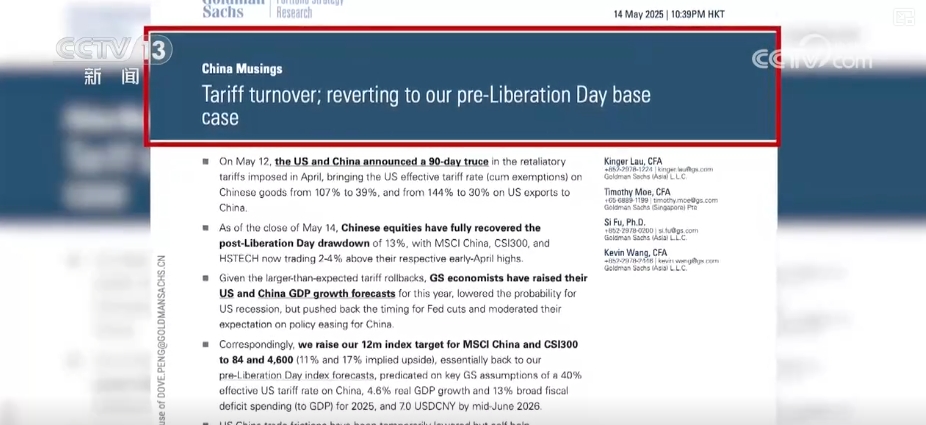
Economic Growth Forecasts - Major international financial institutions, including Goldman Sachs and JPMorgan, have raised their 2025 economic growth forecasts for China by 0.6 to 0.7 percentage points, citing positive effects from a series of incremental policies implemented since September 2024 [1][2] Monetary and Fiscal Policies - The easing of monetary policy by the People's Bank of China from September to December 2024 is highlighted as a key driver for economic support, with a projected fiscal deficit rate exceeding 4% for the first time during the upcoming Two Sessions [2] Foreign Investment and Market Dynamics - China's continuous policy openness and improvements in the business environment have led to a 12.1% year-on-year increase in newly established foreign-invested enterprises, totaling 18,832 in the first four months [3] - The Hong Kong IPO market has raised a total of $9 billion since 2025, reflecting a 320% year-on-year increase, indicating strong interest from international investors [4] Resilience and Confidence in the Economy - Many foreign financial institutions emphasize the "resilience" of the Chinese economy, noting that despite external challenges, domestic growth remains robust [5] - The strong technological innovation capabilities of Chinese enterprises are viewed as a critical factor for continued foreign investment confidence [8] Focus on Technology and Consumption - The technology and consumption sectors are identified as major growth areas, attracting global capital and showcasing significant potential [9] - Changes in consumer behavior, including the rise of domestic brands and innovative consumption patterns, are emerging as new highlights in the consumption sector [14][17]


瑞银集团:原则上支持(瑞士)监管部门的大部分建议。(财务指标的)调整将引发资本要求。将从核心一级资本(CET1 Capital)扣除国外业务部门的投资。将维持大约240亿美元形式上的(Pro Forma)核心一级资本。
news flash· 2025-06-06 15:43
Group 1 - UBS Group generally supports most of the recommendations from Swiss regulators [1] - Adjustments to financial metrics will lead to increased capital requirements [1] - Investments in foreign business units will be deducted from Common Equity Tier 1 (CET1) Capital [1] - The company will maintain approximately $24 billion in Pro Forma CET1 Capital [1]
瑞银集团:强烈反对大幅提高资本要求的提议。原则上支持瑞士联邦委员会今天公布的大部分监管建议。
news flash· 2025-06-06 15:37
Group 1 - UBS Group strongly opposes the proposal to significantly increase capital requirements [1] - UBS generally supports most of the regulatory proposals announced by the Swiss Federal Council today [1]
瑞银集团在瑞士政府提案下面临额外260亿美元资本要求
news flash· 2025-06-06 13:25
据报道,根据瑞士政府改革计划,即其中一项提案要求瑞银将其在境外子公司的境内资本比例从目前的 60%提高至100%,预计瑞银集团将面临额外260亿美元的资本要求。(智通财经) ...
瑞士政府:资本充足率措施将使瑞银集团的资本要求增加最高达180亿美元。
news flash· 2025-06-06 13:15
Core Viewpoint - The Swiss government has announced that capital adequacy measures will increase UBS Group's capital requirements by up to $18 billion [1] Group 1 - The capital adequacy measures are aimed at strengthening the financial stability of UBS Group [1] - The increase in capital requirements is significant, potentially impacting UBS's financial strategies and operations [1] - The measures reflect ongoing regulatory efforts to ensure that major financial institutions maintain robust capital buffers [1]
瑞银集团在瑞士提案下面临额外260亿美元的资本要求。
news flash· 2025-06-06 13:02
Group 1 - UBS Group faces an additional capital requirement of $26 billion under proposals in Switzerland [1]
日债拍卖三度遇冷,瑞银喊话:根本没人买,别发了!
Jin Shi Shu Ju· 2025-06-05 10:00
Group 1 - A senior investment manager suggests Japan should stop issuing bonds with maturities over 30 years to alleviate volatility in the government bond market [1] - The yield on 40-year Japanese government bonds surged to 3.675%, the highest since its introduction in 2007, prompting a call for the Ministry of Finance to cease long-term bond issuance [1] - Domestic demand for long-term bonds is declining due to an aging population, with life insurance companies and pension funds no longer needing to allocate to bonds with maturities exceeding 30 years [1] Group 2 - The recent surge in bond yields has led the Ministry of Finance to seek feedback from market participants regarding potential adjustments to its issuance strategy [2] - It is anticipated that the Bank of Japan should follow up on its January rate hike in the upcoming July monetary policy meeting, signaling a potential for semi-annual rate increases to stabilize market expectations [2] - The current bond portfolio of the Bank of Japan is heavily concentrated in 5-10 year bonds, and a shift towards longer maturities could enhance demand for ultra-long-term bonds [2] Group 3 - During the recent spike in bond yields, tactical purchases of ultra-long-term bonds were made, but significant accumulation will depend on clear signals from the Japanese government regarding market normalization [3]
金十整理:机构前瞻欧洲央行利率决议——宽松周期尾声渐进,欧央行将何时“收手”?
news flash· 2025-06-05 07:57
Group 1 - Goldman Sachs expects a 25 basis point rate cut, maintaining GDP forecasts for this year while lowering next year's GDP forecast and significantly reducing inflation predictions [1] - UBS anticipates a 25 basis point rate cut, with the last cut expected in July, bringing rates down to 1.75%, and a potential rate hike by the end of 2026 to address inflation risks [1] - Bank of America predicts a 25 basis point rate cut, noting that the market has already priced in the recent ECB rate cut, which is unlikely to have a significant impact on the euro [1] Group 2 - Nomura Securities forecasts a 25 basis point rate cut, with further cuts expected in July and September until rates reach 1.50%, while adjusting GDP and inflation predictions [1][2] - Deutsche Bank expects a 25 basis point rate cut, suggesting that the terminal rate for the easing cycle should remain at 1.50%, with a potential rate hike to 1.75% by the end of 2026 [2] - Pacific Investment Management Company anticipates a 25 basis point rate cut, indicating that the ECB is entering the final phase of its easing cycle, with current market pricing around 1.7% appearing reasonable [3]


