奥康国际

Search documents
2025年1-12月皮革、毛皮、羽毛及其制品和制鞋业企业有8783个,同比下降1.38%
Chan Ye Xin Xi Wang· 2026-02-22 03:41
知前沿,问智研。智研咨询是中国一流产业咨询机构,十数年持续深耕产业研究领域,提供深度产业研 究报告、商业计划书、可行性研究报告及定制服务等一站式产业咨询服务。专业的角度、品质化的服 务、敏锐的市场洞察力,专注于提供完善的产业解决方案,为您的投资决策赋能。 2016-2025年皮革、毛皮、羽毛及其制品和制鞋业企业数统计图 数据来源:国家统计局,智研咨询整理 上市公司:万里马(300591),中胤时尚(300901),恒辉安防(300952),ST奥康(603001),红 蜻蜓(603116),ST起步(603557),健盛集团(603558),天创时尚(603608),康隆达 (603665),牧高笛(603908),哈森股份(603958),扬州金泉(603307) 相关报告:智研咨询发布的《2026-2032年中国皮革行业市场现状分析及产业趋势研判报告》 2025年1-12月,皮革、毛皮、羽毛及其制品和制鞋业企业数(以下数据涉及的企业,均为规模以上工业 企业,从2011年起,规模以上工业企业起点标准由原来的年主营业务收入500万元提高到年主营业务收 入2000万元)为8783个,和上年同期相比,减少了123 ...


奥康国际面临索赔诉讼时效风险,业绩连续亏损
Jing Ji Guan Cha Wang· 2026-02-13 08:30
Core Viewpoint - Aokang International (603001) is facing the risk of an impending deadline for investor compensation lawsuits while also being recognized in the "Top 500 Chinese Domestic Brands" list, ranking 230th, indicating its innovative strength in the comfortable footwear sector [1][2]. Recent Events - Aokang International is at risk of investor compensation lawsuits expiring soon, with the deadline set for April 26, 2026, affecting investors who bought and held shares between April 26, 2022, and April 25, 2023 [2]. - The company has been included in the "2025 Top 500 Chinese Domestic Brands" list, ranking 230th, showcasing its brand strength in the comfortable footwear market [2]. Stock Performance - Over the past 7 days, Aokang International's stock price has shown a downward trend, closing at 9.50 yuan on February 13, 2026, with a cumulative decline of 3.36% over the last 5 days and a volatility of 6.61% [3]. - On February 12, 2026, there was a net inflow of 6.3071 million yuan from main funds, accounting for 9.59% of the total trading volume, although overall trading activity remains low with a turnover rate of only 1.73% [3]. - The current stock price is below the 5-day moving average of 9.60 yuan, indicating short-term pressure from a technical perspective [3]. Financial Report Analysis - Aokang International's 2025 earnings forecast indicates an expected net loss attributable to shareholders of approximately 237 million yuan, with a non-recurring net loss of about 264 million yuan, and revenue of 1.923 billion yuan, representing a year-on-year decline of 24.55% [4]. - The losses are primarily attributed to intensified industry competition and weak market demand, with the main footwear business revenue falling short of expectations [4]. - This marks the fourth consecutive year of losses for the company, with a cumulative loss exceeding 900 million yuan [4]. - In the third quarter of 2025, the company reported a single-quarter revenue of 399 million yuan and a net loss attributable to shareholders of 117 million yuan, maintaining a gross margin of 35.38% [4]. Institutional Perspectives - Institutional interest in Aokang International remains low, with the latest sentiment being neutral and no recent institutional research records available [5]. - Profitability forecasts suggest that institutions expect a loss of 0.59 yuan per share in 2025, with net profit projected to decline by 9.85% and revenue expected to decrease by 24.25%, indicating ongoing challenges in performance recovery [5].

场景化成消费核心导向 京东家电家居“巅峰24小时”IP联合品牌高管共探增长新机遇
Sou Hu Wang· 2026-02-10 10:24
Core Insights - The integration of AI technology into daily life is shifting consumer expectations of "home" from mere functional spaces to emotional and healing "lifestyle solution spaces" [1] - The competition logic in the home appliance and furniture industry is evolving from a focus on product performance to a comprehensive competition involving experiential scenarios, emotional connections, and holistic service capabilities [1] Group 1: Consumer Trends - The core trend in home consumption is evolving towards creating "meta scenarios," where the demand for "rituals" shifts from social display to self-care, making "home" a sanctuary for emotional connections [2] - Brands are increasingly collaborating to align with this trend, as seen in Midea's thematic participation in the "Peak 24 Hours" event, which aimed to elevate the product experience into a healing space [2] - The personalization of smart appliances is emerging as a new consumer trend, with brands like Casarte and AUX creating products tailored to specific family scenarios [2] Group 2: Service and Marketing Innovations - Service capability is becoming a new competitive advantage for brands, with companies like Hisense and TCL focusing on integrating consumer needs with technology [3] - Marketing strategies have shifted from traditional advertising to interactive, emotional, and scenario-based communication, exemplified by JD and TCL's "Champion China Tour" event [3] - The collaboration between JD and brands like Lin's Home focuses on creating immersive experiences that blend online and offline interactions, enhancing brand effectiveness [3] Group 3: Future Industry Outlook - Industry leaders agree that the home appliance and furniture sector will evolve towards greater intelligence, personalization, and a focus on holistic value [4] - The future of manufacturing is centered on creating better consumer experiences, as emphasized by Hisense's commitment to enhancing life quality [4] - JD's "Peak 24 Hours" IP is redefining the concept of "home" as a comprehensive carrier of emotions, life renewal, and self-realization, positioning itself as an enabler and co-builder in the industry [4]

从功能消费到情绪消费:2026,人们把家“买”成了什么样?
第一财经· 2026-02-09 06:00
Core Insights - The article emphasizes the transformation in consumer behavior from merely purchasing products to seeking comprehensive "home living solutions" that cater to emotional and experiential needs [1][3][60] Group 1: Consumer Trends - The demand for "ceremony" is shifting inward, focusing on self-care rather than social display, with 40.2% of individuals preferring to spend personal time at home and 77.8% willing to pay a premium for home products that provide emotional value [4][10] - The concept of "meta-scenes" is introduced, breaking down the abstract notion of home rituals into four actionable categories: "reset," "link," "light up," and "renew," which brands can leverage to connect with consumers [6][12] - The trend of "AI personalization" indicates that consumers are willing to invest in smart appliances that understand and meet their needs, moving away from cold, technical specifications to more human-like interactions [14][17] Group 2: Marketing Trends - The integration of online and offline channels is crucial, as consumers prefer immersive experiences in physical stores while valuing the convenience of online shopping [34][35] - Emotional resonance is becoming a key marketing strategy, with brands creating "emotional events" that connect with consumers' feelings rather than relying on traditional advertising methods [40][42] - Products must be contextualized within familiar life scenarios, allowing their functional value to naturally integrate into consumers' daily lives [48][49] Group 3: Future Predictions - The future of smart home technology will focus on "emotional alignment," where devices not only respond to commands but also anticipate user emotions and needs [55][56] - Brands will need to cater to specific consumer segments, offering tailored products that meet the unique demands of different demographics [57] - A shift towards providing "holistic value" will be essential, where brands offer comprehensive solutions that encompass functionality, emotional connection, and service throughout the product lifecycle [58][59]


2026年第5周:服装行业周度市场观察
艾瑞咨询· 2026-02-09 00:03
Industry Environment - The rise of Lao Pu Gold has attracted attention from luxury goods giants, with single-store sales exceeding Cartier and Van Cleef & Arpels, and a gross margin of 40% achieved through high-end mall locations and traditional craftsmanship [2][3] - Star Creation Group targets high myopia consumers with a new sports eyewear brand, NSVE, addressing the needs of individuals with over 450 degrees of myopia in sports scenarios, while transitioning stores to focus on professional services [4] - Luxury brands face challenges from the second-hand luxury market and emerging local brands, with sales declines for brands like Michael Kors and Coach, although some have seen recovery through product innovation and marketing adjustments [5] - Domestic sports brands are gaining market share, with Anta leading with revenue of 70.826 billion yuan and a net profit of 15.6 billion yuan, while Nike and other international brands experience slower growth [6][7] - High-end brands struggle as mid-range consumers flock to affordable options, with supermarkets like Sam's Club and Costco seeing high sales of budget down jackets, while premium brands face declining sales due to high prices and quality concerns [8][10] Key Trends - StockX's report indicates a significant increase in sales for nearly 200 brands, with Nike and Jordan leading, while emerging brands like MIZUNO show notable growth [9] - The popularity of affordable down jackets among middle-class consumers reflects a shift towards value-driven purchasing, with brands like Bosideng facing challenges as they move towards higher-end products [10][12] - The outdoor backpack market is evolving, with brands like Salomon and KAILAS capitalizing on the growing trend of trail running, indicating a shift in consumer preferences towards functional and stylish outdoor gear [11] Brand Dynamics - Pop Mart's Labubu IP saw a rapid rise and subsequent market crash, highlighting the volatility of collectible markets and the need for new growth points [13][14] - Li Ning's participation in Milan Fashion Week showcases a blend of high-quality design and sports technology, aiming to resonate with urban consumers [15] - High-end outdoor brands are focusing on immersive experiences to connect with consumers, as seen in the launch of KAILAS's new line that emphasizes natural aesthetics and sustainable materials [16] - Seven Wolves is showcasing a blend of Eastern wisdom and technology at international exhibitions, emphasizing the shift from scale to value in the Chinese apparel industry [17][18] - China Duty Free Group's acquisition of DFS's Hong Kong and Macau stores aims to enhance its global footprint, despite recent fluctuations in performance [19] - Deckers Brands is streamlining its portfolio by closing underperforming brands to focus on more profitable ones like Hoka and UGG [20] - Aokang's AI fashion show represents a new marketing paradigm in the footwear industry, emphasizing digital transformation and consumer engagement [21][22] - Dongfang Tang is launching a pop-up store featuring traditional craftsmanship, aiming to modernize heritage techniques and expand into urban and international markets [23]



服饰行业周度市场观察-20260207
Ai Rui Zi Xun· 2026-02-07 08:42
Investment Rating - The report does not explicitly provide an investment rating for the apparel industry Core Insights - The luxury jewelry market is seeing a rise in interest from high-net-worth individuals towards traditional gold jewelry, which has significantly higher sales per store compared to established luxury brands like Cartier and Van Cleef & Arpels, achieving a gross margin of 40% [1] - The second-hand luxury market and emerging local brands are putting pressure on affordable luxury brands, which are experiencing declining sales, although some brands like Coach and Ralph Lauren are showing signs of recovery through product innovation and marketing adjustments [4] - The domestic sportswear market is undergoing a transformation with local brands capturing 60% of the global market share, led by Anta and Li Ning, which are focusing on technological advancements and channel optimization to build competitive barriers [4] - The demand for affordable down jackets is surging among middle-class consumers, leading to a decline in sales for high-end brands, which are struggling with high pricing and quality concerns [5][7] - The outdoor gear market is evolving with the popularity of trail running, leading to increased interest in trail backpacks, which are expected to see significant market growth by 2030 [8] Industry Environment - The luxury jewelry market is being disrupted by traditional gold jewelry brands that are attracting high-net-worth consumers, leading to a shift in customer traffic away from established luxury brands [1] - The affordable luxury segment is facing challenges due to tightening consumer spending, with brands like Michael Kors and Coach reporting significant revenue declines in Asia, although some are beginning to recover [4] - The domestic sportswear market is witnessing a major shift with local brands like Anta and Li Ning leading in revenue and brand value, while international brands are experiencing slower growth [4] - The affordable down jacket market is thriving as consumers prioritize value, leading to a stark contrast in sales performance between high-end and budget brands [5][7] - The trail running trend is driving demand for specialized outdoor gear, particularly trail backpacks, which are becoming essential for outdoor enthusiasts [8] Top Brand News - Pop Mart's Labubu toy line experienced a significant market crash after initial success, highlighting the volatility of collectible markets [10] - Li Ning showcased its Honor Gold Label series at Milan Fashion Week, emphasizing a blend of high-quality design and sports technology [11] - Deckers Brands announced the closure of two niche brands to focus on more profitable core brands like Hoka and UGG [14] - Aokang held an AI fashion show to innovate marketing strategies in the footwear industry, showcasing a digital transformation approach [16]


2025年1-12月浙江省工业企业有61277个,同比增长2.92%
Chan Ye Xin Xi Wang· 2026-02-05 03:25
相关报告:智研咨询发布的《2026-2032年中国工业云行业市场深度评估及投资机会预测报告》 2025年1-12月,浙江省工业企业数(以下数据涉及的工业企业,均为规模以上工业企业,从2011年起, 规模以上工业企业起点标准由原来的年主营业务收入500万元提高到年主营业务收入2000万元)为61277 个,和上年同期相比,增加了1739个,同比增长2.92%,占全国的比重为11.65%。 上市公司:天山铝业(002532),宁波富邦(600768),金田股份(601609),ST海越(600387), 中泰股份(300435),英洛华(000795),永兴材料(002756)香飘飘(603711),一鸣食品 (605179),李子园(605337),伟星股份(002003),ST奥康(603001),红蜻蜓(603116),ST 起步(603557),慈星股份(300307),金盾股份(300411),迦南科技(300412),中亚股份 (300512),浙能电力(600023),浙江新能(600032),东望时代(600052),瀚叶股份(600226) 2016-2025年浙江省工业企业数统计图 数据来源: ...

服装家纺板块1月29日涨0.69%,奥康国际领涨,主力资金净流出3488.04万元
Zheng Xing Xing Ye Ri Bao· 2026-01-29 09:03
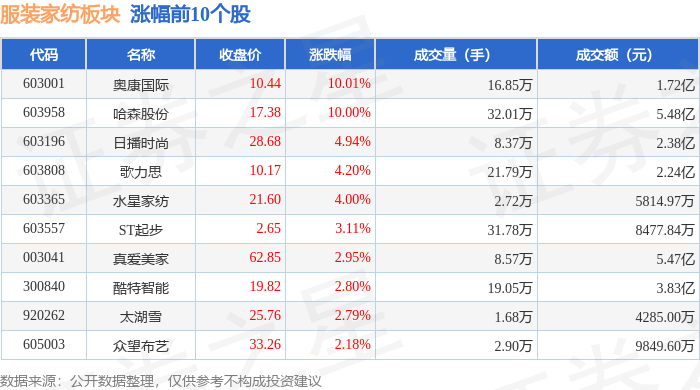
Market Overview - The apparel and home textile sector increased by 0.69% on January 29, with Aokang International leading the gains [1] - The Shanghai Composite Index closed at 4157.98, up 0.16%, while the Shenzhen Component Index closed at 14300.08, down 0.3% [1] Top Performers - Aokang International (603001) closed at 10.44, up 10.01% with a trading volume of 168,500 shares and a turnover of 172 million yuan [1] - Hason Co., Ltd. (603958) closed at 17.38, up 10.00% with a trading volume of 320,100 shares and a turnover of 548 million yuan [1] - Ribor Fashion (603196) closed at 28.68, up 4.94% with a trading volume of 83,700 shares and a turnover of 238 million yuan [1] Underperformers - ST Erya (600107) closed at 5.72, down 4.83% with a trading volume of 106,600 shares and a turnover of 62.08 million yuan [2] - Kanglongda (603665) closed at 35.57, down 4.82% with a trading volume of 53,900 shares and a turnover of 193 million yuan [2] - Bangjie Co., Ltd. (002634) closed at 5.40, down 4.09% with a trading volume of 192,400 shares and a turnover of 105 million yuan [2] Capital Flow - The apparel and home textile sector experienced a net outflow of 34.88 million yuan from institutional investors, while retail investors saw a net inflow of 47.81 million yuan [2] - The top net inflows from retail investors included Aokang International (603001) with a net inflow of 14.61 million yuan, and Ribor Fashion (603196) with a net inflow of 1.29 million yuan [3] Summary of Capital Flow by Company - Aokang International had a net inflow of 14.61 million yuan from institutional investors, with a net outflow of 619,960 yuan from speculative funds [3] - Hason Co., Ltd. saw a net inflow of 7.06 million yuan from institutional investors, with a net outflow of 5.94 million yuan from speculative funds [3] - Semir Fashion (002563) had a net inflow of 2.69 million yuan from institutional investors, with a net outflow of 2.30 million yuan from speculative funds [3]


扣非连亏7年!关店、推新、控费用为何止不住奥康国际的“失血”?
Xin Lang Cai Jing· 2026-01-27 08:36
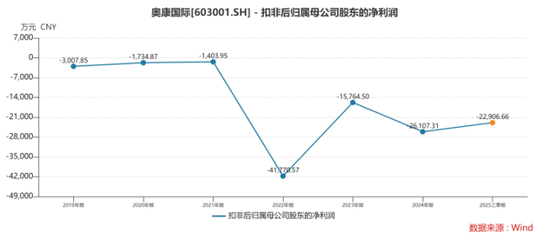
Core Viewpoint - The traditional leather shoe industry, represented by Aokang International, is facing significant challenges due to the rise of athletic and casual footwear, leading to declining sales and profitability [1][4][12]. Industry Overview - The leather shoe market in China is experiencing a contraction in both production and demand, with production dropping to 3.591 billion pairs and demand to 2.92 billion pairs in 2023, and further declines expected in 2024 [4][12]. - The industry is shifting from "quantity expansion" to "quality enhancement," resulting in a polarization where leading brands are gaining market share while traditional companies like Aokang and Red Dragonfly struggle [4][12]. Company Performance - Aokang International's revenue is projected to decline by approximately 24.55% in 2025, with expected losses of about 237 million yuan in net profit and 264 million yuan in net profit after deducting non-recurring items [1][9]. - In the first three quarters of 2025, Aokang's revenue fell by 21.65%, and net profit dropped by 54.02%, resulting in a loss of 209 million yuan [4][12]. - Aokang's non-recurring net profit has been negative for seven consecutive years, accumulating losses of approximately 1.162 billion yuan over this period [1][9]. Competitive Landscape - Competitors such as Red Dragonfly and Tianchuang Fashion also reported revenue declines of 9.84% and 7.12%, respectively, with Red Dragonfly's net profit plummeting by 316.4% [5][13]. - Despite some companies like Tianchuang Fashion and Hason showing double-digit growth in net profit, they remain in a loss position, with Hason expected to lose between 24 million and 36 million yuan in 2025 [5][13]. Strategic Responses - Aokang is focusing on brand rejuvenation and channel improvement, launching a new trendy series aimed at younger consumers and reducing its store count from 2,235 to 1,928 by the end of Q3 2025 [6][15]. - The company is also managing costs, with sales and management expenses decreasing by 25.83% and 12.94%, respectively, although the sales expense ratio remains high at 36.08% due to declining revenue [7][16]. - Aokang's management plans to adopt a dual strategy of focusing on core business and seeking external growth opportunities, although the effectiveness of this strategy in countering declining core business performance remains to be seen [8][17].
AI技术与电商生态双重变革,智能客服如何破局?对话淘宝店小蜜负责人开锋
雷峰网· 2026-01-27 06:43
Core Viewpoint - AI technology is transforming customer service from a cost center into a growth department, enhancing operational efficiency and customer experience [1][4]. Group 1: AI Development and Market Trends - The current development of AI technology is characterized by a "dualistic" trend, with AI assistants rapidly penetrating the consumer market while challenges remain in achieving practical applications and finding product-market fit [2]. - The intelligent customer service sector is seen as a promising area to address these challenges due to its natural alignment with AI capabilities [3]. Group 2: Customer Service Evolution - Multi-turn dialogue understanding is a core advantage of large language models, which aligns well with the inherent nature of customer service interactions [5][6]. - Text generation is a fundamental capability of large language models, making it suitable for various customer service communication forms [6]. Group 3: E-commerce and Customer Service Integration - The focus on "existing user operations" has become central to e-commerce competition, with new service quality metrics being integrated into platform traffic allocation systems [7]. - The shift in strategy emphasizes that service quality is now a critical factor for traffic acquisition and order conversion, leading to a redefined role for customer service as a value-generating function [7]. Group 4: Case Study of Ding Xiaomi - Ding Xiaomi, an intelligent customer service product, has evolved significantly over the past decade, initially addressing high volumes of inquiries during peak sales events [9][10]. - The introduction of Ding Xiaomi 5.0, based on large language model technology, has led to a reduction in manual intervention rates by over 20% and an increase in transaction conversion rates by over 35% [11]. Group 5: Cost Efficiency and Performance Improvement - Ding Xiaomi 5.0 has helped merchants reduce configuration costs by 60%, streamlining the process of training and maintaining customer service systems [19][20]. - The product's ability to automatically extract and integrate product information has significantly reduced the need for extensive manual configuration by merchants [20]. Group 6: Future Directions and Enhancements - Future iterations of Ding Xiaomi will focus on improving pre-sale and post-sale capabilities, enhancing the overall service experience for users [26]. - The product will also allow merchants to integrate their internal knowledge bases and strategies, enabling more personalized and differentiated service capabilities [26].