
成都银行

Search documents
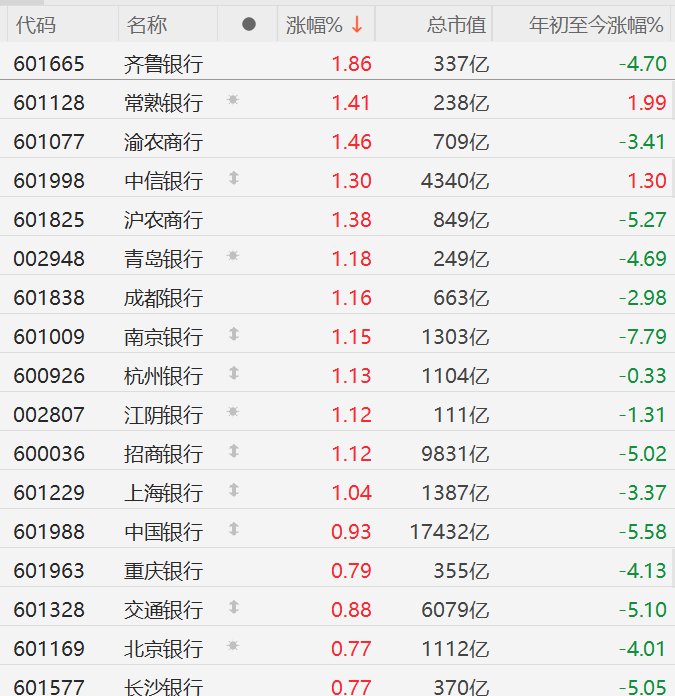
A股银行股逆势普涨,齐鲁银行涨近2%
Jin Rong Jie· 2026-01-20 03:20
Core Viewpoint - The A-share market sees a notable increase in bank stocks, with several banks experiencing significant gains despite broader market trends [1] Group 1: Stock Performance - Qilu Bank rises nearly 2% [1] - Changshu Bank, Chongqing Rural Commercial Bank, CITIC Bank, Shanghai Rural Commercial Bank, Qingdao Bank, Chengdu Bank, Nanjing Bank, Hangzhou Bank, Jiangyin Bank, China Merchants Bank, and Shanghai Bank all see increases of over 1% [1]
银行股逆势普涨,齐鲁银行涨近2%
Ge Long Hui· 2026-01-20 03:06
Group 1 - The A-share market saw a significant increase in bank stocks, with Qilu Bank rising nearly 2% and several other banks, including Changshu Bank and Chongqing Rural Commercial Bank, increasing by over 1% [1] - The total market capitalization of Qilu Bank is 33.7 billion, while Changshu Bank has a market cap of 23.8 billion [2] - Year-to-date performance shows that Qilu Bank has decreased by 4.70%, while Changshu Bank has increased by 1.99% [2] Group 2 - Other banks that experienced gains include Yunnan Rural Commercial Bank (1.46%), CITIC Bank (1.30%), and Shanghai Bank (1.04%) [2] - The total market capitalization of CITIC Bank is 434 billion, and it has a year-to-date performance of 1.30% [2] - Despite the gains, many banks still show negative year-to-date performance, such as Shanghai Bank (-3.37%) and China Bank (-5.58%) [2]





经营贷利率下探至“2字头”
Di Yi Cai Jing Zi Xun· 2026-01-19 14:06
Core Viewpoint - The State Council has implemented a package of policies to promote domestic demand through financial and fiscal collaboration, focusing on optimizing service industry loans and personal consumption loan interest subsidies to lower financing costs and stimulate consumer spending [2] Group 1: Business Loan Market - Business loan interest rates have generally decreased to the "20s" range, with increased flexibility in terms of limits, duration, and product offerings, becoming a key focus for bank credit allocation [2] - State-owned banks maintain stable pricing for business loans, with rates around 3%, while collateralized loans can be as low as 2.5% for qualified clients [3] - Joint-stock banks offer more flexible product structures, with some collateralized loans having rates as low as 2.3%, depending on property evaluations [3][4] - City commercial banks are actively competing, with some offering business loans at rates as low as 2.2% and various repayment options to meet different cash flow needs [4] Group 2: Consumer Loan Market - Personal consumption loan rates have stabilized around 3%, with limited room for further decreases, as products with rates below 3% have largely exited the market [5] - Major state-owned banks have consumer loan rates generally between 3.0% and 4.5%, with specific products like ICBC's "Rong e Borrow" offering rates around 3.5% to 3.65% [5] - Joint-stock and city commercial banks are also active in the consumer loan market, with some offering interest subsidies to enhance product attractiveness [6] Group 3: Risk Management and Market Dynamics - Despite ongoing financial policies to promote consumption, demand for consumer loans remains weak, with significant declines in both short-term and long-term consumer loans reported [7] - Banks are tightening risk controls, with stricter audits on the use of consumer loan funds and customer eligibility to prevent misuse of low-cost funds [7][8] - The asset quality of consumer loans is under scrutiny, with projections indicating a potential increase in non-performing loan rates in 2026 [9]
经营贷利率下探至“2字头”
第一财经· 2026-01-19 13:44
Core Viewpoint - The article discusses the recent implementation of a package of policies by the State Council to promote domestic demand through financial and fiscal collaboration, focusing on optimizing loans for service industry entities and personal consumption loans to lower financing costs and stimulate consumer spending [3]. Group 1: Business Loan Market - Business loan interest rates have generally decreased to the "2" range, with banks increasing loan amounts, terms, and product flexibility, making it a key focus for credit allocation [3][5]. - State-owned banks maintain stable pricing for business loans, with rates around 3%, while collateralized loans can be as low as 2.5% for qualified clients [5]. - Joint-stock banks offer more flexible product structures, with some collateralized loans having rates as low as 2.3%, depending on property evaluations [5][6]. - City commercial banks are competitive, with some offering collateralized business loans at rates as low as 2.2% and flexible repayment options [5]. Group 2: Consumer Loan Market - Consumer loan interest rates have stabilized around 3%, with limited room for further decreases, as products with rates below 3% have largely exited the market [8][9]. - Major state-owned banks have consumer loan rates ranging from 3.0% to 4.5%, with specific products like ICBC's "融e借" averaging 3.5% to 3.65% [8]. - Joint-stock and city commercial banks are also active in the consumer loan market, with some offering interest subsidies to enhance product attractiveness [9]. Group 3: Credit Demand and Risk Control - Despite ongoing financial policies to boost consumption, demand for consumer loans remains weak, with significant declines in both short-term and long-term consumer loans reported [10]. - The tightening of risk controls by banks is evident, with stricter scrutiny on the use of consumer loan funds and customer eligibility to prevent misuse [10][11]. - The asset quality of consumer loans is under observation, with projections indicating a slight increase in the non-performing loan rate for 2026 [11].

利率下探至“2字头” 经营贷成银行新宠
Di Yi Cai Jing· 2026-01-19 13:34
Core Insights - The State Council has implemented a package of fiscal and financial policies to stimulate domestic demand, focusing on optimizing service industry loans and personal consumption loan interest subsidies to lower financing costs and boost consumer spending [1] Group 1: Business Loan Trends - Business loan interest rates have generally decreased to the "2% range," with increased flexibility in terms of limits, duration, and product offerings, becoming a key focus for bank credit allocation [1] - State-owned banks maintain stable pricing for business loans, with rates around 3%, while collateralized loans can be as low as 2.5% for qualified clients [2] - Regional banks are more competitive, with some offering business loans at rates as low as 2.2% and flexible repayment options to meet various cash flow needs [2][3] Group 2: Consumer Loan Trends - Personal consumption loan rates have stabilized around 3%, with limited room for further decreases, as most products now fall within the 3% to 4.5% range [4] - Major banks like ICBC and CCB offer consumer loans with rates between 3.0% and 3.65%, while lower rates below 3% have largely disappeared from the market [4][5] - Some regional banks are enhancing product appeal through interest subsidies for specific consumer categories, such as education and healthcare [5] Group 3: Risk Management and Market Dynamics - Despite ongoing financial policies to promote consumption, demand for consumer loans remains weak, with significant declines in both short-term and long-term consumer loans reported [6] - Banks are tightening risk controls, with stricter scrutiny on the use of consumer loan funds and customer eligibility to prevent misuse of low-cost funds [6][7] - The asset quality of consumer loans is under observation, with projections indicating a potential increase in non-performing loan rates due to stricter regulations and market conditions [7]
利率下探至“2字头”,经营贷成银行新宠
Di Yi Cai Jing· 2026-01-19 12:52
Core Viewpoint - The recent government policies aim to lower financing costs and stimulate consumer spending, leading to a divergence in bank credit allocation, with operational loan rates dropping to the "2s" and consumer loan rates stabilizing around 3% [1][2][4]. Group 1: Operational Loan Rates - Operational loan rates have generally decreased to the "2s," with banks increasing credit limits, terms, and product flexibility [1][2]. - State-owned banks maintain operational loan rates around 3%, with collateralized loans potentially as low as 2.5% for qualified clients [2]. - Some joint-stock banks offer more flexible product structures, with collateralized loans' rates dynamically adjusted based on property evaluations, with some rates dropping to 2.3% [2]. - City commercial banks are aggressively competing, with some offering collateralized operational loans at rates as low as 2.2% and credit limits up to 20 million yuan [2]. Group 2: Consumer Loan Rates - Consumer loan rates have stabilized around 3%, with limited downward movement expected [4][5]. - Major state-owned banks' consumer loan rates range from 3.0% to 4.5%, with specific products like ICBC's "融e借" averaging between 3.5% and 3.65% [4][5]. - Joint-stock and city commercial banks are also active in the consumer loan market, with some offering interest rate subsidies to enhance product appeal [5]. Group 3: Credit Demand and Risk Control - Despite ongoing financial policies to promote consumption, demand for consumer loans remains weak, with significant declines in both short-term and long-term consumer loans reported [6]. - Banks are tightening risk controls, with stricter scrutiny on the use of consumer loan funds and customer eligibility to prevent misuse [6][7]. - The asset quality of consumer loans is under observation, with projections indicating a potential increase in non-performing loan rates in 2026 [7].
8.04亿元主力资金今日撤离银行板块
Zheng Quan Shi Bao Wang· 2026-01-19 09:34
Market Overview - The Shanghai Composite Index rose by 0.29% on January 19, with 23 out of the 28 sectors experiencing gains. The top-performing sectors were basic chemicals and petroleum & petrochemicals, with increases of 2.70% and 2.08% respectively. Conversely, the computer and communication sectors saw declines of 1.55% and 0.96% respectively [1] - The net outflow of capital from the two markets was 35.714 billion yuan, with 13 sectors experiencing net inflows. The power equipment sector led with a net inflow of 7.597 billion yuan and a daily increase of 1.84%, followed by the basic chemicals sector with a net inflow of 1.331 billion yuan [1] Banking Sector Performance - The banking sector declined by 0.60% with a net outflow of 804 million yuan. Among the 42 stocks in this sector, 7 stocks increased while 28 stocks decreased. Notably, 15 stocks had net inflows, with the highest being Shanghai Pudong Development Bank, which saw a net inflow of 133 million yuan [2] - Major banks with significant net outflows included China Merchants Bank, Agricultural Bank of China, and Chengdu Bank, with outflows of 384 million yuan, 312 million yuan, and 146 million yuan respectively [2] Capital Flow in Banking Stocks - The top banking stocks by capital flow included: - Shanghai Pudong Development Bank: +0.72%, net inflow of 1.334 billion yuan - Industrial Bank: +0.00%, net inflow of 1.082 billion yuan - China Communications Bank: -0.73%, net inflow of 1.046 billion yuan - China Merchants Bank: -0.44%, net outflow of 384 million yuan - Agricultural Bank of China: -1.53%, net outflow of 312 million yuan [3]





银行资负跟踪20260119:降准降息还有空间
GF SECURITIES· 2026-01-19 04:26
Investment Rating - The industry investment rating is "Buy" [3] Core Viewpoints - The report indicates that there is still room for further cuts in reserve requirement ratios and interest rates, with a focus on structural monetary policy support for high-quality economic development [15][19] - The central bank has implemented a reduction of 0.25 percentage points in various structural monetary policy tool rates, signaling a supportive monetary policy stance [15][19] - The report emphasizes the importance of timing for future policy implementations, particularly in relation to government bond issuance peaks and the maturity schedule of high-interest bank deposits [15] Summary by Sections 1. Monetary Policy Adjustments - The report notes a reduction of 0.25 percentage points in structural monetary policy tool rates, with a focus on supporting key areas through increased re-lending [15] - Future attention is directed towards December economic data and January LPR [22] 2. Central Bank Dynamics and Market Rates - The central bank conducted a total of 9,515 billion yuan in 7-day reverse repos at an interest rate of 1.40%, with a net injection of 9,741 billion yuan [16] - The report highlights that the funding rates remained stable, with expectations of slight increases due to tax payments and government bond net repayments [16] 3. Bank Financing Tracking - The report indicates that the total outstanding amount of interbank certificates of deposit (CDs) is 19.09 trillion yuan, with an average issuance rate of 1.65% [20] - The report also notes that there were no commercial bank bond issuances during the period, with a total outstanding commercial bank bond size of 3.38 trillion yuan [20]




震荡市中“压舱石”:红利低波ETF(512890)近20个交易日吸金14.8亿 机构激辩“春躁”行情方向
Xin Lang Cai Jing· 2026-01-19 04:20
Core Viewpoint - The A-share market showed mixed performance with the Deep Composite Index and ChiNext Index turning negative after an initial rise, while the Dividend Low Volatility ETF (512890) remained flat at 1.143 yuan, leading its category in trading volume and turnover [1][7]. ETF Performance - The Dividend Low Volatility ETF (512890) reported a turnover rate of 1.75% and a trading volume of 4.64 billion yuan, maintaining its position as the top ETF in its category [1][8]. - The ETF's price remained unchanged at 1.143 yuan, with a 5-day decline of 1.80% [2][8]. Top Holdings - The top ten holdings of the Dividend Low Volatility ETF showed mixed performance, with notable movements including: - COFCO Sugar rising by 0.18% - Nanjing Bank declining by 0.57% - South Steel increasing by 2.85% [2][8]. - The specific holding proportions include: - COFCO Sugar: 3.47% - South Steel: 2.83% - Chengdu Bank: 2.82% [2][8]. Fund Flows - The Dividend Low Volatility ETF (512890) has seen significant net inflows, with 290 million yuan over the last 5 trading days, 1.48 billion yuan over the last 20 days, and 3.09 billion yuan over the last 60 days [2][8]. - As of January 16, 2026, the fund's circulation scale was 26.388 billion yuan [2][8]. Market Outlook - Recent macroeconomic data indicates a GDP growth of 5.0% for 2025, with the first, second, and third industries growing by 3.9%, 4.5%, and 5.4% respectively [4][10]. - Analysts suggest that the market may experience consolidation, influenced by complex overseas conditions and domestic regulatory guidance, with a shift towards focusing on individual stock fundamentals [10]. - The sentiment in the market is gradually returning to rationality, with expectations of a transition to a more volatile trading environment as earnings reports approach [5][10]. Fund Characteristics - The Dividend Low Volatility ETF (512890) was established on December 19, 2018, with a total return of 128.48% as of January 16, 2026, outperforming its benchmark [11]. - The fund is positioned as a stable investment tool in volatile markets, with options for investors to participate through regular investment plans [11].
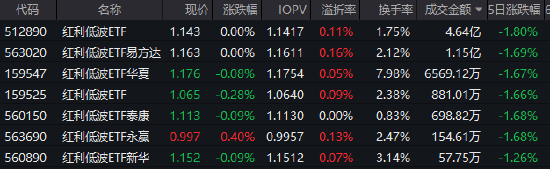
华泰研究:结构性降息落地,融资逆周期调节
HTSC· 2026-01-19 03:10
Investment Rating - The report maintains an "Overweight" rating for the securities and banking sectors, while also suggesting a positive outlook for the insurance sector [10][40]. Core Insights - The report highlights a structural monetary policy shift with a focus on "increasing quantity and reducing price," indicating potential for further interest rate cuts and reserve requirement ratio reductions [12][41]. - The A-share market remains active, with an average daily trading volume of 3.47 trillion yuan and a financing balance exceeding 2.7 trillion yuan, marking a new high [12][28]. - The report emphasizes the importance of the recent increase in the minimum margin requirement for financing from 80% to 100%, which aims to stabilize market conditions and reduce leverage [14][18]. Securities Sector Summary - The securities sector is expected to benefit from improved market conditions, with a focus on high-quality brokerage firms such as CITIC Securities and Guotai Junan [3][27]. - The report notes that the recent increase in financing margin requirements is a regulatory measure to control leverage and stabilize market sentiment [14][15]. - CITIC Securities reported a 38% year-on-year increase in net profit for 2025, reflecting strong performance in brokerage and investment banking [27]. Insurance Sector Summary - The insurance sector is advised to focus on high-quality leading companies, as the market has recognized the strong performance of life insurance sales [39]. - The report indicates that the main drivers for insurance stock prices are currently on the asset side rather than the liability side, leading to some price corrections [12][39]. Banking Sector Summary - The banking sector is characterized by a stable performance, with major banks like Shanghai Bank and Nanjing Bank recommended for investment due to their solid fundamentals [3][40]. - The report highlights a decrease in social financing growth, primarily due to high government debt base effects, but notes an increase in corporate loans [42][43]. - The Central Bank's recent policies suggest room for further interest rate cuts, which could enhance the banking sector's profitability [41][40].



