
银河航天

Search documents
振华科技:公司产品已稳定配套应用于高、中、低轨各型卫星
Zheng Quan Ri Bao Wang· 2026-01-14 13:16
Group 1 - The company, Zhenhua Technology, is a key supplier of core components for satellite manufacturing and rocket launches in China [1] - Its products are stably applied in various types of satellites across high, medium, and low orbits, establishing deep cooperative relationships with clients such as Galaxy Aerospace and Changguang Satellite [1] - The company has achieved comprehensive self-control over capacitor products, from technology to key raw materials, with tantalum capacitor products ranking among the top in shipment volume in high-end special application fields [1]

史无前例,我国20万颗卫星申报背后的“大棋局”
3 6 Ke· 2026-01-14 07:25
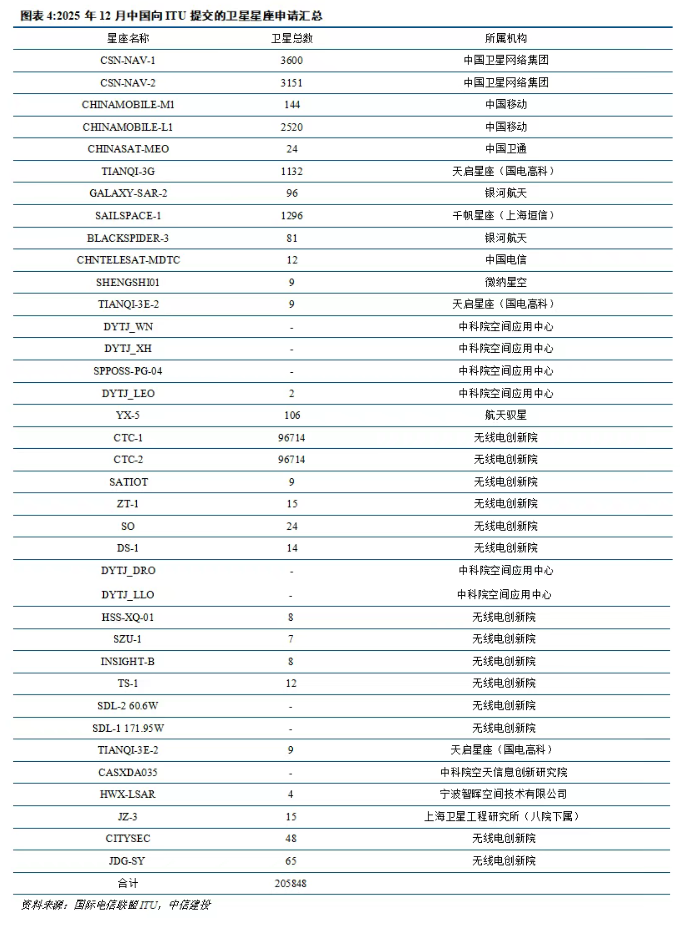
Core Viewpoint - China's recent application to the International Telecommunication Union (ITU) for over 200,000 satellite frequency resources marks a record-breaking action in both the number of applications and the total scale of satellites, indicating a strategic move to secure orbital and frequency resources for future development [1][3][10]. Group 1: Record-Breaking Application - The application includes over 190,000 satellites from a newly registered entity called the "Radio Spectrum Development and Technology Innovation Research Institute," which significantly exceeds previous applications and is several times larger than the current largest constellation, SpaceX's Starlink with 72,000 satellites [1][4]. - In 2025, China submitted 73 frequency coordination applications to the ITU, with a peak of 34 applications in December alone, showcasing unprecedented activity in satellite frequency coordination [4][10]. Group 2: Strategic Intent - The large-scale application is viewed as a "resource positioning" action, aimed at ensuring China has a sufficient "resource pool" of orbital and frequency resources for the next decade or longer [3][10]. - The initiative reflects China's strategic determination to secure more orbital positions and frequencies, which are critical for the development of commercial space and the goal of integrated "space-ground" communication systems, particularly for 6G [3][6][13]. Group 3: Role of Key Institutions - The Radio Spectrum Innovation Institute, established by several key organizations, is positioned as a core research and technical support entity for satellite communication standards and resource management, indicating a strong national strategic intent [6][11]. - The collaboration between the Radio Spectrum Innovation Institute and China SatNet highlights a dual approach where one focuses on demand integration and the other on technological innovation and resource reserve [6][10]. Group 4: Involvement of Telecom Operators - Major telecom operators, including China Telecom and China Mobile, are also involved in the satellite application process, marking a significant step in their satellite internet business and indicating a shift towards integrated communication services [11][12]. - China Telecom aims to complement its existing geostationary satellite capabilities with low Earth orbit satellites to enhance its service offerings, while China Mobile seeks to establish its own satellite constellation to maintain competitive advantages in future communication technologies [11][12][13].



国泰海通:天地一体化建设提速 关注卫星制造与火箭发射端龙头
智通财经网· 2026-01-13 13:29
Group 1 - The core point of the article highlights that China has submitted an application for 203,000 new satellites covering 14 constellations, marking a significant increase in satellite applications and indicating a new era in low Earth orbit (LEO) satellite construction [1][2] - The application includes two major constellations, CTC-1 and CTC-2, which account for nearly 193,000 satellites, reflecting a strategic intent to secure frequency resources for future 6G integrated networks [2][3] Group 2 - The entry of traditional telecom operators like China Mobile and China Telecom into the satellite sector signifies a shift from a single professional satellite operator model to a diversified structure involving national teams, commercial aerospace, and traditional operators [3] - This integration is expected to accelerate the commercial viability of satellite internet services, facilitating the Direct to Cell business model by leveraging the operators' extensive user base and ground infrastructure [3] Group 3 - The new satellite constellations face strict deployment timelines as per ITU regulations, requiring the first satellite to be launched within seven years and full deployment within 14 years, necessitating a significant increase in satellite manufacturing and rocket launch capabilities [4] - The industry must achieve an exponential increase in production capacity to meet the demand for launching thousands of satellites annually over the next decade [4]

国泰海通|机械:20万颗“星海”压境,商业航天格局优化
国泰海通证券研究· 2026-01-13 13:20
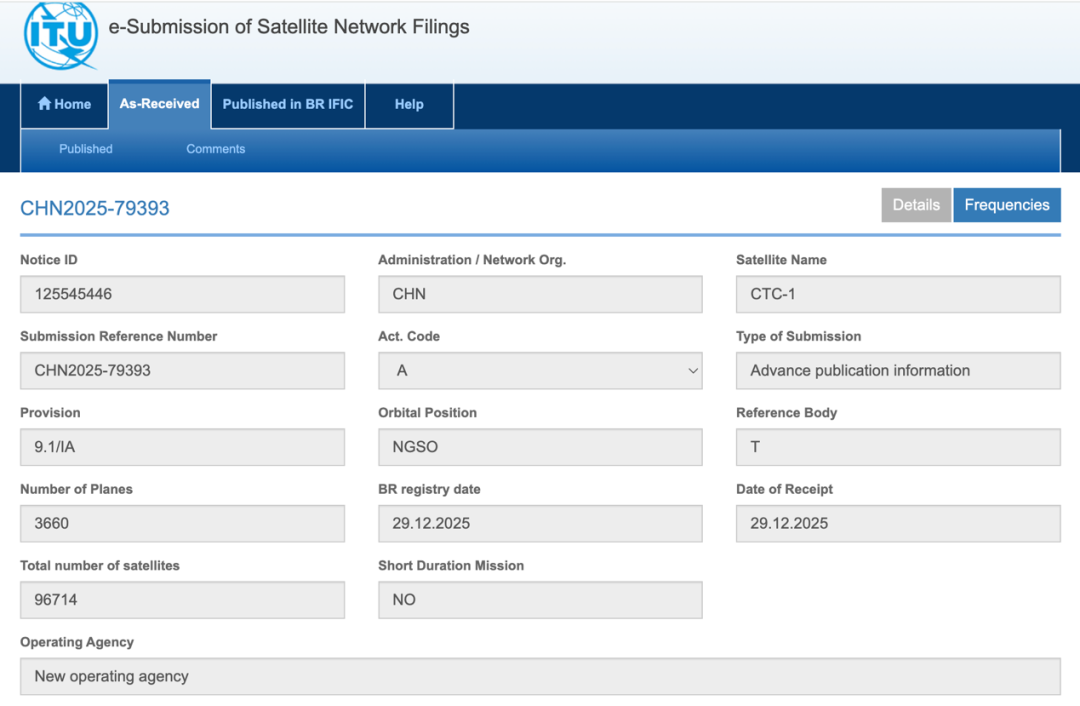
报告导读: 中国新增申请 20 万颗卫星覆盖 14 个星座,含中国移动、中国星网、垣信卫 星等。本轮申报数量激增近一个数量级,未来可能引发全球对太空战略资源的新一轮关注 事件: 近日,中国向国际电信联盟( ITU )提交了新增 20.3 万颗的卫星申请,此次申报涵盖 14 个卫星星座,其中 CTC-1 和 CTC-2 两个星座各自申请 96,714 颗,成为本轮申报的主力。除中国星网、垣信卫星等专业卫星运营商外,申报主体首次广泛包括无线电创新院、银河航天、国电高科等商业航天企 业,以及中国移动、中国电信等传统通信运营商。 申报超 20 万颗,抢占频轨资源 " 制高点 " 。 此次中国向 ITU 提交的 20.3 万颗卫星申报,规模远超此前 "GW 星座 " (约 1.3 万颗)与 " 千帆星座 " (约 1.5 万颗)的总和,标志着中国低轨星座建设从 " 千星 " 迈向 " 十万星 " 量级的新纪元。其中, CTC-1 与 CTC-2 两个超大星座合计申报近 19.3 万颗,成为绝对主力。在近地轨道( LEO )频轨资源日益拥挤的背景下,这种 " 饱和式申报 " 体现了国家级战略意志,旨在通过 " 占频保轨 ...

为什么中国要一口气申报20万颗卫星?
Xin Lang Cai Jing· 2026-01-13 11:27
Core Viewpoint - China has submitted an application to the International Telecommunication Union (ITU) for approximately 203,000 satellites, covering 14 satellite constellations, which is nearly five times the scale of SpaceX's Starlink program, currently capped at about 42,000 satellites [1][21]. Group 1: Application Details - The application includes nearly 190,000 satellites from a newly established institution, the Radio Spectrum Development and Utilization and Technology Innovation Research Institute, which was registered on December 30, 2025 [2][21]. - The application features two massive constellations, CTC-1 and CTC-2, each requesting 96,714 satellites, along with additional constellations from China Mobile and other commercial space enterprises [4][22]. Group 2: Strategic Intent - The large-scale application aims to secure orbital and frequency resources early, preventing later entrants from occupying these resources, in line with the ITU's "first come, first served" principle [8][26]. - The application reflects a strategic shift in China's frequency resource layout, potentially covering traditional Ku and Ka bands, as well as future 6G communication bands [13][31]. Group 3: Competitive Landscape - The competition for low Earth orbit (LEO) satellites is intensifying, with the need for increased launch frequency and satellite manufacturing capacity becoming critical [9][28]. - SpaceX has demonstrated the ability to deploy nearly 10,000 Starlink satellites in a short time due to its reusable Falcon 9 rocket technology, significantly reducing launch costs [9][27]. Group 4: Industry Challenges - Achieving the deployment of approximately 19,400 satellites within nine years to retain frequency resources poses a significant challenge for China's space industry, requiring a substantial increase in launch capabilities [9][27]. - The theoretical limit for satellites in LEO is estimated at around 60,000, indicating a crowded orbital environment [10][29]. Group 5: Regulatory and Safety Concerns - The ITU's "milestone rules" require that satellite constellations must launch their first satellite within seven years of obtaining frequency resources, with subsequent deployment milestones [8][26]. - Recent close encounters between SpaceX's Starlink satellites and China's space station highlight the safety risks associated with increased satellite traffic in LEO [5][23].
商业航天:战略定位升级,核心环节突破
Changjiang Securities· 2026-01-13 06:13
- The report primarily focuses on the commercial aerospace industry, highlighting its strategic importance and the development of its ecosystem, including satellite manufacturing, rocket launches, and downstream applications[9][15][28] - The "Guozheng Commercial Satellite Communication Industry Index" (980018.CNI) is introduced as a quantitative model reflecting the performance of A-share companies in the satellite communication industry, covering the entire value chain from satellite manufacturing to communication services[10][61][80] - The index's construction methodology emphasizes its focus on the aerospace and electronics sectors, with a concentrated weight distribution in core industry segments such as aerospace equipment, communication devices, and semiconductors[10][61][66] - The "Satellite ETF (159206)" is a passive index fund designed to closely track the performance of the Guozheng Satellite Communication Index, employing a full replication strategy to minimize tracking error and deviation[11][83] - The ETF's performance metrics include an annualized tracking error target of less than 2% and a daily tracking deviation of less than 0.2%, with a fund size of 117.69 billion yuan as of January 9, 2026[11][83] - The Guozheng Satellite Communication Index has demonstrated superior returns compared to broader market indices, with a year-to-date return of 18.96% and a one-year return of 122.94% as of January 9, 2026[80][81] - The index's constituent stocks include leading companies in aerospace equipment, electronic manufacturing, and semiconductor design, reflecting a balanced mix of large-cap leaders and growth-oriented mid-cap firms[67][68][70]



我国新增超20万颗卫星申请
第一财经· 2026-01-12 10:29
2026.01. 12 本文字数:1390,阅读时长大约4分钟 作者 | 第一财经 钱童心 在中国商业航天多重利好影响下,2026年开年,卫星产业链表现持续强劲。1月12日,卫星ETF (563230)、卫星ETF易方达(563530)、卫星产业ETF(159218)、卫星ETF(159206)、 卫星ETF鹏华(563790)均触及涨停。 另据Wind数据,截至1月9日,中证卫星产业指数近一个月涨幅接近65%,国证商用卫星通信产业指 数近一个月涨幅也超过50%。多只卫星ETF近一个月的业绩涨幅也都超过60%,卫星产业相关ETF 及联接产品总规模达237.6亿元,较2025年末的121.1亿元接近翻倍。永赢国证商用卫星通信产业 ETF最新规模更是达到117.69亿元,成为市场上诞生的首个单只规模破百亿元的卫星ETF。 市场普遍认为,2026年将成为中国商业航天产业加速发展的元年,具备高进入壁垒、强政策支持和 明确订单可见性的产业中游,火箭发射、卫星制造等领域更具景气确定性。 有基金经理表示,近期商业航天板块利好消息密集释放,政策支持落地、行业标杆企业IPO推进等多 重利好因素等提振下,2026年中国商业航天板 ...

中信建投证券:预计我国可回收火箭年内迎来密集试飞,更好满足卫星发射需求
Xin Hua Cai Jing· 2026-01-12 06:17
Group 1 - The International Telecommunication Union (ITU) reported that by December 2025, China has submitted plans for over 200,000 large-scale satellite constellations, setting a new record for satellite constellation applications in the country [1][2] - The applications include contributions from various entities such as China Satellite Network Group, Shanghai Yuanxin, and traditional telecom operators like China Mobile and China Telecom, indicating a rapid integration of satellite internet into the national information infrastructure [1][2] - According to ITU regulations, satellite frequency and orbital resources follow a "first-come, first-served" principle, requiring the first satellite to be launched within seven years of application and full deployment within nine years, which means China must launch its first satellite by the end of 2032 and complete all deployments by the end of 2039, averaging 14,300 launches per year [2] Group 2 - CITIC Securities predicts that by 2026, China will see a surge in test flights of reusable rockets, which will help reduce launch costs and increase frequency to meet the growing demand for satellite launches [3] - In 2025, China successfully completed the maiden flights of the Zhuque-3 and Long March 12A reusable rockets, although further technical iterations are needed for first-stage recovery [3] - The construction and utilization of domestic commercial rocket launch sites are expected to shorten the test flight cycle, with the total number of launches in 2026 projected to exceed 100, up from 92 in 2025, laying a solid foundation for regular reusable rocket launches [3] Group 3 - A detailed table outlines various rocket models planned for 2026, including the Long March 12A, Long March 12B, and Zhuque-3, with specific launch timelines and key information about their development status [4] - The Long March 12A has successfully completed its first flight but is currently undergoing optimization for recovery, while the Long March 12B is expected to have its maiden flight in 2026 [4] - Other models like the Long March 10 series and Zhuque-3 are also scheduled for launches in 2026, indicating a robust pipeline for China's space launch capabilities [4]

商业航天概念再度爆发,星图测控、流金科技斩获“30cm”涨停
Huan Qiu Lao Hu Cai Jing· 2026-01-12 05:53
根据《中国商业航天产业研究报告》,中国商业航天产业规模预计在2025年达到2.5万亿-2.8万亿元,年 均复合增长率超20%,商业航天企业数量超过600家。另据该报告统计,2025年我国共完成87次航天发 射任务,其中民营商业火箭企业承担23次。 多家券商研报认为,商业航天正逐步迈入规模化发展阶段,行业需求将沿着产业链上下游持续释放。 中邮证券认为,在政策与市场的双重驱动下,商业运载火箭和商业卫星公司大量涌现,产业链条快速完 善,中国商业航天行业已进入快速发展阶段,预计2030年中国市场规模将达到8万亿元人民币。 概念股的走强背后,或与行业重磅消息的催化有关。国际电信联盟(ITU)官网披露的信息显示,我国 于2025年12月25日至31日期间正式提交新增20.3万颗卫星的频率与轨道资源申请,覆盖14个中低轨卫星 星座,这也是我国迄今规模最大的一次国际频轨集中申报行动。 从申报主体来看,本次卫星频谱轨申请涉及中国星网、上海垣信、中国移动、中国电信、无线电频谱开 发利用和技术创新研究院(无线电创新院)、国电高科、航天驭星、银河航天等多家公司机构,申报运 营主体全面扩容。 此次大规模卫星频轨申请的与政策支持、全球竞 ...

商业航天行业点评报告:商业航天:我国新增超20万颗卫星申请,全球太空资源竞争加速
ZHESHANG SECURITIES· 2026-01-11 10:23
Investment Rating - The industry investment rating is "Positive" (maintained) [6] Core Insights - China has submitted applications for over 203,000 satellites, indicating a significant expansion of satellite operation entities [1] - The global competition for space resources is accelerating, with China's new satellite applications aimed at securing frequency and orbital resources [3] - SpaceX has been approved to deploy an additional 7,500 second-generation Starlink satellites, bringing the total approved satellites to 15,000, enhancing network coverage both domestically and internationally [2] Summary by Sections Satellite Applications - In the last week of 2025, China reported multiple satellite constellation plans to the International Telecommunication Union (ITU), totaling 203,000 satellites [1] - The applications cover 14 satellite constellations and involve various operators, including traditional telecom companies and commercial space enterprises [1] Global Competition - The limited capacity for low Earth orbit satellites and the requirement for prior frequency resource applications are intensifying global competition in the space sector [3] - The core objective of China's new satellite applications is to secure frequency and orbital resources, further solidifying the domestic commercial space industry [3] Investment Recommendations - Focus on leading companies in the rocket and satellite sectors, including: - Rocket sector: Hangyang Co., Srey New Materials, Aerospace Power, and others [4] - Satellite sector: China Satellite, Maiwei Co., Zhenyou Technology, and others [4]