Rokid

Search documents
Rokid与杭州文旅、支付宝签约“镜游杭州”项目
Zheng Quan Shi Bao Wang· 2025-12-15 11:50
人民财讯12月15日电,12月15日,以"AI重塑文旅新生态"为主题的2025杭州数字文旅产业发展大会在世 界旅游联盟总部举行。会上,Rokid与杭州市文化广电旅游局、支付宝(杭州)数字服务技术有限公司共 同签署"镜游杭州"项目合作协议,共同开启以"智能眼镜+文旅AI智能体"为核心的沉浸式旅游体验新篇 章。 ...
AI眼镜卖爆,产能跟不上了
3 6 Ke· 2025-12-15 07:03
Core Insights - AI glasses are transitioning from niche products to mainstream consumer items, with multiple domestic manufacturers launching new models this year and Google entering the market recently [1][11] - There is a significant supply chain bottleneck affecting popular models, with long wait times for new orders, indicating high demand [1][3][4] - The market for AI glasses is still in the early stages of consumer education, leading to high foot traffic in stores but low conversion rates for purchases [1][5][8] Company Summaries - Quark AI glasses launched two series, S1 and G1, with prices starting at 3,799 yuan and 1,899 yuan respectively, but are facing supply shortages with delivery times extending to 45 days [2][3] - Rokid has also experienced production challenges, with a goal to sell over 1 million units next year, supported by a recent increase in active users [3][4] - Both Quark and Rokid are working to enhance production capacity, with Quark adding a new assembly line and Rokid collaborating with Lens Technology to overcome production bottlenecks [4][12] Market Dynamics - The primary buyers of AI glasses are enterprise users, with applications in professional settings such as presentations and translation, while general consumers show interest mainly out of curiosity [6][8] - Despite similar functionalities, Quark and Rokid glasses have different pricing strategies and customization options for prescription lenses, affecting consumer choices [9][10] - Google’s entry into the AI glasses market, along with partnerships with major tech companies, highlights the growing potential of the industry and the diverse approaches being taken by different brands [11][13] Technical Challenges - The AI glasses industry faces significant technical hurdles, particularly in balancing battery life and performance, as well as the need for more compelling applications to drive consumer adoption [14]

AI眼镜缺货凸显产能瓶颈 产业链上市公司迎发展机遇
Xin Lang Cai Jing· 2025-12-15 03:33
Core Insights - The AI glasses market is transitioning from niche products to mainstream consumer adoption, with multiple domestic manufacturers launching new models this year and Google entering the market recently [1][12]. Production Capacity Challenges - Quark AI glasses and Rokid are facing production bottlenecks, with Quark's new orders requiring a wait of at least 15 days, and Rokid's supply chain operating in three shifts to meet demand [1][3]. - Quark has added a new production line to increase capacity, aiming to fully release production by January to capitalize on the upcoming consumer demand during the Spring Festival [4][12]. - Rokid's active user base has surpassed 100,000, with a sales target of over 1 million units for next year, supported by improvements in production capacity for optical waveguide lenses [3][4]. Market Dynamics and Consumer Behavior - The current market for AI glasses is characterized by high product homogeneity, with various brands offering similar functionalities, yet the overall market is still in the early stages of consumer education [1][5]. - Sales are primarily driven by enterprise users, with individual consumers showing limited purchasing intent despite high foot traffic in physical stores [6][8]. - The conversion rate from trial to purchase remains low, with sales personnel noting that many customers are curious but not ready to buy [8]. Competitive Landscape - Google has announced two new AI glasses products, indicating a significant entry into the market, which could enhance the industry's growth potential [12]. - Different brands are exploring various technological paths, with some focusing on AR optical displays while others emphasize voice and audio interaction, reflecting a diverse approach to wearable AI technology [12][13]. Technical Challenges - The AI glasses industry faces several technical hurdles, including balancing battery life and performance, as well as the need for more diverse applications and ecosystems [13]. - Current products struggle with short battery life and heavy designs due to the high computational demands of AR displays, while audio devices are still defining their unique value propositions [13].
全球硬件 -AI 眼镜:下一类快速增长的边缘设备-Global Hardware AI Glasses the Next Fast-Growing Edge Device
2025-12-15 01:55
Summary of AI Glasses Market and Key Players Industry Overview - The AI glasses market is projected to grow significantly, with shipments expected to reach approximately 112 million units by 2030, reflecting a compound annual growth rate (CAGR) of 105% from 2024 to 2030 [1][2][18] - Market revenues are forecasted to reach US$40 billion by 2030, with a CAGR of 112% during the same period [1][2][18] - The market is characterized by evolving technology and increasing competition among major tech companies [2][50] Key Players and Market Share - **EssilorLuxottica-Meta** is expected to maintain market leadership with a projected share of around 31% by 2030, down from over 90% in 2024 [1][2][18] - **Google** is anticipated to capture approximately 27% of the market share, followed by **Apple** at around 16% [1][2][18] - Other notable players entering the market include **Snap**, **Samsung**, **Tencent**, and **ByteDance**, indicating a trend towards collaboration between tech companies and fashion brands [2][50][61] Technological Insights - Optical components are critical for AI/AR glasses, potentially accounting for 40-70% of the overall bill of materials (BOM) for fully-featured smart glasses [3][28][39] - The complexity of AI capabilities and interaction design will influence hardware development, with a focus on lightweight, power-efficient semiconductor solutions [32][33] - Current dominant players in the semiconductor space include **Qualcomm**, which is expected to remain a key supplier for smart glasses [3][32] Development Challenges - Key challenges in smart glasses development include semiconductor limitations, battery life, design aesthetics, operating systems, display technology, and eyewear distribution channels [32][33][34][36][37] - The need for stylish designs and compatibility with prescription lenses is crucial for mass adoption, as traditional eyewear companies leverage their distribution networks [37][38] Market Catalysts and Risks - Anticipated product launches from major tech companies in 2026 are seen as potential catalysts for market growth, alongside quarterly shipment updates, particularly from Meta [5][50] - Risks include potential oversupply in the supply chain if production increases ahead of demand, which could lead to downward pressure on prices [5] Future Outlook - The AI glasses market is expected to evolve into a mainstream product category by 2026, with significant advancements in features and functionalities [2][50][61] - Companies like **Meta** and **Apple** are focusing on integrating AI capabilities into their products, with Apple reportedly prioritizing AI smart glasses over mixed reality headsets [61][62] - The partnership between **EssilorLuxottica** and **Meta** is highlighted as a strategic advantage, combining fashion expertise with technological innovation [55][56] Conclusion - The AI glasses market is poised for rapid growth, driven by technological advancements and strategic partnerships among key players. The success of these products will depend on overcoming development challenges and effectively addressing consumer needs for design and functionality.




蓝思科技(300433):垂直整合夯实基础 从云到端全面布局卡位核心
Xin Lang Cai Jing· 2025-12-13 08:34
Core Viewpoint - The company is comprehensively laying out its strategy in the AI cloud computing and AI edge computing sectors, planning to acquire 100% of PMG to quickly gain mature technology and customer certifications in server cabinet business, as well as advanced liquid cooling system integration capabilities [1][2] AI Cloud Computing - The company intends to acquire PMG International Co., LTD to enhance its AI cloud computing layout, as PMG holds a 95.1164% stake in Yuan Shi Technology, which provides server cabinet solutions and is one of the five suppliers certified by NVIDIA [2] - This acquisition will allow the company to quickly obtain mature technology and customer certifications in the server cabinet business, significantly enhancing its core competitiveness in AI computing hardware solutions [2] AI Edge Computing - The company has established a vertical integration capability in AI edge computing, providing core components for smart glasses and embodied intelligence, and has formed deep collaborations with major domestic and international clients [3][4] - The company has launched a new subsidiary, Lens Optoelectronics Technology, to strengthen its vertical integration capabilities in the optical industry [3] Robotics - The company has built a vertical integration platform for humanoid robots, covering core components to complete assembly, and has successfully entered the supply chain of leading North American and domestic robot manufacturers [4][5] - The company is expected to produce 3,000 humanoid robots and over 10,000 quadruped robots in 2025, positioning itself as one of the largest manufacturers in the embodied intelligence hardware sector [4] Consumer Electronics - The company's consumer electronics segment is expected to benefit from the release of foldable models and upgrades in structural components, with significant increases in unit value for foldable devices [6] - The company is a core supplier for key products in foldable devices, including UTG cover plates and glass support plates, which will enhance its revenue potential [6] Automotive Glass - The company's ultra-thin laminated automotive glass has received various certifications and is expected to achieve mass production by the end of 2025, with a production capacity that can meet the demand for over a million vehicles [7] - The automotive glass business is anticipated to become a significant growth driver for the company in the coming years [7] Financial Forecast - The company forecasts revenues of 91.01 billion, 114.98 billion, and 138.58 billion for 2025-2027, with year-on-year growth rates of 30.2%, 26.3%, and 20.5% respectively, and corresponding net profits of 4.74 billion, 6.67 billion, and 8.33 billion [8]

从AR眼镜产业演进看科技金融服务新质生产力的实践逻辑
Zheng Quan Ri Bao Wang· 2025-12-12 10:17
Core Insights - The global technology competition is rapidly evolving, with cutting-edge technologies like AI, spatial computing, and human-machine collaboration reshaping production, lifestyle, and national competitiveness [1] - The 20th National Congress of the Communist Party of China emphasizes accelerating the development of new productive forces and strengthening the role of enterprises in technological innovation, placing "technology finance" as a top priority in building a strong financial nation [1] Development Challenges - Traditional AR glasses face commercialization challenges, with global sales projected at only 500,000 units in 2024, significantly below early market expectations [1] - The core issue lies in the "all-or-nothing" development paradigm, which creates a negative cycle of high R&D investment, high-cost pricing, low user acceptance, and immature supply chains [1][3] - This approach neglects critical variables such as market acceptance, user behavior inertia, and capital patience, making it incompatible with the new paradigm of "early, small, long-term, and hard technology" in technology finance [1] Evolution Path - A new "gradual iterative" paradigm is emerging, led by AI smart glasses, which is validating a three-stage evolution path: audio/camera glasses, AI smart glasses, and AI+AR glasses [2][5] - The first stage involves audio/video glasses that integrate basic functions to cultivate user habits without altering wearing preferences [5] - The second stage introduces AI capabilities for enhanced functionality, transforming devices from mere tools to intelligent companions, as evidenced by the success of Meta's Ray-Ban Meta glasses [7] - The third stage aims to incorporate lightweight AR display modules, achieving "what you see is what you get" spatial computing, supported by accumulated orders that drive down optical module costs [8] Market Logic - The "gradual iterative" approach targets a substantial existing market of over 1.54 billion units of traditional glasses sold annually, providing a natural user base for smart glasses [9] - This paradigm shift redefines smart glasses as "smart traditional glasses," significantly lowering decision-making barriers and facilitating market penetration [9] - Investment in the AR sector is transitioning from a technology risk-driven model to one focused on market validation, with significant funding increases observed in 2025 [9] Competitive Landscape - The global AR glasses market is evolving, with competition shifting from short-term hardware comparisons to long-term ecosystem building [11] - Companies like Meta and Google are adopting different strategies, with Meta focusing on a closed-loop experience and Google promoting an open ecosystem [11] - Domestic players are leveraging rapid hardware iterations and vertical market penetration, while larger companies like Huawei and Xiaomi are creating seamless cross-device experiences [11] Capital Mechanism - The evolution of AR glasses represents a microcosmic experiment in the collaboration of technology, finance, and institutional evolution [12] - The "gradual iterative" paradigm addresses structural mismatches between technological innovation and financial capital, allowing for phased value release mechanisms [14] - This approach enables capital to receive mid-term market feedback and cash flow support without sacrificing long-term visions, alleviating common challenges faced by early-stage hard technology projects [14] Future Outlook - The true revolution of consumer-grade AR glasses lies in redefining the relationship between humans, information, and the world, facilitating seamless integration of digital information into physical reality [16] - AR glasses have the potential to enhance social interactions, transforming them from social isolators to social enhancers, provided they are designed thoughtfully [17] - The successful adoption of AR glasses will depend on the establishment of ethical frameworks and institutional support to address privacy concerns and ensure equitable access [18]
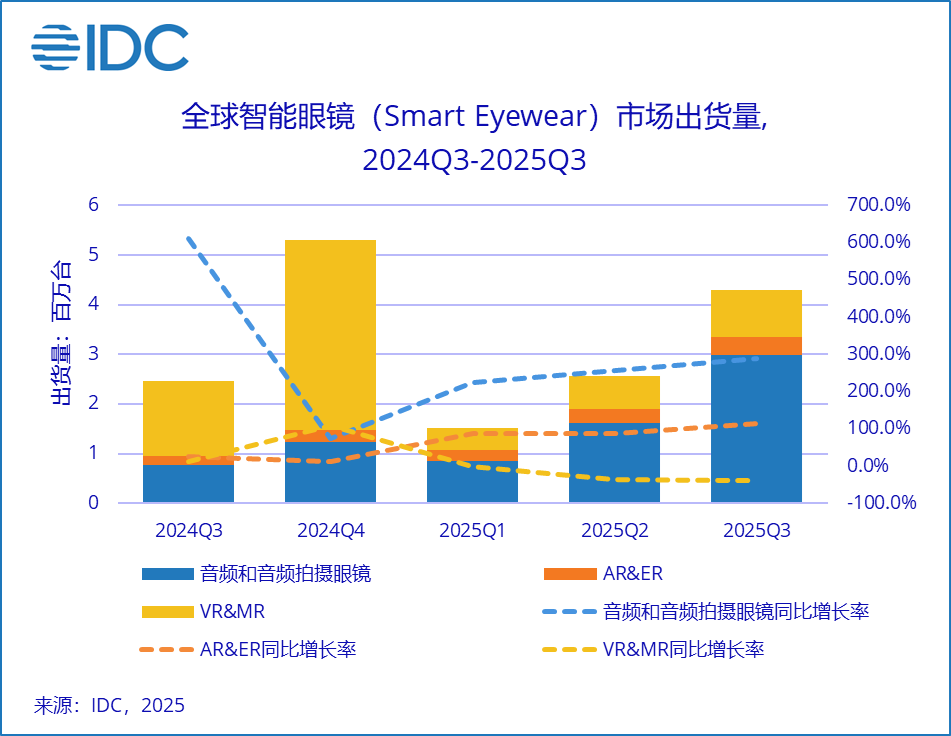
IDC:三季度全球智能眼镜出货量同比增长74.1% 音频和音频拍摄品类大增287.5%
智通财经网· 2025-12-12 06:07
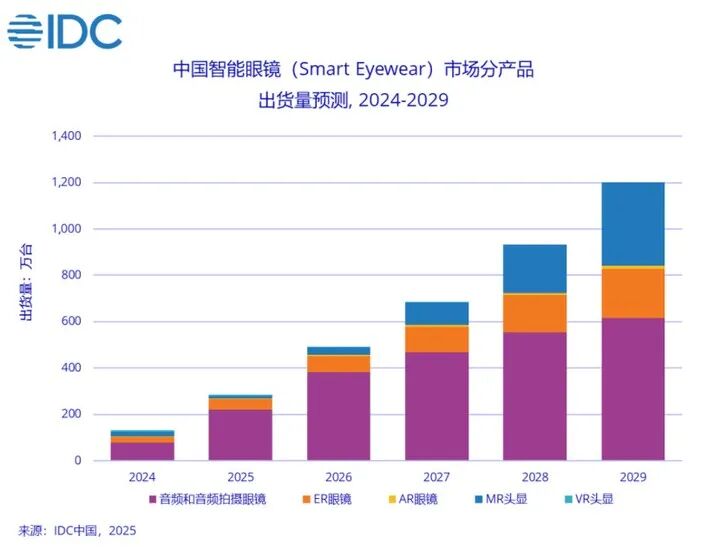
Core Insights - The global smart eyewear market is projected to ship 4.296 million units in Q3 2025, representing a year-on-year growth of 74.1% [1] - The audio and audio-capturing glasses segment is expected to see a significant increase in shipments, with a year-on-year growth of 287.5%, while the AR/VR segment is experiencing a decline of 23.2% [1] - Meta has launched new products, achieving a market share of 75.7%, while Chinese manufacturers like Xiaomi, Thunder, Xreal, and Viture are also gaining traction in the market [1] Global Market Overview - The global smart eyewear market is expected to see a shipment of 4.296 million units in Q3 2025, with a year-on-year growth of 74.1% [1] - The audio and audio-capturing glasses market is projected to ship 2.994 million units, showing a remarkable growth of 287.5% [1] - The AR/VR market is expected to ship 1.302 million units, but it is facing a decline of 23.2% [1] Chinese Market Insights - The Chinese smart eyewear market is projected to ship 623,000 units in Q3 2025, reflecting a year-on-year growth of 62.3% [3] - The audio and audio-capturing glasses segment in China is expected to ship 454,000 units, with a year-on-year growth of 79.2% [5] - The AR/VR market in China is expected to ship 169,000 units, showing a year-on-year growth of 29.4% [6] Product Innovations and Trends - Major Chinese brands are launching new products, including Alibaba's Quark G1 and Baidu's AI glasses, which are expected to enhance market dynamics [5] - The proportion of products supporting large models has reached 49.5%, indicating a trend towards AI integration in smart eyewear [5] - The AR/ER category is leading growth in the AR/VR market, with a market share of 83.4% and a year-on-year growth of 142.3% [6] Future Projections - The Chinese smart eyewear market is expected to reach 4.508 million units by 2026, with a year-on-year growth of 77.7% [6] - The audio and audio-capturing glasses segment is projected to ship 3.434 million units, reflecting a growth of 68.1% [6] - The AR/VR device shipments are expected to reach 1.073 million units, with a year-on-year growth of 62.1% [6] Competitive Landscape - The smart eyewear market is entering a phase of scale growth, with major companies launching new products and driving technological innovation [8] - Competition is shifting towards ecosystem collaboration, content integration, and practical application scenarios [8] - The market is expected to see a more diverse competitive landscape, with a focus on user experience, AI functionality, and ecosystem completeness [9]

AI眼镜大混战:大厂抢入口,“Rokid们”紧张?
3 6 Ke· 2025-12-11 04:22
市场越来越清楚,想做好一款AI智能眼镜,要先让产品可以被用户戴一整天;而不少企业本就已经拥有AI、显示等相关技术,似乎只要做好取舍、让产 品真正有用,就很容易拿到这个赛道的入场券。 在近期的AI智能眼镜市场中,大厂跨界的消息越来越多。 近日,谷歌宣布其正着手开发两种不同类别的AI眼镜:一类配备显示屏,另一类则主打音频功能。谷歌还表示,第一款合作开发的AI眼镜将于2026年上 市。另据智能涌现报道,腾讯内部已开始小范围研究AI眼镜方向;字节跳动在去年立项了两个AI眼镜项目…… 而大厂的发力也并不只停留在传出消息这一层面,近几日,单是拿出新产品的大厂就有两家。 11月27日,预热多时的夸克正式发布了旗下两个系列的AI眼镜产品;几天后的12月3日,理想汽车正式推出了旗下首款人工智能硬件产品——理想AI眼镜 Livis。 大厂们之所以对AI智能眼镜趋之若鹜,与这条赛道逐渐明晰的迭代方向以及软硬件技术的逐步落地有关。 当然,行业中的创业公司也都跟上了热潮。随着行业关注度的提升,以Rokid、雷鸟、XREAL等为代表的智能眼镜品牌纷纷加快了迭代速度,逐渐被更多 消费者熟知。 但挑战也接踵而至。在每一个新对手的实力都不容小 ...

AI 眼镜,距离大众市场还有多远?
3 6 Ke· 2025-12-10 09:12
看到天上的灿烂云霞,点一点眼镜就能拍照留念;参加一场会议,点一点眼镜就能录音总结。 2025年,AI眼镜成了不少人的娱乐搭子。 这些眼镜外观类似普通黑框眼镜,重量在39克~50克之间,比近视眼镜(20g-25g)略重,普遍配有摄像头、麦克风、扬声器,搭载大模型和AI助手,可以 录音录像、拍照识物,续航6h-8h。价格则500-8000元不等,有无AR设备成为价格分水岭,无AR的AI眼镜价格在500-2000元不等,单目AR眼镜价格2000 元以上,双目AR眼镜价格3000元以上。 这是一个再次热闹起来的市场。2021年Roblox爆火带起一波AR眼镜热,Rokid、雷鸟创新、影目科技、Xreal等厂商相继入局(参考阅读《失信难产跳水 月赚1400亿!竟在这件事上输于起跑线》);2023年底Meta Ray-Ban带起一波AI眼镜热,AR厂商顺利转型,同时互联网大厂带资进组,行业热情被彻底 点燃。 IDC预计,2025年全球智能眼镜市场出货量将达到1451.8万台,同比增长42.5%;中国市场的增长更为迅猛,出货量预计达290.7万台,同比暴涨121.1%。 618期间,京东平台AI眼镜成交量同比增长7倍;"双 ...
被忽视的“最后一公里”!跑遍广州八大商场,我发现了AI眼镜的真相
3 6 Ke· 2025-12-09 10:26
Core Insights - Google re-enters the smart glasses market with Project Aura, a collaboration with XREAL, set to launch in 2026, featuring the Android XR platform and Gemini AI [1] - Major players like Meta, Alibaba, and Baidu have already entered the AI glasses space, indicating a growing trend in AI hardware [1] - AI glasses have gained significant attention over the past year, with various brands launching new products and consumers discussing their applications on social media [1] Industry Overview - The AI glasses market is becoming increasingly competitive, with new entrants like Li Auto and collaborations such as Rokid and BOLON generating buzz [1][2] - A recent evaluation by Lei Technology highlights the performance of various AI glasses, including BOLON AI glasses and Quark S1 [2] Market Presence - Despite the hype, AI glasses are not widely available in physical retail locations, particularly in Guangzhou's major shopping districts, indicating a gap between online interest and offline availability [4][5][26] - The lack of AI glasses in prominent retail spaces suggests that they have not yet reached mainstream consumer channels, limiting their visibility and accessibility [26] Consumer Experience - Traditional eyewear retailers are not fully equipped to handle the technological aspects of AI glasses, leading to a disconnect in customer service and product knowledge [27][30] - The dual identity of AI glasses as both tech products and everyday eyewear complicates their market positioning, requiring a balance between digital and optical expertise [30][40] Distribution Challenges - The integration of AI glasses into the traditional eyewear market faces challenges, particularly in providing comprehensive services like fitting and prescription [30][41] - Companies like Rokid and Quark are exploring different approaches to address the compatibility and fitting issues associated with smart glasses [60] Future Outlook - For AI glasses to achieve widespread adoption, a robust offline system that facilitates consumer confidence in purchasing, fitting, and using these products is essential [65] - The industry must navigate the complexities of consumer education and retail integration to ensure that AI glasses become a seamless part of everyday life [65]