华熙生物

Search documents
医疗美容板块8月18日涨1.03%,锦波生物领涨,主力资金净流出781.13万元
Zheng Xing Xing Ye Ri Bao· 2025-08-18 08:45
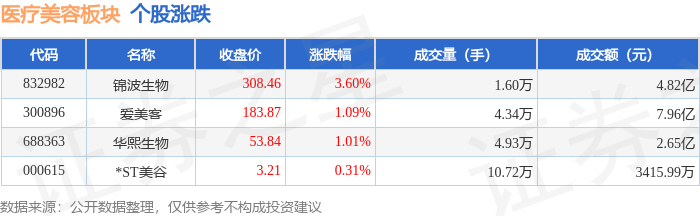
Market Performance - The medical beauty sector increased by 1.03% on August 18, with Jinbo Biological leading the gains [1] - The Shanghai Composite Index closed at 3728.03, up 0.85%, while the Shenzhen Component Index closed at 11835.57, up 1.73% [1] Individual Stock Performance - Jinbo Biological (832982) closed at 308.46, with a rise of 3.60% and a trading volume of 16,000 shares [1] - Aimeike (300896) closed at 183.87, up 1.09% with a trading volume of 43,400 shares [1] - Huaxi Biological (688363) closed at 53.84, increasing by 1.01% with a trading volume of 49,300 shares [1] - *ST Meigu (000615) closed at 3.21, up 0.31% with a trading volume of 107,200 shares [1] Capital Flow Analysis - The medical beauty sector experienced a net outflow of 7.81 million yuan from main funds, while retail funds saw a net outflow of 22.98 million yuan [1] - Speculative funds had a net inflow of 30.79 million yuan [1] Detailed Capital Flow for Individual Stocks - Aimeike (300896) had a main fund net inflow of 15.99 million yuan, with a retail net outflow of 34.19 million yuan [2] - *ST Meigu (000615) saw a main fund net inflow of 0.25 million yuan, with a retail net outflow of 1.13 million yuan [2] - Huaxi Biological (688363) experienced a main fund net outflow of 24.06 million yuan, while retail funds had a net inflow of 1.23 million yuan [2]



【行业深度】洞察2025:中国功能性护肤品行业竞争格局及市场份额(附市场集中度、企业竞争力分析等)
Qian Zhan Wang· 2025-08-18 08:09
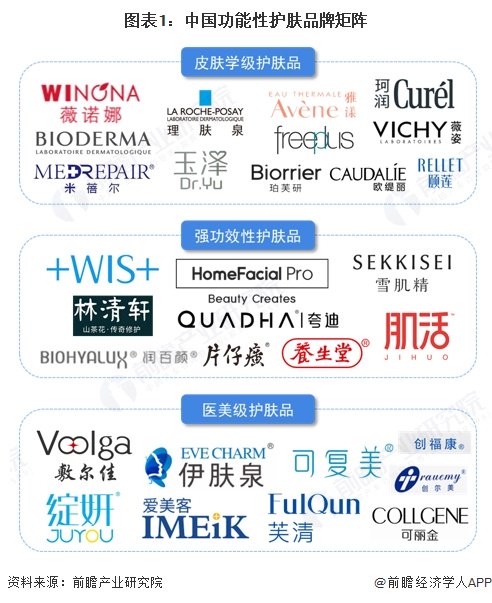
Core Insights - The article discusses the competitive landscape and market dynamics of the functional skincare industry in China, highlighting key players, market share, and industry concentration levels [1][9][11]. Group 1: Brand Ranking - The functional skincare market in China is segmented into three main categories: dermatological skincare, strong efficacy skincare, and medical aesthetic skincare, with leading brands in each category [1]. - Notable brands in dermatological skincare include Winona, La Roche-Posay, and Avene; strong efficacy brands include WIS and HFP; medical aesthetic brands include Fulejia and Aimeike [1]. Group 2: Revenue and Market Position - The functional skincare industry is divided into three tiers based on revenue: - Tier 1: Betaini with revenue exceeding 5 billion CNY, leading the market [3][12]. - Tier 2: Companies like Giant Biological, Shanghai Jahwa, and Fulejia, which have significant revenue and brand recognition [3]. - Tier 3: Companies such as Proya and Furuida, which are publicly listed but have lower revenue from functional skincare [4]. Group 3: Market Share - The projected market size for functional skincare in China for 2024 is approximately 48.743 billion CNY, with Betaini holding a market share of 11.71% [9]. - Other significant players include Huaxi Biological at 5.27%, Fulejia at 4.14%, Shanghai Jahwa at 2.15%, and Giant Biological at 2.44% [9]. Group 4: Market Concentration - The market concentration for domestic functional skincare brands is relatively low, with the top three companies accounting for 21.12% of revenue and the top six for 26.47% [11]. - There is a trend of increasing market concentration, with leading players establishing brand and research barriers [11]. Group 5: Competitive Landscape - The industry shows a strong reliance on imported raw materials, with suppliers having significant bargaining power [16]. - Domestic brands are gaining market share, and competition is intensifying, with high profit margins and potential threats from new entrants and alternative products [16].

中国银河证券:中国医美与护肤市场已进入靶向通路时代 建议关注四大方向
智通财经网· 2025-08-18 02:35
Core Insights - The skincare industry in China is experiencing high growth driven by ingredient transparency and scientifically validated efficacy, with domestic brands leveraging synthetic biology and targeted ingredient development to gain competitive advantages [1][2][3] Group 1: Market Trends - The Chinese skincare market is transitioning to an era of ingredient transparency and scientifically verifiable efficacy, with consumers shifting from brand reliance to rational analysis of ingredient lists [1] - The overall market size for cosmetics in China is projected to reach 774.6 billion yuan in 2024, reflecting a year-on-year decline of 2.83%, while the efficacy skincare segment is expected to grow significantly, surpassing 100 billion yuan [1] - The compound annual growth rate (CAGR) for efficacy skincare products from 2019 to 2024 is estimated at 24.9%, with this segment expected to account for 22.9% of the total skincare market by 2024 [1] Group 2: Product Development and Innovation - The targeted ingredient development has led to a multi-channel synergy for three core functions: anti-wrinkle and firming through peptides and other compounds, soothing and repairing through ingredients like centella asiatica and ceramides, and hydration through amino acids and hyaluronic acid [2] - Domestic brands such as Proya and Winona have entered the top 10 in the high-end anti-aging and soothing markets, traditionally dominated by international brands [2] - The evolution of ingredient formulations has progressed from basic hydration to synthetic biology, with Chinese companies achieving technological advancements, such as Huaxi Biological's breakthrough in hyaluronic acid and the establishment of international standards for recombinant collagen [3] Group 3: Emerging Opportunities - The rise of domestic brands is characterized by cost-effective ingredient innovations and technological differentiation, particularly in the peptide segment, where brands like Proya and Han Shu are reshaping the anti-aging landscape [3] - Traditional Chinese medicine ingredients are becoming core competitive advantages, with significant online sales growth projected for ginseng, astragalus, and artemisia, indicating a strong market for local herbal formulations [3]

可选消费W33周度趋势解析:海外消费表现优异,新消费主题股价稳健回暖-20250817
Haitong Securities International· 2025-08-17 13:34
研究报告 Research Report 17 Aug 2025 中国 & 香港 & 美国可选消费 China (A-share) & Hong Kong & US Discretionary 可选消费 W33 周度趋势解析:海外消费表现优异,新消费主题股价稳健回暖 Week 33 Discretionary Trends: Overseas Consumption Performs Well, New Consumption- Themed Stocks Steadily Recover [Table_yemei1] 观点聚焦 Investment Focus | [Table_Info] | | | | | --- | --- | --- | --- | | 股票名称 | 评级 | 股票名称 | 评级 | | 耐克 | Outperform 德业股份 | | Outperform | | 美的集团 | Outperform 波司登 | | Outperform | | 京东集团 | Outperform 石头科技 | | Outperform | | 格力电器 | Outperform 永辉超市 | | ...
化妆品医美行业周报:淡季布局紧锣密鼓,下周板块财报季重点关注-20250817
Shenwan Hongyuan Securities· 2025-08-17 13:28
Investment Rating - The report maintains a "Buy" rating for the high-end domestic cosmetics brand Mao Geping, projecting a net profit of 1.184 billion, 1.542 billion, and 1.953 billion yuan for 2025-2027, with year-on-year growth rates of +34%, +30%, and +27% respectively [15]. Core Insights - The cosmetics and medical beauty sector underperformed the market, with the Shenwan Beauty Care Index growing by only 0.1% from August 8 to August 15, 2025, lagging behind the Shenwan A Index by 3.0 percentage points [6][7]. - Domestic brands are actively preparing for the upcoming consumption peak, with significant announcements from brands like Proya and Up Beauty, indicating a strategic focus on high-end markets [12]. - Mao Geping's performance in H1 2025 shows a strong revenue forecast of 2.57 billion to 2.6 billion yuan, reflecting a year-on-year growth of 30.4% to 31.9%, and a net profit of 665 million to 675 million yuan, indicating robust profitability in the high-end domestic makeup segment [13][14]. Summary by Sections Industry Performance - The cosmetics and medical beauty sector's performance was weaker than the overall market, with specific indices showing minimal growth [6][7]. - The top-performing stocks in the sector included Baiya Co. (+11.0%) and Nuobang Co. (+6.0%), while the worst performers were Beijia Co. (-13.1%) and Mao Geping (-9.4%) [8]. Recent Developments - The report highlights the upcoming earnings season for key domestic brands, with expectations for significant financial disclosures from companies like Runben Co. and Marubi Biological [12]. - New Oxygen Group reported a Q2 revenue of 379 million yuan, with its light medical beauty chain business showing a remarkable year-on-year growth of 426% [24][25]. E-commerce and Market Trends - The report provides insights into the e-commerce performance of domestic brands, with notable growth in GMV for brands like Proya and Up Beauty, indicating a strong online presence [18]. - The retail sales of cosmetics in July 2025 showed a year-on-year growth of 4.5%, suggesting a recovery in consumer spending [19][22]. Market Share and Competitive Landscape - The domestic cosmetics market is becoming increasingly competitive, with local brands gaining market share against international competitors, as evidenced by the performance of brands like Proya and Natural Hall [31][36]. - The report notes that the market for skincare products is projected to reach 271.2 billion yuan in 2024, despite a slight decline in growth [31].

商贸零售行业周报:7月社零同比+3.7%,老铺黄金官宣产品调价计划-20250817
KAIYUAN SECURITIES· 2025-08-17 12:13
Investment Rating - The industry investment rating is "Positive" (maintained) [1] Core Views - The retail sector shows steady recovery with a year-on-year increase of 4.8% in total retail sales from January to July 2025, and a 3.7% increase in July alone [5][25] - Online channels continue to grow, while offline growth rates are marginally slowing down; specific categories like gold and jewelry, as well as cosmetics, show significant improvement [5][30] - The report emphasizes the importance of consumer sentiment and suggests focusing on high-growth segments such as gold jewelry and domestic beauty brands [8][34] Summary by Sections Retail Market Overview - The retail index closed at 2214.55 points, up 0.44% for the week, underperforming the Shanghai Composite Index which rose by 0.86% [7][16] - The commercial property management sector saw the highest increase this week, while the jewelry sector has led the gains since the beginning of 2025 with a 30.19% increase [20][22] Retail Sales Data - In July 2025, retail sales reached 38,780 billion yuan, with a year-on-year growth of 3.7% [25] - Online retail sales for the first seven months of 2025 reached 86,835 billion yuan, growing by 9.2% year-on-year, with physical goods online sales at 70,790 billion yuan, up 6.3% [27][28] Key Investment Themes - **Gold and Jewelry**: Focus on brands with differentiated product offerings and consumer insights, recommending companies like Laopuhuangjin and Chaohongji [8][34] - **Cosmetics**: Highlighting the rise of domestic brands and the need for innovation in product offerings, with recommendations for brands like Maogeping and Pola [8][35] - **Offline Retail**: Emphasizing the transformation of retail enterprises to adapt to changing consumer behaviors, recommending companies like Yonghui Supermarket and Aiyingshi [8][34] - **Medical Aesthetics**: Suggesting investment in companies with differentiated product lines, recommending Aimeike and Kedi-B [8][36] Company Performance Highlights - Laopuhuangjin reported a revenue of 85.06 billion yuan in 2024, with a net profit increase of 253.9% [40] - Maogeping achieved a revenue of 38.85 billion yuan in FY2024, with a growth of 34.6% [36] - Yonghui Supermarket's revenue for Q1 2025 was 174.79 billion yuan, reflecting a decline of 19.3% [36]



每周股票复盘:华熙生物(688363)发酵法软骨素钠完成医疗器械主文档登记
Sou Hu Cai Jing· 2025-08-16 20:20
Core Viewpoint - Huaxi Biological has successfully registered its fermentation-derived sodium chondroitin sulfate with the National Medical Products Administration, marking it as the first company in China to achieve compliance for this product [1][4] Company Announcements - Huaxi Biological's fermentation-derived sodium chondroitin sulfate has completed the main document registration for medical devices, allowing it to be used in Class II and III medical devices, potentially providing core materials for high-end medical equipment [1][4] - The controlling shareholder, Huaxi Xinyu Investment Co., Ltd., plans to increase its stake in Huaxi Biological by investing between RMB 200 million and RMB 300 million over the next six months, with a maximum purchase price of RMB 70 per share [3][4] Market Context - Traditional chondroitin sulfate is extracted from animal cartilage, which poses issues such as immunogenicity, unsustainable sourcing, and high pollution from extraction processes. The company aims to leverage synthetic biology technology to develop chondroitin sulfate raw materials for ophthalmology, orthopedics, and medical aesthetics [2]
林清轩赴港IPO收证监会反馈:虚假宣传存后遗症,毛利率堪比茅台
Hua Xia Shi Bao· 2025-08-16 03:43
Core Viewpoint - Lin Qingxuan is facing regulatory scrutiny as it prepares for its IPO in Hong Kong, with concerns over unpaid social insurance and false advertising penalties impacting its brand image and potential market performance [2][3][4]. Group 1: Regulatory Concerns - The company received feedback from the China Securities Regulatory Commission (CSRC) regarding its overseas listing, specifically requesting details on unpaid social insurance and housing fund contributions, as well as corrective actions taken after penalties for false advertising [2]. - Lin Qingxuan has a history of regulatory issues, including a fine for misleading advertising claims about its products' anti-aging effects, which raises questions about its compliance and brand integrity [3][4]. Group 2: Financial Performance - Lin Qingxuan has shown significant revenue growth over the past three years, with revenues of 6.91 billion, 8.05 billion, and 12.10 billion yuan for 2022, 2023, and 2024 respectively, reflecting year-on-year growth rates of 16.5% and 50.3% [7]. - The company turned a profit in 2023 with a net profit of 845.18 million yuan, and projected a net profit of 1.87 billion yuan for 2024, following a loss of 5.93 million yuan in 2022 [7]. Group 3: Profitability and Cost Structure - Lin Qingxuan's gross margin exceeded 80% in 2024, significantly higher than industry peers, indicating a strong pricing strategy [2]. - The company's marketing expenses are disproportionately high, reaching 365 million yuan in 2024, which is 12 times its research and development expenditure of 30.4 million yuan [8][10]. Group 4: Brand Positioning and Market Perception - Lin Qingxuan positions itself as a high-end skincare brand, with product prices at least 50% above the industry average, and emphasizes its brand image and retail channel access [11]. - However, market feedback suggests that the perceived value of its products does not align with their high prices, leading to concerns about long-term consumer loyalty and brand reputation [12].

中国注射类医美行业研究报告
艾瑞咨询· 2025-08-16 00:07
Core Insights - The medical beauty industry is undergoing transformation driven by technological advancements and evolving aesthetic perceptions, with non-surgical procedures becoming increasingly popular, particularly in anti-aging treatments [1] - Injection-based aesthetic procedures are gaining traction due to their effectiveness, short recovery times, and high repeat purchase rates, positioning the injection market as a new growth area within the medical beauty sector [1] Injection Aesthetic Concepts and Classification - Injection aesthetic procedures are minimally invasive treatments primarily categorized into hyaluronic acid, botulinum toxin, collagen, regenerative injectables, lipolytic injections, and thread lifting [2] - The market is dominated by hyaluronic acid and botulinum toxin, with botulinum toxin leading globally with 8.878 million treatments in 2023, followed by hyaluronic acid with 5.565 million treatments [2] Market Heat Analysis - The synthetic regeneration field is becoming an investment hotspot, with new materials and combinations expanding market boundaries [5] - By November 2024, 15 injectable products have been approved, primarily hyaluronic acid, with several others including polylactic acid and botulinum toxin [5] Hyaluronic Acid Development Status and Trends - Hyaluronic acid maintains its leading position, with a growth rate of 29.1% from 2022 to 2023, driven by diverse applications and combination treatments [11] - The industry faces challenges such as product homogenization and safety concerns, but innovation and differentiation present opportunities for growth [14][15] Botulinum Toxin Development Status and Trends - The botulinum toxin market is evolving towards a coexistence of natural and recombinant products, with recombinant botulinum toxin expected to penetrate the market due to its safety and customization potential [17] Regenerative Materials Development Status and Trends - Regenerative injectable products, particularly polylactic acid (PLA) and polycaprolactone (PCL), are gaining attention, with hydroxyapatite emerging as a potential market player [23] Collagen Development Status and Trends - The application of collagen in medical aesthetics is expanding, with various types being explored for their unique benefits, particularly types I and III for skin support and hydration [31] User Preferences and Trends - Users increasingly prioritize skin quality and overall facial harmony, with a shift towards personalized beauty standards [39] - The demand for skin improvement remains strong, with private care and hair transplant services emerging as new market opportunities [42] User Decision-Making and Experience - Safety and effectiveness are the primary concerns for users, with a growing emphasis on the qualifications of medical personnel and the quality of procedures over cost [45][60] - Users exhibit a cautious approach to decision-making, with a significant portion requiring thorough research before engaging in aesthetic procedures [47] Market Trends and Future Outlook - The injection aesthetic market is transitioning from simple filling procedures to a focus on long-lasting, precise, and personalized treatments, driven by technological advancements and consumer expectations [68] - Chinese companies are increasingly looking to international markets for growth, with a focus on regulatory compliance and brand recognition to overcome market entry barriers [71]

医疗器械增速放缓、功能性护肤爆发 锦波生物“高价”胶原蛋白产品能否持续领跑?
Mei Ri Jing Ji Xin Wen· 2025-08-15 12:58
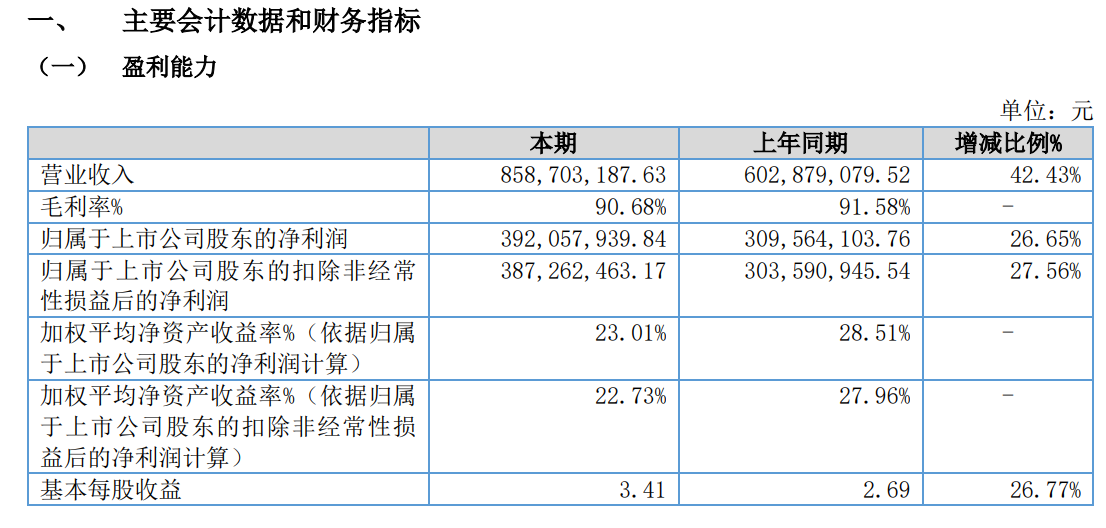
Core Viewpoint - Jinbo Biological, known as the "first stock of collagen protein on the North Exchange," reported a revenue of 859 million yuan and a net profit of 392 million yuan for the first half of 2025, both showing double-digit growth, although the gross margin slightly decreased to 90.68% from 91.58% year-on-year [1][2]. Financial Performance - Revenue for the first half of 2025 reached 859 million yuan, a year-on-year increase of 42.43% compared to 603 million yuan in the same period last year [2]. - Net profit attributable to shareholders was 392 million yuan, reflecting a year-on-year growth of 26.65% from 310 million yuan [2]. - The gross margin was 90.68%, down from 91.58% in the previous year [1][2]. - The weighted average return on equity based on net profit attributable to shareholders was 23.01%, down from 28.51% [2]. Business Segments - The core medical device business, which accounts for over 80% of revenue, saw a revenue increase of 33.41%, significantly lower than the 91.84% growth in the same period last year [5]. - The functional skincare business experienced explosive growth, with revenue increasing by 152.39% year-on-year, driven by proprietary brands like "ProtYouth" [5][4]. - The revenue from single-component functional skincare products had a gross margin of 92.57%, while composite component products had a gross margin of 66.73% [5]. Market Dynamics - The collagen protein market in China is projected to grow at a compound annual growth rate of 44.93%, reaching 58.57 billion yuan by 2025 and 219.38 billion yuan by 2030 [8]. - Jinbo Biological holds all three registered medical device certificates for recombinant human collagen, a significant competitive advantage in the market [9][10]. - The company has seen increased attention from investors, highlighted by a 3.4 billion yuan investment from former billionaire Zhong Shanshan [9]. Competitive Landscape - Competitors like Giant Bio and Huaxi Biological are accelerating their applications for Class III medical device products, indicating a competitive race in the collagen protein sector [10]. - Jinbo Biological's differentiation lies in its dual focus on high-end skincare and medical devices, but the sustainability of this advantage remains to be tested against increasing competition and changing market regulations [10].