沪农商行

Search documents
超千家机构密集调研上市银行!谁最受青睐?重点关注哪些问题?
Xin Lang Cai Jing· 2025-07-07 11:11
Core Insights - The recent surge in institutional interest in listed banks indicates a significant increase in market attention towards bank stocks, reflecting a deep re-evaluation of the banking sector's value amid a weak economic recovery [2][6] - The banking sector has shown strong performance in the first half of the year, with a total stock price increase of 13.1%, making it the second-best performing sector in the market [3][5] Institutional Interest - In the first half of the year, 19 A-share listed banks received over a thousand institutional research visits, marking a record high [1] - Regional banks, particularly those in the Yangtze River Delta, have become the primary targets for institutional investors, with Ningbo Bank, Changshu Bank, and Hangzhou Bank leading in the number of research visits [1] Dividend Policies - Most listed banks have increased their total cash dividends for 2024, with 39 out of 42 banks raising their dividend amounts by a total of 18.6 billion yuan compared to the previous year [2][6] - The average dividend yield for bank stocks stands at 5.04%, significantly higher than the 1.65% yield of 10-year government bonds, making bank stocks attractive to long-term institutional investors [2][3] Asset Quality and Net Interest Margin - Institutions are focusing on banks' asset quality, net interest margin management, and dividend policies during their research [4][5] - The banking sector's non-performing loan ratio is expected to remain low at 1.50% in 2024, although overdue rates are rising, particularly among rural commercial banks [5][6] Future Outlook - Institutions are likely to focus on whether net interest margins stabilize, the direction of loan structure adjustments towards green and technology finance, and the potential for new business growth through digital transformation and comprehensive services [7]



上海农商行拒2万枚硬币兑换,警方验证后仍无果
Guan Cha Zhe Wang· 2025-07-07 10:18
截图来自陆先生社交媒体 7月3日当天,银行工作人员以"硬币来源可疑"为由报警,警方到场核实后确认硬币无假币嫌疑且来源合法,但银行仍拒绝兑换,并要求陆先生签署"自愿放 弃兑换"声明。陆先生表示:"警方已证明合法性,银行仍拒收,这让我难以理解。" 7月3日,上海市民陆先生携带约140斤(约2万枚)1角硬币至上海农商银行总行营业部办理兑换业务时,遭遇工作人员拒绝。尽管警方介入验证硬币来源合 法性,但银行仍以"清点困难""系统故障"等理由未完成受理。 据陆先生陈述,其从事烟酒礼品回收生意,此次携带的硬币系某生活垃圾焚烧发电厂通过焚烧炉灰筛选所得,用于支付货款。自2024年起,他已陆续向十余 家银行兑换硬币,多数机构正常受理,但上海农商银行多次拒收。 截图来自媒体报道 银行业内人士指出,根据《现金管理暂行条例实施细则》,金融机构可与储户协商清点时间,但不得拒绝受理。此外,银行未提供系统故障的具体证明,且 现金业务系统升级属内部管理范畴,不应成为拒收理由。 据悉,硬币清点依赖人工或专用设备,而基层网点硬币清点机的覆盖率有限。老式设备仅支持整卷硬币清点,散币需人工分拣,效率较低。以1角硬币为 例,清点2万枚需2-3名员工工 ...


上市银行红利派发高峰期,7月如何埋伏银行股?
Ge Long Hui· 2025-07-07 09:57
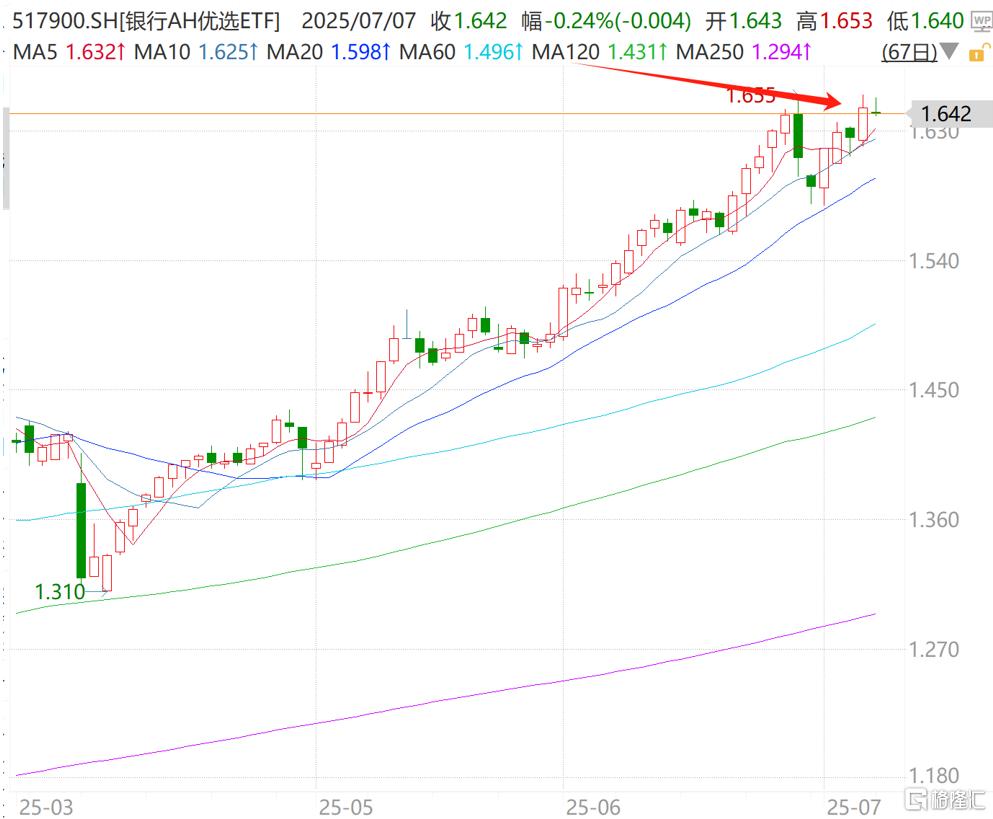
Group 1 - The core viewpoint is that listed banks are proactively announcing dividend plans for 2025, with a peak in dividend distribution expected in July 2024, which is likely to boost bank stocks [1] - The bank AH preferred ETF (517900) has seen its scale grow over 600% since the beginning of the year, increasing from less than 100 million to 722 million in just six months, making it the fastest-growing bank ETF in the market [3] - The continuous rise of the bank AH preferred ETF is attributed to three main reasons: the scarcity of high-dividend assets in a low-interest-rate environment, ongoing policy benefits, and the AH rotation mechanism that provides excess returns [5] Group 2 - In a low-interest-rate environment, with one-year fixed deposit rates below 1% and ten-year government bond yields around 1.65%, the bank AH preferred ETF offers a dividend yield exceeding 6%, attracting long-term funds such as insurance and pension funds [6] - Policy benefits are being continuously released, with potential reallocation funds for bank stocks estimated to be between 500 billion to 800 billion due to public fund assessment regulations, alongside reduced liability costs from recent monetary policy easing [7] - The bank AH preferred ETF utilizes a strategy of buying the cheaper side of banks listed on both A-shares and H-shares, resulting in an 8.48% excess return compared to the CSI Bank Index over the past year, showcasing its effective "automatic arbitrage" design [8] Group 3 - The long-term performance of the bank AH preferred ETF significantly outperforms the CSI Bank Index, indicating a strong investment logic in the banking sector [11] - The bank AH preferred ETF acts as a smart rotation tool in traditional bank stock investments, allowing investors to benefit from high dividend yields while enhancing returns through price difference strategies [11]
投资面再讨论银行周期属性:银行股:从“顺周期”到“弱周期”
ZHONGTAI SECURITIES· 2025-07-06 12:39
Investment Rating - The report maintains an "Overweight" rating for the banking sector [2] Core Insights - The banking sector is transitioning from a "pro-cyclical" model to a "weak cyclical" model, indicating a shift in operational dynamics [2][4] - The report emphasizes the stability of bank dividend yields, which are expected to remain attractive even as risk-free interest rates decline [2][4] - The influx of non-freely circulating funds, such as from state-owned enterprises and insurance capital, is expected to provide a stable source of investment in bank stocks [2][4] Summary by Sections From the Perspective of Risk-Free Interest Rates - Bank dividend yields are characterized by strong certainty and sustainability, with interest margins expected to decline more slowly than risk-free rates [5][12] - The correlation between banks and fiscal policies has strengthened, providing a safety net for core assets [12] - If risk-free interest rates decline, the attractiveness of stable bank dividends will increase, especially in a context of economic weak recovery and asset scarcity [8][18] From the Perspective of Funding Allocation to Bank Stocks - Major funding sources for bank stocks include non-freely circulating funds from fiscal authorities, state-owned enterprises, and insurance capital [5][12] - Non-freely circulating market capitalization accounts for approximately 70% of the banking sector, providing a stabilizing effect [5][12] - Insurance capital is projected to significantly increase its allocation to bank stocks, with an estimated annual inflow exceeding 350 billion [5][12] Investment Recommendations - The report continues to recommend the banking sector, particularly focusing on banks with regional advantages and strong dividend yields [4][12] - Specific recommendations include regional banks in areas like Jiangsu, Shanghai, and Chengdu, as well as major banks such as Agricultural Bank of China, China Construction Bank, and Industrial and Commercial Bank of China [4][12]





银行业周报(20250630-20250706):CIPS规则修订,为何改?改了什么?-20250706
Huachuang Securities· 2025-07-06 12:16
Investment Rating - The report maintains a "Recommended" investment rating for the banking sector, expecting the sector index to outperform the benchmark index by more than 5% in the next 3-6 months [24]. Core Insights - The report highlights the recent revisions to the CIPS (Cross-border Interbank Payment System) rules, which aim to enhance the management of participants and adapt to the growing cross-border e-commerce trade, projected to reach approximately 2.71 trillion yuan in 2024, a 14% year-on-year increase [3][4]. - The CIPS system processed 8.2169 million transactions amounting to 175.49 trillion yuan in 2024, reflecting a significant year-on-year growth of 42.60% [3]. - The report emphasizes the flexibility introduced in the new CIPS rules, allowing financial market infrastructure participants to open CIPS accounts based on business needs rather than strict management requirements [4]. Summary by Sections CIPS Overview - CIPS is a clearing system for cross-border payments in RMB, distinct from SWIFT's messaging system, and has seen a substantial increase in participation, with 174 direct participants and 1,509 indirect participants across 120 countries [2][3]. Recent Developments - The new rules include relaxed entry conditions for system participants, allowing for a more flexible approach to participant management [4]. - The rules specify that foreign direct participants must select domestic direct participants as fund custodians, as foreign banks lack CNAPS accounts [4]. Risk Management Enhancements - The updated regulations detail business processing and risk management requirements, mandating that participants establish robust risk management frameworks and adhere to international anti-money laundering standards [4]. Market Performance - The banking sector index rose by 3.77% during the reporting period, outperforming the CSI 300 index by 2.23 percentage points [8]. - The report suggests a focus on banks with high dividend yields and strong asset quality, recommending major state-owned banks and select regional banks for investment [9]. Company Forecasts - Key banks such as Ningbo Bank, Jiangsu Bank, and China Merchants Bank are highlighted with positive earnings forecasts and investment ratings, indicating strong potential for returns [10].


本周聚焦:5月重点省市信贷投放情况如何?
GOLDEN SUN SECURITIES· 2025-07-06 09:34
Investment Rating - The report indicates a positive outlook for the banking sector, suggesting that certain stocks may benefit from policy catalysts and cyclical recovery [3]. Core Viewpoints - The report highlights that while tariff policies may cause short-term impacts on exports, long-term domestic policies aimed at stabilizing the real estate market, promoting consumption, and enhancing social welfare are expected to support economic growth [3]. - The banking sector is anticipated to benefit from these policies, with specific banks such as Ningbo Bank, Postal Savings Bank, China Merchants Bank, and Changshu Bank being recommended for investment [3]. - The report also emphasizes the potential for continued dividends from banks like Shanghai Bank, China Merchants Bank, Jiangsu Bank, and Chongqing Bank, which are showing positive fundamental changes [3]. Summary by Sections Credit Growth - As of the end of May 2025, the overall loan growth rate in China was 6.6%, with household and corporate loans growing at 3.0% and 8.5% respectively [1]. - Provinces such as Sichuan, Jiangsu, and Anhui led in credit growth, with growth rates exceeding 9% [1][2]. - Corporate loans in Sichuan, Jiangsu, and Shandong showed impressive growth rates of 13.8%, 13.6%, and 13.4% respectively [2]. Key Data Tracking - The average daily trading volume in the stock market was 14,415.38 billion yuan, a decrease of 453.04 billion yuan from the previous week [4]. - The balance of margin financing and securities lending increased by 1.12% to 1.85 trillion yuan [5]. - The issuance of non-monetary funds decreased significantly, with a total of 53.28 billion yuan issued this week, down 273.46 billion yuan from the previous week [5]. Interest Rate Market Tracking - The issuance scale of interbank certificates of deposit was 2,435.10 billion yuan, a decrease of 4,828.40 billion yuan from the previous week [6]. - The average interest rate for interbank certificates of deposit was 1.62%, down 2 basis points from the previous week [10]. - The average yield on 10-year government bonds remained stable at 1.64% [10]. Sector Performance - The banking sector's performance is closely monitored, with specific stocks showing varying degrees of growth and decline [30]. - The report includes detailed charts tracking the performance of various financial stocks and their respective movements [30][36].

高股息板块持续走强!红利低波ETF(512890)连续四个交易日吸金7.7亿元
Xin Lang Ji Jin· 2025-07-04 08:16
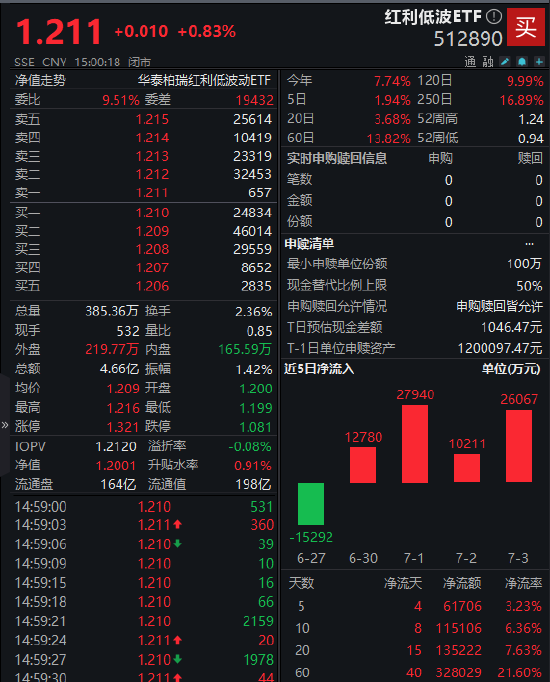
Core Viewpoint - The Hongli Low Volatility ETF (512890) has seen significant inflows and performance, indicating strong investor interest and potential for continued growth in the low-volatility investment space [1][2]. Fund Performance - The Hongli Low Volatility ETF (512890) increased by 0.83% to a latest price of 1.211 CNY, with a turnover rate of 2.36% and a trading volume of 466 million CNY [1][2]. - From June 30 to July 3, the ETF experienced a net inflow of 770 million CNY over four consecutive trading days, bringing its latest circulating scale to 19.622 billion CNY, a new high since its inception [1][2]. Holdings and Investment Strategy - The ETF's top holdings include Chengdu Bank, Yageo, Industrial Bank, and others, with significant weightings in these stocks [3]. - The fund manager, Liu Jun, has positioned the ETF to outperform its benchmark, the CSI Low Volatility Index, with a year-to-date performance exceeding that of the benchmark [2][3]. Market Outlook - According to Xiangcai Securities, the core profitability of banks is improving, and earnings are expected to remain stable, which supports the ongoing appeal of dividend investments in the banking sector [3]. - The strategy of investing in "high dividend + regional growth" is likely to perform well during periods of slowing economic growth [3]. Investment Options - Investors seeking stable returns and low-risk alternatives can consider the Hongli Low Volatility ETF's linked funds, which include various classes such as A, C, I, and Y [4].
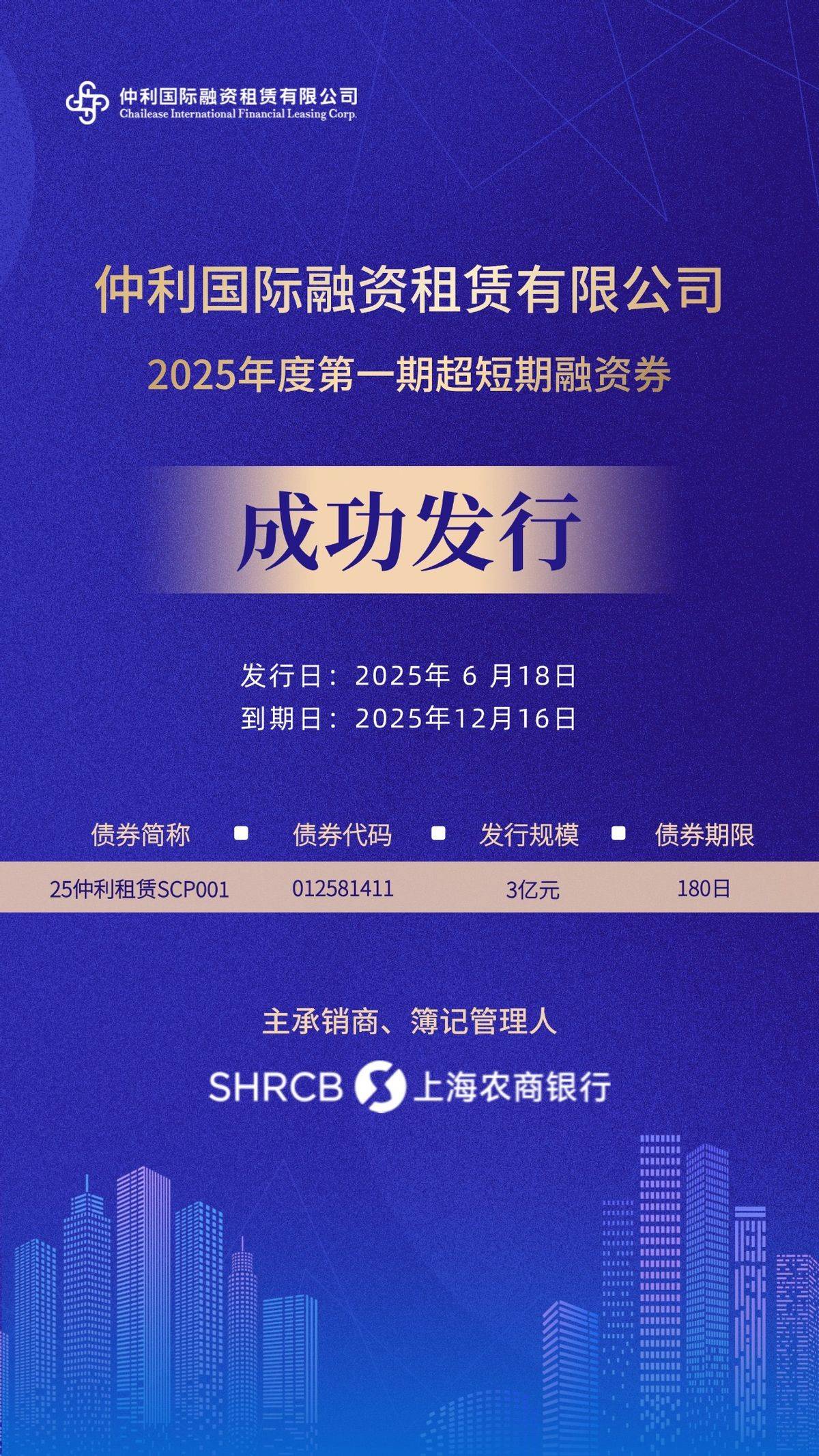
仲利租赁发行2025年度第一期超短期融资券,拓宽融资渠道助力中小微企业发展
Sou Hu Cai Jing· 2025-07-04 06:23
Group 1 - The core viewpoint of the news is that Zhongli International Leasing Co., Ltd. successfully issued its first super short-term financing bond in the interbank bond market, marking a significant step in its capital market activities [1][4] - The total amount of the bond issuance is RMB 300 million, with a maturity of 180 days, aimed at supplementing the company's operating funds and optimizing its debt structure [1] - Shanghai Rural Commercial Bank acted as the lead underwriter and book manager, providing strong support through its capital market experience and professional underwriting capabilities [1] Group 2 - This issuance represents Zhongli Leasing's first foray into super short-term financing bonds, reflecting its proactive exploration in optimizing debt structure and enhancing fund management efficiency [4] - The successful issuance has broadened Zhongli Leasing's financing channels and improved its liquidity management capabilities, providing robust financial support for future business expansion [4] - The company is committed to serving small and micro enterprises by alleviating their funding pressures and will continue to innovate financing products and service models [4]
年内超20家银行高管“变阵”,“70后”已成主流,“80后”加速补位
Jin Rong Shi Bao· 2025-07-04 06:11
Group 1 - The banking industry is experiencing a significant adjustment in management, with numerous high-level executive changes across various banks, including state-owned, joint-stock, and city commercial banks [1][2] - Over 20 commercial banks have seen new appointments for vice presidents and above this year, indicating a trend towards a more dynamic leadership structure [1] - The approval of new executives by the financial regulatory authority has been a common theme, with several banks announcing new appointments and awaiting regulatory approval [1][2] Group 2 - There is a noticeable trend towards younger executives in the banking sector, with a majority of new appointments being individuals born in the 1970s and 1980s, reflecting a shift in management demographics [3] - The push for younger leadership is driven by the need for digital transformation and strategic shifts within banks, as well as policy encouragement for management iteration [3] - The frequency of executive changes in the banking industry has increased, suggesting a growing density of talent exchange, which is linked to the acceleration of digital transformation and internal operational changes [3] Group 3 - The executive appointment mechanism in banks is undergoing profound changes, with a diversification in recruitment methods, including market-based selection for many small and medium-sized banks [4] - Market-based recruitment is seen as a way to enrich the talent pool and enhance management effectiveness, which is crucial for high-quality development in the competitive banking landscape [4] - Several small and medium-sized banks have made leadership changes this year, indicating a strategic move to seek new growth momentum through personnel adjustments [4]



高股息板块中长期仍具备配置价值,300红利低波ETF(515300)整固蓄势
Xin Lang Cai Jing· 2025-07-03 05:51
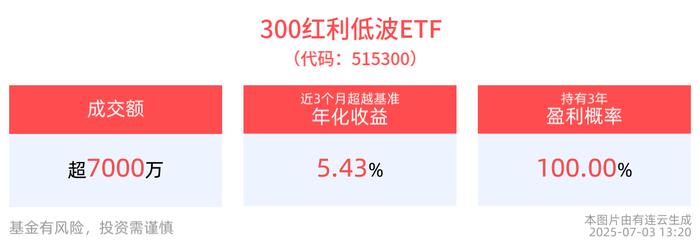
Group 1 - The core index of the CSI 300 Dividend Low Volatility Index has shown a slight increase of 0.03% as of July 3, 2025, with notable gains in constituent stocks such as Hu'nong Commercial Bank (up 1.62%) and CITIC Bank (up 1.53%) [1] - The CSI 300 Dividend Low Volatility ETF (515300) has undergone a downward adjustment [1] - The trading volume of the CSI 300 Dividend Low Volatility ETF reached 77.31 million yuan, with a turnover rate of 1.4% [3] Group 2 - As of July 2, 2025, the average daily trading volume of the CSI 300 Dividend Low Volatility ETF over the past month was 138 million yuan, and its latest scale reached 5.529 billion yuan [3] - The CSI 300 Dividend Low Volatility ETF has achieved a net value increase of 75.70% over the past five years, ranking 45th out of 993 index equity funds, placing it in the top 4.53% [3] - The ETF has recorded a maximum monthly return of 13.89% since its inception, with the longest consecutive monthly gains being five months and an average monthly return of 3.66% [3] Group 3 - The top ten weighted stocks in the CSI 300 Dividend Low Volatility Index include China Shenhua, Gree Electric, and Sinopec, collectively accounting for 35.21% of the index [3] - The performance of high-dividend sectors has shown internal differentiation, with banks and non-banks performing relatively well [6] - The ongoing policy support is expected to increase the scale of long-term funds entering the market, favoring dividend assets as stable low-risk investments [5]