蔚来

Search documents
蔚来李斌:2025年Q4交付4万辆ES8 有望实现盈利目标
Xin Lang Cai Jing· 2026-01-15 11:13
Core Viewpoint - NIO plans to deliver 40,000 units of the new ES8 by Q4 2025, aiming for profitability in that quarter with stable gross margins per vehicle [1] Group 1: Company Strategy - CEO Li Bin outlined a mid-to-long-term growth blueprint, targeting an annual sales growth rate of 40% to 50% over the next 3 to 5 years [1]

李斌开年内部讲话:预计2025年第四季度盈利目标可实现,推动AI在全业务链条落地
Xin Lang Cai Jing· 2026-01-15 10:55
1月5日,蔚来汽车通过内部邮件宣布,正式成立人工智能技术委员会(AGI Committee),该委员会将 牵头推进AI在全业务链条中的落地执行。 1月15日,智通财经获悉,1月14日,蔚来汽车CEO李斌发表新年首次内部讲话。他表示,蔚来在去年第 四季度交付4万辆全新ES8,每辆车均有稳健毛利,预计2025年第四季度盈利目标可以实现。李斌希 望,接下来3至5年,蔚来汽车能够实现年均40%至50%的稳定增长。 李斌在讲话最后强调,2026年公司面临的最大挑战并非市场、产品或销售,而在于组织内部心态。他表 示,蔚来汽车仍是一家创业公司,必须持续巩固阵地,打持久战,以长期、持续的努力赢得最终胜利。 (智通财经记者 周姝祺) 另外,李斌表示,要推动AI在全业务链条中的系统性落地,构建公司级AI能力体系,覆盖从研发、生 产制造、供应链,到财务、人力资源等所有部门和流程,通过AI全面提升效率。 在内部讲话中,李斌明确了蔚来汽车今年的三项重点任务。首先,确保三款新车型按计划、高质量交 付;其次,加大对智能驾驶的算力投入,目标是发布三个重要智驾版本,重新回到行业领先地位。李斌 指出,在公司整体资源依然紧张情况下,他仍然为智驾部 ...
李斌勾勒蔚来2026:全业务链“AI化”,未来三年锚定年增40%
Xin Hua Cai Jing· 2026-01-15 10:29
据了解,蔚来AI战略主要围绕两个方向展开:一是智能驾驶,将持续进行全栈自研,通过年内规划的 三次大版本更新,目标重回行业第一梯队。公司已在算力投入上给予专项支持。 二是AI全业务链落地,将AI应用从研发制造延伸至供应链、销售、财务、人力等所有环节,构建公司 级AI能力体系。李斌强调,蔚来全员需主动拥抱AI,通过每个环节的效率提升,实现公司整体竞争力 的倍增。 李斌表示,目前蔚来在中国市场份额仍不足2%,成长空间巨大。全员需摒弃松懈心态,保持"创业公 司"的奋斗精神,以应对未来的诸多不确定性。 新华财经上海1月15日电1月14日下午,蔚来汽车召开内部会议,蔚来创始人、董事长兼CEO李斌首次发 表2026年内部讲话,公布了公司年度战略目标,核心聚焦于实现稳健增长、全面深化AI技术应用,以 及持续夯实组织体系能力。 李斌表示,回顾2025年,下半年在乐道L90、全新ES8等车型的带动下,蔚来实现销量回升,第四季度 凭借较高毛利车型的放量,有望实现单季盈利,标志着公司进入新的发展周期。 谈及2026年核心目标,李斌表示销量要实现40%-50%的稳健增长,对应销量目标约为45.6万至48.9万 辆,同时要在接下来3-5 ...
开年多家车企密集降价促销
Zhong Guo Zhi Liang Xin Wen Wang· 2026-01-15 09:12
Group 1 - Multiple car manufacturers have launched price reduction promotions at the beginning of the year, with over 20 companies and 70 models participating in various limited-time promotional activities since January 1 [1] - BMW China announced price adjustments for 31 key models, including a significant reduction of 301,000 yuan for the flagship electric model i7 M70L, and the entry-level X1 model dropping below 250,000 yuan [1] - Other luxury brands such as Volvo and Cadillac have also implemented notable price cuts, while Tesla introduced financial incentives for its Model 3 and Model Y vehicles [1][2] Group 2 - GAC Group's promotional policies cover multiple brands and models, offering tax rebates, financial subsidies, and trade-in incentives [2] - New energy vehicle manufacturers like NIO and Xiaomi are also providing targeted promotional offers to attract customers [2] - The recent price reductions are closely linked to policy adjustments, including a halving of the purchase tax for new energy vehicles and changes to the old-for-new vehicle subsidy program [2][4] Group 3 - The increase in inquiries following price cuts indicates a shift in consumer behavior, with high-end brands becoming more accessible to a broader audience [3] - The traditional high-end brands are experiencing a reduction in brand premium, as consumers now have more options within their budget [3] - The competitive landscape is intensifying, with traditional and new energy vehicle brands needing to lower prices to capture market share [3][4] Group 4 - The widespread price reductions reflect intensified competition in the automotive market, characterized by overcapacity and high inventory levels [4] - Data shows that in the first 11 months of 2025, China's automotive production and sales exceeded 31 million units, with new energy vehicle penetration nearing 60% [4] - Industry experts predict a positive growth trend in the automotive market for the first quarter of the year, driven by policy support and increased competition based on product quality [4]
德系豪华三强,连续两年失守中国市场
第一财经· 2026-01-15 08:47
Core Viewpoint - The German luxury car trio, BMW, Mercedes-Benz, and Audi (collectively referred to as "BBA"), has experienced a decline in sales in the Chinese market for two consecutive years, with significant drops in 2025 compared to previous years [3][4]. Group 1: Sales Performance - In 2025, BMW's sales in China were 626,000 units, down 12.5% year-on-year; Audi's sales were 617,000 units, down 5.6%; and Mercedes-Benz's sales were 552,000 units, down 19% [3][4]. - The sales gap between BBA brands is narrowing, with Audi's sales rising to second place in China, trailing BMW by less than 10,000 units [3][4]. Group 2: Market Dynamics - The decline in BBA's sales is attributed to structural changes in the Chinese luxury car market, where brands like Li Auto, NIO, and AITO are attracting traditional BBA customers with their smart technology offerings [4][5]. - The overall market structure is shifting, with the market share of vehicles priced above 400,000 yuan dropping from 6.3% to 5.2%, and the share of vehicles priced between 300,000 and 400,000 yuan falling from 9% to 8.4% [5]. Group 3: Competitive Environment - The competitive landscape has led to significant price reductions for luxury brands, with discounts exceeding 100,000 yuan on popular models like the Mercedes-Benz E-Class, Audi A6L, and BMW 5 Series [5]. - The intense competition has also impacted the dealer network, with frequent reports of luxury brand dealers exiting the market and manufacturers adjusting sales targets and policies to alleviate pressure on dealers [5][6]. Group 4: Future Strategies - BBA plans to launch new products based on a new electric vehicle platform in China and enhance local R&D and partnerships with Chinese tech companies to address their technological shortcomings [6]. - The transition to electric and smart vehicles is critical for maintaining competitiveness, as traditional luxury brand strengths in mechanical performance and brand premium are becoming less relevant [6].

【江北嘴发布】重庆至信实业股份有限公司成功上市
Zhong Guo Jin Rong Xin Xi Wang· 2026-01-15 08:34
Core Viewpoint - Chongqing Zhixin Industrial Co., Ltd. successfully listed on the Shanghai Stock Exchange on January 15, becoming the first new stock listed in Chongqing this year [1] Company Overview - Zhixin Co. specializes in the development, processing, production, and sales of automotive welding parts and related molds [1] - The company is recognized as a national high-tech enterprise and a "specialized, refined, and innovative" small giant enterprise [1] Market Position and Performance - Zhixin Co. has maintained a competitive advantage in the domestic automotive welding parts sector [1] - The revenue from welding parts applied to new energy vehicles increased from 25.27% in 2022 to 71.42% by June 2025, becoming a significant source of the company's growth [1] Clientele and Partnerships - The company has developed into a first-tier supplier for well-known automotive manufacturers such as Changan Automobile, Geely, Changan Ford, NIO, Li Auto, and BYD [1] - Zhixin Co. also supplies parts to notable automotive component suppliers like CATL, Inafa, and Webasto [1]
中国品牌助力,澳大利亚电动化车型12月单月销量首超燃油车
Huan Qiu Wang Zi Xun· 2026-01-15 07:08
来源:环球网 【环球网科技综合报道】1月15日消息,据news报道,最新销售数据显示,2025年12月澳大利亚电动化 车型(含混动、插混、纯电)销量达35058辆,首次在单月销量上超越同期34559辆的燃油车销量,这一 里程碑式节点被业内视为澳大利亚汽车市场电动化转型的潜在拐点。若该趋势持续,2026年有望成为混 动、插混及纯电车型全年销量全面超越传统燃油车的关键一年。 从全年市场表现来看,2025年澳大利亚电动化车型累计销量达355887辆,市场份额攀升至28.6%。其 中,纯电动车占比8.3%,混动车型以199133辆的全年销量成为电动化阵营主力,占市场份额的16%;插 混车型虽规模尚小,但增长势头显著,全年销量53484辆,市场份额达4.3%,反映出消费者对电动化过 渡型方案的接受度持续提升。 目前,燃油车仍是澳大利亚汽车市场的最大单一类别,2025年销量为475279辆,占比38.3%;柴油车型 占比29.4%,过去五年销量保持相对稳定。值得关注的是,澳大利亚汽车市场的电动化转型势头,很大 程度上得益于中国汽车品牌的持续赋能。比亚迪、吉利、上汽名爵、小鹏、极氪等中国车企在澳大利亚 市场的存在感不断增强 ...
2025年汽车产销超3400万辆,10家车企集团稳居“百万俱乐部”
Zhong Guo Jing Ji Wang· 2026-01-15 06:41
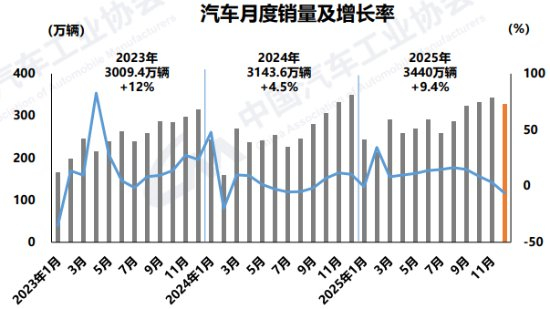
Group 1 - The core viewpoint of the article highlights the robust growth of China's automotive industry in 2025, achieving a total vehicle sales target of approximately 32.3 million units, with a notable increase in new energy vehicle (NEV) sales reaching around 15.5 million units, reflecting a year-on-year growth of about 20% [1][10] - The China Association of Automobile Manufacturers (CAAM) reported that in 2025, the production and sales of automobiles reached 34.5 million and 34.4 million units respectively, marking a year-on-year increase of 10.4% and 9.4%, maintaining China's position as the world's largest automotive market for 17 consecutive years [1][3] - NEV production and sales in 2025 were 16.6 million and 16.5 million units respectively, with year-on-year growth of 29% and 28.2%, indicating that NEVs accounted for over 50% of the domestic market, solidifying their dominance [1][10] Group 2 - In 2025, the automotive industry faced external pressures such as trade protectionism and global supply chain restructuring, yet it demonstrated resilience and vitality, achieving both scale and quality improvements in production and sales [3] - The export of automobiles reached 7.1 million units in 2025, with a year-on-year increase of 21.1%, becoming a key driver for positive growth in the Chinese automotive market [3][10] - The passenger vehicle market saw a significant surge, with production and sales surpassing 30 million units for the first time, achieving 30.3 million and 30.1 million units respectively, reflecting year-on-year growth of 10.2% and 9.2% [3][4] Group 3 - Ten automotive groups achieved sales exceeding one million units in 2025, collectively accounting for 83.9% of total automotive sales, with notable players including BYD, SAIC, and Geely [4] - The market share of domestic brands in the passenger vehicle segment increased, with a market share of 68.8% in December 2025, up 2.7 percentage points from the previous year [4][5] - The sales of traditional fuel vehicles continued to decline, with 13.4 million units sold in 2025, a decrease of 4% year-on-year, highlighting a shift towards electric vehicles [5][10] Group 4 - The article emphasizes the importance of the transition to electric vehicles, noting that while NEVs have not yet achieved a majority in overall sales, they have surpassed 50% in domestic sales [8][10] - The automotive market is transitioning from a growth phase to a more mature phase, with consumer behavior influenced by various factors including policy changes and income expectations [12] - Looking ahead to 2026, the forecast predicts total automotive sales of 34.75 million units, with NEV sales expected to reach 19 million units, reflecting a year-on-year growth of 15.2% [12]



小摩:预计内地首季汽车销售开局缓慢 估乘用车需求续受压
智通财经网· 2026-01-15 06:39
智通财经APP获悉,摩根大通发布研报称,中国代工生产公司的股价表现持平,年初至今集体下滑约 1%,相比MSCI中国指数则升6%。该行认为,这主要是由于今年首季汽车销售开局缓慢。 摩通表示,虽然中国政府更新予汽车行业的新贸易补贴政策,但今年第一季乘用车需求将持续受压,原 因包括提前消费需求、消费者信心疲软及买家对政策和今年新车型持观望态度。该行考虑到市场背景, 预计中国汽车行业的竞争格局将由价格战转向价值创造,又相信具备自动驾驶和人工智能方面技术突 破、有效成本控制以及能进一步扩展海外市场的代工生产公司,将可在竞争中占据有利位置。 该行预期,比亚迪(01211)、吉利(00175)和零跑汽车(09863)将在次季起触底,并建设寻求额外alpha的投 资者可考虑小鹏(09868)和蔚来(09866)。另一方面,该行仍对理想汽车(02015)有所保留。 ...
车企自研、第三方合作“双轮驱动”,城市NOA规模化加速
Zhong Guo Jing Ji Wang· 2026-01-15 02:12
Core Insights - 2025 is identified as a critical year for the commercialization of urban NOA (Navigation Assisted Driving) in China, with a projected market scale growth [1] - The report indicates that from January to November 2025, the cumulative sales of passenger cars equipped with urban NOA reached 3.129 million units, with a penetration rate of 15.1%, an increase of 5.6 percentage points compared to the entire year of 2024 [1] Industry Background - NOA technology is seen as a key driver for smart connected vehicles, bridging advanced driver assistance and fully autonomous driving, which is crucial for enhancing user travel experience and asserting China's competitive voice in the global automotive industry [3] - The report highlights that among the passenger cars sold with urban NOA, domestic brands accounted for 2.5373 million units, representing 81.1% of the total, showcasing innovation and competitiveness in the smart connected vehicle sector [3] Market Dynamics - The current market for urban NOA is characterized by a dual-driven model of self-research by car manufacturers and collaboration with third-party suppliers [5] - Major players in self-research include Tesla, NIO, Xpeng, Li Auto, Xiaomi, and others, while approximately 29 brands collaborate with third-party suppliers [5] - The third-party supplier market is dominated by two key players, Momenta and Huawei, which together hold about 80% market share; Momenta's urban NOA installations reached 414,400 units, accounting for 61.06% of third-party suppliers, while Huawei's HI model accounted for 19.76% with 134,100 units [5] Technological Advancements - The rapid iteration of technology and market competition is driving systemic changes in smart driving technology, core architecture, and industrial ecology [9] - The report emphasizes that end-to-end large models are becoming the core engine for NOA technology iteration, facilitating a shift from modular architecture to integrated systems [10] - New energy vehicle manufacturers are building technological barriers through full-stack self-research, while traditional automakers are accelerating technology deployment through partnerships with third-party suppliers [10] Future Outlook - The report anticipates that by 2030, urban NOA will become a mainstream feature in both assisted and autonomous driving [10] - Recommendations for enhancing the high-quality development of NOA include improving top-level design, strengthening technological innovation, enhancing industry collaboration, and exploring global competitiveness for supply chain enterprises [11]