
大成基金

Search documents
自由现金流基金今年以来募资151亿元 ,业内认为这类产品适合长期持有
Shen Zhen Shang Bao· 2025-06-09 12:12
Group 1 - The first batch of free cash flow strategy funds was announced in February, with 26 funds established so far, raising a total of over 15 billion yuan [1] - The established funds are passive index funds tracking various free cash flow indices, with 12 funds tracking the CSI All Share Free Cash Flow Index [1][3] - The market is seeing an expansion of free cash flow strategy funds, with new products being launched and applications submitted for additional funds [2] Group 2 - Analysts believe that free cash flow is well-suited to the current macroeconomic environment, as companies with ample free cash flow are expected to see stronger valuation increases [2] - Free cash flow indices have shown strong long-term performance, with lower volatility compared to dividend indices, and are concentrated in sectors like energy and consumer goods [3][4] - The National Free Cash Flow Index has outperformed other indices, while the CSI 300 Free Cash Flow Index is noted for its low volatility and stable performance [4]
7家基金公司自购浮费基金总额突破1亿元
news flash· 2025-06-09 11:06
Core Viewpoint - Seven fund companies have collectively purchased over 100 million yuan in floating fee funds, indicating a strong confidence in the market and a commitment to aligning interests with investors [1] Group 1: Fund Companies Involved - The fund companies that have participated in the self-purchase include Dongfanghong Asset Management, Tianhong Fund, Bosera Asset Management, and China Universal Asset Management, each contributing 10 million yuan [1] - Xingsheng Global Fund, Great Wall Fund, and Jiao Yin Schroder Fund have made larger purchases of 20 million yuan each [1] Group 2: Total Investment and Market Implications - The total amount of self-purchases by these fund companies has reached 100 million yuan, reflecting a significant trend in the industry [1] - Self-purchase is becoming an important method for fund companies to express their confidence in the market and strengthen ties with investors [1]
雪球“分红季”重磅开启:共探红利资产新机会
Cai Fu Zai Xian· 2025-06-09 10:24
2025 年 6 月 9 日,雪球发起 #分红季,上雪球 #主题活动,深度探讨红利策略,和基金公司、投资者共 同挖掘高股息资产价值,助力投资者把握这一轮 "真金白银" 的投资机遇。 红利资产作为穿越市场波动的 "现金奶牛",在雪球上受到了投资者的极大关注。沪深300成分股中,金 融、能源、消费等行业分红稳定性突出,部分科技企业(如半导体、光伏龙头)也加入了高分红阵营。 雪球举办此次活动旨在帮助更多投资者理解红利投资的本质,从而抓住投资机会。 作为本次活动的核心,雪球将围绕 "红利策略" 打造一系列创意互动玩法,为投资者提供兼具专业性与 趣味性的交流平台。此次活动涵盖了分红主题征文、夏日红利诗会、寻找红利锦鲤、年中红利故事会等 多种创意互动玩法,各位球友上雪球分享个人红利投资故事、红利投资策略,或看好哪些分红上市公 司、红利基金产品等,优质内容还会随机获得现金红包打赏! 过去两年,在国内宏观经济承压和海外高利率双重压力下,市场风险偏好低迷,被视为具有"类债属 性"和"防御能力"的高股息资产表现相对强势。监管逐步出台了一系列针对上市公司分红的相关政策, 持续完善和优化上市公司现金分红规则,以引导公司合理分红、提高 ...


ETF日报-20250609
Hongxin Security· 2025-06-09 09:04
Report Industry Investment Rating - No relevant content provided Core View of the Report - On June 9, 2025, the A-share market showed an overall upward trend, with the Shanghai Composite Index rising 0.43%, the Shenzhen Component Index rising 0.65%, and the ChiNext Index rising 1.07%. The trading volume of the two markets reached 1312.8 billion yuan. The sectors with the highest gains were Medicine and Biology (2.30%), Agriculture, Forestry, Animal Husbandry and Fishery (1.72%), and Textile and Apparel (1.61%), while the sector with the largest decline was Food and Beverage (-0.43%) [2][6] Summary by Relevant Catalogs Market Overview - The Shanghai Composite Index closed at 3399.77 points, up 0.43%; the Shenzhen Component Index closed at 10250.14 points, up 0.65%; the ChiNext Index closed at 2061.29 points, up 1.07%. The trading volume of the two A-share markets was 1312.8 billion yuan. The sectors with the highest gains were Medicine and Biology (2.30%), Agriculture, Forestry, Animal Husbandry and Fishery (1.72%), and Textile and Apparel (1.61%), while the sector with the largest decline was Food and Beverage (-0.43%) [2][6] Stock ETF - The top three stock ETFs in terms of trading volume were Huaxia CSI A500 ETF (up 0.32%, discount rate 0.34%), Harvest CSI A500 ETF (up 0.41%, discount rate 0.39%), and Huatai-PineBridge CSI 300 ETF (up 0.23%, discount rate 0.32%) [3][7] Bond ETF - The top three bond ETFs in terms of trading volume were E Fund Shanghai Stock Exchange Benchmark Market-Making Corporate Bond ETF (down 0.00%, discount rate 0.11%), Southern Shanghai Stock Exchange Benchmark Market-Making Corporate Bond ETF (down 0.00%, discount rate 0.11%), and Bosera Shenzhen Stock Exchange Benchmark Market-Making Credit Bond ETF (down 0.02%, discount rate 0.09%) [4][9] Gold ETF - Gold AU9999 fell 0.97%, and Shanghai Gold fell 1.11%. The top three gold ETFs in terms of trading volume were Huaan Gold ETF (down 1.08%, discount rate -1.06%), E Fund Gold ETF (down 1.07%, discount rate -1.07%), and Bosera Gold ETF (down 1.07%, discount rate -1.07%) [12] Commodity Futures ETF - Huaxia Feed Soybean Meal Futures ETF rose 0.26%, with a discount rate of 1.11%; China Construction Yisheng Zhengzhou Commodity Exchange Energy and Chemical Futures ETF rose 0.08%, with a discount rate of -0.25%; Dacheng Nonferrous Metals Futures ETF had a change of 0.00%, with a discount rate of 0.00% [15] Cross-Border ETF - The previous trading day, the Dow Jones Industrial Average rose 1.05%, the Nasdaq Composite rose 1.20%, and the S&P 500 rose 1.03%, while the German DAX fell 0.08%. On June 9, the Hang Seng Index rose 1.63%, and the Hang Seng China Enterprises Index rose 1.74%. The top three cross-border ETFs in terms of trading volume were GF CSI Hong Kong Innovative Drug ETF (up 4.72%, discount rate 4.42%), E Fund CSI Hong Kong Securities Investment Theme ETF (up 2.48%, discount rate 2.44%), and Huatai-PineBridge CSOP Hang Seng Tech ETF (up 2.41%, discount rate 2.65%) [17] Money ETF - The top three money ETFs in terms of trading volume were Yin Hua Ri Li ETF, Hua Bao Tian Yi ETF, and Money ETF Jian Xin Tian Yi [19]
信用债ETF可回购质押,成交跃升
HTSC· 2025-06-09 09:01
Quantitative Models and Construction Methods - **Model Name**: Absolute Return ETF Simulation Portfolio **Model Construction Idea**: The model determines the allocation weights of major asset classes based on "momentum + risk budgeting" and enhances returns at the stock industry level by incorporating an industry rotation model and timing views on dividend assets[3][26] **Model Construction Process**: 1. **Risk Budgeting**: Assign higher risk budgets to assets with stronger recent trends 2. **Industry Rotation**: Use a monthly frequency industry rotation model to allocate weights within equity assets 3. **Dividend Timing**: Incorporate timing views on dividend assets 4. **Portfolio Adjustment**: Adjust weights periodically, such as removing steel, basic chemicals, non-bank finance, and computers while adding pharmaceuticals, consumer services, and dividend assets in the latest rebalancing[26][29] **Model Evaluation**: The model effectively balances risk and return, leveraging momentum and industry rotation to enhance performance[26] Model Backtesting Results - **Absolute Return ETF Simulation Portfolio**: - Annualized Return: 6.45% - Annualized Volatility: 3.85% - Maximum Drawdown: 4.65% - Sharpe Ratio: 1.68 - Calmar Ratio: 1.39 - Year-to-Date Return: 3.94% - Weekly Return: 0.30%[28] Quantitative Factors and Construction Methods - **Factor Name**: Credit Bond ETF as Collateral for Repurchase **Factor Construction Idea**: The factor leverages the inclusion of credit bond ETFs in the general collateral pool for repurchase agreements to enhance liquidity and risk diversification in the credit bond market[7][9] **Factor Construction Process**: 1. **Selection Criteria**: ETFs tracking benchmark market-making credit bonds with large scale and high credit quality are selected 2. **Approval Process**: ETFs meeting the criteria apply to China Securities Depository and Clearing Corporation for inclusion as general collateral for repurchase agreements 3. **Implementation**: The first batch of 9 credit bond ETFs was approved and implemented on June 6, 2025[7][8] **Factor Evaluation**: This factor improves market liquidity, optimizes market structure, and supports the development of the real economy[9] Factor Backtesting Results - **Credit Bond ETF as Collateral for Repurchase**: - Example ETFs: - South China Benchmark Market-Making Corporate Bond ETF (Code: 511070.SH): Scale 124.81 billion, Monthly Average Turnover 48.89 billion - Huaxia Benchmark Market-Making Corporate Bond ETF (Code: 511200.SH): Scale 83.09 billion, Monthly Average Turnover 45.89 billion - Ping An ChinaBond High-Grade Corporate Bond Spread Factor ETF (Code: 511030.SH): Scale 170.70 billion, Monthly Average Turnover 17.76 billion[8]
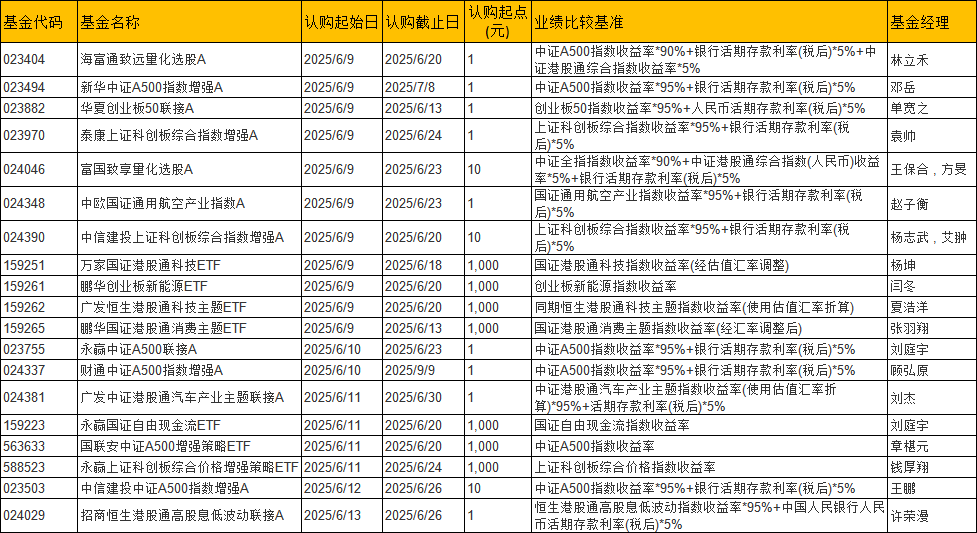
34只新基本周登场:股混、REITs、FOF、QDII齐发 王保合、徐习佳、汪玲等名将“对决”
Xin Lang Ji Jin· 2025-06-09 07:16
Group 1: New Fund Launches - A total of 34 new funds were launched this week, covering various types including equity, mixed, QDII, FOF, and REITs, involving 26 fund companies such as E Fund, GF Fund, and Penghua [1][2] - Among the new products, 19 are equity funds, 5 are mixed funds, 4 are FOF funds, 3 are bond funds, 2 are REITs, and 1 is an international (QDII) fund [1] Group 2: Focus on Equity Funds - The newly launched equity funds primarily focus on popular indices such as the CSI A500, ChiNext 50, and the Shanghai Stock Exchange Sci-Tech Innovation Board Composite Index [2] - Notable fund managers include Zhang Yuxiang from Penghua, Xu Rongman from CMB, and Liu Jie from GF Fund, among others [2] Group 3: Key Fund Managers and Strategies - The "Fuguo Zhixiang Quantitative Stock Selection" fund, managed by Wang Baohe and Fang Min, employs a combination of top-down and bottom-up investment strategies, focusing on qualitative and quantitative analysis throughout the investment process [3] - The fund's performance benchmark is composed of 90% of the CSI All Share Index return, 5% of the CSI Hong Kong Stock Connect Composite Index return, and 5% of the after-tax bank demand deposit rate [3] Group 4: Mixed Funds Overview - This week saw the launch of 5 mixed funds with a minimum subscription of 1 or 10 yuan, with performance benchmarks including the CSI 300 Index and the China Bond Composite Index [5][6] - Notable fund managers include Xu Xijia from Dongfanghong Asset Management and Yuan Wei from Anxin Fund [5] Group 5: FOF Funds and Pension Products - Four FOF funds were launched this week, including two pension funds managed by Wang Ling and Li Biao, with a fundraising target of 2 billion yuan for the E Fund's pension target date fund [7][8] - The performance benchmarks for these funds include various bond and equity indices [7] Group 6: REITs and QDII Funds - Two REITs were launched this week, including the Zhongjin Yizhuang Industrial Park REIT and the Zhongjin China Green Development Commercial Asset REIT, with fundraising targets of 400 million yuan and 500 million yuan respectively [9][10] - The Dachen Hang Seng Medical Care Link fund was also launched, focusing on the Hang Seng Medical Care Index [10]
又一批基金降费;REITs总规模首次站上2000亿元丨天赐良基早参
Mei Ri Jing Ji Xin Wen· 2025-06-09 00:44
Group 1: Management Changes - Red土创新基金 announced the resignation of Chairman阮菲 on June 5, with General Manager冀洪涛 taking over the role [1] -冯劲松 was appointed as the Chief Information Officer of 红塔红土基金 on June 5 [1] Group 2: Investor Warnings - 大成基金 issued a warning to investors about potential financial fraud, highlighting scams using fake investment platforms and impersonating company employees [2] Group 3: Fee Reductions - 中信建投基金 announced a reduction in the custody fee for 中信建投稳泰一年定开债 from 0.1% to 0.05%, effective June 9 [3] -浙商证券资管 also reduced the custody fee for浙商汇金聚兴一年定开债券 from 0.15% to 0.08% [3] Group 4: Fund Fee Trends - Nearly 10 funds have announced fee reductions in June, primarily among bond products [4] - Over 1,000 funds now have annual management fees of 0.15% or lower, with more than 2,100 funds having custody fees of 0.05% or lower [4] Group 5: REITs Market Growth - As of June 5, the total market value of REITs in China reached 2019.91 billion, marking the first time it surpassed 2000 billion [5] - 29 REITs products have seen year-to-date gains exceeding 20%, with 6 products gaining over 40% [5] Group 6: Fund Manager Education - Approximately 3850 fund managers are in the market, with 87.45% holding a master's degree and 9.81% holding a doctorate [7] - The top five universities producing fund managers are 北京大学, 复旦大学, 清华大学, 上海交通大学, and 上海财经大学 [7] Group 7: Innovation Drug Market Insights -融通基金经理万民远 expressed concerns about valuation bubbles in the innovation drug sector, noting that many companies are overvalued despite a favorable policy environment [8]
重组停牌遇上板块大涨 持仓基金频频调整估值
Zhong Guo Zheng Quan Bao· 2025-06-08 21:08
Core Viewpoint - Multiple public fund companies have adjusted the valuation method for long-term suspended stocks held by their funds, adopting the "index return method" during the suspension period, primarily affecting Haiguang Information and Zhongke Shuguang [1][2][3] Group 1: Valuation Adjustment Announcement - Over twenty public fund companies, including E Fund, Huaxia Fund, and Southern Fund, announced on June 6 that they would use the "index return method" for valuing suspended stocks starting June 5 [2] - The suspended stocks primarily involve Haiguang Information and Zhongke Shuguang, with some companies adjusting the valuation for both stocks while others only for Haiguang Information [2][5] - The "index return method" will utilize the AMAC industry index as a calculation basis, as stated by some fund companies [2] Group 2: Reasons for Adjustment Timing - The adjustment of valuation methods occurred on June 5, despite the stocks being suspended since May 26, due to significant changes in the economic environment or major events affecting stock prices [3] - The AMAC electronic index saw a rise of over 3% since the suspension, with a single-day increase of over 2% on June 5, which likely triggered the valuation adjustment [3] Group 3: Prevention of Arbitrage - The primary aim of the valuation adjustment is to prevent arbitrage opportunities for suspended stocks, as investors can indirectly build positions through fund subscriptions during the suspension [4] - If funds continue to value the stocks at pre-suspension prices, investors could buy in at a lower cost and profit upon resumption of trading, which would harm existing fund holders [4] Group 4: Differences in Adjustment Practices - The differences in valuation adjustments among fund companies may relate to the number of shares held; companies with fewer holdings may not need to adjust valuations significantly [5] - If a single fund's holdings significantly impact its net asset value, all funds under the same management must adjust valuations accordingly [5] Group 5: Consistency in Valuation Procedures - Fund managers are required to maintain consistency in valuation procedures and techniques across different funds holding similar investment types, as per regulatory guidelines [6] - Haiguang Information ranks as the 22nd largest holding among active equity public funds, with a total holding value exceeding 9 billion, while Zhongke Shuguang is less prominent in the top holdings [6]


发行两周 亮点十足 新型浮动费率基金火热销售进行时
Zhong Guo Zheng Quan Bao· 2025-06-08 20:52
Core Insights - The new floating rate funds have seen significant sales success within just two weeks of issuance, with multiple banks reporting sales exceeding 1 billion yuan, and some surpassing 10 billion yuan [1][2] - The Oriental Red Core Value Mixed Fund has already exceeded its fundraising cap of 2 billion yuan, with a subscription confirmation rate of approximately 94.03% [2][3] - A trend of self-purchase by fund companies has emerged, with Manulife Fund investing 10 million yuan in its own floating rate fund, reflecting a commitment to shared interests and risk with investors [1][5] Fund Sales Performance - As of June 6, several banks, including SPDB, Bank of China, and others, reported that their sales of new floating rate funds exceeded 1 billion yuan, with SPDB and Bank of China surpassing 10 billion yuan [2] - The first batch of 16 floating rate funds launched on May 27 has seen strong initial subscription, with many funds achieving over 1 billion yuan in subscriptions by June 6 [2][3] Fund Company Actions - Multiple fund companies have announced self-purchases of their floating rate funds, with amounts ranging from 10 million to 20 million yuan, indicating confidence in the market [5][6] - The self-purchase actions by companies like Oriental Red Asset Management and Tianhong Fund demonstrate a commitment to aligning interests with investors [5][6] Fund Characteristics - The new floating rate funds have varied performance benchmarks, with some using the CSI 500 Index as a benchmark, while others target the CSI 300 Index or the CSI 800 Index [4] - The introduction of floating rate funds is seen as a response to the policy aimed at linking management fees to fund performance, marking a new approach in the industry [6]
金融诈骗手段迭代 多家基金公司紧急提醒
Zheng Quan Ri Bao· 2025-06-08 17:18
Core Viewpoint - Multiple fund companies have issued warnings about financial scams disguised as investment opportunities, urging investors to remain vigilant against fraudulent activities that use "stock knowledge sharing" and "block trading" as fronts [1][2]. Group 1: Nature of Scams - Fraudsters are creating fake investment platforms and impersonating official apps to carry out scams, often using high returns and low risks as bait [2]. - Initial small returns may lure investors, but once they increase their investments, platforms may refuse withdrawals under various pretexts like "system upgrades" or "account freezes" [2]. - Some scammers go as far as forging official documents and impersonating fund company employees to trick investors into transferring money to personal accounts [2]. Group 2: Characteristics of Modern Financial Fraud - Current financial scams are more sophisticated, often presenting themselves as legitimate public funds, trust companies, or insurance firms, which distinguishes them from past scams that relied on individual contracts [3]. - Scammers may rent high-end office spaces and hire actors to create an immersive experience, making it harder for investors to detect fraud [3]. - The products offered are often complex, structured, and non-standardized, which can mislead investors into believing in the scammers' expertise and authority [3]. Group 3: Recommendations for Investors - Investors are advised to enhance their risk awareness and adhere to the "three no's and three more" principle: do not click unknown links, ensure financial platforms are downloaded through official channels, and do not trust unknown information [4]. - It is crucial for investors to verify identities, purchase methods, and official contact numbers to avoid falling victim to scams [4].