海螺水泥

Search documents
第三届中国—东盟非金属矿工业博览会将在南宁举办
Xin Hua Cai Jing· 2025-08-19 11:45
本届非矿博览会,规划室内外展览区面积超3000平方米,将开设中国建材集团矿山开发全产业链企业板 块、粤港澳大湾区砂石骨料采购对接板块、数字矿山人工智能板块、会员展示板块、非矿展示五大板 块,并邀请了来自国内和东盟多国的企业和科研院所代表与会共商产业发展新机遇。 (文章来源:新华财经) 新华财经南宁8月19日电 近日,记者从广西非金属矿工业协会获悉,8月28日至30日,以"央地粤桂联 动,推动非矿发展"为主题的第三届中国—东盟非金属矿工业博览会(以下简称"非矿博览会")将在南 宁举办。 协会相关负责人介绍,本届非矿博览会将推动国内和国际市场深度对接,努力把广西打造成为粤港澳大 湾区砂石骨料供应重要腹地,进一步提升广西非金属矿精深加工和绿色转型力度。 ...
股债轮动下的中国市场:资金流向与投资机遇
Zhi Tong Cai Jing· 2025-08-19 11:38
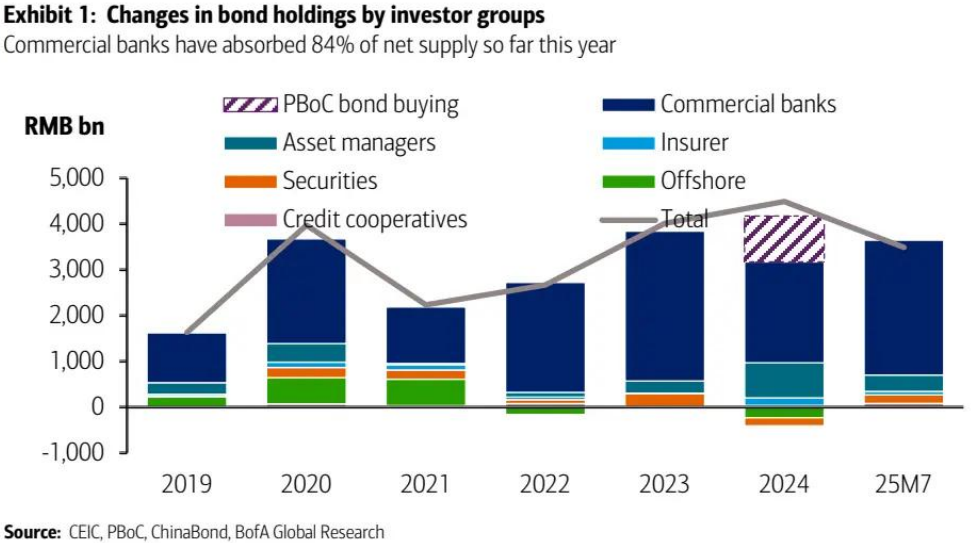
Group 1: Bond Market Dynamics - The demand structure for government bonds reflects the risk appetite of funds, with a net supply of nearly 14 trillion yuan expected in 2025, a 23% year-on-year increase [2] - Commercial banks have become the most stable demand side, holding an additional 2.9 trillion yuan in government bonds in the first seven months of 2025, absorbing 84% of the net supply [2][5] - Insurance companies have shown resilience in bond demand, increasing their holdings by 400 to 600 billion yuan annually over the past five years, despite a shift towards high-dividend stocks [5] - Offshore investors have recently turned into net sellers of bonds, but the outflow of Chinese government bonds is expected to be limited due to high holdings by long-term investors [12] - The central bank may restart bond purchases if there is a lack of demand in the bond market, providing a potential policy buffer [13] Group 2: Stock Market Opportunities - The A-share market is experiencing strong momentum driven by a "debt-to-equity rotation" and "anti-involution" logic, with local participation reaching a new high [14] - The widening yield spread of 10-30 year government bonds is prompting funds to shift from bonds to stocks, particularly as major holders of long-term bonds begin to reduce their positions [14] - High expectations for profit recovery in "involuted" industries could lead to an increase in the MSCI China index EPS growth rate from 10% to 12% between 2025 and 2027 [16] - Goldman Sachs has identified 20 companies with strong potential based on valuation expansion and fundamental improvement, with an average stock price increase of 8% since July [18] Group 3: Market Interactions and Signals - The current market dynamics are characterized by the coexistence of stable demand from banks and insurance companies in the bond market, alongside fluctuating behavior from asset management and offshore investors [21] - The ongoing rotation from bonds to stocks, particularly in anti-involution sectors, is creating structural opportunities driven by profit recovery expectations and fund preferences [21][22] - Investors should closely monitor liquidity changes in the interbank market, the sustainability of stock market profitability, and the central bank's policy signals regarding bond purchases [22]




水泥板块8月19日跌0.72%,西藏天路领跌,主力资金净流出6.82亿元
Zheng Xing Xing Ye Ri Bao· 2025-08-19 08:33
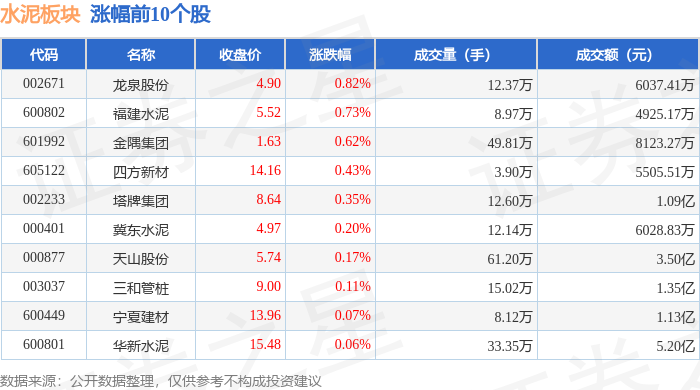
Market Overview - The cement sector experienced a decline of 0.72% on August 19, with Tibet Tianlu leading the drop [1] - The Shanghai Composite Index closed at 3727.29, down 0.02%, while the Shenzhen Component Index closed at 11821.63, down 0.12% [1] Individual Stock Performance - Notable gainers included Longquan Co. (+0.82%), Fujian Cement (+0.73%), and Metal Group (+0.62%) [1] - Major decliners included Tibet Tianlu (-2.64%), Sichuan Jinding (-1.94%), and Conch Cement (-1.45%) [2] Trading Volume and Value - Longquan Co. had a trading volume of 123,700 shares and a transaction value of 60.37 million yuan [1] - Tibet Tianlu recorded a trading volume of 2,758,000 shares with a transaction value of 467.3 million yuan [2] Capital Flow Analysis - The cement sector saw a net outflow of 682 million yuan from institutional investors and 123 million yuan from speculative funds, while retail investors contributed a net inflow of 805 million yuan [2] - The capital flow data indicates that retail investors were more active in the market compared to institutional and speculative investors [3] Net Capital Inflow by Stock - Jinou Group had a net inflow of 6.2856 million yuan from institutional investors, while Longquan Co. saw a net outflow of 1.9952 million yuan [3] - The data shows that retail investors were net buyers in several stocks, including Longquan Co. and Fujian Cement, despite overall net outflows from institutional and speculative funds [3]

智通AH统计|8月19日
智通财经网· 2025-08-19 08:22
后十大AH股溢价率排行 | 股票名称 | H股(港元) | A股 | 溢价率↑ | 偏离值 | | --- | --- | --- | --- | --- | | 宁德时代(03750) | 404.800 | 277.83 | -17.79% | 1.44% | | 恒瑞医药(01276) | 79.000 | 64.1 | -2.81% | 1.95% | | 紫金矿业(02899) | 23.120 | 20.33 | 5.32% | -3.83% | | 美的集团(00300) | 82.600 | 72.68 | 5.40% | -4.64% | | 招商银行(03968) | 48.500 | 43.4 | 7.18% | 1.66% | | 潍柴动力(02338) | 16.620 | 15.26 | 9.99% | -0.64% | | 比亚迪股份(01211) | 114.000 | 107.63 | 13.09% | -128.72% | | 福耀玻璃(03606) | 58.600 | 55.77 | 13.99% | -3.44% | | 药明康德(02359) | 101.000 | ...



中证香港300原材料指数报2721.61点,前十大权重包含江西铜业股份等
Jin Rong Jie· 2025-08-19 07:48
Core Viewpoint - The China Securities Hong Kong 300 Raw Materials Index has shown significant growth, with a 66.50% increase year-to-date, indicating strong performance in the raw materials sector [1]. Group 1: Index Performance - The China Securities Hong Kong 300 Raw Materials Index reported a value of 2721.61 points [1]. - The index has increased by 16.75% over the past month and 41.99% over the last three months [1]. Group 2: Index Composition - The top ten holdings in the index include Zijin Mining (25.69%), China Hongqiao (11.83%), and Luoyang Molybdenum (7.66%) [1]. - The index is composed entirely of stocks listed on the Hong Kong Stock Exchange, with a 100% representation [1]. Group 3: Sector Breakdown - The index's sample composition shows that non-ferrous metals account for 79.48%, non-metallic materials for 14.17%, chemicals for 4.69%, and paper and packaging for 1.66% [2]. - The index samples are adjusted biannually, with changes implemented on the next trading day following the second Friday of June and December [2].
水泥行业反内卷:过去,现在和未来
Tianfeng Securities· 2025-08-19 07:46
Investment Rating - The industry rating is "Outperform the Market" (maintained rating) [5] Core Insights - The necessity for "anti-involution" in the cement industry remains, with a competitive landscape characterized by high concentration and state-owned enterprise dominance [1][12] - The cement industry is experiencing a significant oversupply, with a projected capacity utilization rate of only 53% in 2024, indicating a need for supply-side reforms to reduce actual capacity [3][22] - Short-term measures such as peak-shifting production will continue to support the industry, while medium-term strategies will focus on administrative measures to limit overproduction [4][30] Summary by Sections Supply Structure - The cement industry is primarily led by state-owned enterprises, with a concentration ratio (CR10) of 57% and an expected state-owned enterprise capacity share of around 45% in 2024 [1][12] - The top ten cement companies include four state-owned enterprises, which collectively hold about 71% of the capacity, facilitating coordinated efforts to stabilize prices and enhance efficiency [12][1] Industry Profitability - The industry is projected to achieve a total profit of 260 billion yuan in 2024, with a profit margin of approximately 4.1%, although this represents an 86% decline from the peak levels seen in previous years [16][20] - The worst period in early 2024 saw over 55% of companies reporting losses, but a recovery is anticipated in the fourth quarter, with profits expected to reach 150-160 billion yuan in the first half of 2025 [20][16] Supply and Demand Dynamics - The total cement supply has peaked at around 1.81 billion tons, but demand continues to decline, leading to a significant oversupply issue [22][3] - The expected demand bottom is estimated to be between 1.2 to 1.5 billion tons, indicating a potential decline of 18% to 34% from 2024 levels [22][3] Review of Previous Supply-Side Reforms - Previous reforms included a ban on new capacity and the promotion of peak-shifting production, which successfully reduced new clinker capacity additions from a billion-ton level to a few million tons [2][26] - The industry's profit recovery from 518 billion yuan in 2016 to a historical high of 1867 billion yuan in 2019 was largely due to these reforms [2][29] Future Anti-Involution Strategies - The future governance of "anti-involution" will involve a combination of market, administrative, and legal measures, with a strong emphasis on reducing excess capacity through administrative controls [4][30] - The carbon trading policy expected to be implemented by 2027 will further pressure high-emission capacities to exit the market, promoting a shift towards more efficient production methods [33][35]


摸清“碳家底” 算好“减碳账” 商业银行多维“碳”路绿色可持续发展
Jin Rong Shi Bao· 2025-08-19 02:36
Core Insights - The concept of "green mountains and clear waters are as valuable as mountains of gold and silver" has been proposed for 20 years, and the "dual carbon" goals have been set for 5 years, highlighting the importance of green finance in promoting high-quality economic development [1] - Carbon finance is emerging as a crucial tool for banks to implement the "dual carbon" goals, with commercial banks gradually building climate-adaptive financial service systems to assist high-carbon industries in reducing emissions [1] Group 1: Financial Support for High-Carbon Industries - Postal Savings Bank provided a 30 million yuan loan to Chizhou Conch Cement Co., Ltd. to facilitate the green upgrade of the cement industry [2] - Industrial Bank issued a 200 million yuan loan to an aluminum company in Shandong, helping to lower financing costs and incentivize self-reduction of carbon emissions [2] - The existing green finance system does not fully meet the financing needs of high-carbon industries like steel, cement, and chemicals, which require a gradual reduction in carbon emissions [2] Group 2: Innovative Financial Tools and Services - Industrial Bank's Huizhou branch issued over 8 billion yuan in credit support for a leading petrochemical group's core project, effectively reducing financing costs by 1.5% [3] - Shanghai Bank provided a 40 million yuan loan to Juneyao Airlines, linking the loan interest rate to the airline's carbon emission reduction performance [3] Group 3: Carbon Accounts and Financial Services - Carbon accounts are becoming essential for banks to provide financial services based on carbon emission data, helping companies manage their carbon footprint [4] - Banks like Industrial Bank and China Everbright Bank have initiated personal carbon credit and corporate carbon account services since 2010, enhancing green financial services [4] Group 4: Development of Carbon Financial Market - The reopening of the voluntary greenhouse gas emission reduction trading market (CCER) presents significant opportunities for the carbon financial market [6] - Several banks have launched innovative products linked to CCER, increasing liquidity in the carbon market and providing low-cost financing options for companies [6] - Industrial Bank has pioneered several market-leading carbon financial products, including the first CHUEE product and carbon-neutral bonds [6] Group 5: Future Directions for Carbon Finance - Financial institutions need to establish mature carbon finance operational models, focusing on strategic development and external collaborations with various stakeholders [7] - Banks should enhance their research on carbon reduction and trading policies and consider forming dedicated carbon finance departments [7]

(活力中国调研行)“江水空调”与火锅废油:山城重庆的绿色智慧
Zhong Guo Xin Wen Wang· 2025-08-18 11:34
Group 1: Innovative Energy Solutions - The "River Water Air Conditioning" system in Chongqing utilizes the natural temperature regulation properties of the Yangtze and Jialing rivers, providing a sustainable cooling and heating solution for buildings [1] - This system can save approximately 52,000 kW of electricity capacity annually and conserve 1.98 million cubic meters of water, while reducing carbon dioxide emissions by about 60,000 tons each year [1] Group 2: Waste Management and Recycling - The cement factory in Chongqing employs a technology that transforms organic waste into fertilizers, combustible materials into fuels, and solid waste into raw materials, integrating these into the cement production process [2][4] - The Chongqing Conch Cement Company has a daily capacity to process 200 tons of municipal waste, which not only addresses environmental issues in the Three Gorges area but also contributes 4% of the heat needed for cement production [4] Group 3: Culinary Waste Utilization - In Chongqing, waste cooking oil from the restaurant industry is processed through sorting and dehydration, then further refined into industrial oils for use in aviation and industrial products [5] Group 4: Circular Economy Initiatives - Chongqing Midea Refrigeration Equipment Co., Ltd. incorporates a circular economy approach in its production processes, reusing excess heat, oxygen, and pressure, and is developing a green circular industrial park to support the transformation of the home appliance recycling industry [5]
建材行业报告(2025.08.11-2025.08.17):俄乌冲突有望结束,关注乌克兰重建受益标的
China Post Securities· 2025-08-18 10:31
Industry Investment Rating - The investment rating for the construction materials industry is "Outperform the Market" and is maintained [1]. Core Insights - The report highlights the potential benefits from the reconstruction of Ukraine, with an estimated total cost of approximately $524 billion, which is nearly three times Ukraine's GDP for 2024. Key areas of investment include housing ($84 billion), transportation ($78 billion), energy ($68 billion), industrial and commercial sectors ($64 billion), and agriculture ($55 billion) [3]. - The report emphasizes the competitive advantages of domestic international engineering companies in Ukraine's post-war reconstruction, despite the U.S. leading the efforts. Companies such as China Communications Construction Company, China Chemical Engineering, China National Materials, and China Steel International are noted as potential beneficiaries [4]. - In the cement sector, a policy to limit overproduction is expected to enhance capacity utilization, with a forecasted recovery in demand and price increases starting in August [4]. - The glass industry is facing a downward trend in demand due to real estate impacts, with supply-demand imbalances persisting. However, the report anticipates that environmental regulations will accelerate the industry's cold repair processes [4]. - The fiberglass sector is experiencing growth driven by demand from the AI industry, with expectations for a significant increase in both volume and price [5]. - The consumer building materials sector is projected to see a recovery in profitability, with price increases across various categories such as waterproofing, coatings, and gypsum boards [5]. Summary by Sections Cement - The national cement market price is stabilizing, but demand remains low due to seasonal factors, with July's production down 5.6% year-on-year to 146 million tons [9]. Glass - Glass prices continue to decline, with regional prices dropping by 1-4% per weight box. The report predicts ongoing price fluctuations due to limited demand improvement [14]. Company Announcements - Three companies reported their mid-year results: - **Sanhe Building Materials**: Revenue of 5.816 billion yuan, up 0.97% year-on-year, with net profit increasing by 107.53% [17]. - **Puyang Refractories**: Revenue of 2.79 billion yuan, up 3.6% year-on-year, but net profit down 48.3% [18]. - **Tianan New Materials**: Revenue of 1.444 billion yuan, up 3.97% year-on-year, with net profit increasing by 16.59% [17].
水泥板块8月18日涨0.98%,西藏天路领涨,主力资金净流入3.71亿元
Zheng Xing Xing Ye Ri Bao· 2025-08-18 08:39
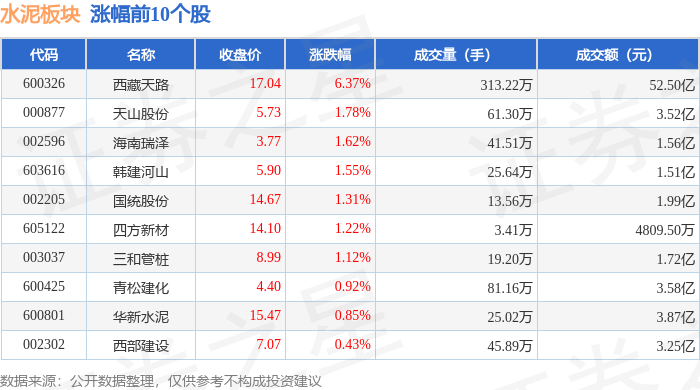
Market Overview - The cement sector increased by 0.98% on August 18, with Tibet Tianlu leading the gains [1] - The Shanghai Composite Index closed at 3728.03, up 0.85%, while the Shenzhen Component Index closed at 11835.57, up 1.73% [1] Individual Stock Performance - Tibet Tianlu (600326) closed at 17.04, up 6.37% with a trading volume of 3.1322 million shares and a transaction value of 5.25 billion [1] - Tianshan Shares (000877) closed at 5.73, up 1.78% with a trading volume of 613,000 shares and a transaction value of 352 million [1] - Other notable performers include Hanjian Heshan (603616) at 5.90, up 1.55%, and Guotong Shares (002205) at 14.67, up 1.31% [1] Fund Flow Analysis - The cement sector saw a net inflow of 371 million from institutional investors, while retail investors experienced a net outflow of 93.33 million [2] - Major stocks like Tibet Tianlu had a net inflow of 34.5 million from institutional investors, indicating strong institutional interest [3] - Conversely, stocks like Hanjian Heshan and Guotong Shares experienced net outflows from retail investors, suggesting a mixed sentiment among retail participants [3]