老板电器

Search documents
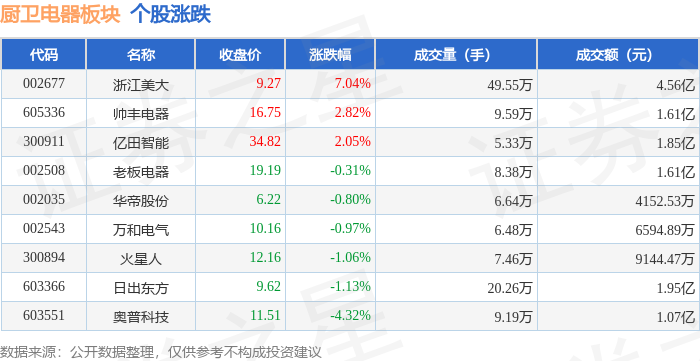
厨卫电器板块1月7日涨0.07%,浙江美大领涨,主力资金净流入4310.57万元
Zheng Xing Xing Ye Ri Bao· 2026-01-07 08:58
Market Performance - The kitchen and bathroom appliance sector increased by 0.07% on January 7, with Zhejiang Meida leading the gains [1] - The Shanghai Composite Index closed at 4085.77, up 0.05%, while the Shenzhen Component Index closed at 14030.56, up 0.06% [1] Stock Performance - Zhejiang Meida (002677) closed at 9.27, with a rise of 7.04% and a trading volume of 495,500 shares, amounting to 456 million yuan [1] - Shuaifeng Electric (605336) closed at 16.75, up 2.82%, with a trading volume of 95,900 shares, totaling 161 million yuan [1] - Yitian Intelligent (300911) closed at 34.82, increasing by 2.05%, with a trading volume of 53,300 shares, amounting to 185 million yuan [1] - Other notable stocks include Boss Electric (002508) down 0.31%, Wanhe Electric (002543) down 0.97%, and Mars Man (300894) down 1.06% [1] Capital Flow - The kitchen and bathroom appliance sector saw a net inflow of 43.11 million yuan from institutional investors and 46.31 million yuan from retail investors, while individual investors experienced a net outflow of 89.41 million yuan [1] - The detailed capital flow for key stocks shows that Zhejiang Meida had a net inflow of 65.68 million yuan from institutional investors, while retail investors had a net outflow of 88.36 million yuan [2] - Other stocks like Yitian Intelligent and Shuaifeng Electric also experienced varying levels of net inflow and outflow from different investor categories [2]


2026年黑龙江国补首单落地京东家电专卖店
Sou Hu Cai Jing· 2026-01-07 01:14
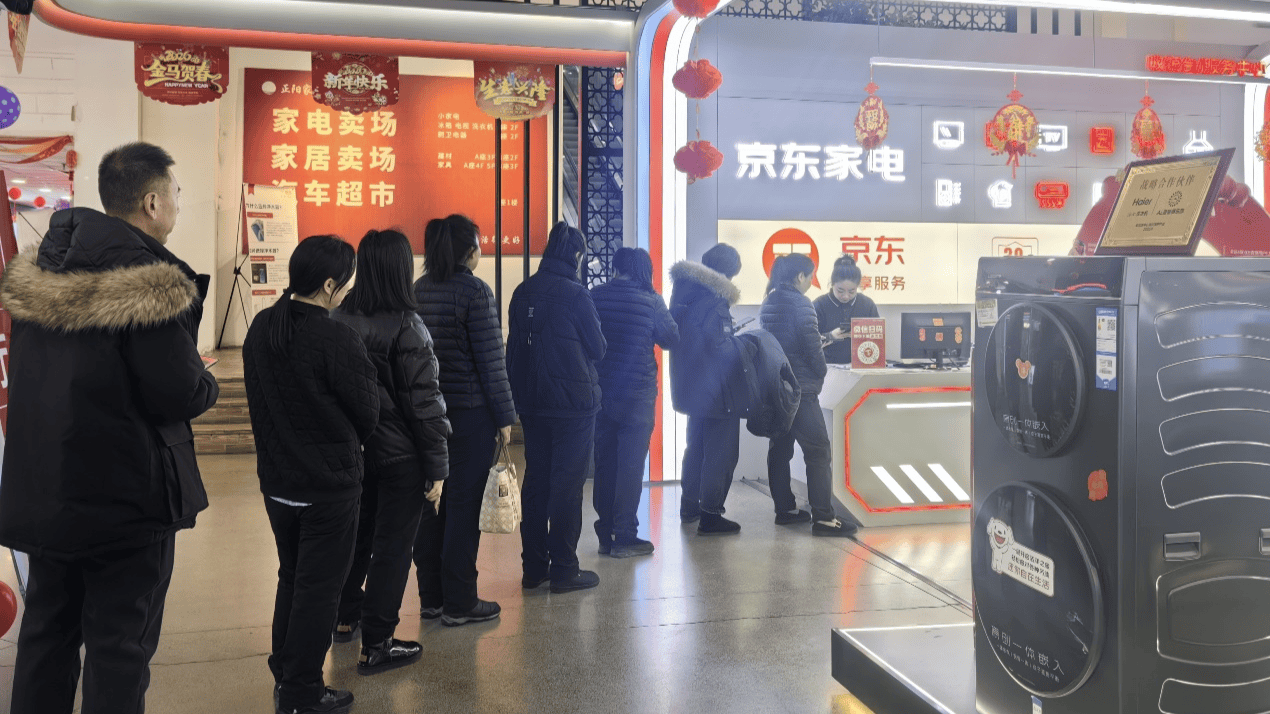
新年伊始,2026年国家补贴政策全面启动。在元旦假期喜庆祥和的氛围中,黑龙江省哈尔滨市的严先生来到当地京东家电专卖店,通过国补以优惠约1000元 的价格购置了一台老板抽油烟机。据悉,这也是2026年黑龙江国补落地成交的第一单。 消费者享受补贴排队结账(京东家电专卖店供图) 严先生家里的老式抽油烟机已使用八年之久,吸力大不如前。最近通过新闻了解到新一轮国家补贴开始实施,于是在元旦假期来到家附近的京东家电专卖店 进行选购。在导购的协助下,严先生选中一款老板抽油烟机,通过国补优惠直接节省了近1000元,直呼太划算了。 据了解,京东全面承接2026年国补落地。消费者在京东购买活动指定的冰箱、洗衣机、电视、空调、电脑、热水器产品,单件/单次至高补贴1500元;购买 活动指定的手机、平板、智能手表手环、智能眼镜产品,单件/单次至高补贴500元。每位消费者累计至高可省11000元! 政策与市场的积极协同,不仅切实提升了消费者的幸福感,也进一步增强了市场发展信心。未来,京东将持续做好两新政策的落地实施工作,助力国家换新 补贴高效、安全地覆盖广大消费者。(来源:京东家电) 自2024年"两新"政策实施以来,在商务部等部委的指导 ...

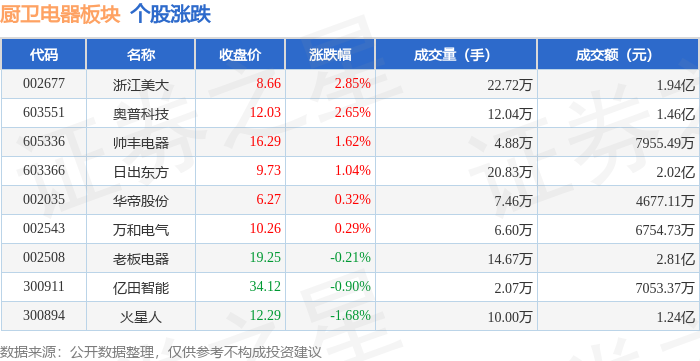
厨卫电器板块1月6日涨0.44%,浙江美大领涨,主力资金净流出79万元
Zheng Xing Xing Ye Ri Bao· 2026-01-06 08:56
Core Viewpoint - The kitchen and bathroom appliance sector experienced a slight increase of 0.44% on January 6, with Zhejiang Meida leading the gains. The Shanghai Composite Index rose by 1.5%, while the Shenzhen Component Index increased by 1.4% [1]. Group 1: Market Performance - The closing price of Zhejiang Meida was 8.66, reflecting a rise of 2.85% with a trading volume of 227,200 shares and a transaction value of 194 million [1]. - Aopu Technology closed at 12.03, up by 2.65%, with a trading volume of 120,400 shares and a transaction value of 146 million [1]. - Shuaifeng Electric's closing price was 16.29, showing an increase of 1.62%, with a trading volume of 48,800 shares and a transaction value of approximately 79.55 million [1]. - The overall kitchen and bathroom appliance sector saw a net outflow of 790,000 yuan from main funds, while retail funds experienced a net inflow of 1.34 million yuan [1]. Group 2: Fund Flow Analysis - Boss Electric had a main fund net inflow of 16.92 million yuan, accounting for 6.01% of its total, while retail funds saw a net outflow of 25.42 million yuan [2]. - Wanhe Electric experienced a main fund net inflow of 8.23 million yuan, representing 12.19%, but had a retail net outflow of 3.86 million yuan [2]. - Aopu Technology faced a significant main fund net outflow of 20.38 million yuan, which is 13.99% of its total, while retail funds had a net inflow of 9.84 million yuan [2].




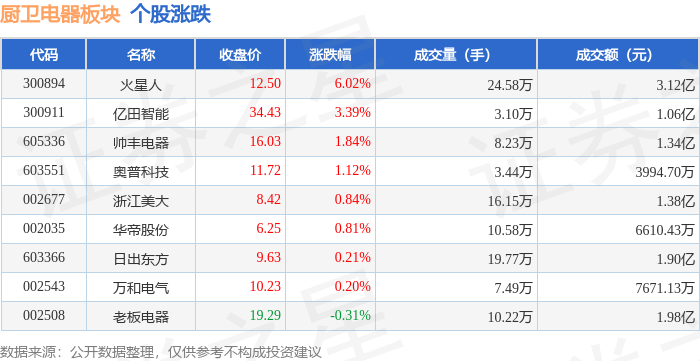
厨卫电器板块1月5日涨0.95%,火星人领涨,主力资金净流出1271.1万元
Zheng Xing Xing Ye Ri Bao· 2026-01-05 08:59
Group 1 - The kitchen and bathroom appliance sector increased by 0.95% on January 5, with Mars leading the gains [1] - The Shanghai Composite Index closed at 4023.42, up 1.38%, while the Shenzhen Component Index closed at 13828.63, up 2.24% [1] - Mars reported a closing price of 12.50, with a rise of 6.02%, and a trading volume of 245,800 shares, amounting to 312 million yuan [1] Group 2 - The main capital flow in the kitchen and bathroom appliance sector showed a net outflow of 12.71 million yuan from institutional investors and 64.71 million yuan from speculative investors, while retail investors had a net inflow of 77.42 million yuan [1] - Specific stock flows indicated that Boss Electric had a net inflow of 12.82 million yuan from institutional investors, while it experienced a net outflow of 16.10 million yuan from speculative investors [2] - Mars had a net outflow of 24.68 million yuan from speculative investors, but a net inflow of 24.12 million yuan from retail investors [2]



全面反弹!消费复苏驱动QDII重仓股走强,公募看好2026年机会
券商中国· 2026-01-04 14:57
Core Viewpoint - The article highlights the positive rebound of Chinese concept stocks in the US market during the New Year period, driven by signs of domestic consumption recovery and optimism about China's consumer market in 2026 [1][3][6]. Group 1: Market Performance - Public QDII funds heavily invested in Chinese concept stocks saw a significant rebound, with the Nasdaq Golden Dragon China Index rising by 4.36% on the first trading day of 2026 [3]. - Individual stocks such as Baidu surged over 15%, while other notable gains included 9.8% for Global Data, 5% for Manbang, 6% for iQIYI, and 2% for Pinduoduo, indicating strong performance across the board for internet and consumer leaders [3]. - The rebound reflects a shift in market sentiment towards consumer stocks, as previously favored tech stocks experienced adjustments during the holiday period [3]. Group 2: Investment Outlook - As the investment horizon shifts to 2026, leading stocks like Alibaba, Bilibili, and NetEase are showing strong upward momentum, suggesting global capital's optimistic outlook on China's consumption recovery [2][6]. - Fund managers are increasingly focusing on structural opportunities within the consumer sector, with many conducting research on companies that are adapting to new consumption trends [5]. Group 3: Policy and Economic Drivers - Multiple fund companies anticipate that government policies aimed at boosting consumption will play a crucial role in 2026, with expectations for increased fiscal spending and support for service consumption [6][7]. - The article notes that the "reward economy," "first release economy," and "silver economy" are emerging consumption trends that could catalyze growth and value re-evaluation for related companies [7]. Group 4: Performance of Consumer Funds - Consumer-focused funds have demonstrated strong performance, with the Southern Hong Kong Growth Flexible Fund achieving approximately 48% returns over the past year and 87% over two years, outperforming many volatile tech-focused funds [5]. - The article emphasizes the long-term attractiveness of the consumer sector, as evidenced by the performance of funds that prioritize quality and strategic stock selection [5].

2026上海国际家电及消费电子展AWE
Sou Hu Cai Jing· 2026-01-04 13:10
Group 1 - The AWE2026 (China Household Appliances and Consumer Electronics Expo) will take place from March 12 to 15, 2026, in Shanghai, featuring a new "one exhibition, dual zones" model [4] - The theme of AWE2026 is "AI Technology, Enjoying the Future," focusing on the innovative applications of artificial intelligence in the home appliance and consumer electronics sectors [6][10] - Over 1,500 exhibitors from more than 70 countries and regions are expected, with anticipated attendance exceeding 400,000, showcasing thousands of smart living products and solutions [6] Group 2 - Major Chinese brands such as Haier, Midea, Changhong, TCL, and Hisense will showcase their latest AI technologies and scenario-based products, highlighting China's technological leadership in manufacturing [6] - International brands like Bosch, Panasonic, Samsung, and LG will also participate, adding a global dimension to the expo [6] - The event will emphasize "full-domain interconnection," "proactive intelligence," and "personalized adaptation," marking a shift from focusing solely on product functionality to integrating advanced technologies [8] Group 3 - AWE2026 will introduce a new exhibition area in the Shanghai Oriental Hub International Business Cooperation Zone, aimed at showcasing advanced technologies in the consumer electronics industry [10] - This expo is positioned as a significant international event following the operational launch of the business cooperation zone, leveraging its unique advantages for global brand aggregation and technological innovation [10]

多行业联合红利资产12月报:股息率年关盘点-20260104
Huachuang Securities· 2026-01-04 06:46
证 券 研 究 报 告 【策略月报】 股息率年关盘点 ——多行业联合红利资产 12 月报 策略研究 策略月报 2026 年 01 月 04 日 华创证券研究所 证券分析师:姚佩 邮箱:yaopei@hcyjs.com 执业编号:S0360522120004 证券分析师:吴一凡 邮箱:wuyifan@hcyjs.com 执业编号:S0360516090002 证券分析师:徐康 电话:021-20572556 邮箱:xukang@hcyjs.com 执业编号:S0360518060005 证券分析师:欧阳予 邮箱:ouyangyu@hcyjs.com 执业编号:S0360520070001 证券分析师:韩星雨 邮箱:hanxingyu@hcyjs.com 执业编号:S0360525050001 证券分析师:单戈 邮箱:shange@hcyjs.com 执业编号:S0360522110001 证券分析师:马野 邮箱:maye@hcyjs.com 执业编号:S0360523040003 相关研究报告 《【华创策略】杠杆&ETF 资金分化趋势逆转—— 流动性&交易拥挤度&投资者温度计周报》 2025-12-01 《【华 ...
瞄准5万亿美元市场:跨界布局机器人,时代的新共识
3 6 Ke· 2026-01-04 00:26
Core Insights - The Chinese robotics industry is poised for significant growth by the end of 2025, with humanoid robots transitioning from experimental concepts to practical applications, achieving over 50% growth and indicating a trillion-yuan industry on the horizon [1] - The entry of major players from various sectors such as automotive, electronics, and the internet into the robotics field marks a shift from niche exploration to widespread competition, creating a unique trend of "cross-industry integration" [1] Group 1: Market Dynamics - In the first eight months of 2025, the primary market financing in the robotics sector reached 38.624 billion yuan, 1.8 times the total for 2024, highlighting the blue ocean effect attracting significant investment [2] - The global industrial robot sales are projected to reach 542,000 units in 2024, with China accounting for 295,000 units, representing 54% of the global market [2] - By 2025, the Chinese robotics market is expected to exceed 150 billion yuan, capturing 35% of the global market share, with predictions suggesting the market for embodied intelligence could reach 400 billion yuan by 2030 and over a trillion yuan by 2035 [2] Group 2: Industry Trends - At least 20 automotive companies have entered the humanoid robot market by the end of 2025, with notable developments including Chery's humanoid robot Mocha and BYD's production line for core robot components [3] - The automotive industry's supply chain overlaps significantly with robotics, with a 60% compatibility rate, driving car manufacturers to invest in robotics as they view vehicles as "mobile intelligent robots" [3] - Home appliance manufacturers are transitioning from traditional manufacturing to smart ecosystems, with companies like Midea establishing dedicated innovation centers for humanoid robots and developing comprehensive R&D systems [7] Group 3: Strategic Shifts - The automotive sector is seen as a key player in the transition to robotics, with companies like Geely planning to invest 5 billion yuan over three years to develop critical components and establish an ecosystem covering all robotics applications [6] - Internet giants are leveraging their technological and capital advantages to enter the robotics space, with ByteDance and Huawei making significant investments in developing advanced robotic models and systems [8] - The competition in the robotics sector is viewed as a strategic restructuring driven by technological advancements, with companies aiming to activate existing technological capabilities and build new ecosystems [9] Group 4: Challenges Ahead - Despite the enthusiasm for entering the robotics market, cross-industry players face challenges such as adapting core competencies to the robotics field, where technology paths are still being defined [10] - The high precision and stability required for industrial applications pose significant challenges for companies transitioning from other sectors, as they may struggle to meet the diverse demands of various operational environments [11] - Cost remains a critical issue, with companies like BYD and GAC aiming to reduce the production cost of humanoid robots to below 200,000 yuan, which requires overcoming substantial supply chain and process optimization challenges [11]




新年补贴连送三天!京东家电家居精选好物限时直降,送装一步到位
Sou Hu Wang· 2025-12-31 09:30
客厅与全屋的温暖呵护,是冬日幸福感的来源。TCL 85英寸的Q10L电视活动享8折优惠,8999元就能带 来沉浸观感。打扫房间也可以很轻松,戴森V15吸尘器优惠近500元,到手价3499元,智能吸尘系统能 深度清洁每个角落,5折补贴后549元的Mova擦窗机器人则会自动规划路径,安全高效,解放双手,擦 亮每一扇窗。 送给至亲与自己的一份宠爱,藏在贴身的细节里。为爱美的她准备一份惊喜,雅萌熬夜闪修仪pro美容 仪8折补贴后2999元到手,是贴心的护肤伴侣。戴森HD16吹风机精耀紫礼盒补贴150元,到手价2799 元,载强劲气流与负离子技术,快速干发同时减少毛躁,呵护秀发光泽。送给父亲或伴侣,博朗9系2.0 巅峰版套组88折补贴到手2229元,声波震动与精准刀头联动,带来舒适贴面的剃须体验;飞利浦经典5 系Pro剃须刀85折补贴到手364.65元,都是经典体面的选择。 安眠与沐浴的治愈角落,是每天的能量站。一夜好眠离不开好床垫,城市爱情喜临门乳胶独袋弹簧床垫 限时5折秒杀,仅需499元,天然乳胶贴合承托。睡前泡一个热水澡,娜拉之夏IP联名款云朵充气泡澡桶 新年将至,是为家添些温暖,为在意的人选份心意的好时候。京东 ...
中国电泳漆市场现状研究分析与发展前景预测报告
QYResearch· 2025-12-31 09:24
Core Viewpoint - The electrophoretic paint market in China is characterized by moderate scale, technical intensity, and stable growth, driven by both domestic demand and global industry trends. The market is expected to grow from $1,504.1 million in 2024 to $1,855.5 million by 2031, with a CAGR of 2.80% from 2025 to 2031 [3][9]. Market Size and Growth Trends - The Chinese electrophoretic paint market is projected to reach $1,504.1 million in sales revenue by 2024 and $1,855.5 million by 2031, indicating a stable growth trend with a CAGR of 2.80% from 2025 to 2031 [3]. Demand Analysis - The automotive and home appliance sectors are the primary consumers of electrophoretic paint, with automotive applications requiring high corrosion resistance and compatibility with subsequent coatings. The demand from the home appliance sector is characterized by large-scale, standardized needs [9]. Competitive Landscape - The market features a mix of international giants and local specialized manufacturers. Multinational companies dominate the high-end market due to their advanced formulation technologies and relationships with major automotive manufacturers, while local firms excel in the mid-to-low-end market segments [10][13]. Key Players - Major players in the Chinese market include PPG Industries, BASF, Haolisen, Xiangjiang Kansai, Axalta, Nippon Paint, and Jinlitai, with the top three companies holding approximately 38.63% of the market share in 2024 [13]. Industry Chain Analysis - Upstream - Key raw materials for electrophoretic paint include resins, solvents, additives, and pigments, with the chemical industry being the primary upstream sector. The market is competitive, and product costs are closely linked to fluctuations in crude oil prices [16]. Industry Chain Analysis - Midstream - Foreign brands hold a strong position in the automotive OEM paint sector, with six major companies controlling about 90% of the market share in automotive coatings. Domestic companies are gradually gaining market share in non-passenger vehicle segments [17]. Industry Chain Analysis - Downstream - The downstream industries include automotive manufacturing and other sectors such as engineering machinery, motorcycles, hardware, and home appliances, which are closely tied to macroeconomic conditions and exhibit cyclical characteristics [18]. Development Drivers - Key drivers for the industry include government support for environmentally friendly coatings, advancements in technology leading to diverse and functional products, and stable growth in downstream industries such as automotive and home appliances [21]. Development Constraints - The industry faces challenges such as risks from macroeconomic fluctuations, volatility in raw material prices, and intense competition, particularly from foreign brands in the high-end market [21].