中国人民银行

Search documents
10月净投放200亿元,央行恢复国债买卖操作
Sou Hu Cai Jing· 2025-11-05 07:32
Core Viewpoint - The People's Bank of China (PBOC) has resumed government bond trading operations, indicating a shift in monetary policy to enhance liquidity management and ensure smooth financial market operations [1]. Group 1: Monetary Policy Actions - In October, the PBOC conducted a net injection of 20 billion yuan through government bond trading, marking the resumption of operations that had been paused since January 2025 [1]. - PBOC Governor Pan Gongsheng emphasized the need for flexible government bond trading operations to accommodate the demand for base currency and changes in the bond market's supply and demand dynamics [1]. Group 2: Strategic Objectives - The resumption of government bond trading aligns with the central financial work conference's directive to enrich the monetary policy toolkit and gradually increase government bond trading in open market operations [1]. - The PBOC's government bond trading is positioned as a tool for base currency injection and liquidity management, allowing for both buying and selling to enhance the scientific and precise management of liquidity [1].
10月净投放200亿元 央行恢复国债买卖操作
Sou Hu Cai Jing· 2025-11-05 07:04
Core Viewpoint - The People's Bank of China has resumed government bond trading operations, indicating a shift in monetary policy to enhance liquidity management and ensure smooth financial market operations [1] Group 1: Central Bank Operations - On November 4, the People's Bank of China announced a net injection of 20 billion yuan through government bond trading in October, marking the resumption of operations that had been paused since January 2025 [1] - The central bank's governor, Pan Gongsheng, emphasized the need for flexible government bond trading operations to accommodate the demand for base currency and changes in the bond market's supply and yield curve [1] Group 2: Monetary Policy Tools - The resumption of government bond trading aligns with the central financial work conference's directive to expand the monetary policy toolkit by gradually increasing government bond transactions in open market operations [1] - The central bank's government bond trading is positioned as a tool for base currency injection and liquidity management, allowing for both buying and selling to enhance the scientific and precise management of liquidity [1]
央行公开市场国债买卖恢复,10月净投放200亿元
Sou Hu Cai Jing· 2025-11-05 05:50
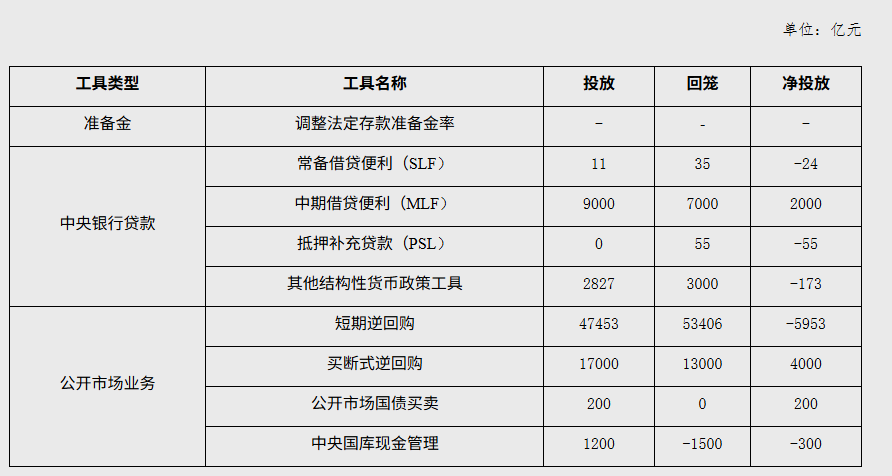
为贯彻中央金融工作会议"要充实货币政策工具箱,在央行公开市场操作中逐步增加国债买卖"要求,去 年8月份,央行启动国债买卖操作。央行国债买卖定位于基础货币投放和流动性管理工具,既有买也有 卖,与其他工具灵活搭配,提升流动性管理的科学性和精准性。 来源:@央视财经 11月4日傍晚,中国人民银行官网公布2025年10月中央银行各项工具流动性投放情况,其中,公开市场 国债买卖净投放200亿元。这表明,10月份央行已恢复2025年1月份以来暂停的国债买卖操作。 10月27日,央行行长潘功胜在2025金融街论坛年会上发表主题演讲时表示,实践中,根据基础货币投放 需要,兼顾债券市场供求和收益率曲线形态变化等情况,灵活开展国债买卖双向操作,保障货币政策顺 畅传导和金融市场平稳运行。 ...
再贷款政策引导下,国开行向科创等领域放贷超1500亿元
Sou Hu Cai Jing· 2025-11-05 05:00
Core Insights - The National Development Bank (NDB) has issued over 150 billion yuan in loans since 2022, guided by the re-lending policy aimed at supporting technological innovation and technological transformation [1][2] - The loans have supported major national technology projects, the development of technology-based small and medium-sized enterprises in their initial and growth stages, and key areas of digitalization, intelligence, high-end technology, and green technology transformation and equipment updates [1][2] - In April 2024, the People's Bank of China announced the establishment of a re-lending program for technological innovation and technological transformation, which is a continuation of the policies established in 2022, aimed at improving financial services to better meet the financing needs in these sectors [1][2]
国开行在再贷款政策引导下向科技创新和技术改造等领域放贷超1500亿元
Xin Hua Wang· 2025-11-05 03:23
Core Insights - Since 2022, the National Development Bank has provided over 150 billion yuan in loans to support technological innovation, technological transformation, and equipment upgrades [1] - The loans have facilitated major national technology projects and supported the development of technology-based small and medium-sized enterprises in their initial and growth stages [1] - In April 2024, the People's Bank of China announced the establishment of a new refinancing tool for technological innovation and technological transformation, aimed at enhancing financial services for these sectors [1] Summary by Categories - **Loan Allocation**: The National Development Bank has allocated more than 150 billion yuan in loans since 2022, focusing on technology innovation and equipment upgrades [1] - **Support for Enterprises**: The loans have been directed towards supporting major national technology projects and the growth of technology-oriented SMEs [1] - **Future Financial Tools**: The People's Bank of China will introduce a new refinancing tool in April 2024 to improve financial service quality for technology innovation and transformation [1]
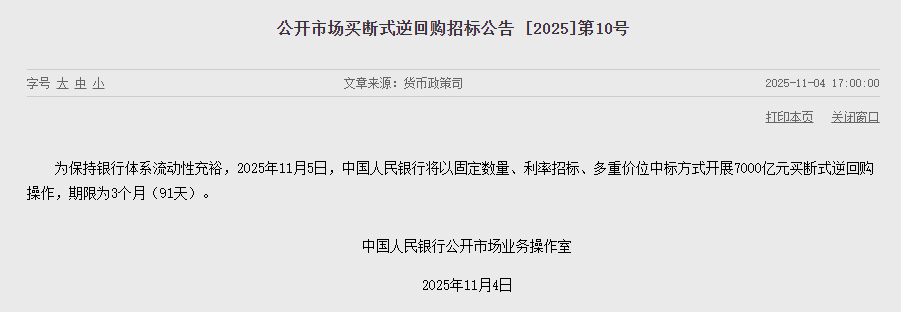
中国人民银行开展7000亿元买断式逆回购操作
Xin Hua Wang· 2025-11-05 03:01
Core Viewpoint - The People's Bank of China (PBOC) is conducting a 700 billion yuan reverse repurchase operation to maintain liquidity in the banking system, indicating a continuation of monetary policy measures to support liquidity management [1] Group 1: Reverse Repo Operations - On November 5, the PBOC conducted a 700 billion yuan buyout reverse repo operation with a term of 3 months (91 days) [1] - This operation is a continuation of the 700 billion yuan 3-month reverse repos maturing in November, indicating a rollover of liquidity support [1] - The PBOC has introduced the buyout reverse repo tool in October 2024 to enhance liquidity management within a year [1] Group 2: Market Data - In October 2023, the PBOC conducted reverse repos amounting to 17 trillion yuan, with 13 trillion yuan being withdrawn, resulting in a net injection of 4 trillion yuan [1] - Additionally, on the same day, the PBOC executed a 655 billion yuan 7-day reverse repo operation at a fixed rate of 1.40%, maintaining the same rate as the previous operation [1]
11月4日央行公告开展7000亿买断式逆回购及10月恢复国债买卖解读
Dong Fang Jin Cheng· 2025-11-05 00:21
Report Summary Core View - The central bank will use repurchase agreements and MLF to inject medium - term liquidity into the market, and the scale of medium - term liquidity increase may decline due to the expected RRR cut in the fourth quarter. The resumption of treasury bond trading in October releases a signal of stabilizing growth and does not affect the RRR cut expectation [3][4] Key Points 1. Open Market Operations - On November 5, 2025, the central bank will conduct 700 billion yuan of 3 - month (91 - day) outright repurchase operations, equivalent to a 300 - billion - yuan roll - over of 3 - month outright repurchase in November. It is expected to conduct a 6 - month outright repurchase operation with a likely increase in volume, resulting in a continuous 6 - month injection of medium - term liquidity [1] - There will be 900 billion yuan of MLF maturing in November, and the central bank may conduct an equivalent or slightly increased roll - over [3] 2. Reasons for Liquidity Injection - The issuance of 500 billion yuan of local government bonds by the end of the year, the growth of supporting loans after the 500 - billion - yuan policy - based financial instruments are put into use, and the increase in the maturity volume of inter - bank certificates of deposit in November will lead to a tightening of the capital market. The central bank injects medium - term liquidity to maintain a stable and abundant capital supply [2] 3. Treasury Bond Trading - In October, the central bank resumed treasury bond trading, injecting 20 billion yuan of long - term liquidity into the banking system. The resumption is due to the rise of the 10 - year treasury bond yield to around 1.8% and the widening of the term spread, and it also helps to stabilize the macro - economy [4] 4. Policy Outlook - A new round of growth - stabilizing policies may be introduced in the fourth quarter, with fiscal stimulus, monetary easing, and efforts to stabilize the real estate market. The central bank will use various price - based and quantity - based policy tools to boost growth, and there is ample room for monetary policy due to low inflation [3][4]
稳步发展数字人民币 货币层次定位有望优化
Shang Hai Zheng Quan Bao· 2025-11-04 19:09
Core Insights - The development of digital RMB is transitioning from pilot exploration to systematic improvement, with the People's Bank of China (PBOC) emphasizing the need for steady development and optimization of the digital RMB management system [1][2] Group 1: Limitations of M0 Positioning - The non-interest-bearing nature of digital RMB reduces the willingness of individuals and enterprises to hold it, as it lacks the value appreciation feature that traditional bank accounts offer [2] - The disconnection between digital RMB and the banking account system complicates user experience, hindering its potential to enhance monetary policy transmission and financial regulation [2][3] - The single-functionality of digital RMB limits its usage scenarios, as it currently only supports payment functions, unlike third-party platforms that offer diverse services [2] Group 2: Need for M1 Transition - There is a growing consensus on the necessity to transition digital RMB from M0 to M1 to address its limitations, as M1 would allow it to be recognized as a liability of commercial banks, thus integrating it into their balance sheets [4][5] - Two proposed pathways for this transition include digitizing deposits to create a seamless connection between bank accounts and digital wallets, and introducing a new savings form that allows funds to be transferred to digital wallets while still being counted as bank liabilities [4][5] Group 3: Enhancing Bank Incentives - The current 100% reserve requirement for digital RMB limits banks' ability to profit from traditional lending spreads, reducing their motivation to promote digital RMB [6] - Experts suggest regulatory reforms to unify technical standards, lower development costs for banks, and allow digital RMB to be classified as a bank liability to enable lending and interest income [6][7] - Banks are encouraged to view digital RMB as an opportunity for customer acquisition and service development, creating high-frequency payment scenarios and leveraging transaction data for targeted marketing and risk management [7]

央行开展7000亿元买断式逆回购操作 有助保持市场流动性充裕
Zhong Guo Jing Ying Bao· 2025-11-04 15:52
Core Viewpoint - The People's Bank of China (PBOC) announced a 700 billion yuan reverse repurchase operation to maintain liquidity in the banking system, indicating a continuation of supportive monetary policy [2][3]. Group 1: Reverse Repo Operations - On November 5, 2025, the PBOC will conduct a fixed-quantity, interest-rate tender, multi-price reverse repurchase operation of 700 billion yuan with a term of 3 months (91 days) [2]. - The operation is aimed at injecting medium-term liquidity into the banking system, helping to stabilize the funding environment and support government bond issuance [2][3]. - In November, an additional 300 billion yuan of 6-month reverse repos is expected, with a likelihood of increased amounts, marking the sixth consecutive month of medium-term liquidity injection [3]. Group 2: Market Liquidity and Policy Tools - The PBOC has been actively using reverse repo operations to adjust short-term liquidity and has also employed medium-term lending facilities (MLF) to enhance medium and short-term liquidity [3]. - In October, the PBOC net withdrew 595.3 billion yuan through short-term reverse repos, while net injecting 400 billion yuan through buyout reverse repos and 200 billion yuan through MLF [3]. Group 3: Future Expectations - Experts anticipate a potential reserve requirement ratio (RRR) cut before the end of the year, as the fourth quarter is a critical period for growth-stabilizing policies [4]. - The PBOC's actions are seen as timely and necessary to maintain ample market liquidity and encourage financial institutions to increase credit issuance [4].

央行恢复公开市场国债买卖 释放什么信号?
Zhong Guo Zheng Quan Bao· 2025-11-04 13:56
Core Viewpoint - The People's Bank of China (PBOC) has resumed the operation of buying and selling government bonds in the open market, with a net injection of 20 billion yuan, indicating a shift in monetary policy to support the real economy and stabilize market expectations [1][4]. Group 1: Monetary Policy Tools - The PBOC's liquidity injection includes various tools, with a notable net injection of 20 billion yuan from government bond transactions, marking the resumption of operations that were paused earlier this year [1][2]. - The central bank's operations also include a net withdrawal of 24 million yuan from the Standing Lending Facility (SLF) and a net injection of 20 billion yuan from the Medium-term Lending Facility (MLF) [2]. Group 2: Market Conditions - The current 10-year government bond yield is around 1.8%, which has widened the yield curve, indicating favorable conditions for resuming bond transactions [5]. - The overall performance of the bond market is considered stable, which supports the decision to restart government bond trading [5]. Group 3: Economic Signals - The resumption of government bond trading is seen as a signal to stabilize macroeconomic operations for the fourth quarter of this year and the first quarter of next year [5]. - The PBOC's cautious approach is reflected in the relatively low net buying scale of 20 billion yuan, aimed at avoiding excessive influence on market expectations [5]. Group 4: Future Expectations - There is a possibility that the PBOC may increase the scale of net bond purchases in the future to counterbalance the pressure from other monetary tools maturing [7]. - The PBOC plans to conduct a 700 billion yuan reverse repurchase operation to maintain ample liquidity in the banking system, indicating ongoing support for the financial market [6].