
北方稀土

Search documents
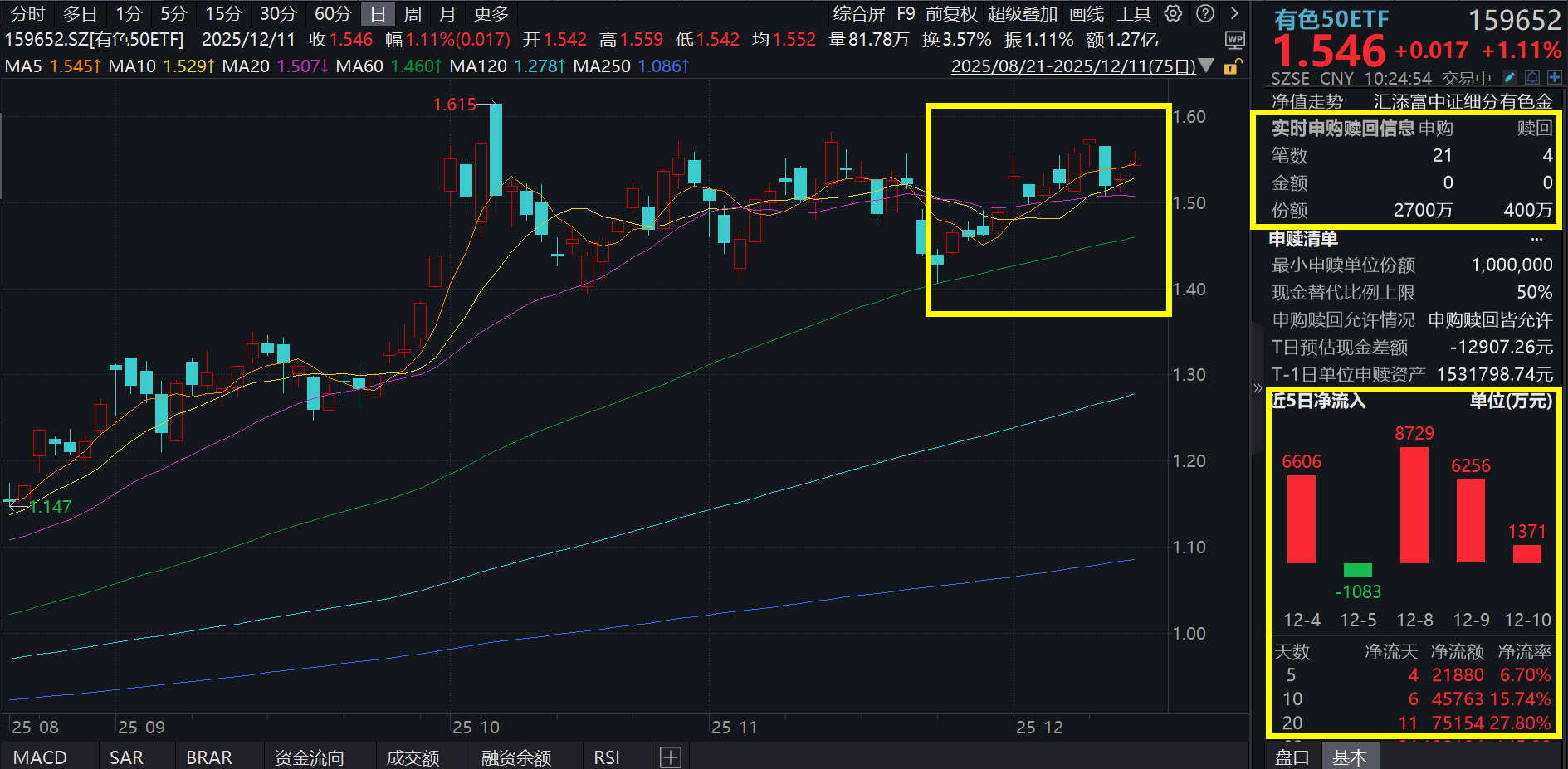
降息落地!金银铜集体飙升,白银又创新高!有色50ETF(159652)巨幅放量一度涨近2%,盘中实时吸金超3500万元!货币宽松预期下,铜价怎么看?
Sou Hu Cai Jing· 2025-12-11 03:00
Core Viewpoint - The A-share market experienced a volatile pullback on December 11, but the Nonferrous 50 ETF (159652) saw a significant inflow of funds, indicating strong investor interest in the nonferrous metals sector amid favorable overseas liquidity conditions [1][4]. Group 1: Market Performance - As of 10:26 AM, the Nonferrous 50 ETF (159652) rose over 1.11%, with an intraday peak approaching 2%, and recorded a net subscription of 23 million shares, resulting in a net inflow of over 35 million yuan [1]. - The latest fund size of the Nonferrous 50 ETF (159652) exceeded 3.5 billion yuan [1]. Group 2: Component Stocks - Most component stocks of the Nonferrous 50 ETF (159652) experienced gains, with Zijin Mining rising by 2.83% and Zhongjin Gold by 2.34%, while Northern Rare Earth and China Aluminum saw slight declines [3]. - The top ten component stocks of the Nonferrous 50 ETF (159652) include Zijin Mining, Luoyang Molybdenum, and Huayou Cobalt, with varying performance metrics [3]. Group 3: Federal Reserve Actions - The Federal Reserve announced a 25 basis point rate cut, lowering the target range for the federal funds rate to 3.50%-3.75%, which aligns with market expectations [4]. - The Fed plans to expand its balance sheet by purchasing $40 billion in short-term Treasury bonds, which is expected to support liquidity in the market [4]. Group 4: Copper Market Insights - Long-term projections suggest that the copper price may strengthen due to the ongoing U.S. rate-cutting cycle, supply-side constraints, and new demand drivers from the energy sector [8]. - Supply-side issues, including frequent mining accidents and production interruptions in major copper mines, are expected to tighten the copper market, leading to a projected supply shortfall of 150,000 tons by 2026 [9]. Group 5: Demand Drivers - The demand for copper is anticipated to grow due to significant investments in renewable energy and the development of new power systems, with a focus on enhancing grid and storage capabilities [10]. - The push for technological advancements, particularly in AI, is expected to drive substantial increases in electricity demand, further boosting copper consumption [10]. Group 6: Investment Opportunities - The Nonferrous 50 ETF (159652) is positioned to benefit from the ongoing super cycle in nonferrous metals, with a high concentration of strategic metals such as copper and gold [11][13]. - The ETF's index has a leading copper content of 31% and gold content of 14%, making it an attractive option for investors looking to capitalize on the nonferrous sector [13][15].







这个赛道多品种走强,两路资金大力加仓(名单)
Zheng Quan Shi Bao Wang· 2025-12-11 01:21
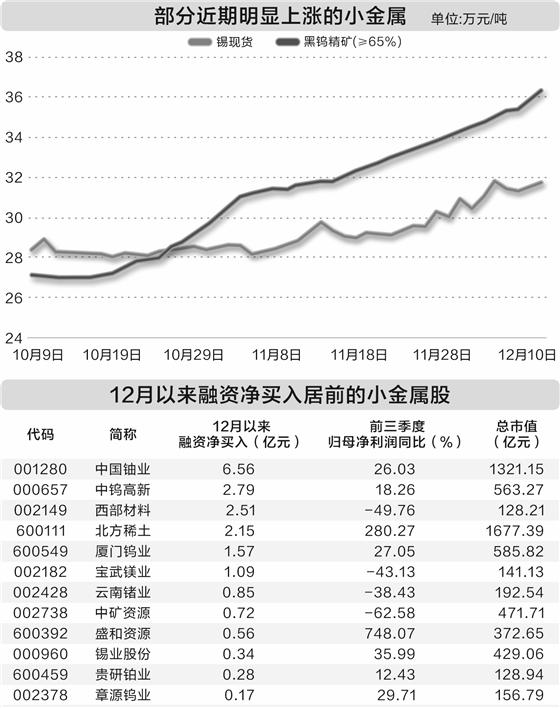
Core Viewpoint - The acquisition of PMG International Co., LTD by Lens Technology (300433) aims to enhance its capabilities in the AI computing hardware sector, leveraging its existing manufacturing strengths and expanding into new markets [1][2]. Group 1: Acquisition Details - Lens Technology signed a letter of intent to acquire 100% equity of PMG International, with specific terms to be negotiated based on due diligence and assessments [1]. - The acquisition is intended to provide Lens Technology with established technology and customer certifications in the server cabinet business, enhancing its competitive edge in AI computing hardware [2]. Group 2: Industry Performance - The small metals sector in A-shares experienced a 0.79% increase on December 10, with significant price rises in tungsten and other metals, indicating strong market demand [3][5]. - Tungsten prices have surged, with black tungsten concentrate reaching 363,000 CNY/ton, a 153.85% increase year-to-date, while ammonium paratungstate (APT) and tungsten powder also saw significant price hikes [3][5]. Group 3: Market Drivers - The price increases in small metals are driven by supply constraints, favorable macroeconomic conditions, and rising downstream demand from industries such as renewable energy and semiconductors [5]. - Expectations of a potential interest rate cut by the Federal Reserve are supporting commodity prices, with an 87.6% probability of a 25 basis point cut in December [5]. Group 4: Capital Inflows - The small metals sector has seen substantial capital inflows, with a net inflow of 1.732 billion CNY on December 10, ranking high among secondary industries [6]. - Notable stocks such as China Uranium Industry and Zhongtung High-tech have attracted significant financing, indicating strong investor interest in the sector [6][7]. Group 5: Company Performance - The small metals sector has shown robust performance, with a total net profit of 13.589 billion CNY in the first three quarters of the year, reflecting a 41.42% year-on-year increase [7]. - Companies like Shenghe Resources and Northern Rare Earth have reported exceptional profit growth, with increases of 748.07% and 280.27% respectively [7].
多重因素推动 小金属赛道多品种走强 两路资金大力加仓
Zheng Quan Shi Bao Wang· 2025-12-10 23:58
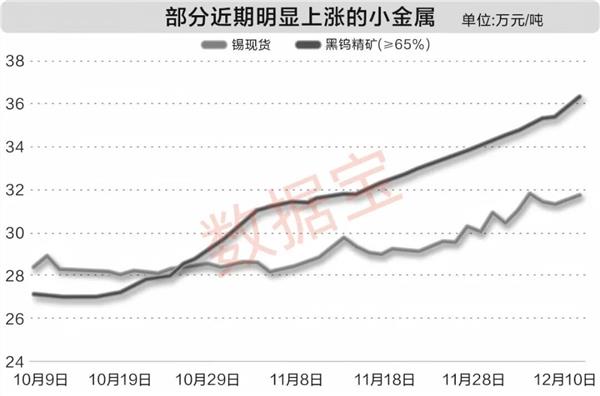
Core Viewpoint - The small metals sector in A-shares has shown a significant upward trend, with the sector index closing up by 0.79% on December 10, driven by notable price increases in various small metal varieties, particularly tungsten [2][3]. Price Movements - Tungsten prices have surged, with black tungsten concentrate (≥65%) priced at 363,000 yuan/ton, up 153.85% year-to-date; ammonium paratungstate (APT) at 535,000 yuan/ton, up 153.55%; and tungsten powder at 880 yuan/kg, up 178.48%, all reaching historical highs [3][5]. - Other small metals like cobalt and tin have also seen significant price increases, with cobalt averaging 408,000 yuan/ton (up 16.91% since October) and tin futures rising 15.74% since October [3][5]. Factors Driving Price Increases - The price increases are attributed to supply constraints, favorable macroeconomic conditions, and rising downstream demand. Supply-side constraints include strict mining quotas and environmental regulations for tungsten, and slow recovery of tin production in Myanmar [5]. - Macroeconomic factors include strong market expectations for a Federal Reserve interest rate cut, which typically weakens the dollar and supports commodity prices [5]. - Downstream demand is driven by growth in industries such as new energy, semiconductors, and military applications, enhancing the outlook for strategic small metals [5]. Capital Inflows - The small metals sector has seen substantial capital inflows, with a net inflow of 1.732 billion yuan on December 10, ranking high among secondary industries [7]. - Notable companies like Western Materials received a net inflow of 1.274 billion yuan, benefiting from their core supply roles in aerospace and marine engineering [7]. Company Performance - The small metals sector's overall performance has improved, with a total net profit of 13.589 billion yuan in the first three quarters, a year-on-year increase of 41.42% [8]. - Companies like Shenghe Resources and Northern Rare Earth have reported significant profit growth, with increases of 748.07% and 280.27% respectively [8]. Capacity Expansion - Shenghe Resources has disclosed plans for capacity expansion, with its subsidiary's high-performance rare earth polishing powder project progressing as scheduled, expected to be operational by the end of Q1 2026 [9].


小金属多品种走强 两大资金加仓热情高涨
Zheng Quan Shi Bao· 2025-12-10 18:49
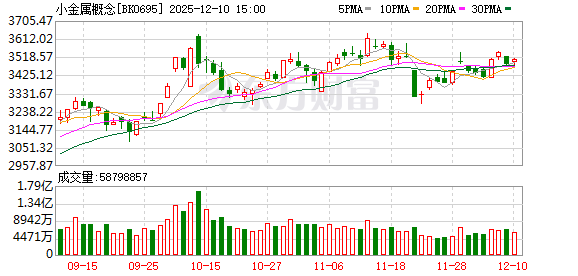
Core Viewpoint - The small metals sector in the A-share market has shown a significant upward trend, driven by multiple factors including supply constraints, favorable macroeconomic conditions, and increasing downstream demand [2][5]. Group 1: Price Movements - The small metals sector has experienced notable price increases, particularly in tungsten, which has reached historical highs. As of December 10, black tungsten concentrate (≥65%) is priced at 363,000 yuan/ton, up 153.85% year-to-date; ammonium paratungstate (APT) is at 535,000 yuan/ton, up 153.55%; and tungsten powder is at 880 yuan/kg, up 178.48% [3][5]. - Other metals such as cobalt and tin have also seen significant price increases, with cobalt averaging 408,000 yuan/ton (up 16.91% since October) and tin rising 13.89% over the same period [3][5]. Group 2: Driving Factors - The price increases are attributed to supply-side constraints, such as strict mining quotas and environmental regulations affecting tungsten, and ongoing export restrictions on cobalt from the Democratic Republic of Congo [5]. - The macroeconomic environment is favorable, with strong expectations for a Federal Reserve interest rate cut, which typically weakens the dollar and supports commodity prices [5]. - Downstream demand from industries like new energy, semiconductors, and defense is rapidly growing, boosting expectations for strategic small metals [5]. Group 3: Capital Inflows - The small metals sector has seen significant capital inflows, with a net inflow of 1.732 billion yuan on December 10, ranking high among secondary industries [6]. - Notably, Western Materials received a net inflow of 1.274 billion yuan, with its stock achieving a strong performance in recent trading sessions [6]. - Financing net purchases in the small metals sector reached 1.879 billion yuan in December, with several stocks, including China Uranium Industry, receiving substantial net purchases [6]. Group 4: Performance Metrics - The small metals sector has shown strong performance in 2023, with a total net profit of 13.589 billion yuan in the first three quarters, reflecting a year-on-year growth of 41.42% [7]. - Companies like Shenghe Resources and Northern Rare Earth have reported significant profit increases of 748.07% and 280.27%, respectively [7]. - Shenghe Resources is expanding its production capacity, with a project expected to be operational by the end of Q1 2026 [7].


4400万吨对190万吨:中国稀土优势有多大?美国重建供应链有多难?
Sou Hu Cai Jing· 2025-12-10 17:43
Core Insights - The announcement of a "substantial framework agreement" between the US and China regarding rare earths has relieved the global tech industry, highlighting China's significant control over rare earth resources with 44 million tons, nearly half of the global total [1][3]. Group 1: Reserve Disparity - Global rare earth reserves are unevenly distributed, with China holding 44 million tons, accounting for 48% of the total 92 million tons worldwide, while the US has only 1.9 million tons, representing about 2% [3]. - China's reserves are 23 times greater than those of the US, indicating a significant disparity in resource availability and structural integrity [3]. Group 2: Production Control - China dominates rare earth production, with an expected annual output of 270,000 tons in 2024, making up 69.23% of global production, compared to the US's 40,000 tons [5]. - China employs a quota system to finely control market supply, maintaining a strict limit on heavy rare earth quotas for six consecutive years [5]. Group 3: Technological Monopoly - China controls over 90% of the global capacity in the critical and high-value separation and refining stage of rare earth processing [7]. - The country is the only one capable of industrially producing 6N-grade (99.9999%) ultra-pure rare earths, meeting the demands of high-end applications [7]. - China's separation costs range from $4 to $7 per kilogram, significantly lower than the $10 to $15 per kilogram costs faced by foreign companies [7]. Group 4: Policy Upgrades - A new export control policy from China's Ministry of Commerce marks a strategic shift from "resource control" to "dual control of technology and supply chain," affecting not only direct exports but also foreign products containing Chinese components [9]. - Following the announcement of this policy, prices for key heavy rare earths like dysprosium and terbium surged by 15-20% within a week [9]. Group 5: Industry Chain Control - China has established a complete industry chain from resource extraction to high-end applications, controlling over 90% of the mining quotas through leading companies [11]. - The US lacks the necessary rare earth refining capabilities, necessitating the transport of mined materials to China for processing [11]. Group 6: Supply Chain Reconstruction Challenges - Major consumers like the US, EU, and Japan are attempting to rebuild their supply chains but face significant barriers, including high technical hurdles and economic feasibility issues [13]. - The timeline for developing a complete supply chain from mining to production typically spans 5-10 years, complicating efforts to reduce reliance on Chinese rare earths [13]. - The most likely scenario is a "diverse but dependent" global market, with China maintaining over 70% market share while overseas alternatives are limited to lower-end segments [15].

北方稀土(600111) - 北方稀土章程(2025年12月修订)
2025-12-10 11:33
中国北方稀土(集团)高科技股份有限公司 章 程 (2025年12月10日公司2025年第二次临时股东大会修订通过) 中国·包头 二〇二五年十二月 | 第一章 总则 . | | --- | | 第二章 经营宗旨和范围 | | 第三章 股份 . | | 第一节 股份发行 . | | 第二节 股份增减和回购 | | 第三节 股份转让 . | | 第四章 股东和股东会 . | | 第一节 股东的一般规定 . | | 第二节 控股股东和实际控制人 | | 第三节 股东会的一般规定 . | | 第四节 股东会的召集 | | 第五节 股东会的提案与通知 | | 第六节 股东会的召开 | | 股东会的表决和决议 第七节 | | 第八节 股东会授权 | | 第五章 党的组织 30 | | 第六章 董事和董事会 . | | 第一节 董事的一般规定 | | 第二节 独立董事 | | 第三节 董事会 | | 第四节 董事会专门委员会 | | 第七章 高级管理人员 51 | | 第八章 职工民主管理与劳动人事制度 54 | | 第九章 财务会计制度、利润分配和审计 56 | | 第一节 财务会计制度 56 | | 第二节 内部审计 . ...
北方稀土(600111) - 北方稀土股东会议事规则(2025年12月修订)
2025-12-10 11:33
第二条 公司股东会的召集、提案、通知、召开等事项适用本规 则。 中国北方稀土(集团)高科技股份有限公司 股东会议事规则 (2025 年 12 月 10 日公司 2025 年第二次临时股东大会修订通过) 第一章 总则 第一条 为规范中国北方稀土(集团)高科技股份有限公司(以 下简称公司)的行为,保证公司股东会依法行使职权,根据《中华人 民共和国公司法》(以下简称《公司法》)、《中华人民共和国证券法》(以 下简称《证券法》)、中国证券监督管理委员会(以下简称中国证监会) 《上市公司股东会规则》、《上海证券交易所股票上市规则》等法律、 行政法规、部门规章、规范性文件(以下简称法律法规)以及公司章 程的规定,制定本规则。 第三条 公司应当严格按照法律法规及公司章程的相关规定召开 股东会,保证股东能够依法行使权利。 公司董事会应当切实履行职责,认真、按时组织股东会。公司全 体董事应当勤勉尽责,确保股东会正常召开和依法行使职权。 第四条 股东会应当在《公司法》和公司章程规定的范围内行使 职权。 第五条 股东会分为年度股东会和临时股东会。年度股东会每年 召开一次,应当于上一会计年度结束后的六个月内举行。临时股东会 不定期召 ...
北方稀土(600111) - 北方稀土董事会议事规则(2025年12月修订)
2025-12-10 11:33
(2025 年 12 月 10 日公司 2025 年第二次临时股东大会修订通过) 第一章 总则 中国北方稀土(集团)高科技股份有限公司 董事会议事规则 第一条 为了进一步规范中国北方稀土(集团)高科技股份有限 公司(以下简称公司)董事会的议事方式和决策程序,促使董事和董 事会有效地履行其职责,提高董事会规范高效运作和审慎科学决策水 平,根据《中华人民共和国公司法》《中华人民共和国证券法》《上市 公司治理准则》《上海证券交易所股票上市规则》《上海证券交易所上 市公司自律监管指引第 1 号——规范运作》等法律、行政法规、部门 规章、规范性文件(以下统称法律法规)以及公司《章程》的规定, 制订本规则。 第二章 会议类型 第一节 定期会议 第二条 董事会会议分为定期会议和临时会议。 董事会召开会议审议包括定期报告在内的重要事项的会议为定 期会议,审议除定期报告外的其他重要事项的董事会会议为临时会议。 董事会每年应当至少在上下两个半年度各召开一次定期会议。 第三条 发出召开董事会定期会议的通知前,董事会秘书应当充 分征求各董事及高级管理人员的意见,初步形成会议提案后交董事长 拟定。 第二节 临时会议 第四条 有下列情形 ...
北方稀土(600111) - 北方稀土担保管理办法(2025年12月修订)
2025-12-10 11:33
中国北方稀土(集团)高科技股份有限公司 担保管理办法 (2025 年 12 月 10 日公司 2025 年第二次临时股东大会修订通过) 第一章 总则 第一条 为维护投资者和全体股东的合法权益,规范中国北方稀 土(集团)高科技股份有限公司(以下简称公司或北方稀土)及控股子 公司的担保行为,防范担保风险,根据《中华人民共和国民法典》《中 华人民共和国公司法》《中华人民共和国证券法》、中国证监会《上市 公司监管指引第8号—上市公司资金往来、对外担保的监管要求》、《内 蒙古自治区国资委出资监管企业融资担保管理办法》、《上海证券交易 所股票上市规则》和《上海证券交易所上市公司自律监管指引第 1 号 —规范运作》等法律法规、规范性文件以及公司《章程》等规定,制 定本办法。 第二条 本办法适用于公司以及公司全资子公司、绝对控股子公 司和拥有实际控制权的相对控股子公司(以下统称控股子公司),包 含全级次的分子公司。 第三条 本办法所称担保是指公司及控股子公司为公司合并报表 范围内的子企业和未纳入合并报表范围的参股企业借款、发行债券、 资产管理计划等融资行为提供的各种形式担保,如一般保证、连带责 任保证、抵押、质押等,也包括出 ...
北方稀土(600111) - 北方稀土董事会战略与ESG委员会工作规则(2025年12月修订)
2025-12-10 11:33
第一章 总则 第一条 为适应公司战略发展需要,提高核心竞争力,保证发展 规划和战略决策的科学性,完善公司治理结构,提升公司环境、社会 及公司治理(ESG)管理运作水平,促进公司规范运作和可持续高质 量发展,根据《中华人民共和国公司法》、中国证券监督管理委员会 (以下简称中国证监会)《上市公司治理准则》《上市公司独立董事管 理办法》、《上海证券交易所股票上市规则》《上海证券交易所上市公 司自律监管指引第 1 号——规范运作》等法律、行政法规、部门规章、 规范性文件(以下统称法律法规)及公司章程等规定,公司董事会设 立战略与 ESG 委员会,制定本规则。 第二条 董事会战略与 ESG 委员会是董事会按照股东会决议设立 的专门工作机构,对董事会负责,按照法律法规、公司章程及董事会 授权和本规则的规定履行职责,向董事会报告工作,为董事会决策提 供咨询和建议,提案提交董事会审议决定。 第二章 人员组成 中国北方稀土(集团)高科技股份有限公司 董事会战略与 ESG 委员会工作规则 (2025 年 12 月 10 日公司第九届董事会第九次会议修订通过) 战略与ESG委员会委员辞任导致战略与ESG委员会成员低于公司 章程及本 ...