
战略小金属

Search documents
这个赛道多品种走强,两路资金大力加仓(名单)
Zheng Quan Shi Bao Wang· 2025-12-11 01:21
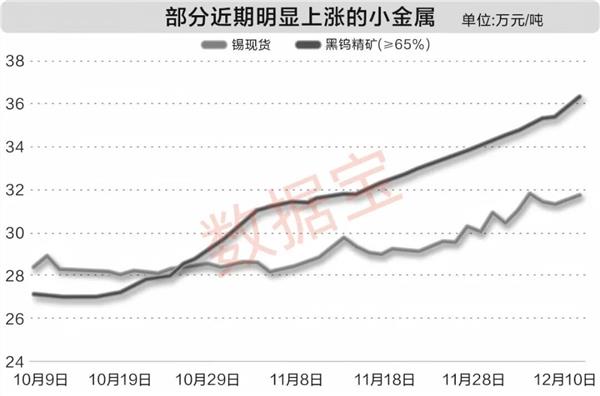
Core Viewpoint - The acquisition of PMG International Co., LTD by Lens Technology (300433) aims to enhance its capabilities in the AI computing hardware sector, leveraging its existing manufacturing strengths and expanding into new markets [1][2]. Group 1: Acquisition Details - Lens Technology signed a letter of intent to acquire 100% equity of PMG International, with specific terms to be negotiated based on due diligence and assessments [1]. - The acquisition is intended to provide Lens Technology with established technology and customer certifications in the server cabinet business, enhancing its competitive edge in AI computing hardware [2]. Group 2: Industry Performance - The small metals sector in A-shares experienced a 0.79% increase on December 10, with significant price rises in tungsten and other metals, indicating strong market demand [3][5]. - Tungsten prices have surged, with black tungsten concentrate reaching 363,000 CNY/ton, a 153.85% increase year-to-date, while ammonium paratungstate (APT) and tungsten powder also saw significant price hikes [3][5]. Group 3: Market Drivers - The price increases in small metals are driven by supply constraints, favorable macroeconomic conditions, and rising downstream demand from industries such as renewable energy and semiconductors [5]. - Expectations of a potential interest rate cut by the Federal Reserve are supporting commodity prices, with an 87.6% probability of a 25 basis point cut in December [5]. Group 4: Capital Inflows - The small metals sector has seen substantial capital inflows, with a net inflow of 1.732 billion CNY on December 10, ranking high among secondary industries [6]. - Notable stocks such as China Uranium Industry and Zhongtung High-tech have attracted significant financing, indicating strong investor interest in the sector [6][7]. Group 5: Company Performance - The small metals sector has shown robust performance, with a total net profit of 13.589 billion CNY in the first three quarters of the year, reflecting a 41.42% year-on-year increase [7]. - Companies like Shenghe Resources and Northern Rare Earth have reported exceptional profit growth, with increases of 748.07% and 280.27% respectively [7].

战略小金属供给刚性下价格弹性显著,稀有金属ETF(562800)一键布局稀有金属板块
Xin Lang Cai Jing· 2025-12-03 02:51
Group 1 - The small metal sector is experiencing a rebound, with the China Rare Metals Theme Index rising by 0.20% as of 10:19 AM on December 3, 2025, driven by significant increases in stocks such as Northern Rare Earth (up 3.41%) and Tin Industry Co. (up 2.93%) [1] - There is a growing demand for strategic small metals due to their applications in high-temperature alloys, semiconductors, and permanent magnet motors, leading to a notable price elasticity despite rigid supply [1] - Limited reserves, high extraction difficulty, and insufficient supply elasticity of strategic small metals are contributing to an intensifying supply-demand conflict, with prices expected to continue rising in the future [1] Group 2 - The top ten weighted stocks in the China Rare Metals Theme Index account for 59.05% of the index, including companies like Luoyang Molybdenum, Northern Rare Earth, and Ganfeng Lithium [1] - The Rare Metals ETF (562800) tracks the China Rare Metals Theme Index, providing a convenient investment tool for investors looking to enter the rare metals sector [2] - Investors can also explore opportunities in the rare metals sector through the Rare Metals ETF linked fund (014111) [2]
倍杰特拟收购大豪矿业55%股权,完善矿业开发业务布局
Zheng Quan Shi Bao Wang· 2025-11-19 12:56
Core Viewpoint - The company plans to acquire a 55% stake in Wenshan Dahao Mining Development Co., Ltd. for 225 million yuan, enhancing its resource supply and operational efficiency in the antimony and tungsten sectors [1][2][3] Group 1: Acquisition Details - The acquisition will be funded through the company's own or raised funds, totaling 225 million yuan [1] - Following the acquisition, Dahao Mining's debts amounting to 191 million yuan will be managed, with 105 million yuan to be repaid through a loan from the company [1] - A loan agreement will be established for further financing of existing mining projects, with an interest rate of 6.5% [1] Group 2: Dahao Mining's Business Overview - Dahao Mining specializes in mineral resource exploration and development, holding nine mining rights, including two mining rights and seven exploration rights [2] - The primary minerals include antimony, tungsten, and lead-zinc, with antimony being crucial for various industrial applications [2] - Tungsten is recognized as a strategic resource essential for national defense and economic development [2] Group 3: Strategic Implications - The acquisition aligns with the company's strategy to secure key raw material supplies and enhance cost control [3] - It aims to improve the efficiency and risk resilience of the entire supply chain, thereby strengthening the company's core competitiveness [3] - The company will appoint executives to oversee Dahao Mining's operations post-acquisition, ensuring effective resource integration and business development [3]
大爆发!尾盘,多股30%涨停
Zheng Quan Shi Bao· 2025-10-29 08:47
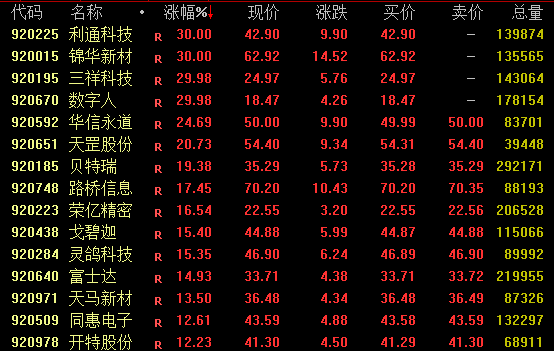
Market Overview - The A-share market experienced a strong rally on October 29, with the Shanghai Composite Index surpassing 4000 points, reaching a 10-year high, while the ChiNext Index rose nearly 3% [1] - The North Exchange 50 Index surged over 8% in the afternoon session, closing with a significant increase [2] Sector Performance Photovoltaic Industry - The photovoltaic sector saw substantial gains, with Sunshine Power rising over 15% to a new historical high, and other companies like Longi Green Energy and Tongwei Co. hitting the daily limit [5][6] - The industry is expected to benefit from improved supply-demand dynamics and rising prices of polysilicon, leading to a potential valuation recovery [7] Nonferrous Metals - The nonferrous metals sector also performed strongly, with tungsten and aluminum stocks showing notable increases. Zhongtung High-tech hit the daily limit for two consecutive days, while Jiangxi Copper approached the limit [8][10] - The tungsten market is experiencing a price increase due to rising demand and supply constraints, with significant price hikes reported for tungsten concentrate and ammonium paratungstate [10] Securities Firms - The securities sector saw gains, with Huazhang Securities and Northeast Securities reaching their daily limits during intraday trading [1] Banking Sector - In contrast, the banking sector faced declines, with Chengdu Bank dropping nearly 6% and other banks like Xiamen Bank and Shanghai Pudong Development Bank falling close to 5% [1] Regulatory Developments - The China Securities Regulatory Commission emphasized the need to improve the North Exchange's listing mechanism and enhance the quality of listed companies, aiming to stimulate market vitality [4]




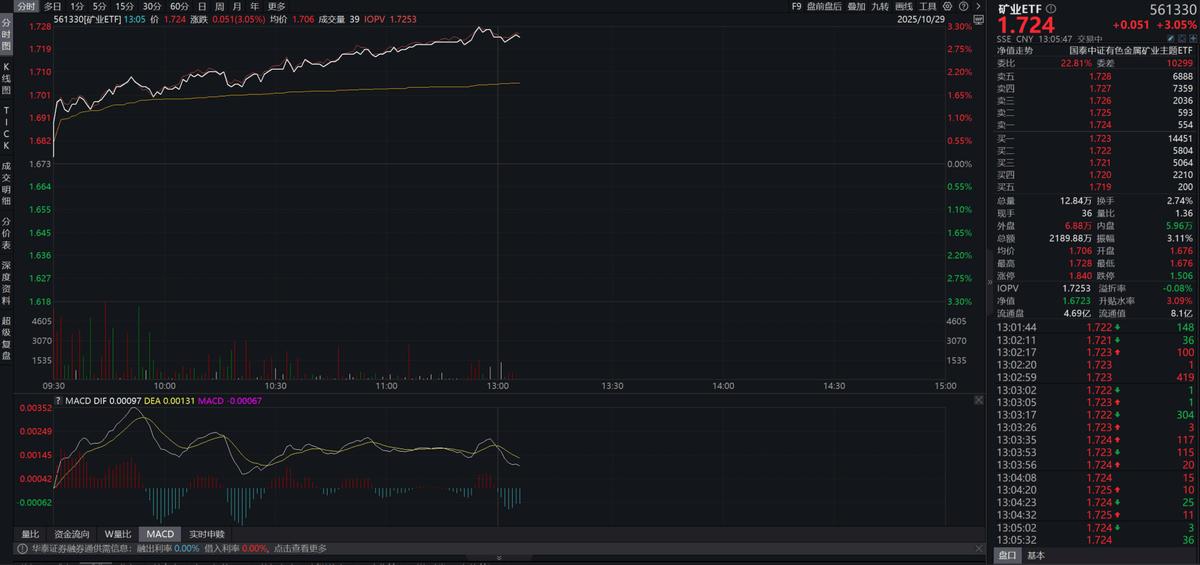
钨矿战略地位提升,矿业ETF(561330)午后大涨超3%,年内涨超有色
Sou Hu Cai Jing· 2025-10-29 05:32
Core Viewpoint - The tungsten market has entered a new upward trend, leading to a rise in the mining sector, with the mining ETF (561330) experiencing a significant increase of over 3% in the afternoon and a year-to-date gain of over 84% [1][3]. Industry Summary - The tungsten market has seen a resurgence, with prices for black tungsten concentrate (≥65%) reaching 288,000 CNY/ton, an increase of 3,000 CNY per ton from the previous trading day. APT (ammonium paratungstate ≥88.5%) is priced at 425,000 CNY/ton, up 7,000 CNY per ton, and tungsten powder (≥99.7%) is at 635 CNY/gram, rising by 5 CNY per gram [3]. - Tungsten's strategic resource status has been elevated, with demand continuing to grow. In the first half of 2025, China's tungsten consumption is projected to total 35,900 tons, a year-on-year increase of 2.1%, with primary tungsten consumption at 30,400 tons, up 2.5% [3]. - The increase in demand is driven by significant production growth in downstream industries such as excavators, metal cutting machine tools, automobiles, and photovoltaics [3]. - Domestic tungsten prices are under pressure due to increased demand, safety production in mines, and environmental inspections, leading to a tight supply-demand situation. Available inventory has been depleted, and while Kazakhstan's Bakuta tungsten mine has potential for increased output, capacity release will take time, potentially exacerbating supply shortages in the short term [3]. ETF Performance Summary - The mining ETF (561330) has outperformed the China Securities Nonferrous Metals Index by nearly 10% year-to-date as of October 28, 2025. The ETF tracks the China Securities Nonferrous Metals Mining Theme Index, which has a more concentrated representation of leading stocks [4]. - The mining ETF consists of 37 components, with the top ten stocks accounting for 57.34% of the index, compared to 48.32% for the top ten stocks in the broader nonferrous metals index, indicating a more precise capture of market trends [4]. - The mining theme index has a higher proportion of "gold, copper, and rare earths" at 56.2%, compared to 52.5% in the broader index, benefiting from favorable catalysts in these popular sectors [6]. Market Outlook - The nonferrous mining sector is expected to have long-term investment value, supported by a recovery in risk appetite following lower-than-expected U.S. core CPI data, which has strengthened expectations for interest rate cuts by the Federal Reserve [10]. - The copper market is showing strong fundamentals, with global copper mine production expected to fall short of expectations due to frequent disruptions in major mines, leading to a projected decrease of 220,000 tons in global copper concentrate output in 2025 [10]. - Demand for copper is anticipated to grow rapidly due to its extensive applications in electric vehicles and AI data centers, with long-term investments in power grids and data centers further supporting copper prices [10]. Investment Opportunity - Investors are encouraged to consider the mining ETF (561330), which currently has a scale of 784 million CNY, ranking first among similar index ETFs, offering superior liquidity and exposure to "gold, copper, and rare earth" opportunities [11].
有色板块拉升,钨概念股表现亮眼,中钨高新两连板
Zheng Quan Shi Bao Wang· 2025-10-29 03:07
Industry Overview - The non-ferrous sector showed significant gains on the 29th, with tungsten concept stocks performing notably well, including Zhongtung High-tech hitting the daily limit for two consecutive days, and Xiamen Tungsten and Zhangyuan Tungsten rising over 4% [1] - Jiangxi Copper, China Aluminum, and Huaxi Nonferrous also saw approximately 5% increases [1] Market Dynamics - The tungsten market has recently entered a rising trend, with prices for black tungsten concentrate (≥65%) quoted at 288,000 yuan/ton, an increase of 3,000 yuan per ton from the previous trading day [1] - APT (Ammonium Paratungstate ≥88.5%) is priced at 425,000 yuan/ton, up 7,000 yuan per ton, while tungsten powder (≥99.7%) is priced at 635 yuan/gram, an increase of 5 yuan per gram [1] Demand and Consumption - Tungsten is increasingly recognized as a strategic resource, with demand continuing to grow. According to Antaike data, China's tungsten consumption from January to June 2025 is projected to total 35,900 metric tons, a year-on-year increase of 2.1%, with primary tungsten consumption at 30,400 metric tons, up 2.5% year-on-year [1] - Key downstream industries such as excavators, metal cutting machine tools, automobiles, and photovoltaics have shown significant production increases, leading to higher tungsten consumption [1] Supply Constraints - Guosen Securities indicates that domestic tungsten prices are under pressure due to increased demand, safety production in mines, and environmental inspections, resulting in tight supply and demand at the mining level, with previously available inventories being depleted [1] - The Bakuta tungsten mine in Kazakhstan has potential for increased output, but capacity release will take time, potentially exacerbating supply-demand gaps in the short term [1] - With heightened export controls, tungsten's status as a strategic metal is being elevated, suggesting that prices for tungsten and related strategic minor metals may continue to rise [1]
战略小金属 迎高光时刻!这些领域需求爆发
Zhong Guo Zheng Quan Bao· 2025-10-14 12:25
Core Viewpoint - The small metals sector is experiencing a continuous rise in prosperity driven by high-end manufacturing and cutting-edge technology, with increasing market attention on strategic metals such as rare earths, molybdenum, antimony, tantalum, and niobium since mid-October [1][2]. Policy Perspective - In September, the Ministry of Industry and Information Technology and seven other departments issued the "Nonferrous Metals Industry Stabilization Growth Work Plan (2025-2026)," aiming for an average annual growth of about 5% in the value added of the nonferrous metals industry and a 1.5% annual growth in the production of ten nonferrous metals by 2026 [1]. - The plan outlines key objectives for 2025-2026, including maintaining positive economic benefits, achieving significant progress in domestic resource development for copper, aluminum, and lithium, surpassing 20 million tons in recycled metal production, enhancing the supply capacity of high-end products, and improving green, low-carbon, and digital development levels [1]. Supply and Demand Dynamics - The supply side of small metals is tightening, with global production of tungsten, molybdenum, bismuth, germanium, and antimony experiencing fluctuations downward over the past decade due to capacity exit and insufficient investment, leading to a price surge in related small metals [2]. - For instance, Northern Rare Earth announced a price increase for rare earth concentrates to 26,205 yuan/ton (approximately $3,600) for Q4, marking a 37% increase from the previous quarter [2]. - Northern Rare Earth's performance forecast for the first three quarters of 2025 indicates an expected net profit of 1.51 billion to 1.57 billion yuan (approximately $210 million to $220 million), representing a year-on-year growth of 272.54% to 287.34% [2]. Emerging Applications - The application of small metals in emerging fields is expanding, creating new growth opportunities for the industry [4]. - Controlled nuclear fusion, as a significant future energy direction, has garnered high market attention and presents potential application markets for tantalum and niobium [5]. - Companies like Dongfang Tantalum Industry have achieved breakthroughs in producing high-purity tantalum powder and ingots, which are critical for semiconductor applications [5]. - The advancement of AI technology is driving upgrades in electronic materials, with over 50% of tantalum's downstream applications in the electronics sector, suggesting a potential increase in demand for tantalum capacitors and semiconductor targets [5]. - The renewable energy sector also offers a broad market for small metals, with demand for tungsten in photovoltaic applications expected to grow by about 10% annually [5]. Market Sentiment - The strategic small metals' "non-replaceability" is becoming increasingly prominent, with market analysts noting a re-evaluation of their "classical safe-haven" value amid macroeconomic conditions such as monetary easing [3][5]. - The combination of commodity and financial attributes of small metals is positioning them as a focal point for capital allocation [5].
战略小金属,迎高光时刻!这些领域需求爆发
Zhong Guo Zheng Quan Bao· 2025-10-14 11:49
Core Viewpoint - The small metals sector is experiencing a continuous rise in market interest driven by high-end manufacturing and cutting-edge technology, particularly in strategic metals like rare earths, molybdenum, antimony, tantalum, and niobium [1][2]. Policy and Supply Dynamics - In September, a joint plan by eight departments, including the Ministry of Industry and Information Technology, set a target for the non-ferrous metals industry to achieve an average annual growth of about 5% in value added by 2026, with a 1.5% annual growth in the production of ten non-ferrous metals [2]. - The plan also aims for significant advancements in domestic resource development for copper, aluminum, and lithium, with recycled metal production exceeding 20 million tons and enhanced supply capabilities for high-end products [2]. Supply-Side Fundamentals - The supply of small metals has been tightening due to production capacity exits and insufficient investment over the past decade, leading to price increases in related small metals [3]. - For instance, Northern Rare Earth announced a price increase for rare earth concentrates to 26,205 yuan per ton for Q4, a 37% increase from the previous quarter. The company expects a net profit of 1.51 billion to 1.57 billion yuan for the first three quarters of 2025, representing a year-on-year growth of 272.54% to 287.34% [3]. Strategic Importance of Small Metals - The irreplaceability of strategic small metals is becoming increasingly evident, highlighting their critical role in various high-tech applications [4]. Emerging Applications - Small metals are finding new applications in emerging fields, particularly in controlled nuclear fusion, which has garnered significant market attention and presents potential markets for tantalum and niobium [5]. - In the semiconductor sector, advancements in high-purity tantalum products have achieved full-process technological breakthroughs, indicating strong demand growth driven by AI technology evolution [5]. - The renewable energy sector is also expanding the market for small metals, with tungsten demand in photovoltaic applications growing at approximately 10% annually, and indium expected to see rapid growth in AI chip and semiconductor markets [5]. Financial Performance and Market Outlook - Recent quarterly financial reports from small metal companies have drawn market attention, indicating a new development cycle driven by high-end manufacturing and technological advancements [6]. - The "safe-haven" value of strategic small metals is being reassessed, as they possess both commodity and financial attributes, making them a focal point for capital allocation in a macroeconomic environment characterized by monetary easing [6].


小金属何来“战略价值”?
Xin Lang Cai Jing· 2025-10-13 16:40
Summary of Key Points Core Viewpoint The recent quota distribution in the Democratic Republic of Congo (DRC) has led to significant implications for cobalt supply, with mining companies receiving the majority of quotas while smelting plants are left without direct allocations. This shift is expected to create a tight supply situation, impacting cobalt prices and market dynamics. Quota Distribution - The total quota allocated is 96,600 tons, with 87,000 tons as the basic quota and 10% as strategic quotas, which can be adjusted based on price changes [2] - Major mining companies like Luoyang Molybdenum (3,120 tons), Glencore (1,330 tons), and Eurasian Resources (1,020 tons) dominate the quota distribution, while domestic smelting plants received no direct quotas [2][3] - The government platforms EGC, STL, and ARECOMS received a combined quota of 16,700 tons for 2026, which can be utilized by smelting plants through collaboration [3] Supply Chain Implications - The lack of direct quotas for smelting plants means they will have to rely on mining companies for raw material supply, leading to increased competition and potential price hikes [7] - Cobalt prices are expected to reflect structural issues rather than just supply-demand balance, as smelting companies will need to purchase raw materials from quota-holding mining firms [7][8] Strategic Quotas and Regulations - Strategic quotas totaling 9,600 tons are aimed at supporting national key projects, indicating a focus on resource nationalism [5] - New regulations prevent quota transfer and require unused quotas to be forfeited, tightening control over cobalt exports [4][6] Market Dynamics and Future Outlook - The pricing power for cobalt is shifting towards companies like Glencore, as they will be the primary suppliers for cobalt salt manufacturers [8] - Resource nationalism is expected to increase costs for acquiring raw materials, leading to higher prices and a need for countries to build new supply chains and safety stocks [8] Conclusion The recent quota changes in the DRC are reshaping the cobalt market, concentrating power among a few mining companies and creating a tighter supply environment that could lead to significant price increases and shifts in market dynamics [7][8]
中美博弈或升温,关注避险需求与战略小金属
East Money Securities· 2025-10-13 12:30
Investment Rating - The report maintains an "Outperform" rating for the industry [2][9]. Core Insights - The report highlights the increasing geopolitical tensions between China and the U.S., which may elevate demand for safe-haven assets like gold and strategic metals such as rare earths and tungsten [5][9]. - The copper market is experiencing supply disruptions, with prices trending upward due to tight supply conditions [5]. - Aluminum demand is expected to continue, with potential opportunities for investment following market corrections [5]. - The strategic importance of rare earths and tungsten is emphasized due to recent export controls and geopolitical developments [5][9]. Summary by Sections Copper Sector - Supply disruptions are ongoing, with LME copper prices at $10,735 per ton, reflecting a week-on-week increase of 1.9% [5]. - The processing fee for imported copper concentrate is negative, indicating tight supply [5]. - Companies with rich copper reserves are recommended for investment [9]. Aluminum Sector - LME aluminum prices reached $2,800 per ton, up 3.6% week-on-week [5]. - The operating rate for aluminum processing enterprises has slightly decreased, but demand is expected to remain stable [5]. - Investment opportunities are suggested for companies in the aluminum sector following market corrections [9]. Gold Sector - Gold prices are rising, with SHFE gold at 901.6 RMB per gram, up 3.1% week-on-week [5]. - The report suggests that geopolitical tensions may enhance gold's strategic position as a safe-haven asset [5]. - Investment in gold-related companies is recommended due to their undervalued resource potential [9]. Rare Metals Sector - Rare earth prices remain stable, with praseodymium-neodymium oxide at 683,000 RMB per ton [5]. - Recent export controls on rare earths have heightened their strategic importance amid U.S.-China tensions [5][9]. - Investment opportunities are highlighted in companies involved in rare earth production [9]. Steel Sector - Steel prices are stable, with SHFE rebar at 3,103 RMB per ton, reflecting a week-on-week increase of 1.0% [6]. - The report notes frequent disruptions in iron ore supply negotiations, which may impact future prices [6]. - Companies with high self-sufficiency in iron ore are recommended for investment [9].




