凯赛生物

Search documents
倒计6天 杭州丨2大院士 50+报告 400+参会:第五届非粮生物质高值化利用论坛
DT新材料· 2025-11-20 16:05
Core Points - The "NFUCon 2025" forum will focus on innovations and commercialization in the non-grain biomass sector, taking place from November 27-29, 2025, in Hangzhou, Zhejiang [1][2] - The forum will feature nearly 50 reports discussing key strategic directions such as green pretreatment of biomass, non-grain sugars, biomass-based chemicals and materials, and biomass energy [2] Registration and Logistics - Registration and check-in will occur on November 27 from 12:00 to 20:00 and on November 28 from 8:30 to 12:00 [3] - The forum will be held at the Hangzhou Gongshu Kaiyuan Mingting Hotel, with transportation options provided from the airport and train station [3] Organizing Institutions - The forum is co-hosted by Ningbo DT New Materials and the National Key Laboratory of Biomass Transportation Fuel Technology, with prominent figures from various institutions serving as co-chairs [5] - Supporting institutions include Zhejiang University and several key laboratories focused on biomass materials and engineering [5] Forum Agenda - The agenda includes a youth forum, keynote speeches, and thematic discussions on non-grain biomass chemicals and materials, as well as biomass energy [6][19] - Specific sessions will cover topics such as the catalytic conversion of sugars, high-value chemical production from biomass, and sustainable aviation fuel (SAF) [19][30] Special Activities - A special session for the SAF industry will invite over 20 guests from various sectors to discuss trends and technologies [18] - The forum will also feature a technology showcase aimed at promoting the commercialization of innovative biomass utilization projects [34]


华恒生物IPO:净利润连年走低毛利率已腰斩 供需格局反转产能过剩或仍将加剧
Xin Lang Zheng Quan· 2025-11-20 08:59
Core Viewpoint - Huaheng Biological has submitted a listing application to the Hong Kong Stock Exchange for an "A+H" dual listing, with Huatai International as the sole sponsor. The company specializes in the research, production, and sales of bio-based products, holding the largest global market share for L-alanine and L-valine as of 2024. However, it faces significant challenges including declining product prices, sharply reduced profit margins, and intensified industry competition [1][2]. Financial Performance - From 2022 to 2024, Huaheng Biological's revenue is projected to grow from 1.419 billion to 2.178 billion yuan, indicating a strong growth trend. However, net profit is expected to drop from 319 million yuan in 2022 to 185 million yuan in 2024, reflecting a year-on-year decline of 58.67%. In the first three quarters of 2025, revenue reached 2.194 billion yuan, a year-on-year increase of 42.53%, but net profit still fell by 5.1% to 159 million yuan [2][3]. - The company's gross margin has significantly decreased from 40.4% in 2023 to 24.8% in 2024, and further down to 23.5% in the first three quarters of 2025, nearly halving from its peak [2][3]. Product Pricing and Market Dynamics - The decline in profitability is attributed to a comprehensive drop in market prices across nearly all product lines. For instance, the average price of amino acid products has fallen from 18,900 yuan per ton in 2022 to 15,000 yuan per ton in the first half of 2025, a decrease of over 20%. Specifically, the price of L-alanine dropped from 35,000 yuan per ton at the beginning of 2025 to 20,000 yuan per ton by mid-year, a decline of approximately 42.86% [3][4]. Supply and Demand Changes - The market's supply-demand dynamics have shifted significantly, with many sub-markets transitioning from high growth to stagnation. For example, the compound annual growth rate for valine is expected to drop from 60.2% (2020-2024) to 8.6% (2024-2030) and further to 3.4% (2030-2035). The inositol market is projected to experience nearly stagnant growth during the same period [4][5]. - The oversupply situation is exacerbated by rapid capacity expansion driven by high previous profits, alongside a slowdown in downstream demand due to macroeconomic factors. This has led to increased price competition [4][5]. Industry Competition and Strategic Shifts - Other companies in the industry are also expanding capacity, with significant new production planned for L-valine by competitors such as Yipin Biological and Jinhai Biological, which will further intensify competition [5][6]. - In response to the fierce competition in its core business, Huaheng Biological is attempting to pivot towards high-value beauty and personal care ingredients. However, this transition faces challenges due to the importance of patent barriers, brand effects, and channel control, areas where the company currently lacks strength [6][7].

政策定调高质量发展,机构看好景气度反转,石化ETF(159731)布局价值凸显
Mei Ri Jing Ji Xin Wen· 2025-11-20 01:50
Group 1 - The A-share market saw a collective rise in the three major indices, with the China Securities Petrochemical Industry Index increasing by approximately 0.4%, driven by strong performances from constituent stocks such as Tongcheng New Materials, Shengquan Group, and Kaisa Bio [1] - The third Petrochemical Industry High-Quality Development Forum emphasized the need for a high-quality transformation and upgrading of the petrochemical industry, focusing on new productive forces, innovation, green development, and safety [1] - Guosen Securities noted that stricter approval for new chemical product capacities and the accelerated elimination of outdated capacities will effectively alleviate the oversupply issue in the petrochemical and chemical industry [1] Group 2 - The Petrochemical ETF (159731) closely tracks the China Securities Petrochemical Industry Index, with the top three sectors being refining and trading (26.76%), chemical products (22.41%), and agricultural chemicals (21.14%) [2] - The petrochemical industry is expected to benefit significantly from policies aimed at reducing competition, structural adjustments, and the elimination of outdated capacities, with a clear direction towards green, low-carbon, and intelligent development [2]
凯赛生物(688065) - 2025年员工持股计划第一次持有人会议决议公告
2025-11-19 09:15
证券代码:688065 证券简称:凯赛生物 公告编号:2025-062 上海凯赛生物技术股份有限公司 2025 年员工持股计划第一次持有人会议决议公告 本公司董事会及全体董事保证本公告内容不存在任何虚假记载、误导性陈述 或者重大遗漏,并对其内容的真实性、准确性和完整性依法承担法律责任。 一、持有人会议召开情况 上海凯赛生物技术股份有限公司(以下简称"公司")于 2025 年 11 月 18 日以通讯及邮件的方式召开了 2025 年员工持股计划(以下简称"本员工持股计 划")第一次持有人会议(以下简称"持有人会议"或"会议")。会议应出席 首次授予部分持有人 124 名,实际出席首次授予部分持有人 121 名,代表公司本 员工持股计划首次授予部分份额 2,902.76 万份,占公司本员工持股计划首次授 予部分总份额 2,935.95 万份的 98.87%。会议由董事会秘书臧慧卿女士召集主持, 本次会议的召集、召开及表决程序符合相关法律法规、规范性文件及本员工持股 计划的相关规定,会议合法有效。 二、持有人会议审议情况 经与会持有人逐项审议,通过如下议案: (一)审议通过《关于设立公司 2025 年员工持股计划管 ...

凯赛生物(688065) - 关于2025年员工持股计划首次授予部分非交易过户完成的公告
2025-11-19 09:15
本公司董事会及全体董事保证本公告内容不存在任何虚假记载、误导性陈述 或者重大遗漏,并对其内容的真实性、准确性和完整性依法承担法律责任。 公司将持续关注本员工持股计划的实施进展情况,并按照相关法律法规的规 定及时履行信息披露义务。敬请广大投资者注意投资风险。 特此公告。 上海凯赛生物技术股份有限公司(以下简称"公司")于 2025 年 9 月 29 日 召开了第三届董事会第二次会议,并于 2025 年 10 月 15 日召开了 2025 年第三次 临时股东会,会议审议通过了《关于<公司 2025 年员工持股计划(草案)>及其 摘要的议案》等相关议案。具体内容详见公司于 2025 年 9 月 30 日和 2025 年 10 月 16 日刊登在上海证券交易所网站(www.sse.com.cn)及指定信息披露媒体上 的相关公告。 根据《关于上市公司实施员工持股计划试点的指导意见》及《上海证券交易 所科创板上市公司自律监管指引第 1 号——规范运作》的相关规定,现将公司 2025 年员工持股计划(以下简称"本员工持股计划")的实施进展情况公告如 下: 根据本员工持股计划首次授予部分参与对象实际认购和最终缴款的查验结 果 ...
免费领取!《2025中国合成生物制造产业发展白皮书》
synbio新材料· 2025-11-19 07:03
Core Viewpoint - The article emphasizes the rising importance of biomanufacturing as a strategic and innovative field that disrupts traditional production methods, presenting it as a new growth point for optimizing industrial structure and transforming economic models. The release of the "2025 China Synthetic Biomanufacturing Industry Development White Paper" highlights the current state, trends, and challenges of the biomanufacturing industry in China [1]. Group 1: Current State and Trends - The white paper outlines the development status and trends of biomanufacturing, analyzing the global landscape and key platform facilities [5]. - It compares the biomanufacturing sectors of China and the United States, identifying competitive advantages and areas for improvement [5]. - Future development trends in biomanufacturing are discussed, indicating a shift towards more integrated and sustainable practices [5]. Group 2: Policy Landscape - The report details major policies affecting biomanufacturing in both domestic and international contexts, providing insights into regulatory frameworks that shape the industry [5]. - It highlights the importance of supportive policies for fostering innovation and growth in the biomanufacturing sector [5]. Group 3: Industry Map and Applications - The white paper presents a comprehensive map of the Chinese biomanufacturing industry, identifying key players and their roles [5]. - It analyzes the biomanufacturing industry chain and key application areas, including pharmaceuticals, food, personal care, agriculture, chemicals, materials, and energy [5]. Group 4: Key Enterprises and Investment Landscape - The report identifies ten leading enterprises in the Chinese biomanufacturing sector, showcasing their contributions and market positions [6]. - It summarizes the strategic directions of 15 listed companies in synthetic biology, highlighting their investment and development strategies [6]. - The investment landscape for synthetic biology in China is examined, providing data on funding trends and opportunities [6]. Group 5: Challenges and Recommendations - The white paper discusses the challenges faced by the biomanufacturing industry in China, including technological, regulatory, and market barriers [6]. - It offers targeted policy recommendations to address these challenges and promote sustainable growth in the biomanufacturing sector [6].
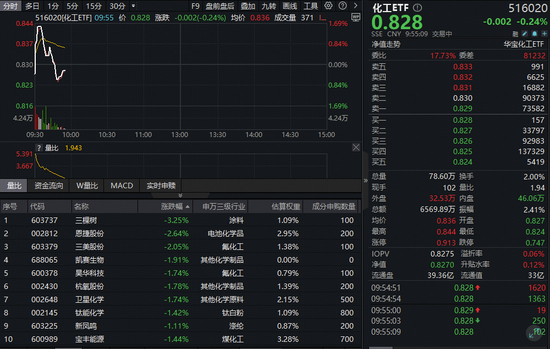
化工板块惊魂一跳!化工ETF(516020)冲高回落,估值水平已至低位!券商预判2026年行业或迎上行起点
Xin Lang Ji Jin· 2025-11-17 02:15
Group 1 - The chemical sector experienced a significant drop on November 17, with the chemical ETF (516020) initially rising by 1.69% before falling to a decrease of 0.24% at the time of reporting [1] - Key stocks in the sector, including coatings, battery chemicals, and fluorochemicals, saw notable declines, with SanKeTree dropping over 3%, and Enjie and Sanmei both falling over 2% [1] - The report indicates that the peak of new capacity additions in the chemical industry has passed, leading to a reduction in capital expenditure, which is expected to improve the supply-demand balance in the sector [1][3] Group 2 - The current PB-LF valuation of the basic chemical industry is close to the bottom levels seen in 2019 and 2024, indicating that the sector is still undervalued [3] - The chemical industry is expected to see a continuous improvement in supply-demand dynamics, with a potential upward trend in industry prosperity [3] - Analysts suggest that the chemical sector may experience a rebound starting in 2026, driven by improved domestic demand and supply-side adjustments [3] Group 3 - The chemical ETF (516020) tracks the CSI segmented chemical industry index, covering various sub-sectors, with nearly 50% of its holdings in large-cap leading stocks [4] - Investors can also access the chemical ETF through linked funds, providing a more efficient way to invest in the chemical sector [4]




华泰证券今日早参-20251113
HTSC· 2025-11-13 01:50
Group 1: Macroeconomic Insights - The U.S. Supreme Court's hearing on the "Trump tariffs" has raised questions about the future of U.S. tariff policies, with market expectations shifting towards a potential rejection of these tariffs [2] - The implications of different verdicts on tariffs could significantly affect macroeconomic conditions, fiscal policies, and the bond market [2] Group 2: E-commerce Industry - The e-commerce sector is expected to see moderate growth during the 2025 Double Eleven shopping festival, with GMV projected to increase by mid-to-high single digits, benefiting from platform subsidies and extended promotional timelines [3] - Major platforms are expected to show differentiated performance, with Douyin's GMV growth estimated at 20-25%, Pinduoduo at 10-15%, while JD.com may see low single-digit growth and Alibaba is expected to remain flat [3] - The competitive landscape among e-commerce platforms is anticipated to remain intense in 2026, with a focus on traffic acquisition and core user benefits [3] Group 3: Fixed Income and Asset Allocation - The asset allocation outlook for 2026 suggests a shift from "sharpness" to a more balanced approach, with a focus on identifying more certain opportunities while mitigating tail risks [4] - Key drivers for the global manufacturing cycle include the AI technology revolution and the transition of China's economic drivers, with a continued emphasis on risk assets [4] Group 4: Home Appliances Sector - The home appliance sector has seen a cumulative increase of 7.7% from January to October 2025, with retail sales driven by subsidies but showing signs of weakening marginal growth [5] - Three major trends are identified: the resilience of leading white goods manufacturers, the strengthening of smart technology in appliances, and significant growth potential in emerging technologies like AI and robotics [5] Group 5: Energy Sector - The fourth-generation nuclear power technologies are expected to gain traction due to site restrictions and resource constraints, presenting investment opportunities in related industries [6] - The company is well-positioned to benefit from the ongoing demand for traditional power generation equipment and the anticipated growth in nuclear power projects [14] Group 6: Selected Companies - Gaode Infrared has been initiated with a "Buy" rating and a target price of 18.90 CNY, driven by expected growth in complete equipment orders [10] - Ying Tong Holdings, a leading high-end perfume brand manager, has been initiated with a "Buy" rating and a target price of 2.86 HKD, benefiting from the recovery in high-end consumption [10] - Harsco Electric is positioned to benefit from the normalization of third-generation nuclear approvals and the anticipated acceleration of fourth-generation nuclear development [14]





新材料:大国博弈下的破局关键,产业升级的坚定选择
材料汇· 2025-11-12 15:48
Core Viewpoint - New materials are a key development direction for China's chemical industry, driven by new industrial demands, policy initiatives, and technological advancements in various sectors such as humanoid robots, AI, and sustainable aviation fuel [2][8]. Group 1: New Materials Development - The main focus for new materials in the second half of 2025 includes industrial new demands, such as those from humanoid robots requiring specific chemical materials like PEEK and high-strength PE, as well as policy-driven demands like bio-jet fuel [2][8]. - The development of synthetic biology, COC materials, and other high-value products is also noteworthy, alongside the progress in domestic alternatives to U.S. products post-tariff [2][8]. Group 2: Humanoid Robots - Humanoid robots are gaining attention due to their potential applications across various fields, including industrial, medical, and entertainment sectors, with significant investments from major tech companies [10][12]. - The focus on lightweight materials in humanoid robots is crucial, as seen in Tesla's Optimus Gen-2, which has reduced weight by 10 kg, enhancing energy efficiency and operational flexibility [12][13]. Group 3: Sustainable Aviation Fuel (SAF) - The global aviation fuel consumption is approximately 328 million tons, with SAF recognized as a viable solution to reduce carbon emissions by up to 85% compared to traditional fuels [17][20]. - The implementation of the CORSIA mechanism starting in 2025 is expected to drive rapid growth in SAF demand, with various countries setting ambitious blending targets [20][21]. Group 4: Electronic Specialty Gases - The electronic specialty gas market is projected to reach $6.023 billion by 2025, with a CAGR of 6.39% from 2022 to 2025, driven by the semiconductor industry's recovery and domestic substitution [27][29]. - The semiconductor industry's growth is expected to boost the demand for electronic specialty gases, with significant investments in advanced logic and storage applications [27][29]. Group 5: OLED Market - The OLED market is expanding rapidly, with mobile devices increasingly adopting OLED screens, which accounted for 57% of smartphone displays in 2021 [30][31]. - The penetration of OLED technology into tablets and automotive displays is anticipated to further drive demand, supported by major manufacturers' investments in production capacity [34][31]. Group 6: PCB Resin and Upgrades - The demand for high-end PCB resins is increasing due to the upgrade of computing power and servers, with a focus on domestic substitution in the supply chain [35][46]. - The transition to high-speed data transmission requires advanced resin materials, creating opportunities for domestic manufacturers to meet the growing demand [40][46]. Group 7: Synthetic Biology - The global synthetic biology market is expected to grow from $5.3 billion in 2019 to $18.9 billion by 2024, with a CAGR of 29% [59]. - Advances in gene sequencing and editing technologies are driving the rapid development of synthetic biology, with significant implications for various industries [59].

医药生物行业2026年上半年投资策略:业绩有所承压,关注细分景气方向
Dongguan Securities· 2025-11-12 09:12
Core Insights - The report maintains a neutral rating for the pharmaceutical and biotechnology industry, indicating that while there are pressures on performance, there are also opportunities in specific segments that are experiencing growth [5][30]. Market Performance Review - In the first ten months of 2025, the SW pharmaceutical and biotechnology index increased by 21.10%, outperforming the CSI 300 index by approximately 2.26 percentage points, ranking 12th among all Shenwan primary industries [14][19]. - Most sub-sectors within the industry recorded positive returns, with the medical research outsourcing and chemical preparation sectors leading with increases of 60.54% and 40.80%, respectively. Conversely, the blood products and vaccine sectors saw declines of 7.89% and 1.60% [15][19]. - As of October 31, 2025, the overall price-to-earnings (PE) ratio for the SW pharmaceutical and biotechnology industry was approximately 53.97 times, which is 4.06 times higher than the CSI 300 index, indicating an increase in industry valuation [19][20]. Policy Outlook for H1 2026 - The 11th batch of national drug centralized procurement is expected to be fully implemented in the first half of 2026, involving 55 varieties and 272 companies, with a selection rate of 57% [30][31]. - The procurement results show a high match between selected brands and clinical needs, with strong supply capabilities from mainstream companies [30]. Sub-sector Highlights Innovative Drugs - Continuous policy optimization supports the development of innovative drugs, with a comprehensive approach to enhance pricing management, insurance coverage, and investment [38]. - The industry is gradually moving away from homogeneous competition, with a significant increase in the proportion of First-in-Class new drug development, which rose by 23 percentage points to 35% since 2020 [38][39]. - Domestic innovative drugs are gaining international recognition, with outbound licensing transactions reaching $66 billion in the first half of 2025, reflecting a growing global presence [41][44]. Medical Devices - The aging population in China is projected to exceed 400 million by 2035, driving demand for medical services and supporting stable growth in the medical device market [50]. - The global medical device market is expected to grow at a compound annual growth rate (CAGR) of 5.7%, reaching $869.7 billion by 2030 [52]. - China's medical device market is rapidly expanding, with projected revenues of 187.5 billion yuan by 2025, indicating significant growth potential [53]. Aesthetic Medicine - The domestic aesthetic medicine market is expected to steadily increase, supported by various policies aimed at promoting healthy industry development and improving market concentration [39]. Synthetic Biology - The market size for synthetic biology is anticipated to approach $40 billion by 2027, driven by multiple factors including technological advancements and increased investment [39].