新石器

Search documents
一家企业融到C13轮了
36氪· 2025-11-08 01:19
Core Insights - The investment enthusiasm in the autonomous driving sector is reportedly returning, with significant financing activities observed recently [2][4][11]. Financing Activities - Momenta has completed two rounds of financing (C12 and C13), with the C13 round achieving a valuation of $6 billion [4]. - In the past month, over 10 financing events in the domestic autonomous driving sector have occurred, totaling more than 10 billion [5][7]. - Notable financing events include Didi's autonomous driving company raising 2 billion yuan in D round financing and New Stone's over $600 million in D round financing, which set a record for single financing in the sector [8][11]. Market Trends - The number of financing events in the autonomous driving industry in 2023 is approximately 140, with a total amount of around 20 billion yuan, indicating a clear "warming" signal in the market [11]. - The investment landscape has shifted, with large private equity firms increasingly participating in the sector, contrasting with the previous cautious sentiment [11][21]. Key Drivers of Investment - The push towards large-scale commercial applications, exemplified by companies like NineSight aiming for significant delivery targets, has sparked renewed investor interest [13][20]. - The emergence of embodied intelligence concepts has provided new opportunities for the autonomous driving sector, enhancing its appeal to investors [14][16]. Competitive Landscape - The current investment trend shows a clear tilt towards leading companies in the sector, particularly those demonstrating verifiable progress in commercialization [19][20]. - Companies like New Stone and Didi are highlighted as leaders in the field, with New Stone being the first to deliver over 10,000 L4 autonomous vehicles [20]. Future Outlook - The entry of major players like Huawei into the autonomous driving space is seen as a potential game-changer, with expectations that the competitive landscape will consolidate to a few dominant players [22]. - The industry is anticipated to transition from a phase of diverse players to a more concentrated market, with only a few key players remaining [22].


9分钟的演讲,刘强东为什么将重点放在无人化物流?
第一财经· 2025-11-08 01:08
Core Viewpoint - The article emphasizes the significant advancements in JD Logistics' application of unmanned devices and artificial intelligence, predicting a substantial reduction in logistics costs in China over the next five years, potentially dropping below 10% of GDP [3][5]. Group 1: JD Logistics' Developments - JD Logistics plans to establish the world's first unmanned delivery station by April next year, featuring drones, unmanned delivery vehicles, and robotic arms for cargo handling [3]. - The company has accumulated ten years of technological advancements in unmanned warehouses, enabling large-scale deployment and simplified operations [3][7]. - JD Logistics aims to procure 3 million robots, 1 million unmanned vehicles, and 100,000 drones over the next five years to enhance its logistics supply chain [7]. Group 2: Industry Trends and Data - The low-speed unmanned driving industry in China is projected to reach a sales scale of 12.3 billion yuan in 2024, marking a 45% year-on-year growth [5]. - In September, Shenzhen's functional unmanned vehicles achieved over 1 million deliveries, generating approximately 8.7 million yuan in commercial value, a 14.5% increase from the previous month [5]. - The average delivery volume per unmanned vehicle in Shenzhen increased to 34.7 deliveries in September, up from 29.4 in August [6]. Group 3: Cost Efficiency and Market Dynamics - The cost of using unmanned vehicles for transporting packages from primary to secondary distribution points is approximately 0.06 yuan per package, which is 0.1 yuan lower than human delivery costs [6]. - The capital intensity in the unmanned delivery sector is rising, with leading companies securing over 8 billion yuan in funding this year [6]. - The industry is transitioning from research and testing phases to large-scale commercial operations, driven by technological advancements that lower costs and enhance efficiency [7].


中国自动驾驶圈最 “实在” 的老板
自动驾驶之心· 2025-11-07 16:04
Core Viewpoint - The article discusses the management style and strategic direction of a leading autonomous driving company, highlighting the importance of human-centric management and technological innovation in achieving success in the industry [5][11]. Group 1: Management Style - The company adopts a humanistic management approach, contrasting with other firms in the autonomous driving sector that employ strict oversight and monitoring of employees [5][6]. - Employees at the company exhibit high levels of self-motivation and engagement, even without mandatory attendance policies [5][6]. - The CEO, Yu Enyuan, emphasizes the importance of fostering a positive work culture and actively engages with employees to build trust and collaboration [6][9]. Group 2: Talent Acquisition and Team Dynamics - The company is expanding its workforce significantly, focusing on integrating talent from diverse backgrounds, including e-commerce, logistics, and technology [6][10]. - Yu Enyuan prioritizes aligning team members' understanding and communication to enhance collaboration and efficiency [6][10]. - The company has faced challenges in maintaining team cohesion, particularly during a technical divide over the preferred sensing technology, which led to the departure of key personnel [10]. Group 3: Technological Focus and Strategy - The company is committed to a vision-based approach for its autonomous delivery vehicles, believing it to be the most cost-effective solution [10][11]. - The strategic plan includes transitioning from vehicle sales to creating a logistics platform, aiming to capture a larger market share in the small business and consumer sectors [11][12]. - The company has secured over $600 million in Series D funding to support its technological advancements and capitalize on market opportunities [11][12]. Group 4: Market Position and Future Outlook - The company is positioned as a rising star in the autonomous driving industry, with increasing interest from domestic and international clients [13]. - The focus remains on internal development and technological enhancement, with significant investments in algorithm development and talent retention [13][14]. - The company aims to leverage its extensive data and operational scale to drive future growth and maintain a competitive edge in the market [12][13].
创投月报 | 10月先进制造单笔融资额再创新高 沃兰特航空跻身“低空独角兽”之列
Xin Lang Zheng Quan· 2025-11-07 09:04
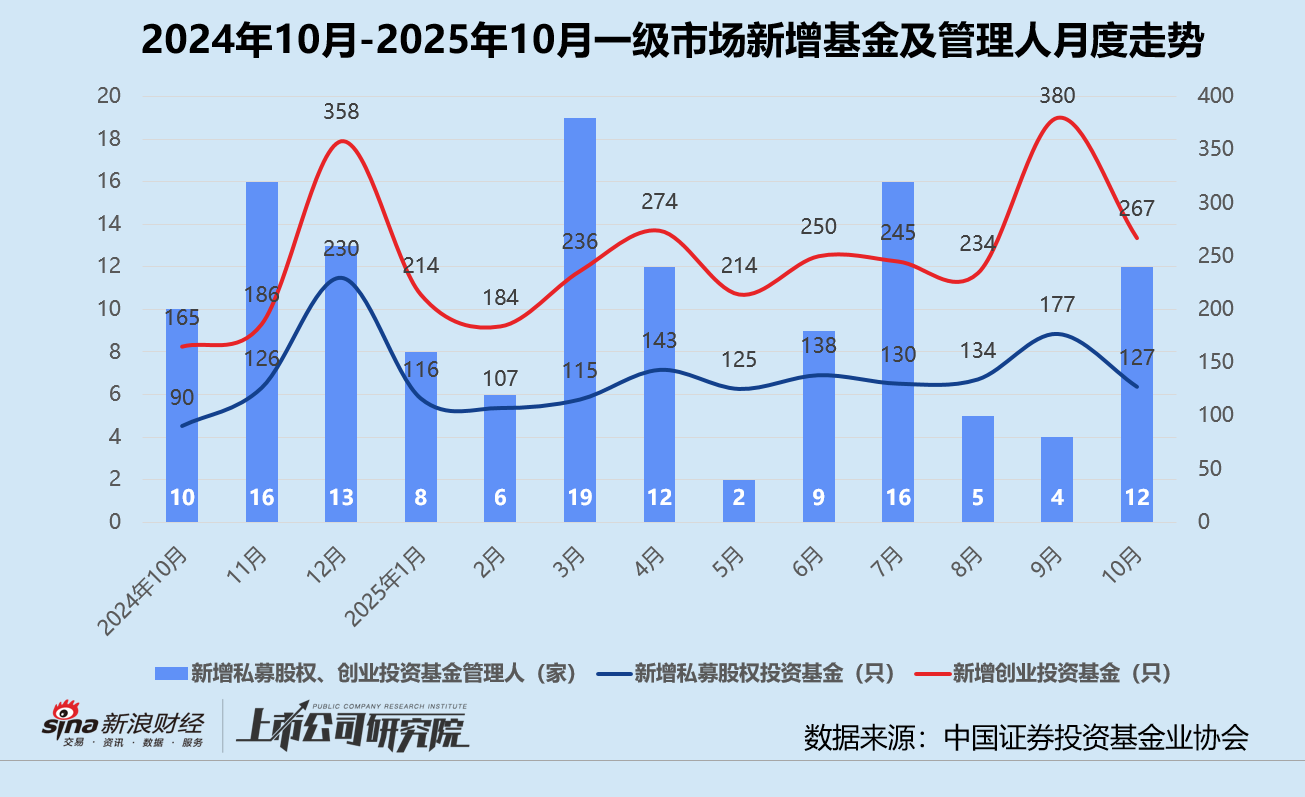
Group 1 - In October 2025, 12 new private equity and venture capital fund managers were registered, marking a 20% year-on-year increase and a 200% month-on-month increase. However, 25 fund managers were deregistered, with over half being voluntary cancellations [1] - The domestic primary equity investment market recorded 457 financing events in October, a slight year-on-year increase of 8.0% but a month-on-month decrease of 33.4%. The total disclosed financing amount was approximately 42.88 billion yuan, representing a year-on-year increase of 118.4% [3] - The average single financing amount reached 93.83 million yuan, marking a year-to-date second-highest figure, with significant contributions from high-end analog integrated circuit chip manufacturer "Silicon Integrated" [3][6] Group 2 - Early-stage financing events (seed, angel, Pre-A, and A rounds) accounted for 70.7% of total financing events, slightly higher than September 2025. A round financing events remained the most prevalent, comprising 33.7% of total events [6][9] - Strategic financing rounds led in disclosed financing amounts, totaling 12.18 billion yuan, while D round financing saw a significant increase driven by "New Stone" raising over 600 million USD [6][12] Group 3 - The advanced manufacturing sector led with 95 financing events, with approximately 44.2% of the funded companies being in the integrated circuit sector. The AI sector also maintained a strong presence with 72 financing events, reflecting a year-on-year growth of 30.9% [12][15] - Jiangsu province completed 95 financing events, maintaining its leading position, with significant contributions from advanced manufacturing and new materials sectors [18][20] Group 4 - The most active investment institutions included Tongchuang Weiye and Guotai Junan Venture Capital, with state-owned institutions accounting for approximately 71.4% of the active investors [23][25] - Kangqiao Capital successfully raised 500 million USD for its second dollar fund, focusing on biotechnology and medical device companies [26][28] Group 5 - Ten financing events exceeding 1 billion yuan were recorded, totaling 22.29 billion yuan, which accounted for about 52.0% of the disclosed financing total. These events were primarily concentrated in the advanced manufacturing sector [30] - "VOLANT" completed a multi-hundred million yuan B round financing, achieving a post-investment valuation exceeding 1 billion USD, marking it as a new unicorn in the eVTOL sector [34]
广州,刚刚迎来一个超级IPO
Xin Lang Cai Jing· 2025-11-06 02:13
Core Insights - Company successfully listed on Hong Kong Stock Exchange after 12 months of being listed in the US, achieving an IPO price of HKD 27.10 per share and a market capitalization of HKD 247.21 billion [1] - The company is recognized as a "super unicorn" in the autonomous driving sector, having received significant backing from major investors [1][4] - The listing coincided with another autonomous driving company, Xiaoma Zhixing, also going public, highlighting the competitive landscape in the sector [1] Company Overview - Founded by Han Xu, a technology expert with a PhD in Computer Engineering, the company has rapidly developed its technology and market presence since its establishment in 2017 [2] - The company has achieved significant milestones in autonomous driving, including being the first to launch L4 autonomous taxis in China [2][3] - Currently, the company operates in multiple sectors including smart mobility, smart logistics, and smart sanitation, and has entered the commercialization phase of autonomous driving [3] Financial Performance - The company reported a revenue of CNY 127 million for Q2 2025, marking a 60.8% year-on-year increase, with Robotaxi services contributing significantly to this growth [6] - Despite rapid revenue growth, the company reported a net loss of CNY 792 million in the first half of the year, primarily due to high R&D expenses [6] - The funds raised from the IPO will be allocated towards further development of autonomous driving technology, scaling L4 vehicle production, and enhancing global marketing efforts [6] Industry Context - The autonomous driving sector is experiencing a resurgence in investment, with over CNY 10 billion raised in the past month alone [7][8] - The market is projected to grow significantly, with McKinsey forecasting that China will become the largest market for autonomous driving by 2030, generating over USD 500 billion in revenue [8] - The current investment landscape is shifting towards established players in the sector, with a focus on companies that have progressed beyond early funding stages [8]

中国创新何以“柳暗花明”(评论员观察)
Ren Min Ri Bao· 2025-11-05 22:11
Group 1 - Innovation is a process of exploring the unknown, which cannot be achieved overnight; it requires bold attempts and the acceptance of mistakes [1][2] - Resource constraints can limit innovation but can also drive it; the key to breaking through is transforming "stumbling blocks" into "stepping stones" [3][4] - Difficulties often inspire significant mental strength and determination, as seen in the development of advanced military aircraft despite financial hardships [4] Group 2 - Companies like Yushutech and BYD exemplify how overcoming initial challenges can lead to significant advancements in technology and market reputation [1][2] - The release of domestically developed technologies, such as the 90 GHz real-time oscilloscope, demonstrates the ability to break through foreign technological barriers [1] - The experience of Chinese companies shows that resource limitations can lead to innovative breakthroughs by returning to the essence of technology and finding alternative paths [3][4] Group 3 - The Chinese government's emphasis on enhancing the national innovation system and autonomous innovation capabilities indicates a strategic focus on technological advancement [5] - The historical context of China's innovation journey highlights the resilience and determination required to achieve significant technological progress despite various constraints [4][5]

自动驾驶公司,正在标配飞书
量子位· 2025-10-31 04:09
Core Viewpoint - The article discusses the rapid development of the autonomous driving industry, highlighting the consensus among companies to leverage AI for improving efficiency and productivity in their operations [1][39]. Group 1: Industry Trends - By 2025, the industry is expected to experience rapid growth, with L2 assisted driving gaining significant traction and companies like Momenta and Horizon achieving substantial market presence [1]. - The penetration rate of L2 assisted driving in domestic passenger vehicles reached 63% from January to July this year, with projections indicating a 100% adoption rate by 2030 [34]. - The year 2025 is referred to as the "mass production year" for Robotaxi, driven by increased competition and investment in the sector [34]. Group 2: AI in Autonomous Driving - The autonomous driving sector is utilizing AI to enhance production processes, a concept derived from lean manufacturing principles, focusing on continuous improvement and waste reduction [3][4]. - Companies like Horizon and Momenta are leading examples of using AI to streamline their research and development processes, with Horizon managing over 700,000 documents annually [5][12]. - Momenta has developed a research efficiency engine that automates the flow of information from project initiation to delivery, significantly reducing the time required for various tasks [13][15]. Group 3: Tools and Collaboration - The adoption of Feishu (Lark) as a core platform for knowledge management and collaboration has enabled companies to efficiently utilize their knowledge assets and improve team coordination [6][10]. - Horizon has established knowledge bases for hundreds of projects using Feishu, allowing for rapid iteration and updates to products [11]. - The use of AI-driven tools within Feishu has led to a significant increase in task completion rates and improved overall efficiency in research and development [10][11]. Group 4: Cultural Shift and Competitiveness - The implementation of AI efficiency initiatives, such as the "AI Efficiency Pioneer Competition," fosters a culture of continuous improvement and knowledge sharing among employees [16][26]. - The competition encourages the dissemination of effective case studies across departments and companies, enhancing the overall efficiency of the industry [26]. - The need for efficient tools is underscored by the challenges faced in traditional communication methods, which are often cumbersome and time-consuming [35][36]. Group 5: Future Outlook - The article emphasizes that the future of physical AI will belong to companies that adopt advanced productivity tools early on, as they will be better positioned to navigate the competitive landscape [41][42]. - The integration of AI into real-world applications is seen as a critical challenge that requires comprehensive support for both software development and hardware production [40].



拼融资、谋上市、打价格战,无人物流车赛道“卷疯了”
3 6 Ke· 2025-10-30 23:12
Core Viewpoint - The emergence of unmanned delivery logistics vehicles is rapidly transforming the logistics industry, with significant investments and competition intensifying among key players like New Stone and NineSight [1][4][5] Industry Overview - The industry is characterized by a few dominant players, with New Stone and NineSight leading the market, both having delivered over 10,000 units cumulatively [2][12] - The market is witnessing a surge in capital investment, with major financing rounds reported for leading companies, indicating a growing interest from top-tier investors [4][12] Market Dynamics - Increased competition is leading to a price reduction trend in the unmanned delivery logistics vehicle market, making cost control a critical factor for survival [5][25] - The market is projected to experience explosive growth, with sales expected to exceed 30,000 units by 2025, compared to only 5,100 units in 2024 [13][15] Technological Development - The industry has evolved from initial skepticism to a more favorable environment due to advancements in technology and supportive policies, allowing for legal operation of unmanned delivery vehicles [9][17] - Continuous technological iterations have improved the safety and efficiency of unmanned delivery vehicles, making them more viable for logistics applications [17][19] Competitive Landscape - Major internet companies like Meituan, JD, and Cainiao are entering the unmanned delivery vehicle space, intensifying competition and leading to potential price wars [21][24] - The cost of unmanned delivery vehicles has significantly decreased, with some models now priced below 20,000 yuan, prompting aggressive pricing strategies among competitors [25][26] Future Outlook - The demand for unmanned delivery logistics vehicles is expected to grow as logistics companies seek to reduce costs and improve efficiency, with projections indicating a potential market size of 600,000 units by 2030 [15][16] - The industry is at a critical juncture, with companies needing to capitalize on current demand while navigating the challenges of increased competition and pricing pressures [26]

9个月吸金86亿,资本重仓“无人区”
凤凰网财经· 2025-10-30 13:14
Core Viewpoint - The article highlights the rapid commercialization and growth potential of the unmanned delivery vehicle industry, predicting significant advancements and profitability for leading companies by 2025 [3][6]. Financing and Market Growth - Leading unmanned delivery companies have secured approximately 8.6 billion yuan in financing since the beginning of the year, with notable rounds including 1 billion yuan for New Stone and over 600 million dollars for NineSight [2]. - The industry is expected to reach a market size of around 500 billion yuan, with an anticipated increase of nearly 100,000 units in the coming year [6]. Commercialization Milestones - The critical threshold for the unmanned vehicle business is identified as 10,000 units, which enables a positive cycle of cost reduction, scenario validation, and scale expansion [4]. - New Stone and NineSight have both achieved the delivery of 10,000 vehicles, with New Stone projecting 1 billion yuan in revenue this year and full profitability by 2026 [4][11]. Operational Efficiency - Unmanned delivery vehicles are addressing significant pain points in the logistics sector, such as low vehicle utilization and high personnel costs, leading to cost reductions and efficiency improvements [9]. - For instance, Shunfeng's unmanned vehicles have reduced per-package costs by 1.32 yuan and improved efficiency by 30% [9]. Technological Advancements - The cost of unmanned delivery vehicles has decreased significantly, with New Stone's vehicle costs dropping from 200,000 yuan to 70,000 yuan between 2018 and 2023, and projected prices as low as 19,800 yuan for future models [14]. - The industry is transitioning from a research and testing phase to large-scale commercial operations, with a tenfold increase in development speed compared to the previous year [11]. Challenges and Regulatory Issues - Despite the rapid growth, the industry faces challenges related to technology, standards, and ecosystem development, particularly in maintaining stability during large-scale operations [17]. - Road rights and regulatory frameworks are significant barriers to scaling operations, with a lack of unified standards across regions increasing operational costs [18][19]. Future Outlook - The next decade is expected to see explosive growth in smart mobility, particularly in last-mile logistics and delivery services [16]. - Companies are exploring collaborative models to optimize resource utilization and reduce operational costs, such as partnerships with public transport entities [19].

自动驾驶三大黄金赛道谁主沉浮?
Xin Lang Cai Jing· 2025-10-30 09:47
Core Insights - The autonomous driving sector is experiencing significant growth, particularly in the areas of RoboBus, RoboTruck, and RoboVan, with a focus on practical applications in real-world scenarios [1][2]. Funding and Investment - Neolix, a provider of L4-level autonomous delivery solutions, has completed over $600 million in Series D financing, setting a record in China's autonomous driving sector [2]. - Other leading companies in the autonomous driving field have also secured substantial funding, with notable investments including nearly $3 million for Karl Power in May 2025 and $100 million for Jiushi Intelligent in October 2025 [2]. Market Dynamics - The autonomous delivery vehicle market is entering a phase of intense competition, with leading companies like Neolix and Jiushi Intelligent rapidly scaling operations. By the end of 2025, several companies are expected to surpass the delivery threshold of 10,000 vehicles [4][5]. - The market is projected to see over 30,000 autonomous delivery vehicles sold by 2025, with a potential annual sales volume exceeding 800,000 units by 2030 [5]. Cost Reduction and Efficiency - The cost of autonomous delivery vehicles has significantly decreased, with prices dropping from hundreds of thousands to around 10,000 yuan, a reduction of nearly 90% [5]. - The introduction of autonomous delivery vehicles has led to a 70% reduction in per-package delivery costs and improved delivery efficiency by 20-30% [8]. Operational Impact - Autonomous delivery vehicles are primarily used for transporting goods between sorting centers and residential areas, enhancing operational efficiency and reducing labor costs [7]. - Major logistics companies, including SF Express and Zhongtong Express, have begun integrating autonomous delivery vehicles into their operations, with Zhongtong deploying approximately 1,000 units [8]. Technological Advancements - The industry is moving towards a more mature technological landscape, with a focus on balancing complexity and cost control in autonomous driving applications [9][24]. - The core technologies driving the sector include advanced sensors, AI algorithms, and modular designs that enhance adaptability across various logistics scenarios [17][18]. Future Outlook - The autonomous bus segment is expected to grow significantly, with projections indicating a market size reaching hundreds of billions by 2030 [22][23]. - The integration of autonomous buses into urban transportation networks is anticipated to create a seamless travel experience, contributing to the overall efficiency of public transport systems [24][25].