晶科能源

Search documents
帝尔激光(300776.SZ):公司与晶科能源有合作
Ge Long Hui· 2026-02-13 06:53
Group 1 - The core point of the article is that the company, 帝尔激光 (Dier Laser), has announced a collaboration with 晶科能源 (JinkoSolar) on an investor interaction platform [1] Group 2 - The collaboration indicates a strategic partnership that may enhance the company's market position and technological capabilities [1] - This partnership could potentially lead to new opportunities in the solar energy sector, aligning with industry trends towards renewable energy solutions [1]


“市场看得见、摸不着”,中国光伏的太空梦卡在哪了?
Xin Lang Cai Jing· 2026-02-13 03:41
"市场还是过于乐观了。" 在太空光伏火爆的几个月里,多位业内人士对智通财经记者提及过类似的观点。 过去数月,光伏产业因切入太空概念而再度成为市场焦点。面对新风口,民企光伏企业们在题材营销与资本互动层面表现得尤为积极,即便是日常宣传推 文,也往往要融入太空元素,强化与太空光伏概念的关联。 自2023年底进入下行周期以来,光伏行业始终笼罩在"反内卷"的舆论氛围中。供给侧未见明显改善,使得行业对需求拓展的渴望愈发迫切。 在此背景下,不少龙头企业开始把希望寄托在太空上,各处接触卫星公司,以期通过布局太空光伏寻求突围路径。 太空光伏概念的爆火,始于2025年11月。 彼时,马斯克在公开连线对话中提及每年将部署100 GW的太阳能AI卫星,称这可能是大规模人工智能供电成本最低的方案。 12月,钧达股份(002865.SZ)、晶科能源(688223.SH)等企业开始针对太空光伏进行发声,部分券商发布了太空光伏研报,与此同时,随着蓝箭航天朱雀三号 的发射,商业航天题材同步升温。 进入2026年,钧达股份公告3000万元认购星翼芯能股权,成为A 股首家明确公开布局太空光伏领域的公司,备受市场关注。 1月22日,马斯克也在达沃斯 ...


研判2026!中国太阳能扩散炉行业概述、产业链、市场规模、竞争格局、发展趋势分析:光伏产业推动,太阳能扩散炉市场规模持续增长[图]
Chan Ye Xin Xi Wang· 2026-02-13 03:30
Core Viewpoint - The solar diffusion furnace industry in China is experiencing significant growth, with the market size expected to reach 6.05 billion yuan by 2025, reflecting an 11% year-on-year increase, driven by the expansion of the photovoltaic industry and supportive government policies [1][6]. Industry Overview - Solar diffusion furnaces are essential for producing crystalline silicon solar cells, specifically for forming PN junctions, which are critical for enhancing cell efficiency [2]. - The main types of solar diffusion furnaces are vertical and horizontal, each offering distinct advantages in terms of production efficiency and space utilization [2]. Industry Chain - The upstream of the solar diffusion furnace industry includes quartz components, heating systems, temperature control systems, and gas control systems, with quartz components being crucial for stability and efficiency [3]. - The midstream involves the manufacturing of solar diffusion furnaces, while the downstream primarily serves the photovoltaic industry, specifically in solar cell and module production [3]. Current Development - The solar diffusion furnace market is benefiting from China's commitment to renewable energy, with solar power generation capacity increasing significantly from 204.2 GW in 2019 to an expected 1,161.2 GW by the end of 2025, marking a 41.90% year-on-year increase [4][5]. - The production of solar cells is projected to reach 83,274.3 MW by 2025, a 7.60% increase from the previous year, driven by government subsidies and technological advancements [5]. Competitive Landscape - The solar diffusion furnace industry has high entry barriers, making it difficult for new entrants to compete. Leading companies leverage technology, supply chains, and customer resources to maintain competitive advantages [7]. - Key players in the industry include North Huachuang, Jiejia Weichuang, and Jing Sheng Machinery, among others, with North Huachuang reporting a revenue increase of 32.97% year-on-year for the first nine months of 2025 [7][8]. Industry Trends - The rapid development of the solar diffusion furnace industry is leading to accelerated industry consolidation, with smaller companies lacking core technologies being phased out, while stronger companies invest in R&D and improve production processes [9]. - Domestic companies are increasingly focusing on international markets, expanding their presence through partnerships and participation in global trade shows, capitalizing on their competitive pricing and responsive service [10].





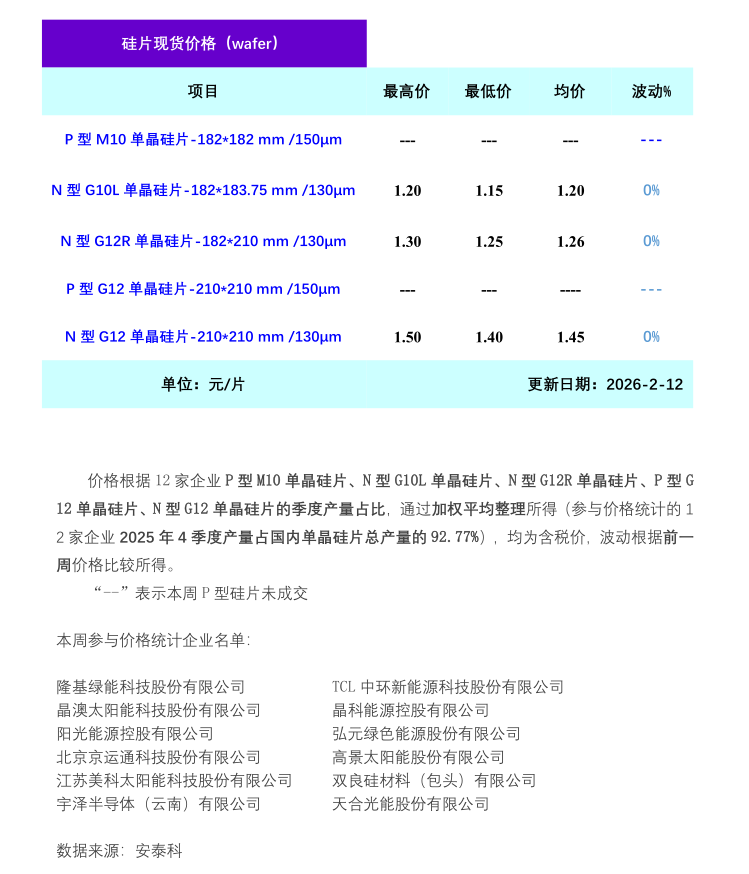
安泰科:本周市场观望为主 硅片价格持稳运行
智通财经网· 2026-02-13 01:55
Core Viewpoint - The silicon wafer prices remain stable this week, with no significant changes observed in the market due to weak demand and pre-holiday purchasing behavior [1][2]. Price Summary - N-type G10L silicon wafer (182*183.75mm/130μm) average transaction price is 1.20 CNY per piece, N-type G12R silicon wafer (182*210mm/130μm) is 1.26 CNY per piece, and N-type G12 silicon wafer (210*210mm/130μm) is 1.45 CNY per piece, all unchanged from last week [1][3]. - The mainstream price for battery cells is between 0.41-0.45 CNY/W, and for modules, it is between 0.71-0.75 CNY/W, also remaining stable compared to the previous week [1]. Market Activity - The silicon wafer market has seen general transaction activity, with companies halting purchasing orders ahead of the holiday, leading to minimal transactions [1]. - The overall operating rate in the industry has slightly decreased, with leading companies operating at 46% and 45%, while integrated companies are at 50%-60%, and other companies range from 50%-70% [1]. Future Outlook - In the short term, the silicon wafer market is expected to remain in a stalemate between upstream price support and downstream price pressure, with prices likely to stabilize [2]. - After the Spring Festival holiday, as terminal installation projects resume, there is potential for a slight market recovery driven by improved downstream demand for silicon wafers [2].




【安泰科】单晶硅片周评-市场观望为主 硅片价格持稳运行(2026年2月12日)
中国有色金属工业协会硅业分会· 2026-02-13 01:43
Core Viewpoint - The silicon wafer prices remain stable this week, with no significant changes observed in the market, reflecting a cautious approach from both upstream and downstream players [1][2]. Group 1: Price Stability - N-type G10L monocrystalline silicon wafer (182*183.75mm/130μm) has an average transaction price of 1.20 yuan per piece, while N-type G12R (182*210mm/130μm) is at 1.26 yuan, and N-type G12 (210*210mm/130μm) is at 1.45 yuan, all unchanged from last week [1][3]. - The mainstream price for battery cells is between 0.41-0.45 yuan/W, and for modules, it is between 0.71-0.75 yuan/W, showing no significant fluctuations [1]. Group 2: Market Dynamics - The silicon wafer market transactions are generally weak, with companies halting purchasing orders ahead of the holiday, leading to minimal sales activity [2]. - The overall operating rate in the industry has slightly decreased, with two leading companies operating at 46% and 45%, while integrated companies are at 50%-60%, and others range from 50%-70% [2]. Group 3: Future Outlook - The market is expected to remain in a stalemate between upstream price support and downstream price pressure, with prices likely to stabilize in the short term [2]. - After the holiday, as terminal installation projects resume, there is potential for a slight recovery in demand for silicon wafers, which may positively impact the market [2].
晶科能源2月12日获融资买入2.36亿元,融资余额13.64亿元
Xin Lang Cai Jing· 2026-02-13 01:21
Group 1 - JinkoSolar's stock price increased by 0.37% on February 12, with a trading volume of 2.186 billion yuan, and a net financing buy of -45.86 million yuan for the day [1] - As of February 12, the total margin balance for JinkoSolar was 1.37 billion yuan, accounting for 1.70% of its market capitalization, indicating a high level of financing activity [1] - The company repaid 28,900 shares of margin loans and sold 110,100 shares on February 12, with a total selling amount of 883,900 yuan, reflecting a high level of short selling activity [1] Group 2 - As of September 30, JinkoSolar had 77,300 shareholders, an increase of 4.14% from the previous period, while the average circulating shares per person decreased by 3.97% [2] - For the period from January to September 2025, JinkoSolar reported a revenue of 47.986 billion yuan, a year-on-year decrease of 33.14%, and a net profit attributable to shareholders of -3.92 billion yuan, a significant decline of 422.67% [2] - Since its A-share listing, JinkoSolar has distributed a total of 3.355 billion yuan in dividends, with 3.125 billion yuan distributed over the past three years [3]
深夜巨震!美股三大指数高开低走,芯片股却逆势大涨,美光科技暴涨近10%,黄金白银原油价格同步飙升!
Sou Hu Cai Jing· 2026-02-12 17:02
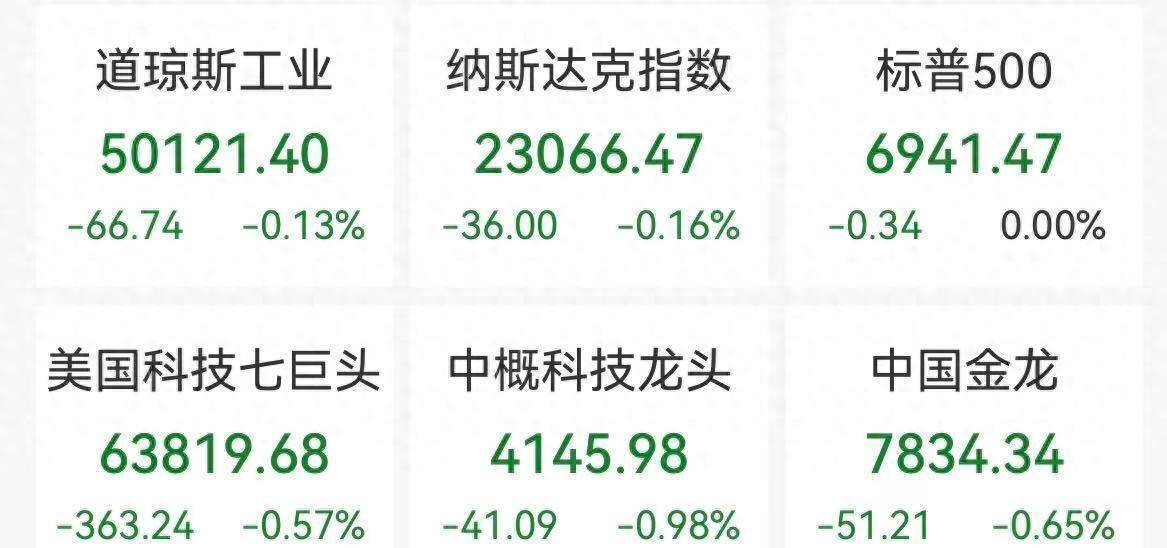
Economic Data and Market Reaction - The U.S. non-farm payrolls increased by 130,000 in January, significantly exceeding the market expectation of 55,000, marking the largest increase in over a year [1][2] - The unemployment rate slightly decreased from 4.4% in December to 4.3%, the lowest since August 2025 [2] - Despite the strong employment report, U.S. stock markets experienced volatility, with the Dow Jones Industrial Average down 0.13%, S&P 500 nearly flat, and Nasdaq Composite down 0.16% [1][4] Sector Performance - Semiconductor stocks performed exceptionally well, with the Philadelphia Semiconductor Index rising by 2.28% and Micron Technology's stock surging nearly 10% [1][5] - The healthcare sector added 124,000 jobs, double the normal level for January 2025, indicating strong growth in this industry [2] - Large tech stocks showed mixed results, with Google and Microsoft down over 2%, while Nvidia and Tesla saw gains of 0.78% and 0.8%, respectively [5] Commodity Market Movements - Gold and silver prices surged due to increased risk aversion, with spot gold rising over 1% to $5,083.7 per ounce and silver up over 4% to $84.3 per ounce [7] - International oil prices also increased, with WTI crude oil futures up 1.05% to $64.63 per barrel, driven by geopolitical tensions [8] Geopolitical Developments - U.S. President Trump emphasized the need for continued negotiations with Iran after a meeting with Israeli Prime Minister Netanyahu, indicating a preference for diplomatic solutions [9][10] - The geopolitical climate remains tense, with military deployments in the Middle East and ongoing sanctions against Iran, which could impact market stability [11][12] Semiconductor Industry Insights - South Korea's semiconductor exports reached $6.73 billion in the first ten days of February, a year-on-year increase of 137.6%, reflecting strong global demand [13] - Micron Technology's stock price target was raised significantly by Morgan Stanley, indicating confidence in the company's future performance amid supply shortages [6][13] - The semiconductor industry is transitioning from quarterly business to long-term collaborative agreements, driven by increasing demand for advanced memory chips [14]
光伏行业"反内卷"成效进一步显现
Zheng Quan Ri Bao· 2026-02-12 09:29
Core Viewpoint - The photovoltaic industry is experiencing a significant cost gradient differentiation due to fluctuations in silver prices and technological upgrades, leading to a visible "anti-involution" effect within the industry [1]. Cost Pressure - The global silver investment demand is expected to remain strong through 2026, supported by geopolitical tensions and U.S. policy uncertainties, with silver prices having risen by 11% this year after surpassing $100 per ounce for the first time in January [2]. - Despite high prices leading to a projected 17% reduction in global jewelry and silverware demand, industrial demand remains resilient [2]. - A supply shortage of approximately 67 million ounces is anticipated in the global silver market by 2026, marking the sixth consecutive year of deficit, which is expected to keep silver prices strong [2]. - The photovoltaic sector, as a major consumer of silver, will continue to face cost pressures due to high silver prices, accelerating the development of silver paste substitution technologies among leading companies [2][3]. Technological Breakthroughs - Leading companies are rapidly advancing silver paste substitution technologies, with some planning large-scale production of alternative materials in the near future [4]. - Longi Green Energy has announced plans to start large-scale production of non-silver solutions, which could further reduce component costs [4]. - Other major players like JinkoSolar and Aiko are also actively pursuing silver paste alternatives, with significant collaborations aimed at industrializing low-silver technologies by 2026 [4][5]. Industry Restructuring - The shift towards high-efficiency and reliable components is expected to create a competitive landscape where companies with technological advantages can command price premiums, while less efficient capacities face dual pressures from price and demand declines [5][6]. - The Chinese photovoltaic industry is projected to see a significant change in 2026, with new installations expected to range between 180GW and 240GW, following a record high of 315GW in 2025 [5][6]. - The core theme of the industry's "anti-involution" in 2026 will be driven by upgraded end-user demand, pushing manufacturers towards high-quality development through technological iterations and improved market mechanisms [6].

金融工程定期:太空光伏板块的资金行为监测
KAIYUAN SECURITIES· 2026-02-12 09:13
2026 年 02 月 12 日 金融工程研究团队 魏建榕(首席分析师) 证书编号:S0790519120001 傅开波(分析师) 证书编号:S0790520090003 高 鹏(分析师) 证书编号:S0790520090002 苏俊豪(分析师) 证书编号:S0790522020001 胡亮勇(分析师) 证书编号:S0790522030001 王志豪(分析师) 证书编号:S0790522070003 盛少成(分析师) 证书编号:S0790523060003 蒋韬(分析师) 证书编号:S0790525070001 常津铭(研究员) 证书编号:S0790126010044 相关研究报告 太空光伏板块的资金行为监测 ——金融工程定期 《有色金属板块的资金行为监测》 -2025.10.10 《 消 费 板 块 的 资 金 行 为 监 测 》 -2025.11.14 《商业航天板块的资金行为监测》 -2025.12.11 《脑机接口板块的资金行为监测》 -2026.01.09 | 魏建榕(分析师) | 苏俊豪(分析师) | 高鹏(分析师) | | --- | --- | --- | | weijianrong@kyse ...
或终止项目或剥离资产 部分A股"追光者"止损
Shang Hai Zheng Quan Bao· 2026-02-12 05:51
Core Viewpoint - The photovoltaic industry is transitioning from oversupply to a phase of accelerated capacity clearance, with expectations of a more intense market correction in 2026 compared to 2025 due to weakening demand forecasts [1][4]. Group 1: Company Actions - Several photovoltaic companies, including Mingguan New Materials and Trina Solar, have announced project terminations or fund reallocations to more promising areas due to declining profitability in the photovoltaic packaging materials sector [2]. - Mingguan New Materials terminated its investment in a solar backplane production project, initially planned with a total investment of 5 billion yuan, citing industry competition and rising operational costs as reasons for the decision [2]. - Trina Solar plans to reduce funding for its original project and redirect the remaining funds to a new distributed smart photovoltaic power station project, which is expected to contribute a net profit of 94.91 million yuan annually [2]. Group 2: Production Halts - Some companies, such as Oujing Technology and Tianyi New Materials, have suspended production due to decreased demand from downstream customers, with production utilization rates as low as 14.66% for certain subsidiaries [3]. - *ST Green Kang, a company that crossed into the photovoltaic sector from veterinary medicine, has completely exited the photovoltaic industry by selling all related assets and liabilities to alleviate financial pressure [3]. Group 3: Supply and Demand Dynamics - The photovoltaic industry is facing significant overcapacity, with analysts indicating that the supply-demand imbalance is worsening, leading to accelerated industry consolidation [4][5]. - The China Photovoltaic Industry Association projects that the new photovoltaic installation capacity in China for 2026 will be between 180 GW and 240 GW, a decrease of 24% to 43% compared to 2025's 315.07 GW [4]. - Globally, the new photovoltaic installation capacity is expected to decline slightly in 2026, with estimates ranging from 500 GW to 667 GW, down from 580 GW in 2025 [5]. Group 4: Future Outlook and Strategies - Despite the high levels of existing capacity, the industry may find a path to recovery through necessary market corrections, which could lead to a return to profitability and normal investment cycles [6]. - Companies are encouraged to explore diversification strategies, such as integrating photovoltaic technology with energy storage and hydrogen energy, to mitigate risks associated with reliance on a single business line [8]. - Trina Solar has set ambitious performance targets, aiming for a net profit of no less than 200 million yuan in 2026, reflecting confidence in recovering profitability and growth in related sectors [8].