英特尔

Search documents
2月半导体需求或将进一步复苏,科创芯片ETF(588200)聚焦国产芯片投资机遇
Xin Lang Cai Jing· 2026-02-06 03:06
Core Viewpoint - The semiconductor and chip industry is experiencing fluctuations, with the Shanghai Stock Exchange's Sci-Tech Innovation Board chip index down by 1.01% as of February 6, 2026, amid mixed performance among constituent stocks [1] Group 1: Market Performance - As of 10:20 AM on February 6, 2026, the Sci-Tech Innovation Board chip index decreased by 1.01%, with stocks like Zhongke Feimiao and Zhongke Lanyun showing gains of 1.18% and 1.09% respectively, while companies like Chip Origin and Yuanzhe Technology faced declines [1] - The top ten weighted stocks in the Sci-Tech Innovation Board chip index account for 59% of the index, including companies like Lanke Technology and SMIC [2] Group 2: Industry Developments - Amazon plans to invest approximately $200 billion throughout the year, primarily in AWS, focusing on self-developed hardware and AI vertical integration to build long-term competitive advantages and high ROIC [1] - The price of storage chips continues to rise significantly, with DRAM and NAND Flash prices increasing by 5.95% to 63.43%, and Samsung Electronics has raised NAND flash prices by over 100% [1] - AI server CPUs are facing supply shortages, with AMD products nearly sold out, prompting both AMD and Intel to consider raising average prices by 10-15% in the first quarter [1] Group 3: Investment Insights - Donghai Securities indicates that semiconductor prices continued to rise in January, with demand recovering, and February is expected to see further demand resurgence [1] - The semiconductor industry is slowly recovering, with AI investments exceeding expectations and storage chip price increases surpassing forecasts [1] - The market currently has high capital enthusiasm, and it is recommended to consider low-cost investments [1]
东海证券晨会纪要-20260206
Donghai Securities· 2026-02-06 02:45
Group 1: Semiconductor Industry Insights - The semiconductor industry showed continued recovery in January 2026, with prices on an upward trend driven by AI computing demand, AIOT, semiconductor equipment, key components, and storage price increases [5][7] - Global semiconductor demand is improving, with slight growth in PCs and smartphones, and rapid growth in TWS headsets, wearable devices, and smart home products. AI servers and new energy vehicles are experiencing high growth, indicating a potential continued recovery in demand for February 2026 [5][10] - January 2026 saw a significant increase in storage prices, with DRAM and NAND Flash prices rising between 5.95% and 63.43%. The overall semiconductor price trend is expected to remain positive in February [7][10] Group 2: Company-Specific Analysis - Jerry Holdings - Jerry Holdings secured a new gas turbine generator order worth $181.5 million, which represents approximately 9.47% of the company's audited revenue for 2024. This is the fourth such contract with a U.S. client since November 2025 [13][14] - The company has accumulated over $400 million in gas turbine generator orders, establishing a new growth curve. It has expanded production capacity to meet North American demand [14][15] - Jerry Holdings has formed strategic partnerships with major players in the gas turbine industry, enhancing its supply chain resilience and providing integrated power solutions [15][17] Group 3: Investment Recommendations - The semiconductor industry is experiencing a slow recovery in demand, with AI investments exceeding expectations and storage chip price increases also surpassing forecasts. It is recommended to consider leading companies in AIOT and semiconductor sectors for investment [11] - For Jerry Holdings, the diversified business model and strong order book in gas turbine generators are expected to support significant profit growth, with projected net profits of 3.164 billion, 3.778 billion, and 4.449 billion yuan for 2025-2027 [17]
【高通(QCOM.O)】FY26Q1业绩符合预期, 内存短缺拖累下游需求——FY26Q1业绩点评(付天姿)
光大证券研究· 2026-02-05 23:08
Core Viewpoint - Qualcomm's FY26Q1 performance met expectations, but the guidance for FY26Q2 fell short due to adverse impacts from memory shortages and price increases affecting downstream demand [4]. Group 1: FY26Q1 Performance - Qualcomm achieved Non-GAAP revenue of $12.252 billion in FY26Q1, slightly above Bloomberg's consensus estimate of $12.196 billion, representing a year-on-year increase of 5% [4]. - The QCT business generated $10.613 billion in revenue, also up 5% year-on-year, while the QTL business reported $1.592 billion, a 4% increase [4]. - Non-GAAP net profit for FY26Q1 was $3.781 billion, exceeding the consensus estimate of $3.690 billion, with Non-GAAP EPS at $3.50, above the expected $3.407 [4]. Group 2: FY26Q2 Guidance - Qualcomm's guidance for FY26Q2 indicates Non-GAAP revenue between $10.2 billion and $11 billion, below the consensus estimate of $11.16 billion [4]. - The projected Non-GAAP diluted EPS for FY26Q2 is between $2.45 and $2.65, compared to the consensus estimate of $2.874 [4]. - The guidance shortfall is primarily attributed to the negative impact of memory shortages and price increases on downstream demand [4]. Group 3: QCT Mobile Business - In FY26Q1, the mobile business revenue was $7.824 billion, reflecting a 3% year-on-year growth, driven by increased shipments of Snapdragon chips [5]. - Qualcomm secured a 75% supply share for high-end smartphone chips for Samsung's upcoming series, and ByteDance's AI smartphone features Qualcomm's Snapdragon Elite chips [5]. - The company anticipates that the ongoing memory chip shortage will constrain the growth of its mobile business in the short term, with FY26Q2 mobile revenue expected to be around $6 billion [5]. Group 4: QCT IoT Business - The IoT business generated $1.688 billion in revenue in FY26Q1, a 9% year-on-year increase, mainly due to higher shipments in edge networking and consumer products [6]. - Qualcomm is expanding its presence in vertical applications, launching new products at CES 2026, including the Dragonwing Q-7790 and Q-8750 for various applications [6]. - The company introduced the Snapdragon X2 Plus chip, enhancing CPU single-core performance by 35% and NPU performance by 78%, with multiple PC products based on Snapdragon showcased at CES [7]. Group 5: QCT Automotive Business - The automotive business reported $1.101 billion in revenue for FY26Q1, a 15% year-on-year increase, driven by higher shipments of vehicles equipped with Qualcomm's smart cockpit technology [8]. - Qualcomm signed a long-term supply agreement with Volkswagen Group, expanding its supply to brands like Audi and Porsche [8]. - The company is collaborating with CARIAD and Bosch to develop autonomous driving systems, indicating progress in its smart driving initiatives [8].


高通(QCOM):FY26Q1业绩符合预期,内存短缺拖累下游需求
EBSCN· 2026-02-05 11:09
Investment Rating - The report maintains a "Buy" rating for Qualcomm (QCOM.O) [6] Core Insights - Qualcomm's FY26Q1 performance met expectations, but the guidance for FY26Q2 fell short due to adverse impacts from memory shortages and price increases affecting downstream demand [1] - FY26Q1 Non-GAAP revenue was $12.252 billion, a 5% year-over-year increase, with Non-GAAP net profit at $3.781 billion [1] - The guidance for FY26Q2 is projected Non-GAAP revenue of $10.2 to $11 billion, below the consensus estimate of $11.16 billion [1] Summary by Sections QCT Mobile Business - FY26Q1 mobile business revenue was $7.824 billion, up 3% year-over-year, driven by increased shipments of Snapdragon chips [2] - Qualcomm secured a 75% supply share for high-end smartphone chips for Samsung's upcoming series [2] - The guidance for FY26Q2 mobile revenue is approximately $6 billion, with expectations of growth being constrained by memory chip shortages [2] QCT IoT Business - FY26Q1 IoT revenue reached $1.688 billion, a 9% year-over-year increase, primarily due to higher shipments in edge networking and consumer products [3] - The company continues to expand into vertical applications in edge networking and industrial IoT, with new products launched at CES 2026 [3] - The PC segment saw the release of the Snapdragon X2 Plus chip, enhancing performance significantly [3] QCT Automotive Business - FY26Q1 automotive revenue was $1.101 billion, a 15% year-over-year increase, attributed to higher shipments of vehicles equipped with Qualcomm's smart cockpit technology [4] - Qualcomm signed a long-term supply agreement with Volkswagen Group, expanding its supply to brands like Audi and Porsche [4] - The company is collaborating with CARIAD and Bosch to develop autonomous driving systems [4] Financial Forecast and Valuation - The report forecasts GAAP net profits of $11.5 billion, $12.5 billion, and $13 billion for FY2026, FY2027, and FY2028 respectively, with growth rates of 107.7%, 8.4%, and 4.2% [4] - The current price corresponds to FY2026-2028 P/E ratios of 14X, 13X, and 12X [4]

英特尔发布巨型玻璃基板,AI 芯片封装进入“玻璃时代”
Xin Lang Cai Jing· 2026-02-05 05:58
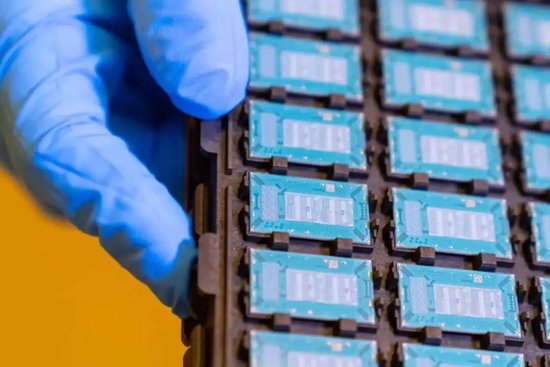
来源:金色note 在2026年日本NEPCON展会上,英特尔正式发布了一款突破性的原型产品,有望重新定义人工智能硬件 的未来:一块尺寸为78mm x 77mm的巨型玻璃芯基板,并集成了英特尔的嵌入式多芯片互连桥 (EMIB)技术。这一突破标志着芯片封装技术的重大变革,正朝着更大、更强大、更复杂的设计方向 发展,以满足下一代人工智能的需求。 作为背景,EMIB 就像一条嵌入基板内的高速通道。它专门用于连接相邻的芯片,使它们之间的数据传 输如同它们属于单个单片芯片一样。 为什么人工智能芯片必须从塑料材质转向玻璃材质? 随着人工智能芯片尺寸不断增大,不断挑战光刻技术的极限(光刻胶尺寸极限),传统的有机衬底正面 临严峻的物理挑战。有机材料在高温下容易因热胀冷缩而发生形变,导致芯片与衬底之间的连接不良。 相比之下,玻璃的热膨胀系数(CTE)与硅非常接近,能够确保芯片在高温下具有卓越的尺寸稳定性, 从而提供了一种解决方案。 此外,与有机基底相比,玻璃超光滑的表面可以蚀刻出更精细的电路图案。这使其成为支撑下一代人工 智能加速器强大计算能力和复杂布线的理想基底。 在规格方面,英特尔的这款原型封装尺寸巨大,达到 78mm x ...

英特尔与香港科技大学共建联合实验室
Jin Rong Jie· 2026-02-05 04:36
2月5日消息,香港科技大学与英特尔宣布成立"香港科技大学-英特尔联合实验室"。该实验室将开展为 期三年的研究计划,重点探索高能效近存计算架构,以应对 人工智能应用在性能与能效方面的挑战。 通过软硬件协同设计创新,双方旨在为智能设备与可持续人工智能系统的未来发展提供技术参考。 ...
AI算力需求驱动全球存储芯片价格大幅上涨,科创芯片ETF(588200)备受资金关注
Xin Lang Cai Jing· 2026-02-05 03:16
数据显示,截至2026年1月30日,上证科创板芯片指数前十大权重股分别为澜起科技、海光信息、中芯 国际、寒武纪、中微公司、芯原股份、华虹公司、佰维存储、拓荆科技、源杰科技,前十大权重股合计 占比59%。 科创芯片ETF(588200)跟踪上证科创板芯片指数,是布局科创板芯片板块的便利工具。 没有股票账户的场外投资者可以通过科创芯片ETF联接基金(017470)关注国产芯片投资机遇。 2026年2月5日早盘,半导体、存储芯片等概念回调整固,截至10:41,上证科创板芯片指数(000685)下跌 1.85%。成分股方面涨跌互现,东芯股份领涨1.27%,芯动联科上涨0.97%,成都华微上涨0.85%;芯原 股份领跌,华峰测控、仕佳光子跟跌。 据中国信通院消息,2026年2月3日,中国人工智能产业发展联盟第十六次全会在北京石景山召开。工信 部有关负责人指出,工信部坚持以制造业为人工智能赋能主战场,全力推进"人工智能+制造"走深向 实。 近期,AI算力需求持续爆发,驱动全球存储芯片价格大幅上涨。东海证券指出,2026年存储器产值预 计同比激增134%,三星电子已在第一季度将NAND闪存价格上调超100%,且涨价势头预计 ...
ABF缺货潮,又要来了?
半导体行业观察· 2026-02-05 01:08
Group 1 - The core viewpoint of the article highlights the tightening supply-demand structure of ABF substrates driven by the increasing demand from AI and high-performance computing, with supply shortages expected to worsen monthly and reach a gap of 10% by the second half of 2026, potentially expanding to 21% in 2027 and 42% in 2028 [2][3] - Goldman Sachs notes that the current tightening of ABF substrate supply is similar to the supply shortages experienced in 2020, which led to price increases of 20% to 30% annually, indicating a positive outlook for price and profit momentum in the coming months and quarters [2] - The article emphasizes that the demand for ABF substrates is structurally driven and long-term, particularly with AI servers now accounting for over 20% of ABF demand, and the introduction of Agentic AI expected to further increase CPU substrate usage starting in 2026 [3] Group 2 - Japanese company Ibiden has announced a significant investment plan of approximately 500 billion yen (about 22.2 billion RMB) to expand high-performance IC substrate production capacity, targeting applications in AI servers and high-performance servers from fiscal year 2026 to 2028 [5] - Ibiden's electronic business, which focuses on IC packaging substrates and printed circuit board manufacturing, reported a revenue of 171.9 billion yen for the first three quarters of fiscal year 2025, marking an 18.2% year-on-year increase, with a notable profit growth of 66% in the same period [6][7] - Despite strong performance in AI applications, Ibiden faces challenges due to a reliance on a limited customer base, with Intel's contribution to revenue decreasing from 70%-80% to about 30%, and a significant drop in advance payments from customers indicating weaker order visibility [8]
英特尔陈立武:存储芯片还会缺两年
Jing Ji Ri Bao· 2026-02-04 22:59
在存储持续短缺之际,英特尔计划重返存储市场,已和软银子公司Saimemory签署新合作协议,将推动 开发和生产被称为Z-Angle Memory(ZAM)的新型垂直堆叠存储,与用于最新AI资料中心的高频宽存 储(HBM)竞争。 ZAM提供的容量大于HBM,频宽也较大,耗电量则较低。 据软银声明,Saimemory和英特尔目标是在2028年3月31日止的年度打造出原型,2029年度商业化。 存储价格飙涨已促使数个消费者电子品牌涨价,或调整产品计划。任天堂公司社长古川俊太郎表示,如 果存储价格高涨持续时间比预期长,该公司明年度起获利能力可能承压;任天堂股价4日应声重挫近 11%。 英特尔执行长陈立武表示,由于人工智能(AI)热潮瓜分存储供给,电脑业存储芯片短缺可能要到 2028年才会舒缓,也就是至少还会持续两年。 思科3日举行AI峰会,陈立武转述两家大型存储业者的看法。他说:「据我所知,(存储短缺)完全没 有改善…2028年前都不会缓解。」 AI基础设施大规模扩张,已为存储芯片计划需求增添柴火,分给传统电脑与智慧手机的供给随之减 少。这个现象已导致存储短缺并带动价格大涨,可能降低消费者购买电脑和智慧手机的欲望。陈 ...
半导体行业1月份月报:算力需求驱动芯片涨价,头部CSP资本开支印证AI主线-20260204
Donghai Securities· 2026-02-04 11:02
Investment Rating - The report maintains a "Neutral" investment rating for the semiconductor industry, indicating a cautious outlook amidst ongoing recovery and price increases in the sector [4]. Core Insights - The semiconductor industry showed signs of recovery in January 2026, with prices continuing to rise, driven by demand from AI computing, AIOT, semiconductor equipment, key components, and storage price increases [4][5]. - Global semiconductor demand is improving, with slight growth in PCs and smartphones, and rapid growth in TWS headphones, wearable devices, and smart home products. AI servers and new energy vehicles are expected to maintain high growth rates [4]. - Despite high inventory levels, certain segments driven by AI demand are experiencing significant growth, leading to price increases from upstream wafer foundries [4][5]. - The report highlights that the semiconductor sector's performance in January 2026 saw a 16.23% increase, outperforming the broader market [11][13]. Summary by Sections Monthly Market Review - The semiconductor sector's performance in January 2026 was a 16.23% increase, while the overall electronic sector rose by 9.38% [11][13]. - The semiconductor valuation metrics indicate a PE of 98.68% and a PB of 82.16%, reflecting high historical percentiles [21][22]. Semiconductor Supply and Demand Tracking - Semiconductor prices continued to rise in January, with storage prices increasing significantly, reflecting a recovery in demand [4][5]. - AI server shipments are projected to grow over 28% in 2026, leading to increased prices for storage and CPU chips [5][20]. Downstream Demand Data - The report notes that AI servers, new energy vehicles, TWS headphones, and wearable devices are showing strong demand recovery, while smartphone sales may decline due to rising storage prices [4][5]. - Global smartphone shipments saw a slight increase of 2.28% in Q4 2025, while PC shipments increased by 9.61% year-on-year [4][5]. Industry News Highlights - Major CSP companies like Meta and Microsoft reported significant capital expenditures, indicating strong investment in AI infrastructure [5][20]. - The report suggests focusing on leading companies in AIOT, AI-driven innovation, and domestic supply chain replacements as potential investment opportunities [5].