Cadence

Search documents
Cadence Design Systems (CDNS) 2025 Conference Transcript
2025-08-27 20:32
Summary of Cadence Design Systems (CDNS) Conference Call Company Overview - **Company**: Cadence Design Systems (CDNS) - **Event**: 2025 Conference Call - **Date**: August 27, 2025 Key Industry Insights - **EDA Landscape**: The current Electronic Design Automation (EDA) landscape is characterized by significant opportunities driven by advancements in AI and chip design technologies [2][4] - **AI Super Cycle**: The AI super cycle is a major focus, with customers pushing the boundaries in chip design, including 3D IC and advanced packaging [4][5] - **Customer Base**: Cadence has strong partnerships with leading companies such as NVIDIA, Intel, Samsung, and TSMC, which enhances its market position [5][6] Financial Performance - **Backlog**: Cadence finished the previous year with a record backlog of $6.8 billion, which decreased to $6.4 billion by mid-year. However, strong booking activity is expected to lead to a new record backlog by year-end [26][28] - **Revenue Model**: Approximately 80% of Cadence's revenue is ratable, primarily from subscription-based models, which allows for gradual revenue recognition as customer adoption increases [8][10] Product Development and Innovation - **cadence.ai Portfolio**: The cadence.ai portfolio is expanding, with significant adoption beyond the top five customers. The introduction of products like Cerberus AI Studio is expected to enhance productivity and reduce time to market by 5x to 10x [14][6] - **Integration of AI**: The integration of AI tools is leading to increased productivity and faster time to market for customers, which in turn is expected to result in earlier revenue recognition for Cadence [10][12] Competitive Landscape - **ANSYS Merger Impact**: The recent merger of ANSYS is viewed as neutral to positive for Cadence, as it may lead to increased competition but also provides opportunities for customers to explore alternatives [20][22] - **Market Position**: Cadence maintains a strong competitive position against Synopsys, with both companies benefiting from healthy competition that drives innovation [21][22] Customer Dynamics - **Intel Relationship**: There is potential for increased business with Intel, especially under new leadership. Cadence is well-positioned to support Intel's needs with silicon-ready IP and tools for advanced nodes [40][42] - **China Market**: The Chinese market is expected to remain volatile, but Cadence's revenue is based on consumption rather than geographical location, which mitigates risks associated with regional fluctuations [44][46] M&A Strategy - **Acquisition Philosophy**: Cadence prefers to develop internally rather than pursue large acquisitions. The company focuses on small, strategic tuck-in acquisitions that align with its long-term growth strategy [56][66] - **Talent Retention**: Cadence emphasizes retaining AI talent by providing opportunities to work on innovative projects, which is crucial given the competitive landscape for skilled professionals [59][60] Conclusion - Cadence Design Systems is well-positioned in the EDA market, leveraging its strong customer relationships and innovative product offerings to capitalize on the AI super cycle. The company is focused on sustainable growth through strategic partnerships, a diversified product portfolio, and a commitment to internal development over opportunistic acquisitions.

Cadence Design Systems: Growth Outlook Remains Robust
Seeking Alpha· 2025-08-26 19:01
Core Insights - The investment approach focuses on identifying businesses with potential for long-term growth and significant terminal value generation [1] - Emphasis is placed on understanding core business economics, including competitive advantages, unit economics, reinvestment opportunities, and management quality [1] - The goal is to generate long-term free cash flow and create shareholder value through fundamental research in sectors with strong secular tailwinds [1] Investment Philosophy - The investor is self-educated and has been active in the investment field for 10 years, currently managing personal funds sourced from friends and family [1] - The motivation for sharing insights on platforms like Seeking Alpha is to provide valuable analysis and receive feedback from other investors [1] - The focus is on helping readers understand the drivers of long-term equity value and ensuring that analysis is both analytical and accessible [1]


特朗普政府入股英特尔,华裔CEO此前被其要求辞职
Sou Hu Cai Jing· 2025-08-23 12:04
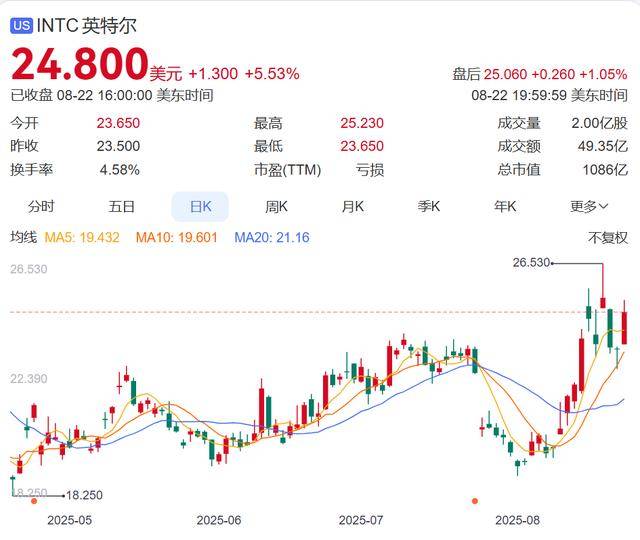
Group 1 - Intel has reached an agreement with the U.S. federal government for an investment of $8.9 billion, acquiring 9.9% of the company's shares at $20.47 per share [1][3] - Following the announcement, Intel's stock price increased by 5.53%, closing at $24.8, with a total market capitalization of $108.6 billion [1] - In July, Intel announced layoffs and the cancellation of certain overseas projects due to poor management, with over 20,000 employees laid off this year [3][4] Group 2 - In Q2, Intel reported a revenue of $12.9 billion, a slight increase from $12.8 billion year-on-year, but incurred a net loss of $2.9 billion, including significant restructuring costs [4] - The company's client products revenue decreased by 3% to $7.9 billion, while data center and AI business revenue grew by 4% to $3.9 billion [4] - Intel's projected revenue for Q3 is between $12.6 billion and $13.6 billion, with adjusted earnings per share expected to be zero, falling short of market expectations [4] Group 3 - CEO Chen Lifeng emphasized the need for organizational restructuring to improve efficiency and focus resources on future growth areas, particularly AI and foundry services [3][4] - Chen Lifeng's leadership has seen multiple rounds of layoffs and project cancellations, including a significant reduction in workforce and the closure of new projects in Germany and Poland [4] - The company has faced scrutiny from former President Trump, who called for Chen Lifeng's resignation due to alleged conflicts of interest [4][5]
从生成式AI到代理式AI,Cadence说半导体设计有这些变化
Di Yi Cai Jing· 2025-08-20 06:36
半导体芯片的功能日益复杂,需要集成数万亿个晶体管,必须支持高性能计算,并采用先进的工艺节点 设计。 "制程节点的开发无法再与工具和IP的开发分离,必须协同工作。" 保罗认为随着复杂多芯片封 装(如中介层2.5D封装)和堆叠技术(如多达16片的晶圆堆叠)的应用,推动超越摩尔定律势在必行。 为此,Cadence提出了"三层蛋糕"(three layer cake)概念,以智能系统设计为核心,提供先进的计算软 件、专用加速硬件和 IP 解决方案,能够适应客户动态的设计要求。包括AI代理层、核心仿真层以及运 行计算的硬件层。 从生产环节来看,Cadence不仅仅关注半导体本身,还会向后端物理世界延伸,包括 机电、热力、流体等领域,甚至模拟整个数据中心,以实现从芯片到系统端到端的优化。在技术原理上 来看,仿真与AI技术的传统方法依赖数学和计算机科学,AI能够解决以前无法处理的问题,如复杂的 物理建模和自动化设计。支撑前两者的是计算本身,当定制加速器可应用于x86 CPU、Arm架构、GPU 等多种平台,Cadence的软件也在越来越异构化。借助 AI 释放的创造力,Cadence 能够实现卓越设计, 帮助客户满足关键的 ...
Silvaco Group (SVCO) FY Conference Transcript
2025-08-18 16:00
Summary of Silvaco Group (SVCO) FY Conference Call - August 18, 2025 Company Overview - **Company**: Silvaco Group (SVCO) - **Industry**: Electronic Design Automation (EDA) and Technology Computer-Aided Design (TCAD) software - **Market Position**: Competes with major players like Synopsys, Cadence, Siemens, and Enter Graphics - **Recent Developments**: IPO in May 2024, with bookings of $65.8 million and revenue of approximately $60 million, reflecting a 10% growth in revenue and 13% growth in bookings in 2024 [2][3] Core Business Units - **Business Units**: - Traditional EDA tools for chip design - TCAD software for new material analysis and device simulation - Semiconductor IP company - **Market Size**: Addressing a Serviceable Available Market (SAM) of $3.8 billion, with an additional $710 million added through recent acquisitions [3][4] Technology and Competitive Positioning - **TCAD Software**: Fundamental for simulating complex chip designs and new materials, essential for advancements in semiconductor technology [6][9] - **Market Leadership**: Positioned as the second-largest provider of TCAD solutions globally, with a focus on power electronics, photonics, and memory markets [10][11] - **Fab Technology Co-Optimization (FTCO)**: Introduced to enhance manufacturing processes using AI, allowing for faster simulations and reduced costs associated with wafer runs [12][15] Customer Engagement and Market Strategy - **Initial Customers**: Micron as the first FTCO customer, with ongoing R&D collaborations with advanced CMOS fabs and power electronics companies [15][16] - **Market Penetration Goals**: Aim to capture 10-15% of the newly added SAM within three to five years of FTCO introduction [25] Recent Acquisitions - **Acquisitions**: Three acquisitions completed within three months, enhancing capabilities in design, wafer fabrication, and photonics [28][29] - **Mixel**: Added $110 million in market share, focusing on automotive IP [35] - **TechX**: Enhances digital twin modeling and wafer etching capabilities [36] - **Proximity Correction Technology from Cadence**: Addresses mask-making challenges in manufacturing [41] Market Trends and Opportunities - **China Market**: Historically 15-20% of revenue, with potential for growth due to reduced restrictions and increasing demand in TCAD, automotive, and photonics sectors [58][59] - **Quantum Computing**: Engaged with two customers in quantum computing, providing TCAD and IC design modeling services [62][64] - **AI Integration**: Exploring AI applications in design assistance, automation of IP block creation, and advanced manufacturing processes [80][82] Financial Metrics and Future Outlook - **Revenue Growth**: Expected double-digit growth for the current year, with a focus on profitability neutrality [5] - **Integration of Acquisitions**: Anticipated completion by September, with a focus on tracking return on invested capital (ROIC) from acquisitions [45] Conclusion - **Strategic Focus**: Silvaco aims to expand its market presence through innovative technologies, strategic acquisitions, and a strong emphasis on customer collaboration in the evolving semiconductor landscape [70][71]
处理器芯片,大混战
半导体芯闻· 2025-08-18 10:48
Core Viewpoint - The article discusses the evolving landscape of artificial intelligence (AI) processing solutions, highlighting the need for companies to balance current performance with future adaptability in AI models and methods. Various processing units such as GPUs, ASICs, NPUs, and FPGAs are being utilized across different applications, from high-end smartphones to low-power edge devices [1][12]. Summary by Sections AI Processing Units - Companies are exploring a range of processing units for AI tasks, including GPUs, ASICs, NPUs, and DSPs, each with unique advantages and trade-offs in terms of power consumption, performance, flexibility, and cost [1][2]. - GPUs are favored in data centers for their scalability and flexibility, but their high power consumption limits their use in mobile devices [2]. - NPUs are optimized for AI tasks, offering low power and low latency, making them suitable for mobile and edge devices [2]. - ASICs provide the highest efficiency and performance for specific tasks but lack flexibility and have high development costs, making them ideal for large-scale, targeted deployments [3]. Custom Silicon - The trend towards custom silicon is growing, with major tech companies like NVIDIA, Microsoft, and Google investing in tailored chips to optimize performance for their specific software needs [4]. - Custom AI accelerators can provide significant advantages, but they require a robust ecosystem to support software development and deployment [4]. Flexibility and Adaptability - The rapid evolution of AI algorithms necessitates flexible hardware solutions that can adapt to new models and use cases, as traditional ASICs may struggle to keep pace with these changes [4][5]. - The need for adaptable architectures is emphasized, as AI capabilities may grow exponentially, putting pressure on decision-makers to choose the right processing solutions [4][5]. Role of DSPs and FPGAs - DSPs are increasingly being replaced or augmented by AI-specific processors, enhancing capabilities in areas like audio processing and motion detection [7]. - FPGAs are seen as a flexible alternative, allowing for algorithm updates without the need for complete hardware redesigns, thus combining the benefits of ASICs and general-purpose processors [8]. Edge Device Applications - Low-power edge devices are utilizing MCUs equipped with DSPs and NPUs to meet specific processing needs, differentiating them from high-performance mobile processors [10]. - The integration of AI capabilities into edge devices is becoming more prevalent, with companies developing specialized MCUs for machine learning and context-aware applications [10][11]. Conclusion - The edge computing landscape is characterized by a complex mix of specialized and general-purpose processors, with a trend towards customization and fine-tuning for specific workloads [12].






华大九天(301269):回款力度加大,受益于半导体国产化大趋势
SINOLINK SECURITIES· 2025-08-17 02:16
Investment Rating - The report maintains a "Buy" rating for the company, indicating an expected price increase of over 15% in the next 6-12 months [4][12]. Core Insights - The company reported a revenue of 500 million RMB in the first half of 2025, representing a year-on-year growth of 13% [2]. - The net profit attributable to the parent company, excluding non-recurring gains and losses, was -19 million RMB, showing a reduced loss compared to the same period last year [2]. - The adjusted net profit, excluding share-based payment impacts, was 85 million RMB, marking a significant year-on-year increase of 73% [2]. - The second quarter revenue reached 270 million RMB, with a year-on-year growth of 16% [2]. - The company has improved its cash collection efforts, with cash received from sales and services increasing by 73% year-on-year [3]. - The domestic EDA industry is maturing, and the company is expected to benefit from the trend of semiconductor localization [3]. Summary by Sections Performance Review - In the first half of 2025, the company achieved a revenue of 500 million RMB, a 13% increase year-on-year, while the net profit attributable to the parent company was -19 million RMB, indicating a narrowing loss [2]. - The adjusted net profit, excluding share-based payment impacts, was 85 million RMB, reflecting a 73% increase compared to the previous year [2]. Operational Analysis - The company's gross profit increased by 10.2%, outpacing the combined growth of sales, management, and R&D expenses at 9.3% [3]. - The company has intensified its cash collection efforts, leading to a 73% year-on-year increase in cash received from sales and services [3]. - The reduction in credit impairment losses by 19 million RMB compared to the previous year was noted, although other income decreased by 46 million RMB due to reduced EDA project subsidies [3]. Profit Forecast, Valuation, and Rating - Revenue projections for 2025-2027 are estimated at 1.39 billion RMB, 1.62 billion RMB, and 1.88 billion RMB, with year-on-year growth rates of 13.8%, 16.2%, and 16.4% respectively [4]. - The net profit attributable to the parent company is forecasted to be 60 million RMB, 190 million RMB, and 330 million RMB for the same period, with significant growth expected in subsequent years [4].

CDNS Stock Gains 25% in a Year: Stay Invested or Book Profits?
ZACKS· 2025-08-14 16:06
Core Insights - Cadence Design Systems (CDNS) stock has increased by 24.6% over the past year, outperforming the Computer-Software industry (up 23.1%), the broader Computer and Technology sector (up 24.2%), and the S&P 500 composite (up 17.5%) [1] - The company has seen a 4.6% rise since July 28, following a better-than-expected second-quarter performance, with the stock closing at $349.12, below its 52-week high of $376.45 [2] Growth Drivers - AI is significantly transforming semiconductor and system design, with Cadence being well-integrated into this shift. Key growth drivers include 5G, hyperscale computing, and autonomous vehicles [3] - The rapid adoption of Generative AI, Agentic AI, and Physical AI is leading to increased computing needs and semiconductor innovation, benefiting Cadence. The company collaborates with industry leaders like Qualcomm and NVIDIA on next-generation AI designs [4] - Rising R&D spending by customers focused on AI-driven automation is expected to benefit Cadence. The company is unifying its capabilities across various domains to capture opportunities from the ongoing AI supercycle [5] Financial Performance - Cadence's ratable software model, strong backlog, and high recurring revenue mix provide resilience amid macroeconomic volatility [6] - Core EDA revenues grew by 16% year over year in the second quarter, driven by demand from AI and hyperscale clients. The company launched Cerebrus AI Studio, which offers significant improvements in chip design efficiency [9] - The IP business saw a 25% year-over-year revenue increase in the second quarter, supported by a broadening silicon solutions portfolio and rising demand in AI and HPC [10] - Management has upgraded its revenue outlook for 2025 to a range of $5.21-$5.27 billion, with non-GAAP EPS expected between $6.85 and $6.95 [12] Cash Flow and Shareholder Returns - As of June 30, 2025, Cadence had cash and cash equivalents of $2.823 billion, with operating cash flow of $378 million and free cash flow of $334 million. The company repurchased shares worth $175 million in the second quarter and plans to execute $200 million in repurchases in the third quarter [13] Competitive Landscape - The company faces headwinds from global macroeconomic conditions and competition in the EDA/AI space, particularly from Keysight Technologies and Synopsys, which recently acquired ANSYS [15] - Cadence generates a significant portion of its revenues from international markets, with 47% of revenues coming from the U.S. in 2024. Adverse foreign currency exchange rates could impact revenue growth [16] - Cadence stock is trading at a premium, with a forward 12-month Price/Earnings ratio of 46.83X compared to the industry's 35.12X [17] Conclusion - Cadence's strong fundamentals, robust AI-driven demand, and resilient recurring revenue model position it well for long-term growth, despite macro uncertainties and competitive pressures [18]

CDNS, NVDA Team Up to Advance Billion-Gate AI Design Power Analysis
ZACKS· 2025-08-14 15:15
Group 1: Breakthrough in Power Analysis - Cadence Design Systems and NVIDIA Corporation have achieved hardware-accelerated dynamic power analysis for billion-gate AI designs, completing the process in just a few hours with up to 97% accuracy [1][4] - The new Cadence Dynamic Power Analysis App, integrated with the Palladium Z3 Enterprise Emulation Platform, allows for accurate power consumption estimates in real-world workloads, enhancing energy efficiency and preventing delays in chip design [4][5] - Traditional power analysis tools are limited to processing a few hundred thousand cycles, but the collaboration between Cadence and NVIDIA has enabled unprecedented accuracy across billions of cycles [3][4] Group 2: Market Opportunities and Growth - There is broad-based demand for Cadence's solutions, particularly in AI-driven portfolios, driven by trends such as 5G, hyperscale computing, and autonomous driving [5][7] - Cadence is collaborating with major tech companies like Qualcomm and NVIDIA on next-generation AI designs, and is targeting new markets such as Life Sciences with its OpenEye drug discovery software [6][7] - The company is expanding partnerships with foundry partners like Taiwan Semiconductor Manufacturing, Intel, and Arm Holdings, positioning itself to benefit from increased R&D spending on AI-driven automation [7] Group 3: Competitive Landscape - Cadence faces intensifying competition and challenges related to international exposure and a high level of goodwill and intangible assets [8] - In the broader software space, competitors like PTC Inc. and Adobe Inc. are also leveraging AI technologies, indicating a competitive environment for Cadence [9][13]

特朗普滥用总统权力,他突然对美企下狠手,唯独不敢对中国提条件
Sou Hu Cai Jing· 2025-08-09 04:34
Group 1: Trump's Interference in Corporate Governance - Trump's demand for Intel CEO Lip-Bu Tan to resign due to alleged "conflict of interest" led to a nearly 5% drop in Intel's stock price on August 7, 2025 [4] - Senator Tom Cotton's letter to Intel's board accused Tan of investing approximately $200 million in over 200 Chinese chip and advanced manufacturing companies, some linked to the Chinese military [4] - Trump's actions are seen as a violation of U.S. laws, as corporate executives should be investigated by courts rather than being judged through presidential tweets [7] Group 2: Implications for the Semiconductor Industry - Trump's strong measures against Intel and other U.S. companies aim to consolidate America's technological advantage in the global chip industry [7] - The response from China's Ministry of Commerce indicates that the U.S. must cease its "tech hegemony" and interference in internal affairs for any trade negotiations to proceed [4][12] - The evolving global trade dynamics show that unilateral pressure from the U.S. is becoming increasingly ineffective, as countries like ASEAN and the EU deepen their trade ties with China [9][12] Group 3: Global Trade Dynamics - ASEAN has become China's largest trading partner for three consecutive years, with bilateral trade growing by 15.3% in the first half of 2024 [9] - The EU's reliance on China is increasing, with Dutch company ASML's exports to China surpassing 46% in Q2, and German car manufacturers' sales in China accounting for 37% of their global sales [9] - The shift towards a multipolar economic structure indicates that the U.S. cannot dictate terms unilaterally, as evidenced by the changing attitudes of global partners towards trade with China [12]