Rokid

Search documents
爆发元年与洗牌前夜:AI眼镜“成长的烦恼”
Xi Niu Cai Jing· 2025-11-28 02:28
Core Insights - The AI glasses market in China is experiencing explosive growth, with significant sales increases during the "Double 11" shopping festival, indicating a strong consumer demand for this technology [2][6][8] - Major tech companies like Alibaba, Baidu, and Xiaomi are entering the AI glasses space, intensifying competition with established players like Rokid and Thunder Innovation [3][4] - Despite the growth, the industry faces challenges such as high return rates, supply chain issues, and a lack of killer applications, which hinder its maturity [8][9][10] Group 1: Market Dynamics - The AI glasses market is projected to grow significantly, with global shipments expected to exceed 40 million units by 2029, and China leading in growth rates [6] - Major brands like Ray-Ban Meta have contributed to the market's transition from concept to consumer-level products, with sales reaching 2 million units since launch [6] - The "Double 11" sales data shows a staggering 25-fold increase in smart glasses sales on Tmall, with other brands like Thunder Innovation and Rokid also reporting over 80% growth [7][8] Group 2: Competitive Landscape - Established players focus on core hardware technology, while internet giants leverage AI ecosystem integration to capture market share [3][4] - Xiaomi's AI glasses, priced at 1999 yuan, aim to create a seamless ecosystem with its other devices, lowering the entry barrier for consumers [4] - Baidu's re-entry into the market with its AI glasses Pro showcases the company's commitment to integrating AI capabilities into wearable technology [3] Group 3: Challenges and Risks - High return rates are a significant concern, with average rates around 30% on major platforms and as high as 40-50% on Douyin [8][9] - Technical issues such as weight, battery life, and performance are common complaints among users, impacting overall satisfaction [9] - The industry lacks a "killer application" that would drive daily usage and consumer loyalty, making it difficult for companies to establish a strong market presence [10][11] Group 4: Future Outlook - The year 2025 is anticipated to be a pivotal year for AI glasses, but current high return rates and user experience challenges indicate that the market is still in an exploratory phase [12] - The industry must focus on technological advancements and real-world applications to transition from novelty items to essential smart devices [12] - Companies are encouraged to prioritize user feedback and rapid iteration to overcome existing barriers and achieve widespread adoption [12]

AI眼镜中小ODM代工厂欲突破“魔界” 找品牌商“陪跑”
Di Yi Cai Jing· 2025-11-26 10:06
Core Insights - The article discusses the competitive landscape of the AI glasses market, highlighting the strategies of Antawave, a small to medium-sized ODM manufacturer in the Pearl River Delta, as it navigates challenges and opportunities in the industry [1][2][3]. Group 1: Company Strategies - Antawave's general manager, Yan Pengfei, is actively seeking to expand the scale of AI glasses production through partnerships with both B2B and B2C clients, despite facing financial pressures from inventory sales [1][3]. - The company has launched a low-cost AI translation glasses priced at 119 yuan during the Double 11 shopping festival, aiming for a sales target of 500,000 units [2][3]. - Antawave plans to introduce a new model priced at 399 yuan in December, which will feature improved AI translation and navigation capabilities compared to its previous 599 yuan model [2][3]. Group 2: Market Dynamics - The AI glasses market is seeing increased competition, with major brands like Xiaomi and Rokid focusing on higher-priced models, while Antawave and similar manufacturers target the budget segment [2][3]. - The emergence of domestic chip solutions is enabling smaller manufacturers to offer more affordable and lightweight AI glasses, enhancing their competitiveness against larger firms [3][4]. - IDC forecasts that by 2026, the global smart glasses market will exceed 23.68 million units, with China's market expected to surpass 4.915 million units, indicating significant growth potential in the sector [5][6]. Group 3: Technological Advancements - Antawave is leveraging local supply chains in the Pearl River Delta to reduce costs and accelerate product iterations, with a development cycle of approximately six months for new models [3][5]. - The article notes that advancements in domestic AI glasses chips are expected to lead to more diverse functionalities, including multi-modal interaction and improved power efficiency [4][5]. - Other companies in the sector, such as Yijing Virtual and Gudong Intelligent, are also innovating with lightweight designs and advanced features, indicating a trend towards more integrated and user-friendly AI glasses [6].
AI眼镜中小ODM代工厂欲突破“魔界”,找品牌商“陪跑”
Di Yi Cai Jing· 2025-11-26 09:50
小米、雷鸟、Rokid等主要做1500元以上AI眼镜,是在"仙界";中小代工厂做百元级的白牌AI眼镜,是在"魔界",一些有研发能力的中小代工厂想破界。 作为一家珠三角的中小型AI眼镜ODM代工厂的负责人,安塔威总经理鄢鹏飞今年过了双11仍然在忙碌。尽管他们双11在抖音上卖119元的AI翻译眼镜销量不 错,但是Rokid双11卖了5000万元、上万副眼镜,这在鄢鹏飞看来已是一家独大。 "我们如果现货卖,资金压力大",鄢鹏飞正积极与ToB、ToC和ODM的客户洽谈,以扩大代工AI眼镜的规模。安塔威在东莞正建设新厂,其科技园展厅即将 投入运营。11月21日,鄢鹏飞在深圳办公室已接待了包括品牌商在内的四家重要客户。 不甘心只做百元AI眼镜 以智能手表等可穿戴电子产品起家的安塔威,看好AI眼镜的新赛道,今年年初已开始研发搭载国产芯片方案的低成本AI眼镜。在7月小米推出近2000元AI眼 镜的次日,安塔威立马跟进推出了599元的带AI翻译和导航功能的AI眼镜。 这款百元级AI眼镜随后几个月在华强北、抖音直播间和代理商渠道销量猛增,月出货量曾突破2万台。前不久,大朋等纷纷跟进国产芯片方案,在双11也推 出599元的AI眼镜 ...
争夺“超级AI助理”:本地生活入口战火升级,谁主沉浮?
Cai Jing Wang· 2025-11-25 11:32
Core Insights - The launch of JD's independent delivery app and AI-driven tools marks a new phase in local life services, initiating a competition for "super AI assistants" [1][2] - JD's commitment to non-commercialization of its review and ranking tools addresses industry issues of trust and authenticity in user reviews [2] - The AI Agent landscape is evolving, with major players like Meituan and Didi also introducing their own AI-driven solutions for local services [3][4] Group 1: Company Strategies - JD has launched an independent delivery app alongside AI tools "JD Review" and "JD True List," utilizing AI to analyze consumer data and create the first AI-generated rankings globally [2] - Meituan's "Xiao Mei" app, powered by its self-developed LongCat-Flash-Chat model, aims to enhance user experience in local services through natural language interactions [3] - Didi's AI travel assistant "Xiao Di" transforms the ride-hailing experience by allowing users to actively choose vehicles based on their needs [3] Group 2: Market Trends - The competition in the local life services sector is intensifying, with AI Agents seen as a key area for commercial potential due to their ability to meet frequent user demands [4][5] - The AI Agent market in China is projected to grow significantly, with estimates suggesting it will reach 6.9 billion yuan by 2025, reflecting a growth rate exceeding 140% [7] - The introduction of AI technology in local services aims to address issues like information asymmetry and high decision costs, which have plagued traditional models [7][8] Group 3: Challenges and Requirements - AI Agents in local life services face higher demands for real-time responsiveness, multi-turn dialogue capabilities, and data privacy compliance [5][6] - The complexity of integrating AI Agents with various platforms and ensuring accurate execution of tasks presents significant challenges [6] - Industry experts highlight the need for AI Agents to evolve from basic functionality to seamless service execution across multiple scenarios [9]


百镜大战,Rokid能扛得住吗?
3 6 Ke· 2025-11-25 10:21
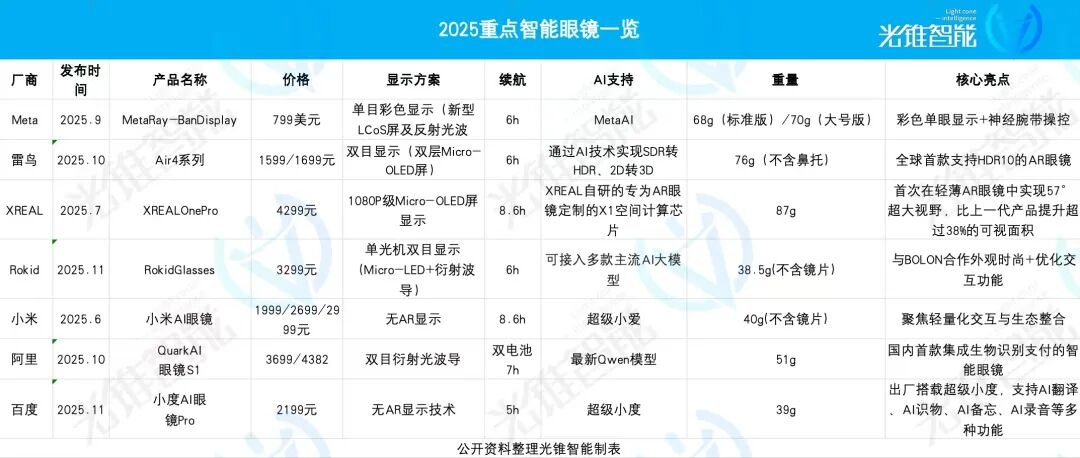
Core Insights - The smart glasses industry is experiencing a significant surge in demand, with Rokid founder Zhu Mingming acknowledging underestimating the market potential for 2025, as the company has already received 200,000 orders this year, far exceeding initial expectations of 100,000 to 150,000 units [1][5][10] - The global smart glasses market saw a shipment of 4.065 million units in the first half of 2025, representing a year-on-year growth of 64.2%, with major sales events like Tmall's Double 11 showing a staggering 25-fold increase in transaction volume [1][10][11] - Rokid's strategic shift towards consumer-grade products is evident, focusing on enhancing the functionality of Rokid Glasses, which has become the company's primary product amid fierce competition from tech giants like Xiaomi, Alibaba, and Baidu [4][6][8] Market Dynamics - The smart glasses market is becoming increasingly competitive, with dozens of new products launched this year, leading to a crowded landscape [2][4] - Major brands are releasing products with similar features, resulting in a high degree of homogeneity in the market, particularly in AI capabilities and basic functionalities [3][4][16] - Rokid's market share remains relatively low despite the overall industry growth, with the company facing challenges from emerging competitors and the prevalence of less sophisticated products dominating sales [10][13][16] Product Development and Strategy - Rokid has shifted its focus to consumer applications, moving away from a mixed B2B and B2C approach, and is now prioritizing features that cater to entertainment and daily use [6][8] - The company has launched Rokid Glasses with a strong emphasis on an open ecosystem, allowing developers to create diverse applications, which has attracted nearly 30,000 developers and 5,000 enterprises [9][8] - Despite the positive reception of Rokid Glasses, the company is currently facing production capacity constraints, leading to delays in fulfilling orders and a halt on new product launches for the remainder of the year [5][6] Future Outlook - Rokid aims to achieve ambitious sales targets of 1 million units in the next year and 2 to 3 million units in the following year, but these goals may be overly optimistic given current market conditions [10][11] - The company is at a critical juncture, needing to differentiate its products significantly to avoid further commoditization in a rapidly evolving market [18][20] - The overall smart glasses market is projected to grow substantially, with IDC forecasting shipments to exceed 40 million units by 2029, indicating a robust future for the industry despite Rokid's current challenges [10][11][15]
瑞声科技(02018.HK)收购芬兰Dispelix:瞄准META/苹果/谷歌XR供应链?
Ge Long Hui· 2025-11-24 08:54
Core Insights - The acquisition of Dispelix by AAC Technologies marks a significant move to enhance its XR capabilities, focusing on transparent waveguide technology for AR devices [1][4] - The deal has garnered positive attention from industry leaders, indicating strong interest and support for the transaction [3] Group 1: Strategic Implications - The acquisition is a key step for AAC Technologies in the XR field, as it collaborates with top mobile ecosystem builders to develop next-generation XR reference design hardware platforms [4][5] - The announcement hints at potential partnerships with major players like Meta, Apple, and Google, which are pivotal in the XR ecosystem [4][5] Group 2: Business Synergies - Prior to the acquisition, AAC Technologies had established capabilities in acoustic, haptic, and optical modules, and the addition of Dispelix fills a critical gap in AR waveguide technology [6] - The integration of XR capabilities is expected to synergize with AAC's existing business, leveraging its supply chain resources and manufacturing expertise to accelerate XR commercialization [6][7] Group 3: Growth Strategy - The acquisition aligns with AAC Technologies' strategic focus on building core technology platforms and achieving cross-domain technology reuse, which has been a consistent theme in its growth strategy [7] - Previous acquisitions have successfully expanded AAC's capabilities across various sectors, indicating a replicable growth model for future ventures into emerging fields [7] Group 4: Market Potential - The global XR investment is projected to grow from $15.22 billion in 2024 to $39.7 billion by 2029, with a compound annual growth rate of 21.1%, highlighting significant growth potential in the industry [8]

AI眼镜的冰与火 如何跨越“不可能三角”
2 1 Shi Ji Jing Ji Bao Dao· 2025-11-20 10:37
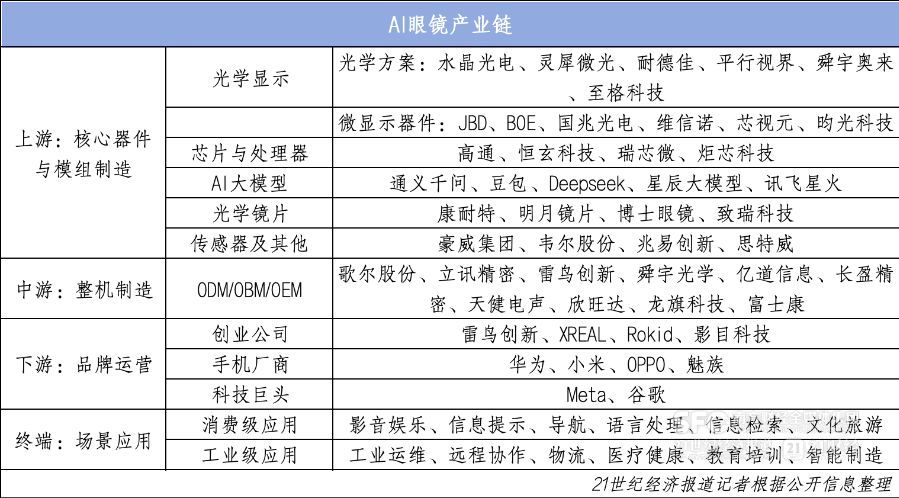
Core Insights - The AI glasses market is experiencing significant growth, with sales of AI shooting and display glasses increasing over tenfold year-on-year, making it the fastest-growing category in digital products [1] - Major players in the industry include internet giants like Alibaba and Baidu, as well as hardware manufacturers such as Huawei and Xiaomi, alongside numerous vertical startups [1][2][4] - The global smart glasses market is projected to exceed 40 million units by 2029, with China expected to lead in growth rate [1][6] Market Dynamics - The AI glasses sector is crowded with various players, including established tech companies and startups, indicating a competitive landscape [1][5] - Baidu and Alibaba have launched their AI glasses, with Baidu's product weighing 39 grams and Alibaba's Quark AI glasses topping sales charts during the Double Eleven shopping festival [2][3] - Xiaomi's AI glasses sold out within half an hour of release, showcasing strong consumer demand [4] Investment and Financing - The smart glasses market is attracting significant investment, with 23 rounds of financing reported in 2025 alone [5] - Thunder Innovation recently completed a financing round, raising approximately 800 million yuan, surpassing initial expectations [5] Sales Performance - The AI wearable device index has risen by 26.3% over the past year, reflecting a robust market trend [6] - During the Double Eleven sales event, the transaction volume for smart glasses surged by 2500%, with brands like Rokid and Thunder Innovation seeing sales increases of over 700% and 80%, respectively [6] Industry Challenges - The industry faces a "trilemma" where achieving lightweight design, high performance, and long battery life in AI glasses is challenging [1][10] - High return rates for AI glasses, estimated at 30% to 50%, indicate issues with customer satisfaction and product maturity [9] Technological Integration - AI models are crucial for the evolution of smart glasses, enabling functionalities beyond entertainment to include payment, navigation, and e-commerce [8] - The integration of AI models is seen as a key factor for the future success of AI glasses, with companies like Xiaomi and Alibaba incorporating their proprietary AI technologies [8] Supply Chain and Production - The supply chain for AI glasses is complex, involving multiple components such as chips, sensors, and optical modules, which are not yet fully mature [10] - Production capacity is a significant challenge, with many manufacturers struggling to meet demand due to high production costs and the need for specialized manufacturing processes [11] User Experience Focus - Industry experts suggest a shift from adding features to enhancing user experience, emphasizing the need for AI glasses to prioritize comfort and usability [12][13] - The design of AI glasses is evolving to meet aesthetic demands, with a focus on lightweight models weighing between 20 to 40 grams [14]
Rokid“风林火山”四大国潮系列发布
Xin Lang Ke Ji· 2025-11-20 07:20
Core Insights - Rokid has launched the "Wind, Forest, Fire, Mountain" series of national trend smart glasses, integrating traditional cultural symbols with modern technology [1] - The new series showcases advancements in functional innovation and fashion integration within the company's wearable devices [1] Product Details - The "Wind" series model, named "Liu Lan," features Hangzhou embroidery craftsmanship, embodying the theme of "poetry of nature" [1] - The "Forest" series model, named "Lin Xi," utilizes wood carving craftsmanship, conveying the philosophy of "coexistence with nature," priced at 5688 [1] - The "Fire" series model, named "Zhuo Hua," employs dripping glaze craftsmanship, priced at 5858 [1] - The "Mountain" series model, named "Shan Jing," uses leather carving craftsmanship, priced at 4599 [1] User Engagement - Rokid reports an average daily usage time of nearly 8 hours for the smart glasses, with cumulative usage exceeding 15 million times [1] - A significant 81% of users express willingness to create and share content related to the product [1]
消费电子PCB需求激增,科翔股份发力AI手机终端大周期
Quan Jing Wang· 2025-11-20 06:56
Core Viewpoint - The consumer electronics industry is entering a new AI-driven iteration cycle, with mobile phones and smart wearables becoming the best entry points for AI applications. Canalys predicts that by 2028, the shipment proportion of AI smartphones will exceed 50%, driving a surge in demand for high-end PCBs due to increased terminal integration [1]. Group 1: Company Positioning and Strategy - The company, Kexiang Co., is a leading PCB manufacturer in China, with nearly 20% of its revenue coming from consumer electronics. It has established deep integration into the supply chains of major brands like ZTE and Xiaomi through a dual strategy of direct partnerships and ODM indirect channels, positioning itself to benefit from the industry's super cycle [1][2]. - Kexiang Co. has a high sales proportion of high-end consumer electronics PCBs, particularly for smartphones, and has formed partnerships with several well-known ODM manufacturers, making it a significant supplier in the smartphone PCB industry [2][3]. - The company has been collaborating with ZTE since 2020, and starting in 2024, it will upgrade its product orders to focus on mid-to-high-end PCBs for mobile phones and communication devices, with steadily increasing unit prices [3]. Group 2: Technological Advancements and Product Offerings - Kexiang Co. is leveraging its advanced technology to meet the high-density integration demands of AI smartphones, capable of mass-producing 14-16 layer HDI boards with a minimum line width/spacing of 0.05mm, suitable for multi-chip collaborative computing [5]. - The company's high-frequency and high-speed boards utilize low-loss dielectric materials, ensuring signal transmission stability that meets the standards of major clients like Huawei and ZTE, making them suitable for high-speed data processing scenarios in AI terminals [5]. - Kexiang Co. has entered the supply chains of AR glasses manufacturers like Meta and Rokid with its ePOP storage products, positioning itself in the emerging virtual and augmented reality terminal market. The company has accumulated over 300 authorized patents and plans to invest 6% of its R&D budget in 2024, particularly in high-end fields like MiniLED packaging substrates [6]. Group 3: Market Outlook and Growth Potential - The company is expected to benefit from the increasing penetration of AI terminals, which will drive demand for high-end PCBs. Its strong customer matrix and technological reserves create synergistic advantages, positioning it to achieve simultaneous growth in volume and profit during the industry's super cycle [6]. - In the short term, the improving consumer electronics market is likely to release incremental orders for Kexiang Co. from collaborations with clients like ZTE, Xiaomi, Samsung, and DJI [6].

退货率高达50%!AI眼镜是下一个iPhone,还是下一个“智商税”?
创业邦· 2025-11-19 10:11
Core Viewpoint - The AI glasses market is experiencing explosive growth, with significant sales increases during events like Double Eleven, but high return rates pose challenges for companies [3][6][18]. Sales Performance - During Double Eleven, Rokid achieved the highest sales in the AI glasses category, with a 10-fold increase on JD and an overall growth of 800%, surpassing 50 million yuan in sales [6][10]. - Rokid's new AI glasses sold 40,000 units within five days of launch, with total orders reaching 200,000 units since the beginning of 2025 [3][10]. Product Features and Comparisons - Rokid AI glasses feature a green screen display and can integrate with prescription lenses, while the Baolong AI glasses focus solely on voice control and are lighter but lack visual information [6][8]. - The weight and battery life of the glasses present trade-offs, with Rokid's glasses weighing 49 grams and having shorter battery life compared to Baolong's 39 grams and longer battery life [6][8]. Market Dynamics - The AI glasses market is expected to see intense competition by 2025, with nearly 20 companies launching products, including major players like Alibaba and Baidu [13][16]. - Rokid and other leading companies are backed by government support, which aids in their growth and funding [13][14]. Consumer Behavior and Challenges - High return rates, estimated at over 50%, are driven by consumer dissatisfaction after trying the glasses, often due to expectations not being met [4][18]. - Consumers question the value of AI glasses compared to traditional glasses and smartphones, leading to hesitance in purchasing [18]. Strategies to Reduce Returns - Implementing offline try-on services in traditional eyewear stores can help reduce return rates by allowing consumers to assess fit and comfort before purchase [19][21]. - Rokid's collaboration with Baolong includes providing trial services in over 15 eyewear chains, enhancing consumer experience and reducing returns [21]. Industry Outlook - The industry is still in its early growth phase, with companies needing to find unique positioning to succeed [22]. - The challenge of balancing weight, battery life, and performance remains, with the potential for a company to emerge as a leader akin to the iPhone if they can achieve this balance [22].