OPPO

Search documents
Counterpoint:第三季度全球智能手机营收同比增长5% 创下九月季度历史新高
Zhi Tong Cai Jing· 2025-11-06 07:25
Core Insights - The global smartphone market revenue is projected to grow by 5% year-on-year in Q3 2025, reaching $112 billion, marking the highest revenue for this quarter in history [1] - Global smartphone shipments are expected to see a moderate growth of 4% year-on-year, totaling 320 million units [1] - The average selling price (ASP) of smartphones has reached a record high for Q3 at $351, driven by an expanding mature user base upgrading to more expensive devices [1] Market Performance - Apple led the global smartphone market with a 60% revenue share, achieving a 6% year-on-year revenue growth and a 9% increase in shipments [2][5] - Samsung holds the largest market share in shipments at 19%, with a 9% revenue growth and a 3% increase in ASP, attributed to the success of high-end products like the Galaxy S25 series [5] - Xiaomi ranks third in global shipments with a 14% market share, experiencing a 2% growth, supported by demand in emerging markets [5] Brand Analysis - OPPO recorded the highest ASP growth among the top five brands, increasing by 3.4% year-on-year, with a 1% revenue growth driven by the strong performance of the Reno14 series [5] - Vivo achieved the fastest revenue growth among the top five brands at 12% year-on-year, fueled by strong shipment growth in India and Southeast Asia [6] - The overall trend indicates a shift towards high-end devices and an increase in the adoption of foldable smartphones, which is expected to further boost ASP and revenue in the global smartphone market by 2025 [6]


2025 年 Q3 中国智能手机销量同比下滑 2.7%;在 iPhone 17 需求推动下 Q4 销量增长势头向好
Counterpoint Research· 2025-11-06 07:03
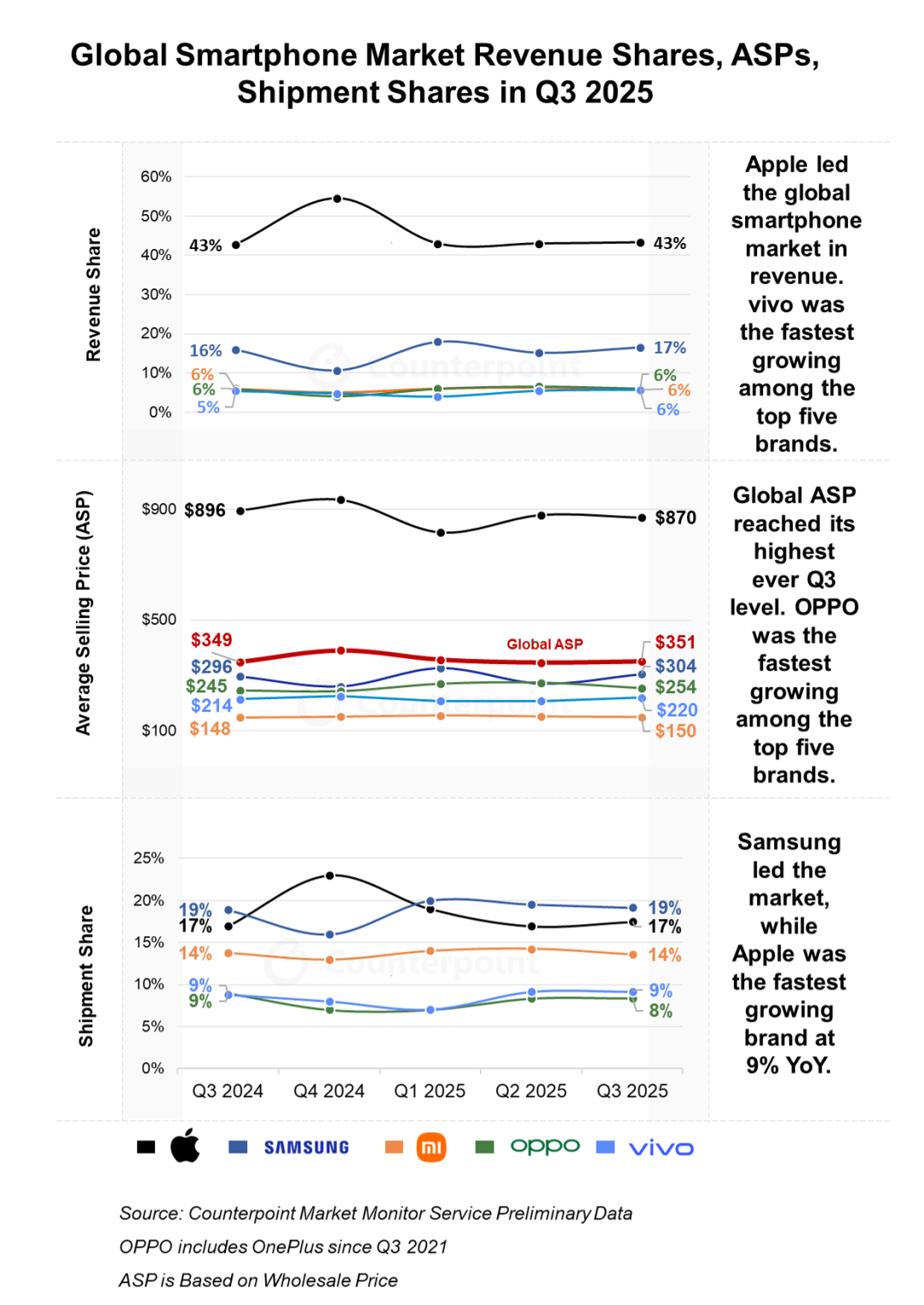
Core Insights - The Chinese smartphone market experienced a year-on-year decline of 2.7% in Q3 2025 due to economic slowdown and reduced demand [5][4] - OPPO achieved the highest year-on-year growth rate among major OEMs, driven by strong demand for its sub-brand OnePlus [6][5] Market Performance - The overall smartphone sales in China decreased by 2.7% in Q3 2025, influenced by ongoing economic factors such as the summer vacation and back-to-school season [5][4] - Vivo's market share fell to 18.5% amid intensified competition, yet it maintained a leading position with a diverse product line [5][6] - Huawei's high-end Mate 70 and Pura 80 series saw lower sales compared to previous models, while the Nova 14 series continued to perform well [5][6] Brand Analysis - OPPO's growth of 2.1% was attributed to stable sales of the Reno 14 series and strong performance from OnePlus, particularly the Ace 5 and 13 series [6][5] - Xiaomi recorded a year-on-year growth of 1.1%, supported by the Redmi Note 15 and K80 series, with the recently launched Xiaomi 17 series receiving positive market feedback [6][9] - Honor's X70 series stood out in the entry-level market, but the brand's overall sales declined by 8.1% [6][5] Apple Performance - The iPhone 17 series outperformed the iPhone 16 series in initial sales, with the base model being particularly popular due to its competitive pricing [7][11] - Apple's pricing strategy has increased pressure on high-end Android brands, with expectations of intensified competition in Q4 [7][11] - The iPhone 17's sales in September were nearly double that of the iPhone 16 during the same period last year, indicating strong market demand [11][9]
印度智能手机 Q3 出货量同比增长 5%,Apple 跻身前五
Counterpoint Research· 2025-11-06 07:03
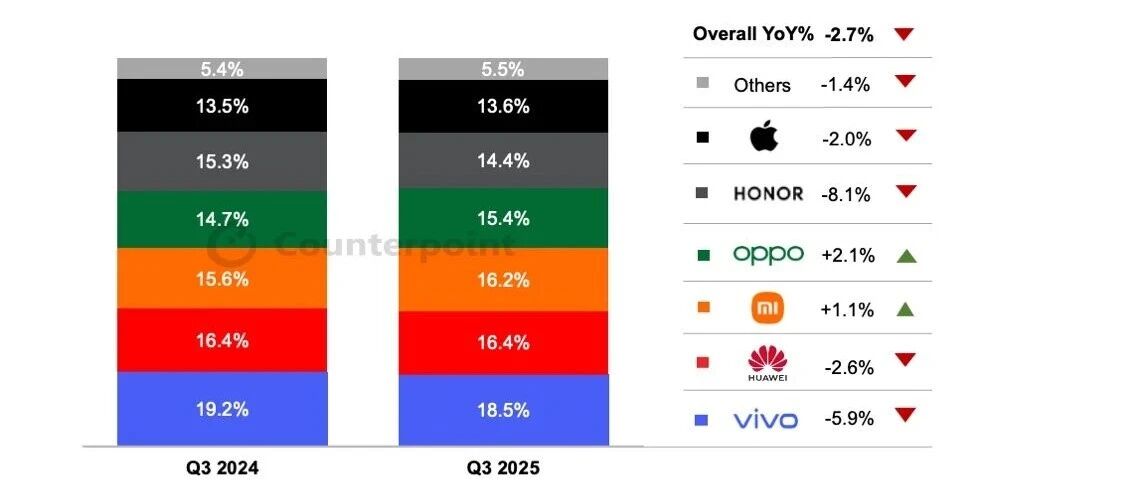
Core Insights - The Indian smartphone market experienced a 5% year-on-year increase in shipment volume and an 18% increase in shipment value in Q3 2025, reaching a historical quarterly high, driven by pre-festival stockpiling and sustained demand for high-end models [4][5][6]. Market Dynamics - The market is transitioning towards a stable growth phase focused on value, supported by festive season stockpiling and promotional activities across online and offline channels. Key drivers include convenient installment payment plans, trade-in policies, and significant discounts [5][6]. - Retail inflation has slowed, and fiscal support has improved household liquidity, leading to a notable recovery in consumer confidence during the festive season [6]. High-End Market Performance - The high-end segment (priced above 30,000 INR, approximately 339 USD) saw a 29% year-on-year increase in shipment volume, making it the fastest-growing segment. The overall market value increased by 18%, with the average selling price (ASP) rising by 13% [9]. - Apple led the market with a 28% share of sales value, driven by strong demand for the iPhone 16 and 15 series, while the newly launched iPhone 17 series outperformed its predecessor [6][9]. Brand Performance - Vivo (excluding iQOO) captured the top market position with a 20% share, benefiting from a robust offline network and the popularity of its mid-range T series [7][9]. - Samsung followed with a 13% market share, supported by its S series and A series, along with successful promotions for its high-end Galaxy Z Fold series [6][7]. - OPPO achieved accelerated growth through a diverse product portfolio and enhanced retailer collaboration [7]. - Apple entered the top five in shipment volume for the first time in Q3 2025, making India the third-largest iPhone market globally [9]. Additional Trends - The online channel accounted for 45% of shipments during the festive season, while offline channels maintained a dominant 55% share [14]. - iQOO emerged as the fastest-growing brand with a 54% year-on-year increase in shipments, driven by a strong gaming-focused product line and community marketing efforts [14]. - Motorola's shipments grew by 53%, fueled by demand for its G series and Edge series [14].
全球智能手机营收在 2025 年第三季度同比增长 5%,创下九月季度历史新高
Counterpoint Research· 2025-11-06 07:03
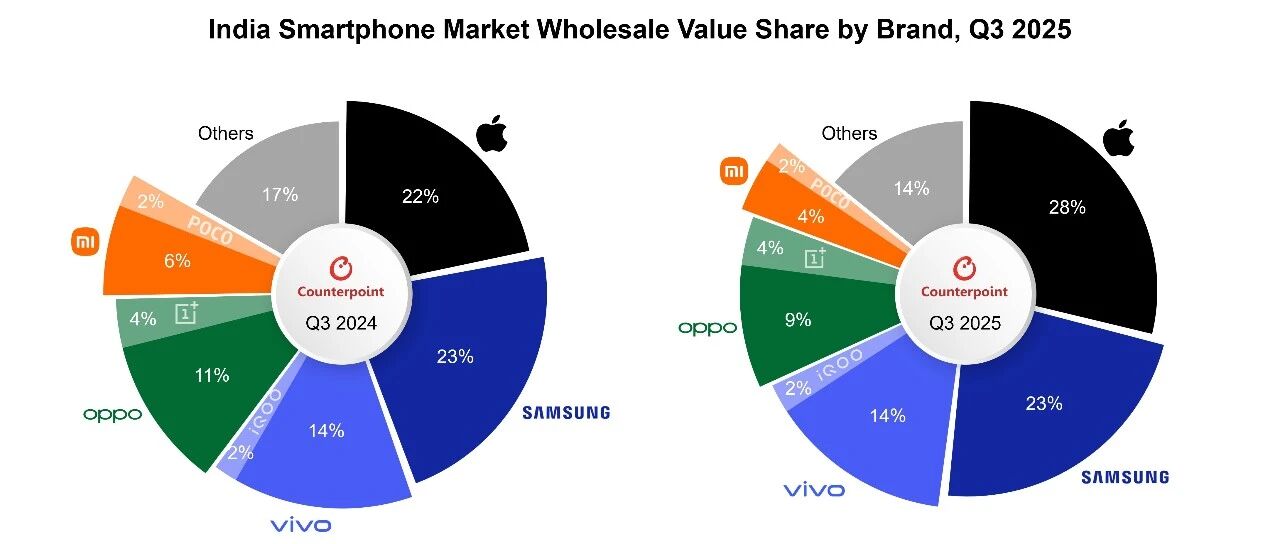
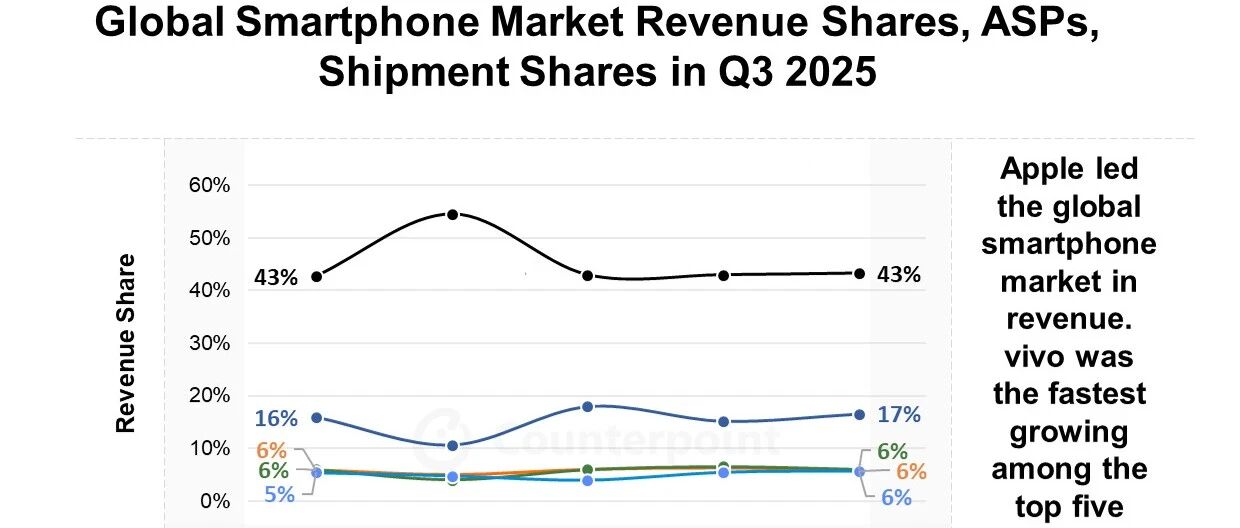
Core Insights - The global smartphone market revenue grew by 5% year-on-year in Q3 2025, reaching $112 billion, marking the highest level for Q3 in history [4][5] - The global smartphone shipment volume also saw a moderate 4% year-on-year increase, totaling 320 million units [5] - The average selling price (ASP) of smartphones reached a record high for Q3 at $351, driven by an expanding mature user base upgrading to more expensive devices [5][8] Company Performance - Apple led the market with a 43% revenue share and a 6% year-on-year growth, achieving its best-ever Q3 revenue [8][11] - Samsung experienced a 9% year-on-year revenue growth, supported by strong sales of the Galaxy S series and foldable devices, with its ASP increasing by 2.9% to $304 [5][11] - Vivo was the fastest-growing brand among the top five, with a 12% year-on-year revenue growth, driven by strong shipments in India and Southeast Asia [5][11] - OPPO achieved the highest ASP increase among the top five brands, growing by 3.4% to $254, thanks to strong performance in higher price segments [5][11] - Xiaomi held a 14% market share with a 2% year-on-year growth, benefiting from mid-to-high-end smartphone demand in emerging markets [11] Market Trends - The ongoing trend of premiumization in the smartphone market is expected to continue, with increasing adoption of foldable smartphones further driving ASP and revenue growth [8] - The introduction of trade-in offers, financing options, and bundled sales has lowered the upgrade barrier, particularly in emerging markets [5]

2025 OPPO 手机观察:来自 Counterpoint 研究的10篇报告数据
Counterpoint Research· 2025-11-06 07:03
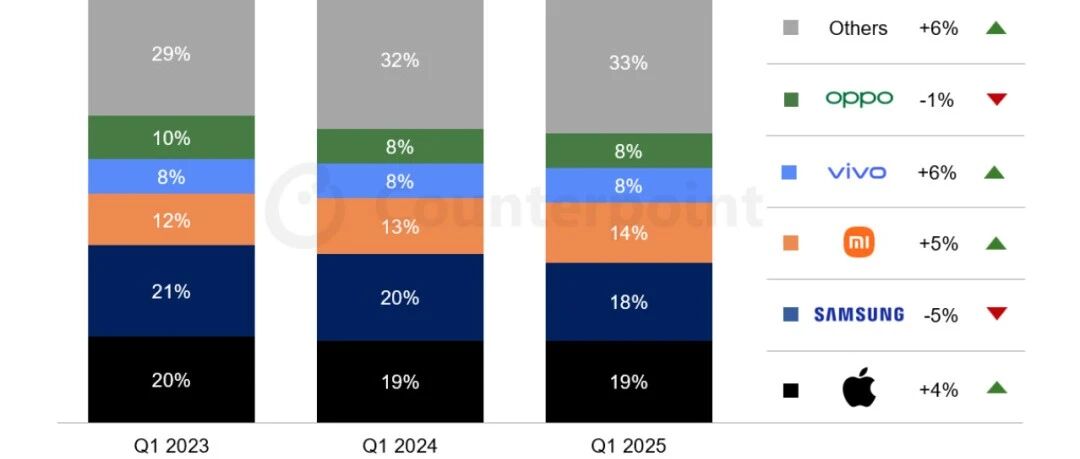
Core Insights - The article discusses the performance of OPPO smartphones in the market, highlighting its growth amidst a general decline in smartphone sales in China [6][10][30]. Group 1: Market Performance - In Q3 2025, China's smartphone sales decreased by 2.7% year-on-year, but OPPO achieved a growth rate of 2.1%, making it the fastest-growing major OEM [6][10]. - OPPO's Reno 14 series has been particularly successful, combining flagship features with mid-range pricing, making it one of the best-selling flagship phones in China after the iPhone 16 series [10][30]. - The overall smartphone market in China is entering an adjustment period, with a 2% decline in sales during the first eight weeks of Q3 2025 [9][29]. Group 2: Regional Insights - In Vietnam, OPPO ranked third in smartphone shipments, benefiting from the Reno 14 series, which supports 5G and offers promotional data incentives [15]. - The Latin American market saw a 4% year-on-year growth in smartphone shipments in Q2 2025, with OPPO leading among Chinese brands in 5G market share [19]. Group 3: Financial Performance - OPPO's average selling price (ASP) increased by 14% year-on-year in Q2 2025, the highest among the top five brands, while its revenue grew by 10% [22]. - Despite a decline in shipment volume, OPPO's revenue growth was driven by high-end models like the Reno 13 series and Find X8 [22][37]. Group 4: Product Strategy - OPPO's product strategy includes a focus on high-end models and a successful launch of the Reno 14 series before major sales events, which helped maintain strong sales momentum [30]. - The OnePlus brand under OPPO has also seen significant growth, targeting tech-savvy male consumers and young audiences with enhanced gaming experiences [30].
高通中国区董事长孟樸:下一个“手机级”市场,藏在机器人与智能眼镜里
Guo Ji Jin Rong Bao· 2025-11-06 06:57
Core Insights - Qualcomm has participated in the China International Import Expo for eight consecutive years, showcasing its commitment to global trade cooperation [1] - The company is recognized as a core technology supplier in the connectivity and computing sectors, with over 3 billion devices powered by Snapdragon chips globally [1] - Qualcomm's business extends beyond mobile phones, with significant investments in 5G, IoT, and automotive electronics, contributing to the global digital economy [1] Qualcomm's Strategic Focus - Qualcomm emphasizes the importance of the Import Expo as a platform for collaboration and innovation with Chinese partners, expanding its product offerings from smartphones to PCs, smart connected vehicles, and IoT [2] - The company has been a key player in China's telecommunications evolution, from 2G to 5G, and aims to ensure Chinese brands are among the first to launch 5G products globally [3] Emerging Technologies and Market Potential - Qualcomm identifies robotics and smart wearable devices, including AR, VR, and AI glasses, as two sectors that could rival or surpass the smartphone market in the future [3] - The company has launched the "Qualcomm Leap" brand to focus on industrial IoT and connectivity solutions, showcasing various IoT applications at the Import Expo [4] AI and XR Integration - The integration of AI and XR technologies is expected to revolutionize user experiences, with China leading in the development of innovative terminal products [4] - Qualcomm's AI initiatives are projected to significantly impact various sectors, with McKinsey estimating AI could contribute an additional $13 trillion to global GDP by 2030 [5][6] Automotive Industry Transformation - The automotive sector is becoming a key area for innovation, with Qualcomm's Snapdragon Digital Chassis supporting over 210 vehicle models from various Chinese brands [7] - The company aims to collaborate with China's automotive industry to accelerate the adoption of advanced technologies and drive deeper smart transformation [7] Future Outlook on 6G - Qualcomm is preparing for the transition from 5G to 6G, emphasizing the integration of AI in future communication technologies [8] - The company envisions 6G as a collaborative innovation platform that will enhance AI applications and connectivity, with commercial terminals expected as early as 2028 [9]


华为Mate70 Air亮相:麒麟9020A/B处理器,4199元起售
Guan Cha Zhe Wang· 2025-11-06 05:20
Core Viewpoint - Huawei's new ultra-thin smartphone, Mate70 Air, has been launched for pre-sale starting at 4199 yuan, featuring the Kirin 9020A/B processor and HarmonyOS 5.1, positioning itself against Apple's iPhone Air [1][3][9] Product Specifications - The Mate70 Air is equipped with either the Kirin 9020A processor with 16GB RAM or the Kirin 9020B with 12GB RAM, differing from the previously launched MateXTs which used the Kirin 9020 processor [3] - The device has a thickness of 6.6mm and weighs approximately 208 grams, compared to the iPhone Air's 5.6mm thickness and 165 grams weight [3] - The screen ratio of Mate70 Air is 18.8:9, closely resembling Huawei's Pura X [5] Competitive Features - Mate70 Air boasts features such as a 6500mAh battery for extended battery life, a "Red Maple Imaging" system with ultra-wide and telephoto lenses, and stereo sound, which are not available in the iPhone Air [5] - However, it sacrifices some specifications compared to the Mate70 Pro series, including the absence of wireless charging and a lower camera configuration [5] Pricing Strategy - The starting price of Mate70 Air is 4199 yuan for the 12GB+256GB version, which is 900 yuan lower than the standard Mate70 and 1600 yuan lower than the Mate70 Pro [5] Market Context - According to Omdia, the Chinese smartphone market saw a 3% year-on-year decline in Q3, with Huawei ranking second in shipments at 10.5 million units, holding a 16% market share, while Apple was the only brand among the top five to show growth [10]

高通:携手生态伙伴共建智能未来
Zheng Quan Shi Bao Wang· 2025-11-06 02:28
Core Insights - Qualcomm showcased its latest collaborative achievements with Chinese industry partners at the 8th China International Import Expo, emphasizing the integration of 5G and AI technologies across various sectors [1][2] - The company is celebrating its 40th anniversary and 30 years in China, aiming to expand its partnerships and enhance the innovation ecosystem in the country [1] - Qualcomm's Snapdragon 8 Gen 2 mobile platform is featured in 12 flagship smartphones from Chinese manufacturers, highlighting the rapid product innovation and collaboration with brands like Xiaomi, Honor, and others [1] - In the automotive sector, Qualcomm's Snapdragon Digital Chassis has supported over 210 models from Chinese automotive brands since 2023, showcasing the expansion of smart technology applications [2] - The launch of the "Qualcomm Leap" brand signifies the company's commitment to industrial IoT and connectivity solutions, with specific applications demonstrated at the expo [2] - The integration of AI, 5G, IoT, and edge computing is transforming lifestyles and production modes, driving industries towards a new phase of digitalization and intelligence [2] - Qualcomm emphasizes the importance of open collaboration and continuous innovation as key drivers for future development, aiming to unlock new opportunities for high-quality industrial growth [2]
国务院关税税则委员会:调整对原产于美国的进口商品加征关税措施;俄总统普京:若美恢复核试验,俄将采取对等反制措施;受政府“停摆”影响,全美40个主要机场运力将削减10%|早报
Di Yi Cai Jing· 2025-11-06 00:19
Group 1 - The Chinese government will adjust tariffs on imports from the United States, suspending a 24% tariff while maintaining a 10% tariff starting from November 10, 2025 [2] - The Ministry of Commerce announced the adjustment of export control lists, stopping measures against 15 U.S. entities while continuing to suspend measures against 16 entities for one year starting November 10, 2025 [5] - The marriage registration in China for the first three quarters of 2025 reached 5.152 million couples, an increase of 405,000 compared to the same period last year [6] Group 2 - In October 2025, retail sales of new energy vehicles in China reached 1.4 million units, a year-on-year increase of 17%, with a cumulative retail of 10.27 million units for the year, up 23% [7] - Beijing plans to establish a special incubation fund for brain-computer interface technology, aiming to create an industrial cluster in Changping District [8] - Shanghai encourages financial institutions to provide targeted financial products for the development of multimodal transport [9] Group 3 - The U.S. Federal Aviation Administration announced a 10% reduction in flight capacity at 40 major airports due to government shutdown impacts [4] - The Chinese football association appointed former national player Shao Jiayi as the new head coach of the national men's football team [11] - The U.S. Senate Republicans rejected President Trump's proposal to end the "filibuster" [12]
双十一手机「摇一摇」广告杀疯了,为何越管却越泛滥?
3 6 Ke· 2025-11-05 23:23
Core Viewpoint - The introduction of the "shake to shake" advertising feature in the Guangzhou Metro app has sparked significant criticism from users due to its intrusive nature, leading to the eventual removal of this feature after public backlash [4][5][6]. Group 1: Advertising Mechanism - The "shake to shake" advertising mechanism is designed to trigger ads when users interact with their phones in specific ways, such as scanning QR codes at metro gates, which has led to user frustration and complaints [4][16]. - Despite the negative reception, this advertising method has proven effective in increasing ad exposure rates, particularly in high-traffic environments like the Guangzhou Metro, which sees around 10 million rides daily [16]. Group 2: Regulatory Response - Regulatory bodies have attempted to address the issues surrounding "shake to shake" ads by establishing standards to prevent automatic ad triggers that do not align with user intent, aiming to protect user rights [5][6]. - The National Cybersecurity Standardization Technical Committee has issued guidelines that specify the conditions under which "shake to shake" ads can be triggered, emphasizing user control and consent [6][12]. Group 3: User Experience and Alternatives - Users have expressed a strong desire for more control over advertising features, with some apps like Bilibili adhering to guidelines by providing options to disable "shake to shake" ads [28]. - For users seeking to avoid intrusive ads, alternatives such as using NFC metro cards or other apps that do not employ such advertising methods are recommended [29][31].