
中国铝业

Search documents
有色金属概念股早盘走低,多股跌超3%
Mei Ri Jing Ji Xin Wen· 2025-12-09 01:48
(文章来源:每日经济新闻) 每经AI快讯,12月9日,有色金属概念股早盘走低,闽发铝业、精艺股份跌超5%,罗平锌电、电工合 金、常铝股份、江西铜业、中国铝业等跌超3%。 ...



有色板块走低 多股跌超3%
Xin Lang Cai Jing· 2025-12-09 01:36
有色金属概念股早盘走低,闽发铝业、精艺股份跌超5%,罗平锌电、电工合金、常铝股份、江西铜 业、中国铝业等跌超3%。 ...
险资持股政策优化9只绩优潜力股获长期持仓
Zheng Quan Shi Bao· 2025-12-08 18:12
为完善保险公司偿付能力监管标准,充分发挥保险资金作为耐心资本的优势,提升服务实体经济质效, 近日金融监管总局发布《关于调整保险公司相关业务风险因子的通知》(以下简称《通知》)。 关于股票投资相关部分,《通知》指出,保险公司持仓时间超过三年的沪深300指数成份股、中证红利 低波动100指数成份股的风险因子从0.3下调至0.27。该持仓时间根据过去六年加权平均持仓时间确定; 保险公司持仓时间超过两年的科创板上市普通股的风险因子从0.4下调至0.36。该持仓时间根据过去四年 加权平均持仓时间确定。 中泰证券指出,2025年三季度末,保险资金投资股票期末余额为3.62万亿元。假设其中沪深300和中证 红利低波动100成份股、科创板股票投资占比分别为40%、5%,同时符合《通知》要求的加权平均持仓 时间标的为20%。据此测算,考虑风险分散效应前静态释放最低资本为326亿元。 据证券时报·数据宝统计,以前十大流通股东为统计范围,截至2025年三季度末,险资持有的个股数量 超过600只,其中持仓超过三年(2022年四季度至2025年三季度)的沪深300指数成份股、中证红利低波 动100指数成份股以及持仓超过两年(2023年 ...
PriceSeek提醒:铝锭现货价格普遍下跌
Xin Lang Cai Jing· 2025-12-08 12:25
华东市场对外报价21920元/吨,华南市场对外报价21810元/吨,西南市场对外报价21840元/吨,中原市 场对外报价21770元/吨;较上一交易日分别下跌170元/吨、160元/吨、160元/吨、170元/吨。 PriceSeek评析 铝,多空评分:-1 文章显示中国铝业铝锭(AL99.70)现货价格在华东、华南、西南、中原市场分别下跌170元/吨、160元/ 吨、160元/吨、170元/吨,跌幅约0.7-0.8%,表明市场供应充足或需求疲软,对现货价格构成一般利空 影响。 【大宗商品公式定价原理】 生意社基准价是基于价格大数据与生意社价格模型产生的交易指导价,又称生意社价格。可用于确定以 下两种需求的交易结算价: 1、指定日期的结算价 生意社12月08日讯 中国铝业股份有限公司2025年12月8日铝锭(AL99.70)现货价格各地区价格下跌,具体如下: C:升贴水,包括物流成本、品牌价差、区域价差等因素。 生意社12月08日讯 中国铝业股份有限公司2025年12月8日铝锭(AL99.70)现货价格各地区价格下跌,具体如下: 华东市场对外报价21920元/吨,华南市场对外报价21810元/吨,西南市场对外 ...


2026年中国再生铝市场分析:随着对低碳铝产品需求旺盛,产量同比增长9.3%[图]
Sou Hu Cai Jing· 2025-12-08 08:08
Core Insights - The report titled "2026-2032 China Recycled Aluminum Market In-Depth Investigation and Investment Prospects Analysis" provides essential reference for decision-makers and investors in the recycled aluminum sector [1][14]. Group 1: Market Overview - The recycled aluminum industry is experiencing continuous capacity expansion, with regions like Guangyuan forming large-scale production clusters, achieving a capacity of 1.6 million tons and processing capacity exceeding 2.2 million tons [7]. - The demand for recycled aluminum is expected to grow, particularly driven by the lightweight trend in the electric vehicle sector, with a projected production increase of 9.3% year-on-year by 2026 [7]. Group 2: Industry Analysis - The report utilizes various data sources, including annual reports from listed companies, manufacturer surveys, and expert validations, to ensure data accuracy and reference value [3]. - The recycled aluminum market is characterized by a competitive landscape, with increasing international competition and a growing strategic importance of aluminum waste resources [11][19]. Group 3: Application and Trends - Recycled aluminum is widely used in various fields, including traditional casting aluminum alloys and increasingly in deformed aluminum alloys and high-end aluminum alloys, providing more development opportunities [10]. - The report outlines the development trends and investment forecasts for the recycled aluminum industry from 2026 to 2032, indicating a broad market outlook and technological advancements [21].

有色ETF基金(159880)冲击4连涨,锂矿概念盘中活跃
Xin Lang Cai Jing· 2025-12-08 06:41
Group 1 - The core viewpoint of the news highlights the strong performance of the non-ferrous metal industry, particularly the lithium sector, with significant price increases in lithium carbonate and a positive outlook for demand driven by electric vehicles and energy storage [1][2]. - The non-ferrous metal industry index (399395) has shown a 0.30% increase, with notable gains in individual stocks such as Yahua Group (6.09%) and Ganfeng Lithium (5.33%) [1]. - Lithium carbonate prices have risen to 92,633.33 yuan/ton, marking a 16.81% increase over the past 30 days and a 26.61% increase over the past 60 days [1][2]. Group 2 - The demand for lithium salts remains robust, supported by the rapid growth of power battery consumption in both commercial and passenger electric vehicle markets, as well as a full order book in the energy storage battery market [2]. - The non-ferrous ETF fund closely tracks the non-ferrous metal industry index, which reflects the overall performance of listed companies in the non-ferrous metal sector [2][4]. - As of November 28, 2025, the top ten weighted stocks in the non-ferrous metal industry index account for 52.34% of the index, with companies like Zijin Mining and Ganfeng Lithium among the leaders [3].

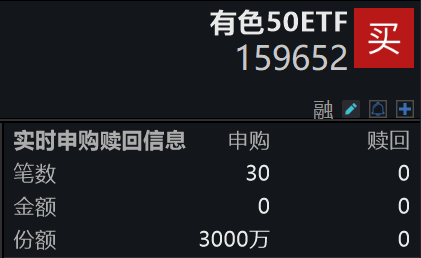
有色板块上扬,赣锋锂业涨超5%,有色50ETF(159652)翻红涨0.64%,盘中净申购超4600万元,机构:工业金属的超级周期或已来临!
Xin Lang Cai Jing· 2025-12-08 06:29
Group 1 - The core viewpoint of the news highlights the recent performance of the non-ferrous metal sector, particularly the rise of the Non-ferrous 50 ETF (159652) and its constituent stocks, indicating a positive market sentiment and potential investment opportunities in this sector [1][2][3]. - As of December 5, 2025, the Non-ferrous 50 ETF has seen a cumulative increase of 4.70% over the past week, ranking it in the top half among comparable funds [1]. - The liquidity of the Non-ferrous 50 ETF is notable, with a turnover rate of 3.73% and a trading volume of 1.27 billion yuan, indicating active market participation [1][2]. Group 2 - The latest scale of the Non-ferrous 50 ETF reached 3.409 billion yuan, marking a one-year high, with a net inflow of 306 million yuan over the past five trading days [2]. - The leverage funds are actively positioning themselves in the Non-ferrous 50 ETF, with a financing buy amount of 5.1882 million yuan and a financing balance of 20.3152 million yuan [2]. - Key constituent stocks such as Tianqi Lithium and Ganfeng Lithium are maintaining stable production and supply, indicating a healthy operational status amidst market fluctuations [2]. Group 3 - Analysts predict a potential easing of short-term supply-demand tensions in lithium carbonate due to seasonal factors and production resumption expectations, with a bullish outlook for the lithium sector in the coming year driven by demand growth [3]. - The expectation of a dovish monetary policy under the new Federal Reserve chair could lead to upward pressure on non-ferrous metal prices, particularly copper and aluminum, due to tightening supply conditions [3][4]. - The industrial metals sector is anticipated to enter a super cycle, with significant price elasticity expected from even minor supply-demand gaps during the interest rate reduction phase [4]. Group 4 - The Non-ferrous 50 ETF is strategically positioned with a high concentration of core commodities such as copper, gold, aluminum, lithium, and rare earths, which are expected to benefit from the ongoing super cycle in non-ferrous metals [4][5]. - The ETF's index has a leading copper content of 33% and gold content of 13%, making it a competitive option in the market [5]. - The ETF has demonstrated superior performance with a cumulative return leading its peers since 2022, alongside a lower maximum drawdown, indicating a favorable investment experience [10][11]. Group 5 - The price increase in the non-ferrous sector is driven by earnings rather than valuation expansion, with the Non-ferrous 50 ETF's index PE ratio at 23.74, reflecting a 61% decrease compared to five years ago, suggesting a high valuation cost-effectiveness [12]. - The index has achieved a cumulative increase of 131%, indicating that the growth is primarily driven by earnings rather than valuation adjustments, currently positioned in an EPS-driven phase [12].
【掘金板块牛熊】直击AI算力痛点 AI硬件流量BUFF加满!有色板块走弱 短期能否有起色?
第一财经· 2025-12-08 05:29
①牛榜 - 直击AI算力痛点!AI硬件流量BUFF加满!CPO板块持续拉升,中际旭创股价创历史新高, 天孚通信涨近10%,通宇通讯、中瓷电子涨停,泰晶科技、腾景科技跟涨。 ②熊榜 - 上周活跃的有色板块走弱,倍杰特、铜陵有色、中国铝业等领跌。短期能否有起色? 市场迷雾重重,还在为抓不住市场热点而焦虑?《掘金板块牛熊》帮你精准把握风格切换信号,带领你 看懂热钱的情绪周期。 每个交易日午间解密当天盘面热点的核心逻辑,《掘金板块牛熊》让你踩准市 场节奏,财富增值不迷路! 前言 点击付费阅读,解密今日盘面热点的核心逻辑! ...
双融日报-20251208
Huaxin Securities· 2025-12-08 02:06
Market Sentiment - The current market sentiment score is 74, indicating a "relatively hot" market condition, with a tendency for the market to enter a consolidation phase as sentiment becomes cautious [4][6]. Hot Themes Tracking - **Non-ferrous Metals**: Demand expectations are boosted by potential US interest rate cuts, with copper prices rising due to financial attributes and supply constraints. Key stocks include Zijin Mining (601899) and China Aluminum (601600) [4]. - **Banking Sector**: Bank stocks offer high dividend yields, with the China Securities Bank Index yielding 6.02%, significantly above the 10-year government bond yield. This makes bank stocks attractive for long-term investors during economic slowdowns. Relevant stocks include Agricultural Bank of China (601288) and Ningbo Bank (002142) [4]. - **AI Mobile Phones**: ZTE has released a limited version of the Nubia M153 smartphone featuring the "Doubao Phone Assistant," aimed at developers and tech enthusiasts. This assistant operates at a system level, allowing for complex command execution. Related stocks include ZTE Corporation (000063) and Guanghetong (300638) [4]. Capital Flow Analysis - **Net Inflow**: The top stocks by net inflow include C-More-U (688795.SH) with 171,088.72 million, followed by BOE Technology Group (000725.SZ) with 91,808.23 million [7]. - **Net Outflow**: The stocks with the highest net outflow include Heertai (002402.SZ) with -192,121.31 million and Sanhua Intelligent Control (002050.SZ) with -100,152.71 million [9]. - **Industry Net Inflow**: The non-ferrous metals industry leads with a net inflow of 105,095 million, followed by the computer sector with 94,326 million [13]. Investment Strategy Recommendations - In a "relatively hot" market, it is advisable to moderately increase investments while being cautious of potential overheating risks [16].





中国材料板块:重申核心观点,首选铝和铜,其次是电池产业链-China Materials_ Reiterating Our Key Calls, Aluminum and Copper Most Preferred, Followed by Battery Chain
2025-12-08 00:41
Summary of Key Points from the Conference Call Industry Overview - The focus is on the materials sector, specifically aluminum, copper, and the battery chain, with a cautious stance on anti-involution sectors [1][2][3]. Core Insights Aluminum - Aluminum is preferred over copper due to underappreciated supply risks, particularly regarding smelting capacity in Indonesia and potential over-optimism in Middle Eastern expansion plans [2]. - Chinese smelter utilization is reported at over 98%, with China being a net importer of aluminum, primarily from Russia [2]. - Apparent consumption and inventory levels for aluminum in China are healthier compared to copper [2]. - Top picks in aluminum include Hongqiao and Chalco H/A [2]. Copper - Demand for copper is weakening as of Q4 2025, with inventory stockpiling observed in both the US and China [3]. - Price expectations for copper may be influenced by anticipated rate cuts into 2026, with long-term bullish sentiment due to potential supply deficits in the next 3-5 years [3]. - Tight global power supply is contributing to positive sentiment for copper [3]. - Zijin Mining's copper and lithium assets are considered undervalued, with a Buy rating maintained [3]. - Among pure copper plays, MMG is preferred over CMOC for better valuation [3]. Battery Chain - The battery chain is viewed as more defensive, with a rally driven by strong expectations for energy storage systems (ESS) [4]. - Caution is advised before the Chinese New Year, as the rally may be mostly priced in [4]. - Defensive names like CATL are preferred into Q1 2026 due to uncertainties in production pipelines and weak EV demand [4]. - Key catalysts to watch include the production pipeline in March 2026, which could shift market sentiment towards companies with higher elasticity [4]. Cement and Steel - Cement and steel sectors are the least preferred, with steel demand supported by exports but facing weaker anti-involution enforcement [5]. - Production cuts in cement are not expected due to profitability among companies, leading to low prices and profits into H1 2026, with potential recovery in H2 2026 [6]. Additional Important Points - The report emphasizes the importance of monitoring the production pipeline and market conditions closely, particularly for aluminum and copper [2][3][4]. - The overall sector ranking is: Aluminum > Copper > Battery > Gold > Battery Materials > Coal > Cement > Steel [1]. - Cross-sector top picks include Hongqiao, Chalco H/A, Zijin Mining H/A, and CATL-A [1].

