
OPPO

Search documents
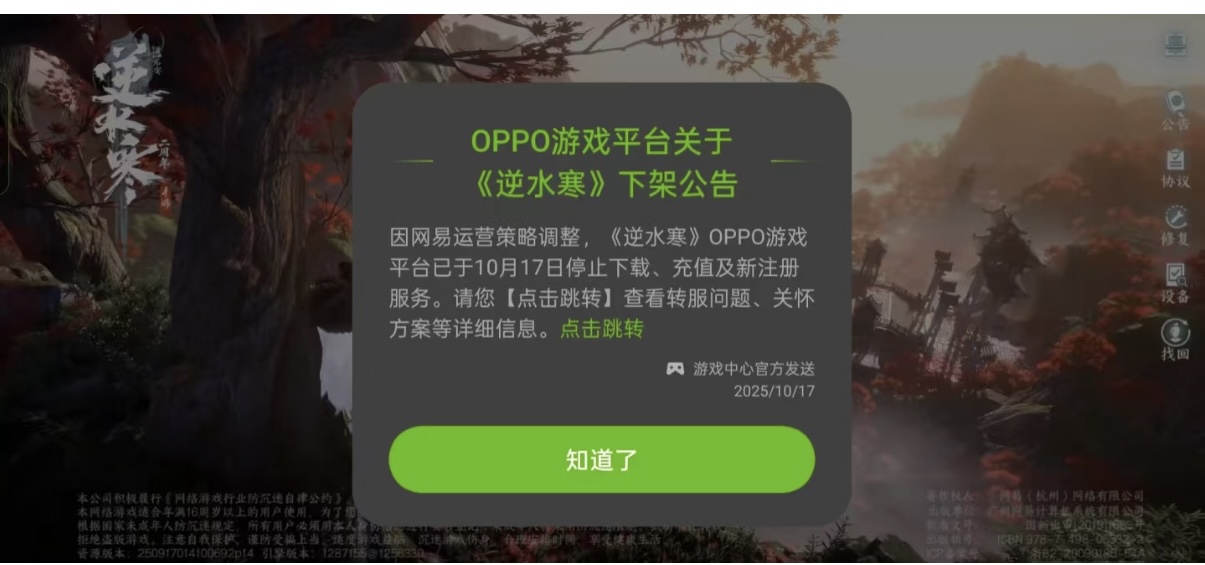
多款游戏下架OPPO渠道,厂商与渠道的博弈进入深水区
Di Yi Cai Jing· 2025-11-05 09:55
Core Viewpoint - The era of channel-based revenue collection is coming to an end, as major game developers like NetEase are increasingly withdrawing their games from OPPO's channel services due to operational strategy adjustments and high revenue-sharing costs [1][4][5]. Group 1: Game Industry Trends - Multiple NetEase games have announced the cessation of their OPPO channel services, including popular titles like "Onmyoji: Yokai House" and "Reverse Water Cold," indicating a broader trend in the gaming industry [1][3]. - Analysts suggest that the withdrawal from channel services is driven by the rising costs associated with Android channels, which have become unsustainable for game developers [3][4]. - The gaming industry is witnessing a shift where developers are moving away from reliance on app store channels for user acquisition, as the contribution of these channels to new user growth diminishes while revenue-sharing ratios remain high [4][5]. Group 2: Developer Strategies - Game developers, including NetEase and Tencent, are confident in their games' appeal and are willing to withdraw from channel services, believing it will not significantly impact user retention [5]. - The trend of high-quality games attracting users through direct downloads rather than through channels is becoming more prevalent, allowing developers to bypass traditional revenue-sharing models [5]. - The "hardcore alliance" formed by major companies like Tencent has led to significant changes in how games are distributed on Android platforms, with developers seeking more favorable terms [4].


魔幻2025:换机热情下滑,“跳级”真能救市?
3 6 Ke· 2025-11-05 09:38
Core Insights - The smartphone market in 2025 is experiencing significant changes, with Xiaomi and Apple adopting contrasting strategies to address consumer behavior and market dynamics [1][3][9] - Xiaomi's launch of the Xiaomi 17 series, directly competing with Apple's iPhone 17, has generated considerable market interest despite initial criticism [1][5] - Apple is reportedly considering skipping the iPhone 19 and launching the iPhone 20, reflecting a shift in high-end smartphone marketing strategies [2][10] Xiaomi's Strategy - Xiaomi's decision to skip the 16 series and launch the 17 series has led to over 20% sales growth compared to the previous generation, with the Pro series seeing sales increase by approximately three times [1][3] - The unique back screen design of the Xiaomi 17 Pro Max has attracted a new user base, showcasing the power of emotional consumption and user-generated content [5][6] - Xiaomi plans to maintain the back screen design in future models and is launching a dedicated short drama app to enhance user engagement and brand loyalty [8][6] Apple's Strategy - Apple has adopted a conservative approach by significantly upgrading the iPhone 17 base model, focusing on value and practicality rather than flashy innovations [9][10] - The decision to potentially skip the iPhone 19 and launch the iPhone 20 is seen as a strategic move to create buzz and signify a shift towards future-focused branding [10][12] - Apple's planned staggered release of new models aims to balance market performance and extend product lifecycle value, reflecting a careful consideration of market dynamics [12][13] Market Trends - The global smartphone market is projected to see only a 1% increase in shipment volume in 2025, but the average selling price is expected to rise by 5%, indicating a shift towards value-driven purchasing [13][14] - The competition between domestic brands and international giants is intensifying, prompting manufacturers to innovate in branding, product design, and marketing strategies [13][14] - The industry is at a critical juncture where understanding consumer psychology and building ecosystems will be essential for future growth [14]


Q3'25国内市场智能手机复材后盖渗透率达15%,同比增长6个百分点
CINNO Research· 2025-11-05 08:58
Core Insights - The penetration rate of composite material back covers in the domestic smartphone market reached 15% in Q3 2025, representing a year-on-year increase of 6 percentage points [2]. Group 1: Market Trends - The report covers the changes in the penetration rates of various materials used for smartphone front and back covers in the Chinese market from Q1 2023 to Q3 2025 [3]. - It provides a detailed analysis of the sales volume and market share of different specifications of smartphone back covers across major brands in China [2][3]. Group 2: Brand-Specific Analysis - The report includes data on the sales volume and market share of Honor smartphones' back cover specifications from Q1 2023 to Q3 2025 [3]. - It also details the brand share of glass back covers in the Chinese smartphone market during the same period [3]. - The analysis extends to the brand share of composite material back covers in the market from Q1 2023 to Q3 2025 [3]. - Additionally, it presents the average price trends of different back cover specifications in the market over the specified period [3]. - Specific brand analyses include sales volume and market share for Apple, Huawei, Vivo, Xiaomi, and OPPO smartphones' back cover specifications from Q1 2023 to Q3 2025 [3].
复旦硕士创业,拿下创纪录4亿融资:打破日企20年垄断、年增速600% |36氪首发
3 6 Ke· 2025-11-05 01:24
Financing Information - Zhejiang Zhongling Technology Co., Ltd. has recently completed a C-round financing of over 400 million RMB, marking the largest single financing round in the domestic FMM industry [1] - The leading investor is Shenzhen Capital Group, with participation from China Jianyin Investment, Yida Capital, Guangdong Science and Technology Finance, and others [1] - 50% of the funds will be used for R&D, 30% for G8.6 generation FMM capacity expansion and overseas market layout, and 20% for working capital and IPO reserves [1] Company Overview - Established in September 2020, the company is located in Haining, Zhejiang Province [1] - The company is the only domestic entity capable of mass production of 20μm FMM products, with a 100% domestic supply chain for Invar materials [2] Market Potential - The global FMM market is nearly 10 billion RMB, with over 90% of the market share historically dominated by Japanese company DNP [5] - The shift towards larger OLED displays in products like tablets and laptops presents significant opportunities for domestic FMM production [5] Company Performance - Revenue has grown from millions in 2022 to several hundred million in 2023, with projections to exceed 1 billion in 2024 and double by 2025, indicating an average growth rate of nearly 600% [6] - The company holds over 60% of the domestic FMM market share and has validated its products with major AMOLED panel manufacturers [6] Technical Capabilities - The core team consists of experienced professionals from leading semiconductor panel manufacturers, covering the entire supply chain from Invar material development to mass production testing [7] - The company has achieved mass production of 20μm FMM, supporting flagship products like the Xiaomi 17 Pro Max [4] Strategic Goals - The company aims to launch an 18μm ultra-thin FMM product by 2026, with a commitment to continuous product iteration [14] - Plans to capture over 50% of the domestic FMM market and expand into international markets starting in 2025 [14] New Business Development - The company is exploring new business opportunities in the semiconductor and renewable energy sectors, particularly in the printing materials for photovoltaic cells [15] Investment Perspective - Deep Venture Capital views Zhongling Technology as a key player in breaking the long-standing Japanese monopoly in the OLED FMM market, highlighting its potential for future growth and technological advancement [17]


应聘者被骂「吃的不如狗」?格力回应;市占率存疑?影石回应市占率下滑及大疆价格战;零跑汽车辟谣将被一汽集团收购:消息不实丨雷峰早报
雷峰网· 2025-11-05 00:48
Key Points - Gree Electric responded to a viral incident involving a job applicant being insulted by a recruiter, clarifying that the individual was not an employee and that the company will pursue legal action against the unauthorized recruitment group [4][5] - Yingshi Innovation addressed concerns about its market share decline due to DJI's price war, stating that competition can expand the market and that their global market share remains strong according to some reports [7] - Gaode is reportedly entering the Robotaxi business in collaboration with XPeng Motors, which is also reviving its own Robotaxi project [8][9] - Tiantong Weishi has submitted its IPO application in Hong Kong, backed by major investors including SAIC and SenseTime, and is positioned as a leading provider of intelligent driving solutions [11][12] - Leap Motor denied rumors of being acquired by FAW Group, asserting that the information is false [14] - Apple has prohibited offline distributors from selling products online to maintain pricing integrity ahead of the "Double 11" shopping festival [6][15] - OPPO's channel has reportedly stopped several NetEase games due to the expiration of their partnership [16] - Horizon's former president has recruited a key executive from Didi's autonomous driving division to lead a new venture focused on embodied intelligence [18] - Nokia plans to delist from the Paris Stock Exchange, citing low trading volume and high administrative costs [19] - WeRide and Pony.ai have set their IPO prices ahead of their listings in Hong Kong, with WeRide aiming to raise approximately HKD 29.32 billion [20][21] - Bilibili denied rumors that users could block ads by blacklisting specific accounts, stating that the claims are false [25] - Xiaomi's CEO emphasized the company's commitment to rigorous vehicle testing, claiming their testing efforts exceed industry averages [27][28] - BYD is set to launch a new two-door convertible sports car, the Tengshi Z, which features advanced suspension technology [29][30] - TikTok sellers in the U.S. are facing account suspensions due to compliance checks, raising concerns about platform stability [32] - Apple has launched a web version of the App Store, allowing users to browse applications without needing Apple devices, although downloads are not yet supported [34][35] - IBM is planning layoffs affecting approximately 2,700 employees as part of a broader trend in the tech industry towards automation and AI [36] - Tesla's major shareholder opposed Elon Musk's proposed $1 trillion compensation plan, raising concerns about its scale and potential dilution [37][38] - OpenAI has signed a $38 billion cloud computing deal with AWS, ending its exclusive partnership with Microsoft [38][39] - Amazon brands are significantly increasing their inventory on AliExpress ahead of the Double 11 shopping event [40][41] - Apple is reportedly outsourcing the development of its AI model for Siri to Google, aiming to enhance its capabilities [42]

10月出海活动回顾:中东出海机遇在哪些行业?
吴晓波频道· 2025-11-05 00:29
Core Insights - The article emphasizes the importance of Chinese companies accurately capturing growth opportunities in overseas markets, particularly in the Middle East, by avoiding blind expansion and focusing on specific sectors [2][4]. Group 1: Market Opportunities - The Gulf Cooperation Council (GCC) countries, particularly Saudi Arabia and the UAE, are highlighted as key target markets for Chinese enterprises due to their high GDP per capita, exceeding three times the world average, and a young population [4][5]. - In 2024, Saudi Arabia is projected to attract foreign direct investment (FDI) of 119 billion RMB, a 24% increase year-on-year, while the UAE's FDI is expected to grow by 48%, reaching a historical high [6]. - The core opportunities in these markets are concentrated in infrastructure, digitalization, and renewable energy, with Chinese state-owned enterprises actively bidding for local projects [7]. Group 2: Consumer Market Dynamics - The consumer market in the region is described as a pyramid structure, with high-end luxury goods targeting wealthy individuals and low-cost daily necessities aimed at foreign laborers, indicating limited space for middle-class products [8]. - The UAE, particularly Dubai, is characterized as a trade and financial hub, with a significant Chinese business presence, including over 8,000 Chinese companies [8][10]. Group 3: Strategic Considerations for Chinese Enterprises - Chinese companies are advised to conduct thorough country selection and internal/external assessments before entering the Middle Eastern market, ensuring compliance and establishing efficient operational teams [11]. - The article notes that successful Chinese brands like Huawei, OPPO, and BYD have already established a presence in the region, indicating a positive reception for Chinese products [10]. Group 4: Upcoming Events and Focus Areas - The article outlines a series of closed-door meetings organized by the Huashang Outbound Industry Alliance, focusing on various overseas markets, including the U.S., Indonesia, and Mexico, to provide practical guidance for companies looking to expand internationally [15][18][21].

8点1氪:上海民政局回应夜店登记结婚争议;用学生跳楼出题,作业帮回应;江西通报“多地办电话卡需无犯罪证明”
36氪· 2025-11-05 00:10
Group 1 - Shanghai Civil Affairs Bureau clarified that the marriage registration must be done at the Huangpu District Civil Affairs Bureau, not at INS New Paradise, and there is no registration process on-site [3] - Nokia plans to apply for delisting from the Paris Stock Exchange, continuing to be listed on the Helsinki Nasdaq and the New York Stock Exchange [4] - The 2026 holiday schedule has been announced, with the Spring Festival holiday lasting 9 days, marking the longest holiday in history [5] Group 2 - The Ministry of Education in Sichuan has implemented a spring and autumn break for primary and secondary schools, allowing for flexible arrangements based on local conditions [12] - Coupang reported a 51% increase in operating profit for Q3, driven by strong performance in product commerce and new business sectors [21] - Evonik's Q3 sales decreased by 12% year-on-year, with an expected continued weak market demand until the end of the year [21] Group 3 - Apple has issued a notice prohibiting offline distributors in China from selling products online, aiming to maintain price stability [9] - The "private shipping king" Ren Yuanlin's restructuring plan for the Shanshan Group was rejected at the last moment due to irreconcilable demands from various parties [10] - Hippocratic AI raised $126 million in its latest funding round, achieving a valuation of $3.5 billion [19]


不上不下的中端手机,正陷入“进退两难”
3 6 Ke· 2025-11-04 23:53
Core Insights - The global smartphone market is experiencing a rebound, with sales growth of approximately 4% to 7% year-on-year, primarily concentrated in high-end and low-end segments, while the mid-range market is losing growth opportunities [1][3] - The mid-range segment, which includes 500 million users in China, is highly competitive, with brands focusing on high performance and cost-effectiveness [1][4] - The shift from an incremental to a saturated market is evident, as the average selling price of smartphones is projected to be $356 in 2024, while 70% of consumers are resistant to price increases [3][4] Market Dynamics - The mid-range smartphone market is under unprecedented pressure due to the influx of new models, with 396 new models expected in 2024, most of which are mid-range [4][6] - Price wars are intensifying, leading to a decline in the perceived value of mid-range devices, as many models are seeing price reductions of 200 to 400 yuan compared to previous generations [7][9] - High-end smartphones are also reducing prices, further eroding the competitive edge of mid-range devices, as consumers can access high-end features at lower prices [8][9] Consumer Behavior - Consumers are increasingly price-sensitive, preferring low-cost practical options or being attracted to discounted high-end models, which complicates the mid-range market's dynamics [9][10] - The gaming segment is becoming a focal point for mid-range brands, with several new models emphasizing gaming performance to attract younger consumers [10][12] - The demand for smartphones among younger users is growing, with a significant portion of the market being captured by brands that cater to gaming and social media needs [12][13] Profitability Challenges - Despite a stable production increase in the smartphone industry, profitability is declining, with major brands like Xiaomi and Huawei reporting significant drops in profit margins [14][15] - Rising component costs, particularly for memory chips, are squeezing margins, leading to a dilemma where brands must choose between raising prices or absorbing costs [16][20] - Companies are exploring strategies to enhance product value through technology investments and expanding user bases to offset rising costs [21][22]

“非洲手机之王”三季度净利降45%
Nan Fang Du Shi Bao· 2025-11-04 23:12
Core Insights - The company, Transsion Holdings, reported significant revenue growth in Q3 2025, reaching 20.466 billion RMB, a year-on-year increase of 22.60%. However, this revenue growth did not translate into profit, with net profit attributable to shareholders declining by 11.06% to 0.935 billion RMB, indicating a situation of "increased revenue but decreased profit" [2][4] - Over the first three quarters of 2025, the company faced intensified profit pressure, with total revenue of 49.543 billion RMB, a slight decrease of 3.33% year-on-year, and net profit down by 44.97% to 2.148 billion RMB [2][4] Revenue and Profit Analysis - The Q3 report highlighted a stark contrast in profitability, with net profit for the first three quarters of 2025 significantly down by 44.97% compared to the previous year, while the net profit excluding non-recurring gains and losses fell by 46.71% to 1.731 billion RMB [4][5] - The company attributed the decline in total profit and net profit to increased market competition and supply chain costs, which led to reduced revenue and gross profit [4][5] Market Competition - Transsion Holdings is facing fierce competition in its primary market, Africa, with Xiaomi and other Chinese brands aggressively targeting its market share. Xiaomi's market share in Africa rose to 13.8%, a 2.6 percentage point increase year-on-year [5][6] - Other competitors, including Honor, Samsung, OPPO, and vivo, are also expanding their presence in the African market, further squeezing Transsion's market space [5][7] Cash Flow and R&D Investment - Despite the pressure on profits, the company reported a remarkable increase in operating cash flow, with a net cash flow from operating activities of 3.285 billion RMB, up 164.66% year-on-year [8][9] - The company has also increased its R&D investment by 17.26% to 2.139 billion RMB in the first three quarters of 2025, indicating a strategic focus on innovation and product upgrades [8][9][10] - In Q3 alone, R&D spending reached 777 million RMB, a year-on-year increase of 21.22%, reflecting the company's commitment to strengthening its competitive position through technological advancements [10]


AI手机发展重心转向端侧 移动终端生态迎变革
Zheng Quan Shi Bao· 2025-11-04 17:51
Core Insights - The future of mobile technology is predicted to see the disappearance of traditional smartphones and apps within the next 5-6 years, with AI assistants becoming the main interface for human-computer interaction [1] - Mobile companies are shifting their focus from cloud collaboration to edge computing, enhancing AI capabilities directly on devices [3][4] Group 1: AI Development Trends - The rise of generative AI, particularly after the success of ChatGPT, has led mobile companies to invest heavily in AI technologies, with the first AI smartphones launched in late 2023 [2] - Companies like vivo and OPPO are prioritizing edge models, with vivo introducing a 3B (30 billion parameters) edge multimodal inference model, moving away from large cloud models [3][5] Group 2: User-Centric AI - Edge models are designed to create personalized data models based on user data, ensuring privacy and efficiency, which is crucial for personalized intelligence [4][10] - The integration of AI into user habits is emphasized, with companies like vivo implementing seamless AI features that operate without user intervention [6][7] Group 3: Ecosystem Transformation - The shift towards edge computing will redefine the mobile ecosystem, with companies aiming to control user data and flow to third-party applications [7][8] - Huawei has established an AI collaboration ecosystem through its HarmonyOS, while other companies like OPPO and Honor are also developing their own AI ecosystems [8] Group 4: Challenges Ahead - The transition to edge AI faces challenges, including compatibility between cloud and mobile architectures, as well as the need for sufficient device power and memory [9][10] - The core value of edge AI lies in its ability to access private user data, which is a significant differentiator from traditional apps [10][11]