宁德时代

Search documents
固态电池-全面看好无负极路线
2026-02-11 05:58
Summary of Conference Call on Solid-State Battery Technology Industry Overview - The focus is on the solid-state battery industry, particularly the development of anode-free battery technology which offers higher energy density and lower costs compared to traditional lithium-ion batteries [1][2]. Key Points and Arguments - **Energy Density and Cost Advantages**: Anode-free batteries can achieve energy densities of 650 Wh/kg and 1,300 Wh/L, significantly outperforming traditional lithium-ion batteries [1][6]. - **Technological Advancements**: - CATL (宁德时代) is advancing self-generating anode technology, enhancing battery performance. - BYD is integrating a porous sponge-like structure to improve current collector performance in solid-state batteries [1][2][3]. - **Challenges**: The technology faces issues such as lithium dendrite formation and dead lithium, which are being addressed through current collector improvements, electrolyte optimization, and artificial SEI (Solid Electrolyte Interphase) membrane construction [1][4][8]. - **Market Position**: - CATL and BYD are leading the charge in the application of anode-free technology, with CATL's technology already in use in their products. - BYD has made progress in reducing kinetic barriers for lithium ions, ensuring preferential deposition at the bottom [2][7]. Additional Important Content - **Current Collector Improvements**: The most challenging aspect of anode-free technology is the enhancement of current collectors, with Zhongyi Technology (中一科技) leading in this area by producing ultra-thin copper foils that suppress lithium dendrite growth [9]. - **Market Potential**: If the modified current collector price is 8 RMB/m² and the national 100GWh capacity penetration rate reaches 10%, Zhongyi Technology could contribute over 500 million RMB in performance, corresponding to a market value of approximately 15 to 20 billion RMB [10]. - **Investment Opportunities**: The lithium battery industry is currently focused on battery and separator sectors, with recommendations for CATL and Xinwangda. The separator industry is expected to see price increases in the second half of 2026 due to high capacity utilization [12]. Companies to Watch - **Top Picks**: Zhongyi Technology is highlighted as a key player, along with companies related to calcium-based acid production and electrolyte manufacturers like Xiapu New Energy and Guoci Boyue [11].


小米旗下瀚星创投等入股曦诺未来
Sou Hu Cai Jing· 2026-02-11 05:48
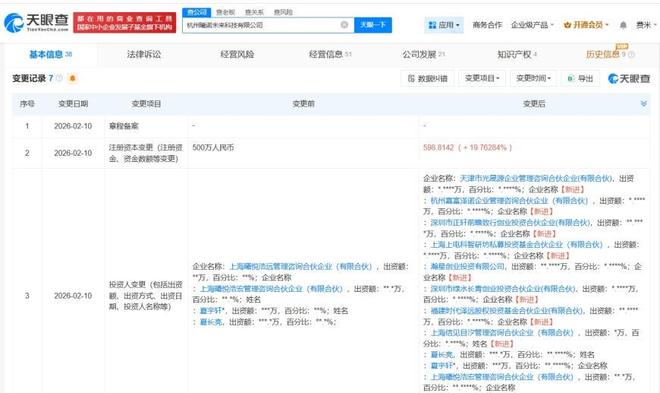
官网显示,该公司是一家人形机器人领域的核心零部件供应商。 2月11日,天眼查App显示,近日,杭州曦诺未来科技有限公司发生工商变更,新增小米旗下瀚星创业 投资有限公司、宁德时代参投的福建时代泽远股权投资基金合伙企业(有限合伙)等为股东,同时,注 册资本由500万人民币增至约598.8万人民币。 杭州曦诺未来科技有限公司成立于2024年12月,法定代表人为夏宇轩,经营范围包括智能机器人的研 发、智能机器人销售、工业机器人制造等。股东信息显示,该公司现由夏长亮、夏宇轩及上述新增股东 等共同持股。 ...

宁德时代,拟发行不逾50亿科技创新公司债券,中信建投证券牵头承销
Xin Lang Cai Jing· 2026-02-11 05:42
Core Viewpoint - CATL (Contemporary Amperex Technology Co., Limited) plans to publicly issue technology innovation corporate bonds to professional institutional investors in mainland China, with a total issuance amount not exceeding 5 billion RMB, aimed at project construction, working capital supplementation, and repayment of interest-bearing liabilities [2][12]. Group 1: Bond Issuance Details - Issuer: CATL New Energy Technology Co., Ltd. [3] - Bond Name: "CATL New Energy Technology Co., Ltd. 2026 Public Issuance of Technology Innovation Corporate Bonds (First Phase)" with the short name "26CATLK1" [3][13]. - Issuance Scale: The bond issuance scale is not exceeding 5 billion RMB (including 5 billion RMB) [4][14]. - Bond Term: The bond has a term of 5 years, with an issuer's option to adjust the coupon rate at the end of the third year and an investor's put option [4][14]. - Face Value: The bond has a face value of 100 RMB [5][15]. - Issuance Price: The bond will be issued at par value [6][16]. Group 2: Bond Characteristics - Credit Enhancement: The bond is unsecured [7][17]. - Bond Form: The bond is a registered book-entry corporate bond, with custody recorded in accounts opened at the securities registration agency [7][17]. - Interest Rate: The bond will have a fixed interest rate determined through offline inquiry and book-building, with annual simple interest calculation [7][17]. - Interest Rate Adjustment: The interest rate will remain fixed for the first three years; if the issuer exercises the adjustment option, the rate for the remaining two years will be adjusted based on the previous rate plus or minus a certain basis point [7][17]. Group 3: Issuance Process - Issuance Method: The bond will be issued through offline inquiries to professional institutional investors, with allocation based on book-building results [7][17]. - Target Investors: The bond is aimed at professional institutional investors with A-share accounts opened at the Shenzhen branch of China Securities Depository and Clearing Corporation Limited, excluding those prohibited by law [7][17]. - Underwriting Method: The bond will be underwritten by the lead underwriter on a balance underwriting basis [8][18].


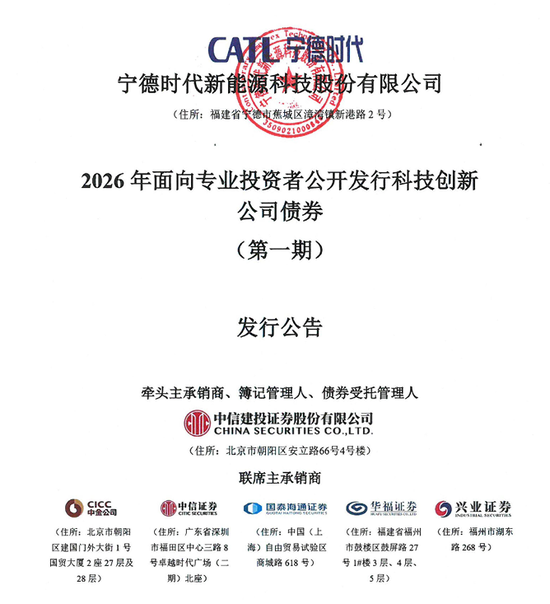
原宁德时代执行总裁朱威“跳槽”地平线,余凯:因为共同的事业和愿景走到一起
Xin Lang Cai Jing· 2026-02-11 05:18
2026年2月9日,地平线与宁德时代旗下子公司——宁德时代(上海)智能科技有限公司(以下简称"时 代智能")签署战略合作协议。双方将聚焦新能源汽车智能化升级需求,以"高智能、高安全的智能出行 体验"为目标,为全球整车企业与终端用户提供卓越的智能化出行体验。 值得一提的是,本次战略合作协议签署仪式由地平线总裁朱威,时代智能董事总经理杨汉兵代表双方公 司签约。而这也是地平线新任总裁朱威首次公开亮相。 对此,地平线创始人CEO余凯微博发文表示,因为共同的事业和愿景走到一起! 据了解,朱威本科毕业于中国科学技术大学精密仪器专业,并拥有耶鲁大学商学院MBA学位。曾在宁 德时代任职8年,担任执行总裁,负责乘用车以及海外储能业务。此前曾任法雷奥中国区副总裁,负责 汽车舒适及辅助驾驶业务。 责任编辑:李思阳 2026年2月9日,地平线与宁德时代旗下子公司——宁德时代(上海)智能科技有限公司(以下简称"时 代智能")签署战略合作协议。双方将聚焦新能源汽车智能化升级需求,以"高智能、高安全的智能出行 体验"为目标,为全球整车企业与终端用户提供卓越的智能化出行体验。 值得一提的是,本次战略合作协议签署仪式由地平线总裁朱威,时代智能 ...
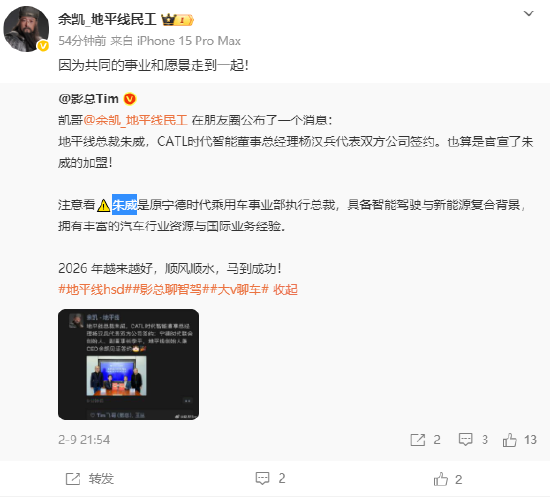
宁德时代50亿元公司债券已获批复
Sou Hu Cai Jing· 2026-02-11 04:58
Core Viewpoint - Contemporary Amperex Technology Co., Limited (CATL) has received approval from the China Securities Regulatory Commission (CSRC) for the issuance of corporate bonds totaling up to RMB 5 billion, aimed at professional institutional investors [1] Group 1: Bond Issuance Details - The bond issuance is registered under the name "26CATLK1" with the bond code "524672" [1] - Each bond has a face value of RMB 100, with an issuance price also set at RMB 100 per bond [1] - The bonds have a maturity period of 5 years, featuring an issuer's option to adjust the coupon rate at the end of the third year and an investor's put option [1] Group 2: Interest Rate Information - The coupon rate inquiry range for the bonds is set between 1.60% and 2.20% [1]
宁德时代入股260亿锂电上市公司!
起点锂电· 2026-02-11 04:52
Core Viewpoint - Yongtai Technology plans to acquire a 25% stake in Yongtai High-tech from CATL through a share issuance, aiming to enhance its lithium battery materials business and improve profitability [2][4]. Group 1: Acquisition Details - The acquisition will make Yongtai High-tech a wholly-owned subsidiary of Yongtai Technology, while CATL will become a shareholder of the listed company [4]. - Yongtai Technology currently holds a 75% stake in Yongtai High-tech, which specializes in lithium battery materials such as lithium hexafluorophosphate and lithium bis(fluorosulfonyl)imide [5]. Group 2: Financial Performance - Yongtai High-tech's revenue fluctuated significantly, with reported revenues of 779 million yuan in 2021 and 1.454 billion yuan in 2022, but dropped to 639 million yuan in 2023 and is expected to decline further to 457 million yuan in 2024 [8]. - The company faced net losses of 325 million yuan in 2023 and 154 million yuan in 2024, but is projected to reduce losses to between 25.6 million and 48.6 million yuan in 2025, a decrease of over 90% compared to the previous year [8]. Group 3: Market Dynamics - The demand for lithium battery materials surged due to the rapid growth in the electric vehicle and energy storage markets, leading to significant increases in sales and prices of core products [9]. - The price of lithium hexafluorophosphate saw a dramatic increase from around 60,000 yuan per ton to 180,000 yuan per ton within a few months, marking a rise of over 280% [8]. Group 4: Strategic Implications - The acquisition is expected to maximize shareholder value by integrating assets at a reasonable price, while also enhancing collaboration with CATL in technology development and market expansion [9]. - CATL's investment aims to secure a stable supply of electrolyte materials and mitigate price volatility, reinforcing its long-term partnership with Yongtai Technology [10]. Group 5: Industry Trends - The transaction reflects a trend of consolidation at the bottom of the lithium battery supply chain, with leading companies strengthening collaboration through capital ties [13]. - CATL has invested in numerous suppliers across various segments of the lithium battery industry, creating a comprehensive ecosystem known as the "CATL system" [13].

博世“痛苦之年”的中国亮色
Xin Lang Cai Jing· 2026-02-11 04:49
Core Insights - Bosch is experiencing a challenging fiscal year in 2025, with a significant drop in profit margins due to high transformation costs and sluggish growth in the automotive sector [3][7] - The company reported total sales of €91 billion, a slight increase of 0.8%, while EBIT plummeted by 45% to €1.7 billion, resulting in a profit margin of approximately 2% [5][8] - The Chinese market is emerging as a critical support for Bosch's transformation, contributing about 20% to total revenue with a growth rate of 4.9% [6][26] Financial Performance - Total sales for fiscal year 2025 reached €91 billion, up from €90.3 billion in 2024, reflecting a 0.8% increase, with a real growth rate of 4.2% after currency adjustments [5] - EBIT decreased from €3.1 billion in 2024 to €1.7 billion in 2025, marking a 45% decline [5][8] - The EBIT margin fell to approximately 2%, significantly below the 3.5% margin in 2024 and the long-term target of 7% [5][8] Transformation Challenges - The decline in profit margins is attributed to three main factors: the costs associated with restructuring and layoffs, adverse global economic conditions, and sustained high R&D investments [8][9] - Bosch has set aside approximately €2.7 billion for restructuring and severance, which has heavily impacted current profits [8] - The company is undergoing a significant workforce reduction, planning to cut around 13,000 jobs between 2025 and 2030 to maintain desired profit margins [8][11] Market Position and Competitiveness - Despite the challenges, Bosch maintains a strong position in core automotive components, particularly in chassis control and powertrain systems, with a robust order book of €10 billion in advanced driver assistance systems and sensor technologies [9][10] - Bosch's competitive advantages include its deep expertise in vehicle mechanics and large-scale manufacturing capabilities, which are difficult for competitors to replicate [10] - The company faces increasing competition from new entrants in the battery and software sectors, which are reshaping the automotive landscape [16][17] Strategic Focus on China - Bosch's strategy of "In China, for the World" emphasizes leveraging China's rapid innovation and efficiency in the automotive supply chain to drive global competitiveness [6][27] - In 2025, Bosch's sales in China reached approximately €14.98 billion, with the smart mobility segment growing by 6.2%, outperforming global averages [26][28] - The company aims to utilize its experiences and innovations from the Chinese market to enhance its global operations and support the internationalization of Chinese automakers [27][28]

小米旗下瀚星创投等入股曦诺未来 后者为人形机器人零部件供应商
Jin Rong Jie· 2026-02-11 04:08
Core Viewpoint - Hangzhou Xinuo Future Technology Co., Ltd. has undergone a business change, adding new shareholders including Xiaomi's Huanxing Venture Capital and CATL's Fujian Times Zeyuan Equity Investment Fund, while increasing its registered capital from 5 million RMB to approximately 5.988 million RMB [1]. Company Information - Hangzhou Xinuo Future Technology Co., Ltd. was established on December 24, 2024, with Xia Yuxuan as the legal representative. The company focuses on the research and development, sales, and manufacturing of intelligent robots, particularly in the humanoid robot sector [1][2]. - The company is identified as a core component supplier in the humanoid robot field, indicating its strategic position within the robotics industry [1]. Shareholder Structure - The current shareholders include Xia Changliang, Xia Yuxuan, and the newly added shareholders, which reflect a diversified investment base [1]. - The new shareholders include significant players in the technology and energy sectors, which may enhance the company's growth potential and market reach [1].

商汤科技进入MSCI中国指数,成为港股首家被纳入该指数的AI企业
Jin Rong Jie· 2026-02-11 03:49
Group 1 - The core viewpoint of the news is that SenseTime has been included in the MSCI China Index, marking a significant recognition of its value in the global AI sector and attracting international passive investment [1][2][4] - SenseTime's stock price surged by 11.39% to HKD 2.64 per share on the day the MSCI announcement was made, indicating strong market interest [1] - The inclusion in the MSCI China Index is seen as a validation of SenseTime's competitive advantages and long-term value, as the index is a key benchmark for global capital allocation [2][4] Group 2 - SenseTime's strategic advantage lies in its "big device - big model - application" integrated approach, which differentiates it from competitors that focus solely on models or applications [3] - The company's recent financial report indicates that its generative AI revenue is expected to rise significantly, reaching 77% by mid-2025, with projections of 91% by 2030 according to Goldman Sachs [3] - The MSCI index adjustment could lead to a substantial reallocation of funds, as over USD 17 trillion in assets are benchmarked to MSCI indices, with passive funds exceeding USD 2 trillion [4] Group 3 - The inclusion of SenseTime in the MSCI China Index signifies its core position in the AI industry, potentially attracting a broader base of long-term value investors [4] - SenseTime's addition to the index aligns it with other major tech companies like Tencent and CATL, highlighting its technological strength and governance standards [4] - The current narrative around AI development is largely defined by Western entities, and companies like SenseTime are expected to gradually shape the future global technology landscape [5]
北京经开区接到“零碳KPI”,如何建成零碳园区?
2 1 Shi Ji Jing Ji Bao Dao· 2026-02-11 03:49
Core Insights - The Beijing Economic-Technological Development Area (BDA) aims to establish around 100 national-level zero-carbon parks during the 14th Five-Year Plan, with a focus on the new energy and intelligent connected vehicle industries [1][3] - A significant challenge is the current carbon emission intensity of 1.6 tons of CO2 per ton of standard coal, which is far above the national requirement of 0.2 tons [2][4] - The BDA plans to implement an AI-powered energy-carbon management platform to optimize energy and carbon flow management [1][10] Group 1: Current Challenges - The BDA's carbon emission intensity must decrease from 1.6 to 0.2 tons of CO2 per ton of standard coal, requiring a reduction of approximately 140,000 tons of carbon emissions over three years [2][4] - The energy consumption in the core area is projected to reach 303 million tons of standard coal in 2024, a 4.75% increase from the previous year, primarily due to the production of Xiaomi vehicles [2][3] - The BDA's carbon emissions decreased by 24.61% during the 13th Five-Year Plan, with a current energy structure of 75% electricity and 25% natural gas [2][3] Group 2: Renewable Energy Supply Issues - The BDA faces a critical challenge in sourcing renewable energy, as local generation meets less than 5% of its electricity needs, while the zero-carbon park requires at least 50% direct renewable energy connection [6][7] - Plans to import green electricity from Inner Mongolia and Hebei are complicated by long transport distances and technical challenges [6][7] - Projects such as agricultural solar power bases and biomass waste-to-energy initiatives are being explored to enhance local green electricity supply [6][7] Group 3: Cost and Infrastructure Challenges - The cost of replacing fossil fuels poses a significant challenge, with projected electricity consumption expected to double by 2028 due to expansions by companies like Xiaomi and CATL [7][8] - The BDA aims to reduce natural gas consumption from 27.72% to 10.67% by 2028, but the high costs of electric boilers compared to gas boilers hinder this transition [7][8] - The approval process for large-scale energy storage projects has stalled, impacting the ability to stabilize the grid with renewable energy [8][9] Group 4: Strategic Roadmap - The BDA has outlined a three-step roadmap from 2026 to 2028, focusing on energy efficiency improvements, green electricity initiatives, and the development of an AI-driven energy-carbon management platform [10][11] - The year 2026 will focus on energy-saving preparations and pilot projects, while 2027 will emphasize breakthroughs in green electricity connections [10][11] - By 2028, the goal is to integrate energy-saving and carbon reduction with industrial development, achieving the core carbon emission target [10][11]