光明肉业

Search documents
食品加工板块9月24日跌0.16%,味知香领跌,主力资金净流出5.67亿元
Zheng Xing Xing Ye Ri Bao· 2025-09-24 08:39
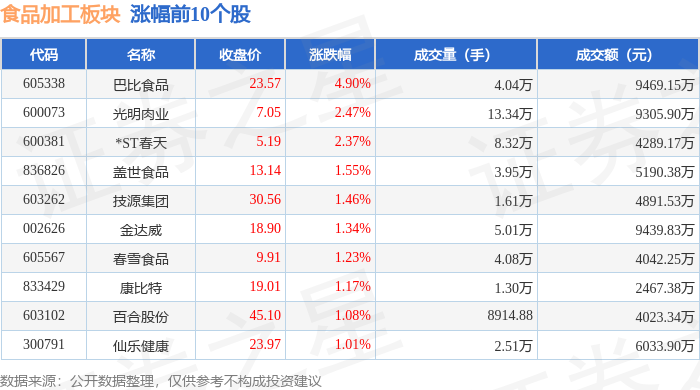
Core Insights - The food processing sector experienced a slight decline of 0.16% on September 24, with Weizhi Xiang leading the drop [1][2] - The Shanghai Composite Index closed at 3853.64, up 0.83%, while the Shenzhen Component Index closed at 13356.14, up 1.8% [1] Stock Performance - Notable gainers in the food processing sector included: - Baba Foods (605338) with a closing price of 23.57, up 4.90% [1] - Guangming Meat (600073) at 7.05, up 2.47% [1] - ST Chuntian (600381) at 5.19, up 2.37% [1] - Conversely, Weizhi Xiang (605089) closed at 28.11, down 1.54% [2] - The sector saw a total trading volume of 5.67 billion yuan in net outflow from major funds, while retail investors contributed a net inflow of 2.49 billion yuan [2][3] Fund Flow Analysis - Major funds showed a net outflow of 5.67 billion yuan, while speculative funds had a net inflow of 3.18 billion yuan [2] - Retail investors contributed a net inflow of 2.49 billion yuan [2] - Specific stock fund flows included: - Guangming Meat (600073) with a net inflow of 17.05 million yuan from major funds [3] - Jindawi (002626) with a net inflow of 11.20 million yuan from major funds [3] - Xianle Health (300791) had a net inflow of 2.03 million yuan from retail investors [3]


牛专题深度:肉牛超级大周期、奶牛去化:进展到哪儿?
Tianfeng Securities· 2025-09-23 07:14
Industry Rating - The industry rating is maintained at "Outperform the Market" [2] Core Insights - The dairy sector is experiencing a significant supply contraction, with the potential end of capacity reduction in sight. The milk price has been declining for four years, leading to an industry loss for 1.5 years, resulting in an approximate 8% reduction in dairy cow capacity as of August 2025. The upcoming third-quarter silage feed procurement season may accelerate the clearing of livestock due to increased funding needs [4][27] - The beef sector is at a turning point in a super cycle, with domestic beef cattle capacity being fully cleared. The prolonged loss cycle has driven a deep reduction in breeding cows, which is expected to lead to a decline in beef cattle inventory starting in 2024. The supply of beef is anticipated to enter a contraction phase in the second half of 2025 [5][50] Summary by Sections Dairy Sector - Supply contraction is nearing its end, with milk prices expected to rebound due to a tightening supply-demand balance. The reduction in capacity is expected to stabilize by the end of 2025 or the first half of 2026, supported by seasonal demand during the upcoming holidays and long-term improvements in consumption driven by child-rearing subsidies [4][27] - The financial performance of dairy companies varies, with some showing resilience against falling milk prices due to unique business advantages, while others face significant pressure [6] - The dairy industry is characterized by a longer production cycle compared to other livestock, leading to a more prolonged adjustment period in capacity [6][27] Beef Sector - The beef cattle market is experiencing a super cycle, with a significant reduction in domestic beef cattle capacity. The prolonged loss cycle has led to a decrease in breeding cows, which will impact beef supply in the coming years [5][50] - External factors affecting beef supply are diminishing, with a long-term global beef supply gap emerging due to various pressures on major production areas [5] - The demand for beef is expected to grow steadily, driven by rising income levels and health consciousness among consumers, with a notable reliance on imported beef to meet domestic demand [50][51] Investment Recommendations - The report suggests focusing on companies that are well-positioned to benefit from the anticipated recovery in both the dairy and beef sectors. Specific companies to watch include China Shengmu, Guangming Meat Industry, and Fucheng Co., for beef, and Yuran Dairy, China Shengmu, and Modern Dairy for dairy [6][7]


在上海,这些“老字号”突变排队爆款
Guo Ji Jin Rong Bao· 2025-09-19 12:29
Core Insights - The 19th China Time-Honored Brand Expo is being held in Shanghai from September 19 to 21, showcasing over 200 time-honored brands and 170 new products, with a theme of "Inheritance and Innovation" [1][9] - The expo highlights the integration of traditional craftsmanship with modern consumer demands, leading to a surge in national trend consumption [1][8] Group 1: Product Innovation - The food and beverage sector is leveraging cross-industry collaborations, such as the "Nong Hao Shanghai" gift box that combines traditional pastries with modern design elements [2][3] - 72% of new food products feature low-sugar and zero-additive recipes, while 65% are packaged in smaller, portable formats to appeal to younger consumers [3][8] - New product offerings include innovative items like the "搭饭" series from Shanghai Meilin, which provides convenient meal options for fast-paced lifestyles [6] Group 2: Technological Advancements - The expo showcases technological innovations, such as the Ice Spring Cotton T-shirt that offers a cooling effect exceeding industry standards by 1.6 times [4] - The eyewear industry is also innovating with a collaboration that integrates art and technology, featuring a seven-in-one automatic eye examination device [4] Group 3: Cultural Integration - The event emphasizes the cultural significance of products, with brands like Dragon and Phoenix embracing modern aesthetics while preserving traditional techniques [5][8] - The integration of traditional brands with contemporary culture is evident, as seen in the collaboration between Wu Liangcai glasses and Dunhuang Museum [8] Group 4: Market Trends - The expo reflects a shift in consumer preferences, with 78% of families seeking comprehensive health solutions, leading to the creation of all-age health spaces [7] - The event also features immersive experiences that blend nostalgia with modern technology, attracting significant consumer engagement [7][8]

湖北省咸宁市市场监督管理局食品安全监督抽检信息公示 (2025年第8期)
Zhong Guo Zhi Liang Xin Wen Wang· 2025-09-18 08:32
Overall Situation - The Xian Ning Market Supervision Administration conducted a special inspection of 130 batches of 14 categories of food products, resulting in 127 qualified samples and 3 non-compliant samples [3][4]. Non-compliant Products - The non-compliant products include: 1. Dried osmanthus from Xian Ning Wenquan Xiangguiyuan Food Factory, which exceeded the allowable limit of sulfur dioxide residue at 0.700 g/kg (standard: not allowed) [4]. 2. Dried mustard greens from Gao Xin Wenquan Zhu Xiangjun Dried Goods Store, which had a lead content of 1.20 mg/kg (standard: ≤0.8 mg/kg) [4]. 3. Reusable disinfected dining utensils from Xian Ning Gao Xin Jiu Xing Ge Restaurant, which tested positive for coliform bacteria (standard: not detectable) [4]. Compliance Measures - The Xian Ning Market Supervision Administration has mandated local market supervision departments to immediately seal, remove, and recall the non-compliant products. Further investigations will be conducted to determine the batches, quantities, and reasons for the non-compliance, along with corrective measures [4].
拒餐厅“投喂”预制菜 消费者盼餐饮“于东来”
2 1 Shi Ji Jing Ji Bao Dao· 2025-09-16 00:09
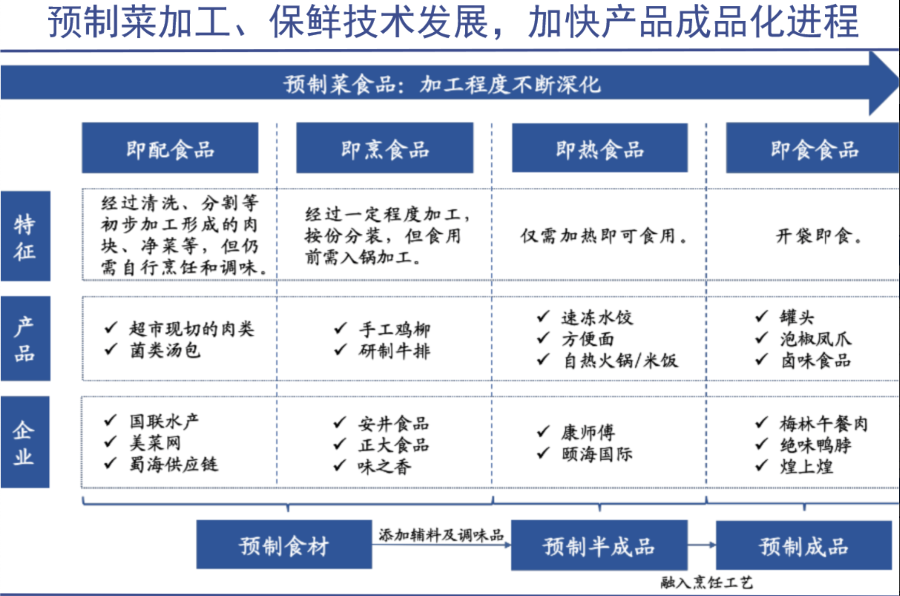
Core Viewpoint - The ongoing debate surrounding pre-prepared meals (pre-cooked dishes) highlights consumer concerns about transparency and quality in the restaurant industry, with a call for industry leaders who prioritize consumer rights and operational efficiency [1] Group 1: Consumer Attitudes - Many consumers express strong opposition to being served pre-prepared meals in restaurants that offer freshly cooked dishes, indicating a desire for transparency in food sourcing [1] - A significant disparity exists in consumer acceptance of pre-prepared meals based on dining context; over 50% of consumers accept them in fast-food settings, while only 8.8% do so in high-end restaurants [8][9] - Consumers are not entirely resistant to pre-prepared meals; they prefer to choose them from retail channels rather than being served them in restaurants [9] Group 2: Industry Perspectives - Industry professionals argue that pre-prepared meals, when produced under proper standards, can enhance food safety and efficiency, countering negative perceptions [1][5] - The pre-prepared meal sector is seen as a solution to challenges faced by large-scale chain restaurants, such as high rental and labor costs [5][6] - The pre-prepared meal market in China is projected to reach 617.3 billion yuan by 2025, reflecting a 27.3% year-on-year growth [7] Group 3: Regulatory and Standardization Issues - Current regulations prohibit the use of preservatives in pre-prepared meals, ensuring their natural quality and safety through cold chain logistics [5] - There is a pressing need for clearer definitions and standards for pre-prepared meals to address consumer confusion and enhance trust [11][12] - The upcoming national standards for pre-prepared meals are expected to clarify their classification and usage in restaurants, marking a significant shift towards regulatory compliance in the industry [12] Group 4: Future Outlook - The future of the restaurant industry will likely see a coexistence of artisanal cooking and pre-prepared meal solutions, emphasizing the need for technological integration and robust regulations [13]
食品加工板块9月12日跌0.56%,技源集团领跌,主力资金净流出5191.49万元
Zheng Xing Xing Ye Ri Bao· 2025-09-12 08:31
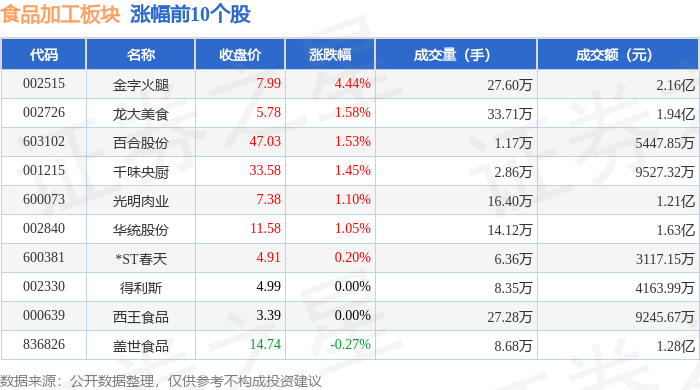
Market Overview - On September 12, the food processing sector declined by 0.56%, with Jiyuan Group leading the losses [1] - The Shanghai Composite Index closed at 3883.69, up 0.22%, while the Shenzhen Component Index closed at 12996.38, up 0.13% [1] Stock Performance - Notable gainers in the food processing sector included: - Jinzi Ham: closed at 7.99, up 4.44% with a trading volume of 276,000 shares and a turnover of 216 million yuan [1] - Longda Meishi: closed at 5.78, up 1.58% with a trading volume of 337,100 shares and a turnover of 194 million yuan [1] - Zihua Co.: closed at 47.03, up 1.53% with a trading volume of 11,700 shares and a turnover of 54.48 million yuan [1] - Conversely, Jiyuan Group saw a decline of 3.12%, closing at 31.96 with a trading volume of 51,200 shares and a turnover of 165 million yuan [2] Capital Flow - The food processing sector experienced a net outflow of 51.91 million yuan from institutional investors, while retail investors saw a net inflow of 70.17 million yuan [2][3] - Key stocks with significant capital flow included: - Longda Meishi: net inflow of 34.73 million yuan from institutional investors, but a net outflow of 20.44 million yuan from retail investors [3] - Guangming Meat Industry: net inflow of 18.61 million yuan from institutional investors, with a net outflow of 12.08 million yuan from retail investors [3] - Qianwei Yangchu: net inflow of 17.90 million yuan from institutional investors, with a net outflow of 7.35 million yuan from retail investors [3]


国信证券晨会纪要-20250912
Guoxin Securities· 2025-09-12 02:51
Group 1: Macro and Strategy - The report highlights the impact of the Federal Reserve's quantitative easing (QE) policies on U.S. Treasury yields, indicating that while QE provides liquidity, its long-term effects significantly lower yields [8][9]. - The report outlines four phases of the Federal Reserve's bond purchasing history, detailing the transition from traditional monetary policy to QE during the 2008 financial crisis and the COVID-19 pandemic [9][10]. - Recent economic data indicates a potential rebound in the bond market, with expectations for improved performance following the release of economic growth data on September 15 [11][12]. Group 2: Industry and Company Insights - The semiconductor industry, particularly the analog chip sector, is expected to see growth, with global market sizes projected to increase by 3.3% and 5.1% in 2025 and 2026, respectively [16][17]. - Domestic companies in the analog chip market are anticipated to benefit from increased demand in industrial, automotive, and AI applications, with significant potential for domestic market share growth [17][18]. - The renewable energy sector, particularly wind power, is experiencing favorable pricing outcomes, with competitive bidding results indicating strong investment returns for wind projects [19][20]. - Agricultural products are projected to enter a bullish cycle, with expectations for rising prices in beef and milk, driven by supply dynamics and market recovery [21][22][23]. - The report notes that the company Golden Meat Industry has seen a significant increase in profits from its beef and lamb business, despite challenges in its pig farming segment [35][36]. Group 3: Company-Specific Developments - Daikin Heavy Industries has secured a large contract worth approximately 1.25 billion yuan for offshore wind turbine foundations, which is expected to positively impact its financial performance in 2026 [24][25]. - Kelaiying, a leading CDMO in China, is expanding its service offerings and is projected to achieve steady revenue growth, with a forecasted revenue of 66.8 billion yuan in 2025 [26][28]. - Aibo Medical has reported a significant increase in net profit driven by high-end artificial crystal products, with a 30% quarter-on-quarter growth in the second quarter [29][30][31]. - Bluko is launching new products to enhance its IP portfolio, which is expected to drive revenue growth, particularly in the lower-priced market segment [33][34].



光明肉业2025年半年度业绩说明会问答实录
Quan Jing Wang· 2025-09-10 03:05
Core Viewpoint - The company is focusing on its core meat business and aims to enhance its integrated meat industry strategy to improve operational efficiency and profitability [2][3][17]. Group 1: Company Strategy - The company plans to deepen industry collaboration and strengthen its supply chain across the entire meat production process, including feed production, pig farming, slaughtering, and meat processing [2][3][17]. - The company emphasizes brand innovation and product development to meet consumer demands and expand sales channels [2][3]. - The company is committed to a "meat industry integration" strategy to enhance operational management and create value for investors [2][3][17]. Group 2: Financial Performance - The company reported a significant increase in financial expenses, primarily due to exchange rate losses from its New Zealand subsidiary [8]. - The company has faced challenges in its pig farming segment, leading to asset impairment provisions of approximately 130 million [5][11]. - The company is actively working to reduce costs and improve efficiency in its pig farming operations through various measures [5][11][17]. Group 3: Market Conditions - The company anticipates a continued high supply of pigs, which may suppress pig prices in the second half of the year [3]. - The international beef market has seen price increases, but the company is facing challenges with its New Zealand operations due to reduced slaughter volumes [3][17]. - The company is optimistic about the beef and lamb market outlook but acknowledges potential pressures from declining slaughter volumes [17]. Group 4: Debt and Risk Management - The company is monitoring the debt situation of its subsidiary, Hebei Zhongwang, and is taking measures to protect its interests [4][7][15]. - The company has been transparent about its asset impairment provisions and is committed to complying with relevant accounting standards [11][15][29]. - The company is focused on improving its overall management and operational efficiency to mitigate risks associated with its subsidiaries [4][7][15].
光明肉业:生猪养殖业务上半年尚处于亏损状态,将持续推进降本增效工作
Bei Jing Shang Bao· 2025-09-09 13:28
Core Viewpoint - The company is currently facing losses in its pig farming business due to high biosecurity and environmental investment costs, as well as relatively small farming scale, but is implementing various strategies to improve efficiency and reduce costs [1] Summary by Relevant Sections Business Performance - The pig farming segment is experiencing losses in the first half of the year due to comprehensive biosecurity measures, regional environmental investments, and small-scale operations [1] - The company is committed to cost reduction and efficiency improvement in its pig farming sector [1] Strategic Initiatives - The company plans to optimize asset allocation and shut down inefficient farms [1] - It will implement a classified management strategy for farms, including the elimination of redundant personnel and low-efficiency positions [1] - The company aims to enhance lean farming practices and leverage technology in pig farming [1] Core Business Focus - The meat business, including pork and beef, is identified as the core operation of the company [1] - The company will focus on its "meat industry integration" strategy, enhancing operational efficiency and industry collaboration [1] - The strategy includes strengthening the entire meat industry chain from feed production, pig farming, slaughtering, to fresh and processed meat sales [1]
中国预制菜行业现状深度研究与发展前景分析报告(2025-2032年)
Sou Hu Cai Jing· 2025-09-03 16:27
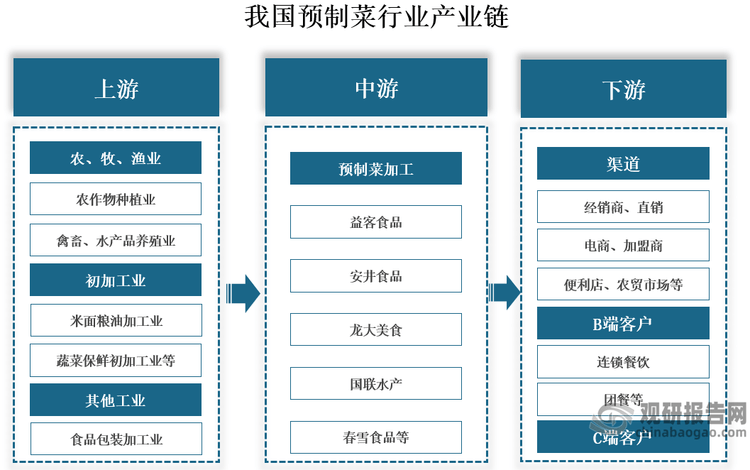
Core Viewpoint - The pre-prepared food industry in China, also known as semi-finished or ready-to-eat meals, is characterized by a diverse range of participants, including specialized manufacturers, agricultural enterprises, and restaurant chains, with significant revenue generation and varying growth rates across companies [3][6]. Industry Overview - The pre-prepared food industry in China includes upstream sectors such as agriculture and food processing, midstream processing companies like Yike Food and Anjuke Food, and downstream distribution channels including e-commerce [1]. - Major players in the industry include Shuanghui Development, Guangming Meat, Yike Food, and Anjuke Food, with annual revenues exceeding 10 billion yuan [3][6]. Company Performance - Shuanghui Development leads the market with a revenue of 595.61 million yuan and a market capitalization nearing 100 billion yuan as of April 22, 2025 [4][6]. - Anjuke Food reported a revenue of 110.77 million yuan with a growth rate of 7.84%, while other companies like Longda Meishi and Guolian Aquatic faced revenue declines of 20.70% and 24.14%, respectively [4][6]. - In the first half of 2024, Anjuke Food's frozen prepared food segment achieved a 13.04% year-on-year growth, contrasting with the overall industry trend of declining revenues [6][7]. Revenue Trends - The overall revenue growth for pre-prepared food companies is expected to be below 10% in 2024, with many companies experiencing revenue declines [3][6]. - The revenue from overseas operations is significant for companies like Sanquan Food, which reported 94.23 billion yuan in 2024, with overseas revenue accounting for 42.86% of total revenue [8]. Market Dynamics - The pre-prepared food industry is characterized by a diverse range of participants, including specialized manufacturers and cross-industry players, indicating a competitive landscape [3][6]. - The industry is facing challenges with revenue growth, as many companies reported negative growth rates in 2024, highlighting the need for strategic adjustments [4][6].