四川长虹

Search documents
CES观察|智能眼镜群雄逐鹿 清洁电器进化“具身智能”
Xin Jing Bao· 2026-01-09 15:03
Group 1: Core Insights - CES 2026 focuses on systemic transformations in artificial intelligence technology, with smart glasses emerging as a key highlight of the event [1] - The year 2026 is anticipated to be a golden period for the development of smart glasses, driven by an increasing number of players entering the market [2][3] - AI is being fully integrated into home appliances and consumer electronics, with traditional companies merging with new entrants [1][6] Group 2: Smart Glasses Development - Over 50 companies, including notable brands like Thunder Innovation, XREAL, and Rokid, showcased their smart glasses at CES 2026 [2] - New lightweight models were introduced, such as Rokid's AI+AR glasses weighing only 49 grams and another model at 38.5 grams [2] - The Chinese market is seeing a surge in AI glasses from various brands, including Xiaomi and Lenovo, since 2025 [2][3] Group 3: Market Trends and Opportunities - The introduction of new national subsidy policies in China has expanded the categories eligible for subsidies, including smart glasses [3] - The global shipment of smart glasses is projected to exceed 11 million units in 2026, indicating a competitive and diverse market landscape [3] - The penetration rate of cleaning robots in global households remains below 10%, suggesting significant growth potential in the cleaning appliance sector [4] Group 4: Cleaning Appliances and AI Integration - Cleaning appliances, particularly robotic vacuums, are advancing towards embodied intelligence, with innovations like bionic designs enabling multi-floor cleaning [4] - Chinese brands have rapidly increased their market share in the global robotic vacuum sector, capturing 65.7% of the market in the first three quarters of 2025 [5] - AI is becoming a core capability across home appliances, with companies like TCL and Hisense showcasing advanced AI-integrated products at CES [6][7]
智能眼镜群雄逐鹿,清洁电器进化“具身智能”
Xin Jing Bao· 2026-01-09 15:02
作为全球规模最大、最具权威性及影响力的科技盛会CES(国际消费电子展)2026正在进行,展会聚焦 人工智能技术的系统级变革。 其中,智能眼镜成为展会上的"最靓仔",随着越来越多的玩家加入,2026年成为智能眼镜发展黄金期。 而清洁电器率先体现"具身智能"趋势,多家品牌通过仿生机械臂、轮足设计等创新,突破跨楼层清洁等 长期瓶颈。AI全面融入家电与消费电子领域,老牌企业融合新生。 2025年以来,在中国市场,小米、联想、海信、李未可、360、阿里、小度、理想、老凤祥、KTC康冠 等来自各领域的品牌纷纷布局AI眼镜。 同时,CES成为多元智能终端展示平台,越来越多的智能终端正在各场景落地。 智能眼镜新晋玩家增多,不断轻量化 智能眼镜就已经成为CES2026当之无愧的主角之一。在今年的展览中,洛图科技统计,包括雷鸟创新、 XREAL、INMO、Rokid、星纪魅族、阿里、光峰、歌尔、联想在内超过50家相关产业企业参展。 AR品牌雷鸟创新带来了首款支持eSIM功能的AR眼镜,支持微信、抖音、B站等多款主流应用,可以在 AR眼镜与智能手机间切换。乐奇Rokid亮相量产的轻质全功能AI+AR眼镜,重量仅49克。乐奇现场发布 ...
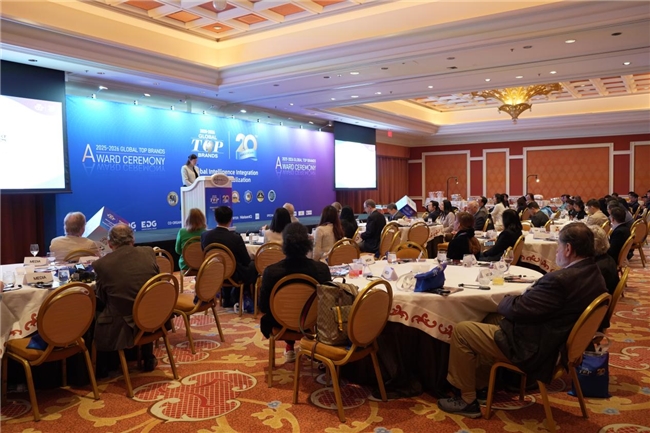
二十载品牌沉浮:Global Top Brands见证消费电子的迭代与坚守
Quan Jing Wang· 2026-01-09 12:12
Core Insights - The Global Top Brands (GTB) awards celebrate 20 years of recognizing leading brands in the consumer electronics industry, reflecting the evolution of the market and technological advancements [1][3][28] Industry Evolution - Over the past two decades, the GTB awards have documented the rise of major brands like Apple, Samsung, and Sony, as well as the emergence of Chinese brands such as Huawei, TCL, and BOE, showcasing a shift from catching up to leading the market [3][21] - The consumer electronics industry has transitioned from single product competition to a comprehensive ecosystem, with AI playing a crucial role in driving innovation and industry progress [7][11] Market Trends - In 2025, the global technology and consumer electronics industry sales are projected to exceed $1.29 trillion, with emerging markets contributing 40% to this growth [15] - The display panel market is expected to reach $180 billion by 2025, with Chinese companies holding over 55% market share, indicating a significant shift in the competitive landscape [21] Brand Recognition - The GTB awards have gained international recognition, with the Nevada state government acknowledging its contributions to promoting global brand leadership and innovation in the consumer electronics sector [5][28] - The 2025-2026 GTB list includes leading brands like TCL and BOE, which have achieved recognition through technological innovation and market leadership [16][21] Smart Home Evolution - The smart home sector has evolved from single-device automation to a fully interconnected ecosystem, with Chinese brands becoming key players in this transformation [22] - The global smart home market is projected to surpass $2.1 trillion by 2025, with over 55% penetration of interconnected systems, highlighting the dominance of Chinese brands in this space [22] Brand Adaptation - Brands are increasingly crossing traditional boundaries and innovating to stay relevant, as seen with companies like Baidu and Meituan integrating technology into their services [26] - Continuous research and ecosystem development have allowed brands like Huawei, BOE, and TCL to transition from product exports to technology outputs, showcasing their adaptability in a changing market [26][28]



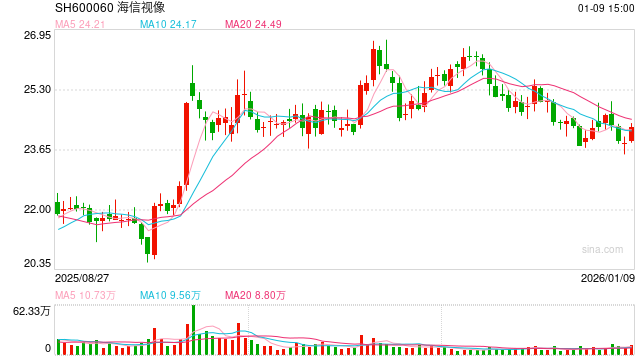
海信视像营收滞涨关联收购用于扩产 退税补助占比4成、销售费用率远超同行|光学成像并购潮
Xin Lang Cai Jing· 2026-01-09 11:09
Core Viewpoint - The optical imaging industry is experiencing a wave of capital operations characterized by mergers, acquisitions, and financing, driven by the promising market prospects in emerging technologies such as automotive lenses, AR/VR optics, and machine vision [2][14]. Company Summary - Hisense Visual Technology has engaged in multiple asset acquisitions and sales, primarily involving related parties within the Hisense group, without extending into new fields through external mergers [2][3]. - In 2025, Hisense Visual's revenue growth is nearly stagnant, with a year-on-year increase of only 5.36%, yet the company has made consecutive acquisitions of related party assets to expand production capacity [6][18]. - The company sold a 26% stake in its kitchen and bath business just three years after acquiring it, citing a focus on core business development [7][19]. Financial Performance - Hisense Visual's sales expense ratio has consistently exceeded 6%, significantly higher than the approximately 4% R&D expense ratio and far above comparable companies like Sichuan Changhong and TCL Technology [9][21]. - In 2023 and 2024, the company reported net profits of 2.096 billion and 2.246 billion, respectively, with approximately 42.9% and 35.2% of net profits derived from tax refunds, government subsidies, and various investment income, indicating a diminished actual profitability from core operations [11][23]. Strategic Focus - The company is accelerating the application of new business areas such as commercial displays, cloud services, and chips, while actively laying out plans in artificial intelligence and AR/VR to create new growth engines for the future [8][20].

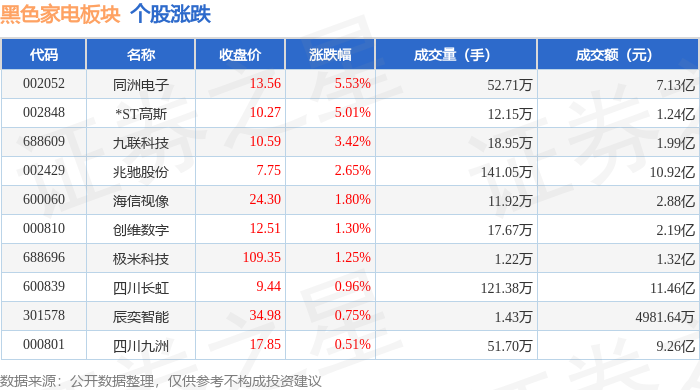
黑色家电板块1月9日涨1.82%,同洲电子领涨,主力资金净流入8144.05万元
Zheng Xing Xing Ye Ri Bao· 2026-01-09 08:54
Market Overview - The black home appliance sector increased by 1.82% on January 9, with Tongzhou Electronics leading the gains [1] - The Shanghai Composite Index closed at 4120.43, up 0.92%, while the Shenzhen Component Index closed at 14120.15, up 1.15% [1] Stock Performance - Key stocks in the black home appliance sector showed varied performance, with Tongzhou Electronics closing at 13.56, up 5.53% on a trading volume of 527,100 shares and a transaction value of 713 million [1] - Other notable performers included *ST Gauss, which rose by 5.01% to 10.27, and Jiulian Technology, which increased by 3.42% to 10.59 [1] Capital Flow - The black home appliance sector saw a net inflow of 81.44 million in main funds, while retail funds experienced a net outflow of 104 million [1] - Retail investors contributed a net inflow of 22.16 million, indicating a mixed sentiment among different investor types [1] Detailed Capital Flow Analysis - Non-Chi Holdings had a main fund net inflow of 10.9 million, but retail funds saw a significant outflow of 78.86 million [2] - Tongzhou Electronics experienced a main fund net inflow of 19.50 million, while retail funds had a net outflow of 1.20 million [2] - Hisense Visual had a main fund net inflow of 14.99 million, with retail funds showing a net inflow of 0.43 million [2]


通讯丨“中国智造”在美消费电子展舞台逐浪前行
Xin Hua Wang· 2026-01-09 08:28
Core Insights - "Chinese manufacturing" is making significant strides at the CES, showcasing higher innovation density and clearer technological pathways, positioning itself at the forefront of international competition [1] Group 1: Industry Participation - Over a thousand Chinese companies participated in CES, including industry leaders like TCL, Hisense, BOE, and Lenovo, as well as numerous startups [1] - Several Chinese companies received "CES Innovation Awards," highlighting global recognition of their innovative capabilities [1] Group 2: Display Technology - Chinese companies are leading in the display technology sector, shifting focus from single product parameters to AI-supported full-scene application revolutions [2] - TCL had the largest and most diverse exhibition space, showcasing innovations in television screens, electronic writing pads, and AR glasses [2] - Hisense presented next-generation large-screen display solutions, emphasizing color space enhancement and system optimization for eye protection [2] - The Chinese display industry has evolved from a technology follower to a global leader, particularly in LCD and OLED technologies [2] Group 3: Robotics Innovation - AI and robotics were major highlights at CES, with Chinese companies dominating the humanoid robot and related sectors, demonstrating rapid iteration and scalability [3] - Various robots showcased capabilities such as emotional companionship, autonomous lawn maintenance, and advanced coffee-making, emphasizing real-world application [3] - The focus has shifted from conceptual displays to tangible intelligent products that adapt to real environments [3] Group 4: Smart Home Solutions - Smart home technology has become a key area for Chinese companies to demonstrate systemic innovation and lifestyle solutions [4] - Solutions showcased include AI and IoT applications that create intelligent systems capable of perceiving, learning, and interacting [4][5] - Products like smart air conditioners and refrigerators exhibit advanced features such as dynamic energy management and food preservation [5] Group 5: Intelligent Mobility - Intelligent mobility was a focal point, with Chinese automotive companies showcasing innovations in smart cockpits and AI integration [6] - Geely's WAM model enhances understanding of complex driving scenarios, improving overall driving experiences [6] - Chinese companies are transitioning from cost and scale advantages to focusing on user experience, system integration, and technological maturity in the smart mobility sector [6] Group 6: Global Impact - CES serves as a platform for international collaboration and industry dialogue, with China recognized as a key driver of global technological advancement [6] - Chinese consumer electronics companies are accelerating their smart upgrades, becoming pioneers in global AI development [6] - "Chinese manufacturing" continues to navigate the waves of global technological change, contributing to the formation of a new international tech landscape through innovation and application [6]

CES变成中国科技秀:机器人跳舞、熊猫获奖
3 6 Ke· 2026-01-09 08:24
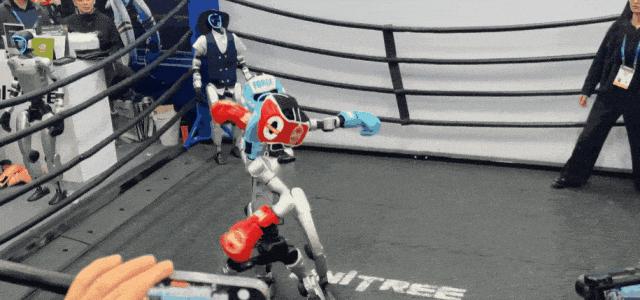
Group 1: Core Themes of CES 2026 - The main theme of CES 2026 is "human-centered" AI applications, marking a shift from traditional consumer electronics to AI-centric technological transformations [1] - Chinese companies are increasingly taking center stage at CES, with 942 exhibitors, accounting for approximately 22% of the total, maintaining their position as the second-largest exhibiting nation [1] - In specific sectors, Chinese firms dominate, with 55% of humanoid robot exhibitors and nearly 70% of AI glasses brands coming from China [1] Group 2: Robotics and AI Innovations - Chinese manufacturers are expected to continue leading in cost reduction and efficiency improvements in humanoid robots, showcasing their capabilities in unstructured environments [2] - Notable products include the Unitree H1 humanoid robot with advanced sensing capabilities and the latest generation of the "绝影" series robotic dogs, which excel in indoor navigation [4][11] - The "Care-bot" humanoid robot by Fourier demonstrates embodied intelligence in real-life interaction scenarios [7] Group 3: Consumer Electronics and Smart Devices - Over 80% of global smart glasses supply chain manufacturers are from China, with 16 Chinese companies showcasing their products at CES [15] - Innovations in smart home devices include the AI-driven "安安" companion robot designed for elderly and cognitively impaired individuals [16] - Companies like Alibaba and XREAL are launching advanced AI glasses, with features such as ultra-lightweight designs and integration with various AI services [19][20] Group 4: Automotive and AI Integration - The automotive industry is transitioning from "software-defined" to "AI-defined" vehicles, with companies like Geely and Great Wall showcasing new technologies [28] - Geely's G-ASD smart driving solution and Great Wall's focus on new energy technologies highlight the industry's shift towards AI integration [30][32] - New products like the AI-driven logistics solutions from New Stone and advanced lidar technology from Hesai demonstrate the growing importance of AI in transportation [34][35] Group 5: Home Appliances and AI - Hisense introduced new RGB-Mini LED display technology and AI-controlled smart refrigerators, showcasing the integration of AI in home appliances [41] - TCL's innovations in display technology, including the world's first printed OLED car screen, reflect advancements in consumer electronics [43][44] - Companies are increasingly focusing on AI capabilities in home security and smart home management systems [51][49] Group 6: Overall Impact of AI - CES 2026 emphasizes the profound impact of AI on the consumer electronics industry, with expectations for AI user numbers to grow significantly [59] - The event serves as a platform for global tech companies to set the foundation for future technological development and transformation [59] - The integration of AI into various sectors, including robotics, automotive, and consumer electronics, indicates a trend towards deeper AI adoption in everyday life [59]




渤海证券研究所晨会纪要(2026.01.09)-20260109
BOHAI SECURITIES· 2026-01-09 03:33
Macro and Strategy Research - The central bank's 2026 work meeting emphasizes "counter-cyclical and cross-cyclical adjustments" to enhance support for high-quality economic development, with a focus on expanding domestic demand and optimizing supply [2] - The monetary policy will maintain a "moderately loose" stance, prioritizing stable prices as a key goal for the year [2] - The capital market will see mechanisms established to provide liquidity to non-bank institutions under specific scenarios, indicating continued support for market stability [2] Financial Engineering Research - All major indices in the A-share market rose last week, with the ChiNext Index showing the smallest increase of 2.36% and the STAR 50 Index the largest at 5.11% [5] - The margin trading balance reached 25,716.11 billion yuan, an increase of 243.18 billion yuan from the previous week, indicating growing investor participation [5][6] - The average daily trading volume in the two markets was 2.75 trillion yuan, a significant increase compared to the previous period [2] Industry Research - The "Artificial Intelligence + Manufacturing" policy has been launched, creating favorable conditions for AI applications in the manufacturing sector [8][10] - The computer industry saw a 13.3% year-on-year increase in business revenue, reaching 139,777 billion yuan, while profit totaled 16,954 billion yuan, up 6.6% [8] - The AI computing power sector is expected to accelerate with the launch of NVIDIA's next-generation AI chip platform "Rubin," enhancing the AI computing capabilities of cloud service providers [11]
音频 | 格隆汇1.9盘前要点—港A美股你需要关注的大事都在这
Xin Lang Cai Jing· 2026-01-08 23:12
格隆汇1月9日|国际要闻: 13、A股投资避雷针︱贝斯美:子公司永安化工收到检察机关起诉书;振芯科技:控股子公司收到违规 处理决定。 大中华区要闻: 1、美股三大指数收盘涨跌不一,英特尔跌超3%,中概指数涨1.09%; 2、WTI 2月原油期货收涨3.16%,报57.76美元/桶; 3、美联储理事米兰呼吁宽松救市 称今年应该降息150个基点; 4、年度商品指数调仓周四启动 超百亿美元被动卖盘将冲击金银; 5、芝商所再出手 近期第三次上调贵金属期货保证金; 6、特朗普政府考虑砸钱说服格陵兰人"加入"美国; 7、特朗普称已决定美联储主席人选; 8、特朗普:我不需要国际法; 9、矿业巨头嘉能可与力拓重启合并谈判; 10、马斯克称终极目标是每年生产1万艘星舰飞船; 11、委内瑞拉股指近期暴涨124% 外国投资者寻求入场机会; 12、"求稳"高于一切 委内瑞拉新高层以石油出口换取执政生机; 13、伊朗外长称做好准备应对战争; 14、雀巢:已在至少50个国家启动召回部分奶粉; 1、英伟达要求中国客户订购H200芯片付全款; 2、中国据报最快本季内批准进口英伟达H200芯片 3、商务部回应审查Meta收购Manus:企业从 ...
长虹工业互联网“双跨平台”:三年深耕不忘初心,双轮驱动巩固引领
和讯· 2026-01-08 09:36
Core Viewpoint - The "Changhong Dual-Cross Platform" has significantly improved its ranking in the 2025 cross-industry industrial internet platform evaluation, marking a historical high for Sichuan Province in this field, and solidifying Mianyang's leading position in the province's industrial internet landscape [1][2]. Group 1: Platform Development and Achievements - The platform has risen 17 positions since being selected as a national-level "dual-cross" platform in 2023, achieving a total increase of 6 positions recently, ranking third nationally and first in the western region [1]. - The platform is built on over 60 years of manufacturing experience, emphasizing its unique advantage in empowering industries through a deep understanding of manufacturing [1]. - It has established a service matrix that integrates "intelligent, green, and integrated" services, driving deep transformation in the manufacturing sector [1]. Group 2: Technological Integration and Industry Impact - The platform utilizes a data-driven approach to connect devices, systems, and enterprises, creating a collaborative system across the entire value chain, which enhances production efficiency and resource allocation [2][9]. - It has developed an intelligent empowerment system that spans eight major industries and nine fields, serving over 3,000 enterprises to facilitate their digital transformation and improve efficiency [9]. Group 3: Value Service System and Solutions - The platform adopts a "1+4+N" architecture, focusing on five major value service systems to address core pain points for enterprises, providing clear transformation blueprints and reducing decision-making risks [10]. - It aims to lower the barriers for small and medium-sized enterprises to start their digital transformation through lightweight and modular solutions [10]. - The platform emphasizes the activation of data potential across eight value links, facilitating a dynamic data exchange system that enhances production efficiency by 10% and inventory turnover by 30% for upstream enterprises [12]. Group 4: Future Directions and Strategic Goals - The "Changhong Dual-Cross Platform" plans to evolve into an ecological organizer, focusing on upgrading from "scale" to "value" and serving as the core engine for Changhong Group's digital transformation [17]. - The platform aims to transform validated best practices into replicable solutions, ultimately becoming a digital model that empowers various industries rooted in Chinese manufacturing [17].