国泰基金

Search documents
蓝色光标股价涨5.11%,国泰基金旗下1只基金重仓,持有156.66万股浮盈赚取151.96万元
Xin Lang Ji Jin· 2026-02-09 01:44
数据显示,国泰基金旗下1只基金重仓蓝色光标。国泰创业板人工智能ETF(159388)四季度持有股数 156.66万股,占基金净值比例为3.16%,位居第四大重仓股。根据测算,今日浮盈赚取约151.96万元。 国泰创业板人工智能ETF(159388)成立日期2025年3月26日,最新规模5.72亿。今年以来收益6.57%, 同类排名1363/5579;成立以来收益115.92%。 2月9日,蓝色光标涨5.11%,截至发稿,报19.94元/股,成交5.52亿元,换手率0.80%,总市值715.89亿 元。 资料显示,北京蓝色光标数据科技集团股份有限公司位于北京市朝阳区酒仙桥北路9号恒通国际创新园 C9-C,香港铜锣湾希慎道33号利园1期19楼1920室,成立日期2002年11月4日,上市日期2010年2月26日, 公司主营业务涉及整合数字营销、公共关系、广告创意策划及媒体代理、活动管理以及国际传播业务。 主营业务收入构成为:出海广告投放83.45%,全案推广服务11.32%,全案广告代理5.22%。 从基金十大重仓股角度 截至发稿,麻绎文累计任职时间2年187天,现任基金资产总规模136.57亿元,任职期间最佳基 ...

从“固收+”到“多元配置” 公募FOF乘风而起
Shang Hai Zheng Quan Bao· 2026-02-08 17:48
Group 1 - The core viewpoint of the articles highlights the significant growth and popularity of FOF (Fund of Funds) products in the A-share market, driven by strong demand from bank clients for diversified asset allocation in a low-interest-rate environment [1][6][7] - Since the beginning of 2026, FOF products have seen a surge in issuance, with many products being sold out in just one day, indicating a robust market interest [2][3] - The total issuance scale of new FOF products in 2026 has reached approximately 300 billion yuan, a substantial increase compared to 61.29 billion yuan in the same period of 2025 [2][3] Group 2 - Major banks are actively promoting FOF products, with several banks creating FOF preferred pools to enhance product visibility and growth [4][5] - The collaboration between banks and fund companies has led to significant increases in FOF product sizes, with some products reaching nearly 100 billion yuan in scale [5][6] - The shift from "fixed income +" to "multi-asset allocation" reflects a broader trend in the FOF market, as new products increasingly incorporate diverse asset classes, including equities and commodities [6][7] Group 3 - The unique advantage of FOF products lies in their ability to diversify investments and improve the risk-return profile, making them attractive in the current market environment where traditional fixed-income assets are underperforming [7] - FOF products are positioned as essential tools for investors seeking stable returns and wealth preservation in uncertain market conditions [7][8] - The focus for FOF management in 2026 will be on diversified allocation to mitigate risks rather than solely pursuing returns from individual asset classes [7]




基金研究系列(35):从股债二元到多元配置:多资产基金投顾的三维画像与业绩归因
KAIYUAN SECURITIES· 2026-02-08 05:14
Quantitative Models and Construction Methods 1. Model Name: "Risk Preference-Concentration-Turnover" Three-Dimensional Label Classification System - **Model Construction Idea**: The model aims to classify multi-asset fund advisory products based on three dimensions: risk preference, concentration, and turnover rate, to better understand their risk-return characteristics and performance differentiation[3][32] - **Model Construction Process**: - **Risk Preference**: Classified based on the proportion of income-generating assets and growth assets in the portfolio. If income-generating assets exceed 70%, it is classified as debt-oriented; if growth assets exceed 70%, it is equity-oriented; otherwise, it is balanced[34] - **Concentration**: Measured using the Herfindahl-Hirschman Index (HHI), calculated as $ \sum_{i} w_{i}^{2} $, where $w_{i}$ represents the weight of each asset class. Thresholds are set as follows: HHI > 0.5 is high concentration, HHI < 0.25 is low concentration, and values in between are medium concentration[34] - **Turnover Rate**: Measures the timing adjustment ability of multi-asset fund advisory products at the asset class level. Annualized one-sided turnover rate is used, with thresholds defined as follows: turnover rate > 2 is high turnover, < 1 is low turnover, and values in between are medium turnover[34] - **Model Evaluation**: The model effectively captures the heterogeneity in multi-asset fund advisory products and provides insights into their risk-return characteristics and strategic differences[3][34] --- Model Backtesting Results 1. "Risk Preference-Concentration-Turnover" Three-Dimensional Label Classification System - **Risk Preference**: - Equity-oriented products: 2025 annualized return 18.5%, 2024 annualized return 10.5%, 2023 annualized return -1.0%[37][39] - Debt-oriented products: 2025 annualized return 7.4%, 2024 annualized return 5.9%, 2023 annualized return 3.9%[37][39] - Balanced products: 2025 annualized return 15.7%, 2024 annualized return 8.8%, 2023 annualized return -4.7%[37][39] - **Concentration**: - Low concentration (HHI < 0.25): 2025 annualized return 17.7%, 2024 annualized return 8.2%, 2023 annualized return 0.4%[37][39] - Medium concentration (0.25 ≤ HHI ≤ 0.5): 2025 annualized return 13.0%, 2024 annualized return 6.9%, 2023 annualized return -4.0%[37][39] - High concentration (HHI > 0.5): 2025 annualized return 7.8%, 2024 annualized return 6.9%, 2023 annualized return 3.9%[37][39] - **Turnover Rate**: - Low turnover (< 1): 2025 annualized return 15.6%, 2024 annualized return 8.8%, 2023 annualized return 1.7%[37][39] - Medium turnover (1 ≤ turnover ≤ 2): 2025 annualized return 10.6%, 2024 annualized return 7.3%, 2023 annualized return 0.5%[37][39] - High turnover (> 2): 2025 annualized return 11.2%, 2024 annualized return 7.6%, 2023 annualized return -5.4%[37][39] --- Quantitative Factors and Construction Methods 1. Factor Name: Brinson Attribution Model - **Factor Construction Idea**: The model decomposes the excess return of multi-asset fund advisory products into two components: allocation return and selection return, to evaluate the sources of excess returns[42][46] - **Factor Construction Process**: - **Allocation Effect**: Measures the timing and allocation ability of fund managers across major asset classes. The formula is: $$ R_{allocation} = \sum_{i} (w_{i}^{actual} - w_{i}^{benchmark}) \times r_{i}^{asset} $$ where $w_{i}^{actual}$ is the actual weight of asset $i$, $w_{i}^{benchmark}$ is the benchmark weight, and $r_{i}^{asset}$ is the return of asset $i$[42][46] - **Selection Effect**: Reflects the ability to select superior funds within each asset class. The formula is: $$ R_{selection} = R_{excess} - R_{allocation} $$ where $R_{excess}$ is the total excess return relative to the benchmark[42][46] - **Factor Evaluation**: The model provides a clear decomposition of excess returns, helping to identify whether returns are driven by strategic asset allocation or fund selection[42][46] --- Factor Backtesting Results 1. Brinson Attribution Model - **Equity-Oriented Products**: - Example: "Guotai Global Allocation" achieved 2025 allocation return of 10.5% and selection return of 6.3%[48][49] - Example: "招商海外掘金" achieved 2025 allocation return of -0.8% and selection return of 14.5%[48][49] - **Debt-Oriented Products**: - Example: "嘉实百灵全天候策略" achieved 2025 allocation return of 3.8% and selection return of 0.5%[56][58] - Example: "全球固收+" achieved 2025 allocation return of 2.6% and selection return of 1.3%[56][58] - **Balanced Products**: - Example: "时光旅行者" achieved 2025 allocation return of 15.6% and selection return of -10.3%[65][66] - Example: "绘盈长投计划" achieved 2023 allocation return of 10.1%, providing a strong safety net during a bear market[65][66]
“千亿ETF”仅剩3只!股票型ETF开年“失血”超7000亿元
Mei Ri Jing Ji Xin Wen· 2026-02-08 03:30
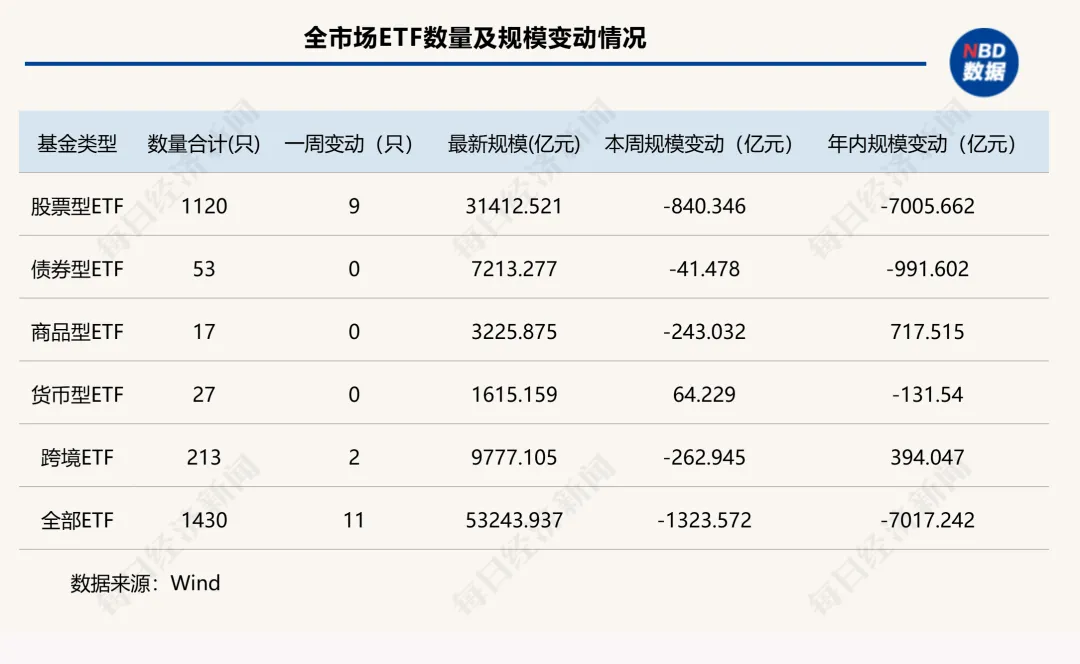
Market Overview - A-shares experienced fluctuations with major indices declining, including a 1.13% drop in the CSI 300 and a 3.28% drop in the ChiNext Index [1][16] - The ETF market is undergoing significant changes, with stock ETFs shrinking by over 700 billion yuan this year, reducing the number of "billion club" products to just three [1][16] ETF Market Dynamics - As of February 7, the total ETF market size decreased to 5.32 trillion yuan, with a weekly decline of 1,323 billion yuan [2][17] - Stock ETFs alone saw a reduction of 840.35 billion yuan, bringing their total size down to 31,412.52 billion yuan [3][18] - The number of ETFs listed reached 1,430, with 11 new ETFs introduced in the week, including 9 stock ETFs [2][17] Fund Management Changes - Fund size reshuffling is evident, with Guotai Fund maintaining its position in the top five, while Huabao Fund entered the top ten [1][22] - Major funds like Huaxia and E Fund have seen their ETF sizes shrink by over 100 billion yuan this year [1][22] Performance of Specific ETFs - The SGE Gold 9999 index saw a significant reduction of over 22 billion yuan, marking it as the largest decline among major indices [4][19] - The CSI 300 ETF managed by Huatai-PB has shrunk by over 2,000 billion yuan this year, now standing at 2,208.55 billion yuan [29][30] Institutional Fund Performance - Five institutions reported ETF size reductions exceeding 100 billion yuan, with Southern Fund experiencing the largest drop of 268.53 billion yuan [22][26] - Conversely, Huabao Fund and Hai Futong Fund both saw increases of over 30 billion yuan in their ETF sizes [23][26] Growth and Decline of ETFs - Only two products in the top 20 managed to achieve size growth, indicating a general trend of decline in the ETF market [26][27] - The "billion club" for ETFs has diminished, with only three members remaining due to widespread shrinkage [26][30]

次新基金上演“建仓加速度”
Zheng Quan Ri Bao· 2026-02-07 01:27
Group 1 - The core viewpoint of the articles highlights a significant trend in the fund market, where a large number of newly established funds are rapidly increasing their stock positions to seize market opportunities during the spring season [1][3] - As of February 6, 2023, out of 282 newly established funds, 81 have announced early closure of fundraising, indicating a shift in strategy to quickly deploy capital [1][3] - Active equity funds have shown notable net value fluctuations shortly after their establishment, with some funds achieving returns of 1.46% and 1.15% within a few weeks [1] Group 2 - Passive products, particularly ETFs, are also building positions rapidly, with some ETFs reaching stock asset ratios of 97.21% and 95.80% just before their listing [2] - The resurgence of "proportional allotment" in fund subscriptions reflects a strong demand for new funds, as seen with the Penghua Fund's rapid scale limit being reached [2][3] - Analysts suggest that the current favorable policies and abundant liquidity in the A-share market are encouraging quick positioning by fund managers, allowing them to capture low-risk opportunities [3] Group 3 - The phenomenon of early fundraising closures provides new funds with more market opportunities, allowing fund managers to quickly access capital and make timely investments [3] - The influx of incremental funds from both residents and institutions supports the issuance of new funds, enhancing the overall market liquidity [3] - Industry experts recommend that investors focus on the research capabilities of fund managers and product suitability rather than merely chasing fast-building and high-heat products [4]
消费起势 多只消费主题基金成立
Shang Hai Zheng Quan Bao· 2026-02-06 18:36
Group 1 - The consumer sector has recently rebounded after a prolonged period of stagnation, with multiple fund companies launching consumer-themed funds, indicating a potential shift in market sentiment [1][4] - Several new consumer-themed funds have been established, including the Guangfa Consumer Leading Stock Fund with a scale of 52.33 million and the Taixin Consumer Selected Mixed Fund with 10.08 million, both of which are initiated funds that can be quickly established [2] - As of February 5, 2023, consumer-themed ETFs have seen increased capital inflow, with the Huatai-PB Consumer ETF experiencing a net inflow of 1.936 billion, and both the Fuguo Consumer 50 ETF and the E Fund Hong Kong Stock Connect Consumer ETF exceeding 500 million in net inflows [3] Group 2 - The consumer sector's valuation and institutional holdings are at historical lows, presenting a favorable cost-performance ratio for investors, as noted by fund managers [4] - The allocation of public funds in the consumer sector has decreased, with the proportion of the consumer industry in active equity funds' A-share holdings dropping to 7%, reflecting a pessimistic outlook on consumption [4][5] - Future investment strategies in the consumer sector will focus on selective stock picking, emphasizing companies with solid business models and clear growth paths, rather than relying on single sectors for excess returns [6]
81只产品提前结募 次新基金上演“建仓加速度”
Zheng Quan Ri Bao· 2026-02-06 16:16
本报记者 彭衍菘 Wind资讯数据显示,截至2月6日,年内新成立的282只基金中,有81只基金宣布提前结束募集。而且,大量次新基金在成 立后迅速提升股票仓位。从净值波动情况可见,基金经理们正"火速"将募集资金转化为实际持仓,抢抓春季行情与结构性机会 的建仓窗口期。 多只年内成立的主动权益类基金在短短数周内净值已出现明显波动。例如,国泰海通低碳经济睿选A成立于1月20日,截至 2月6日,其成立以来收益率已达1.46%;平安港股通均衡配置A成立于1月13日,同期收益率也达到近1.15%。这意味着,在成 立不足一个月的时间里,上述基金的基金经理已完成核心仓位的构建并开始捕捉市场收益。发行规模达49.16亿元的华宝优势产 业混合A,在1月27日成立后,截至1月30日净值也已实现0.26%的正增长。 被动型产品的建仓步伐更为迅猛。按规定,ETF需在上市前完成建仓。梳理ETF上市公告书可见,部分ETF在建仓末期时 仓位几乎"拉满"。例如,富国中证智选船舶产业ETF在2月6日上市前夕,股票资产占比已达97.21%;易方达中证全指食品ETF 在上市前一日,股票仓位也高达95.80%。这种高效建仓,反映出基金管理人对相关主题赛 ...
2/6财经夜宵:得知基金净值排名及选基策略,赶紧告知大家
Sou Hu Cai Jing· 2026-02-06 15:40
写在文章前的声明:在本文之前的说明:本文中所列的投资信息,只是一个对基金资产净值进行排行的客观描述,并无主观倾向性,也不是投资建议,纯属 娱乐性质。 一顿操作猛如虎,基金净值已更新,谁是基金中的王者,谁又垫底,请看数据: | 基金简称 PK | | | 最新净值型 一般的重要人 | | | --- | --- | --- | --- | --- | | 1 | 申万菱信新 ... C | 2.3620 | 4.61% | 23 | | | 022739 | 2026-2-6 | | | | 2 | 申万菱信新 ... A | 2.3950 | 4.59% | 7 | | | 001156 | 2026-2-6 | | | | 3 | 方正富邦远 ... A | 1.4686 | 3.97% | | | | 017993 | 2026-2-6 | | | | 4 | 方正富邦远 ... C | 1.4347 | 3.96% | 8 | | | 017994 | 2026-2-6 | | | | 5 | 鹏华碳中和 ... C | 2.0424 | 3.74% | | | | 016531 | 2026-2-6 ...

资金加仓!这一方向显著吸金
Zhong Guo Zheng Quan Bao· 2026-02-06 13:16
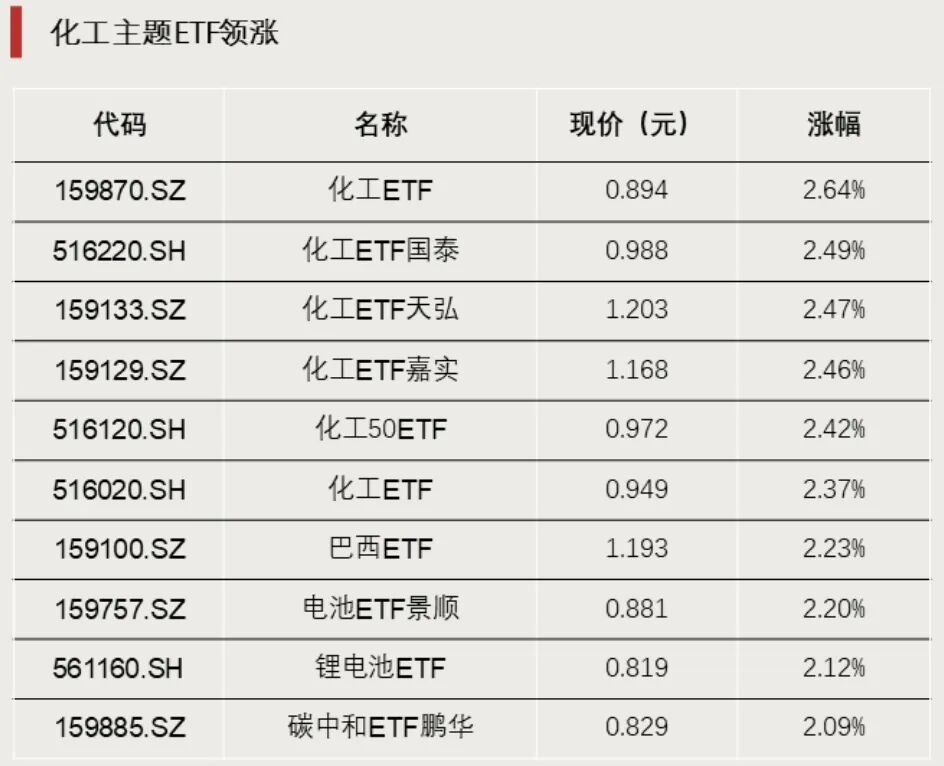
Group 1: Chemical Sector Performance - On February 6, the A-share chemical sector experienced a strong rally, with multiple sub-sectors such as chemical fibers, chemical products, chemical raw materials, and petrochemicals showing significant gains, leading to several chemical-themed ETFs rising over 2% [2][4] - The chemical ETF performance included notable increases: Chemical ETF (159870.SZ) rose by 2.64%, Chemical ETF Guotai (516220.SH) by 2.49%, and Chemical ETF Tianhong (159133.SZ) by 2.47% [3] - Analysts from Zhongyuan Securities noted a significant recovery in chemical prices in January, with liquid chlorine, acetonitrile, and butadiene performing well, suggesting that supply constraints in the chemical industry may strengthen in the future [3] Group 2: New Energy and Battery Sector - The new energy and battery sectors saw strong performance, with several related ETFs actively rising, including the Science and Innovation New Energy ETF and Battery ETF Jiashi, both nearing a 2% increase [4][5] - The Science and Innovation New Energy ETF (588830.SH) increased by 1.99%, while the Battery ETF Jiashi (562880.SH) rose by 1.96% [5] Group 3: ETF Market Trends - The ETF market has seen significant inflows, particularly in technology-themed ETFs, with the top ten products by net inflow mostly being technology-related [8] - The Huatai-PB Hang Seng Technology ETF recorded a net inflow of over 3.1 billion yuan, while other technology ETFs also saw substantial inflows exceeding 2 billion yuan [9] Group 4: A500 Index and Investment Value - The A500 index, represented by the A500 ETF (563800), has shown significant investment value due to its balanced industry distribution and focus on leading companies, making it attractive for long-term investment [10] - Analysts from GF Fund highlighted the index's advantages, including its ability to effectively capture growth opportunities while mitigating risks associated with single industries [10]
视频|十年激荡,谁主沉浮?中国ETF市场TOP20阵营洗牌:华夏、易方达“双雄争霸” 华宝华安融通“掉队”
Xin Lang Cai Jing· 2026-02-06 11:31
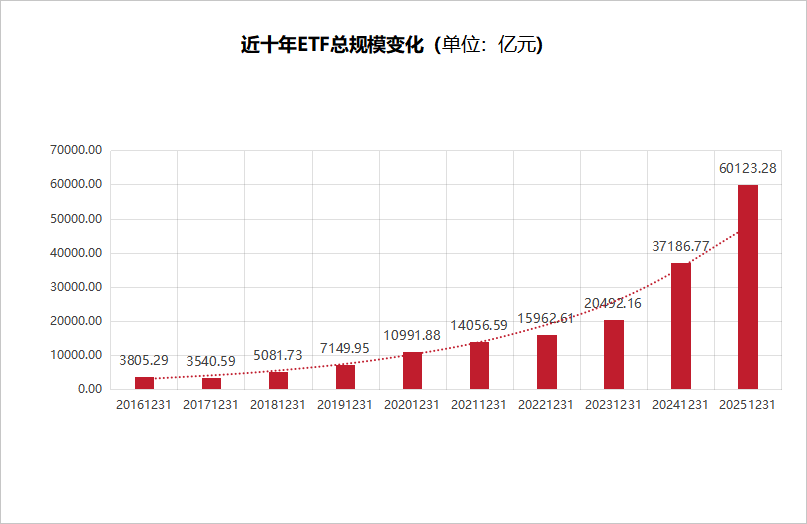
专题:新浪仓石基金研究院 过去十年,是中国公募基金行业,尤其是交易型开放式指数基金(ETF)实现跨越式发展的黄金年代。市场从一个 小众、专业的投资工具,迅速成长为容纳数万亿资金、产品种类繁多的主流资产配置选项。在此过程中,基金管 理公司的竞争格局也发生了翻天覆地的变化,头部公司的排名座次经历了显著洗牌。 市场全景:规模激增十五倍,参与主体日益丰富 根据Wind数据统计,中国ETF市场的总规模从2016年12月31日的约3805亿元,飙升至2025年12月31日的超过6.01万 亿元,实现了十年15倍的惊人增长。关键节点上,2020年10月ETF规模首次突破1万亿元,2023年底规模达到2.05 万亿元,2024年规模激增1.68万亿元,9月突破3万亿元;2025年实现历史性跨越——4月破4万亿、8月破5万亿、12 月破6万亿,年内连跨三个万亿级整数关口。 数据来源:Wind 统计区间:2016年12月31日-2025年12月31日 产品数量也从最初的146只激增至1381只,数量增长近9倍,为投资者提供了覆盖海内外、横跨股债商品的多维度 选择。 与此同时,参与ETF管理的基金公司数量从33家扩充至57家,显示 ...