
景顺长城

Search documents
多只基金收益超10%!景顺长城“固收+”表现亮眼
Xin Lang Ji Jin· 2025-10-27 07:34
Core Insights - The A-share market has shown significant profit-making effects this year, boosting the "fixed income +" fund sector and driving the growth of traditional equity firms' "fixed income +" businesses [1][4] - In particular, the performance of Invesco Great Wall's "fixed income +" funds has been outstanding, with an average return of 6.83% year-to-date, significantly outperforming various bond indices [1][4] Fund Performance - In the secondary bond fund sector, the Invesco Great Wall Jingyifengli fund has achieved a return of 20.73% this year, ranking 9th out of 502 in the past year and 1st out of 421 over the past two years [1][2] - The Invesco Great Wall Ningjing fund, managed by Dong Han and Li Xunlian, has employed a barbell strategy, achieving a return of 13.05% this year, with strong rankings in the past three years [2] - The Invesco Great Wall Stable Income fund, managed by Li Xunlian and He Jiangbo, has focused on convertible bonds, achieving a return of 9.75% this year, ranking 10th out of 267 in the past year [3] Risk Management and Strategy - The average maximum drawdown for the 24 "fixed income +" funds is -2.34%, which is lower than the average drawdown of -3.28% for similar funds [3] - Invesco Great Wall emphasizes the diversity of enhancement strategies across its "fixed income +" products, tailoring strategies to different fund managers' styles and client risk preferences [3][4] Overall Investment Capability - Invesco Great Wall ranks first among large fixed income fund companies in absolute returns over the past two, three, and five years, according to a report by Guotai Junan Securities [4] - The company's strong equity investment capabilities complement its fixed income performance, contributing to the overall success of its "fixed income +" funds [4]
危险的科技成长基金
Hu Xiu· 2025-10-27 02:52
Core Viewpoint - The recent surge in A-share technology growth stocks has created both excitement and anxiety among investors, with a significant focus on AI computing, innovative pharmaceuticals, and robotics sectors, which are expected to drive China's economic growth in the future [3][4]. Investment Trends - Leading funds this year have primarily concentrated their investments in AI computing, innovative pharmaceuticals, and robotics, with some funds achieving over 200% returns [3]. - The A-share market is expected to continue offering opportunities in these technology sectors, as major fund companies are directing their research resources towards exploring industry trends [4]. Fund Performance - High-performing technology funds include both large and small public fund companies, with smaller firms often taking more concentrated positions in popular sectors like AI computing [10]. - For instance, as of October 20, a fund named Xinao achieved a 94.15% return, while another fund, Zhonghang, reached 108.17% [10]. Fund Manager Dynamics - Smaller companies tend to adopt more aggressive investment strategies to achieve higher returns, while larger firms focus on balanced portfolios [11]. - The top ten active equity fund companies as of Q2 2025 include Yifangda, Zhongou, and Fuguo, with each having a substantial number of technology-focused fund managers [15]. Team Structure and Strategy - Leading fund companies are enhancing their technology research teams, with a focus on specialization and collaboration to improve coverage of various technology sectors [17][25]. - For example, Zhongou has expanded its technology research team to create a more industrialized approach, while Huatai has divided its research department into specialized groups [17]. Long-term Stability vs. Short-term Gains - Investors are advised to focus on the stability of fund performance over the long term, as technology funds can experience significant volatility [18][23]. - Historical examples illustrate that while some fund managers have achieved remarkable short-term gains, sustaining those returns has proven challenging [18]. Selection Criteria for Investors - Investors should consider the talent structure, performance stability, and research capabilities of fund teams when selecting technology growth funds [43]. - The top-tier public funds in technology growth include Fuguo, Yifangda, and Zhongou, each with distinct strengths and weaknesses in their fund management teams [43][44].
机构风向标 | 华新环保(301265)2025年三季度已披露持仓机构仅5家
Xin Lang Cai Jing· 2025-10-27 01:22
Core Viewpoint - Huanxin Environmental (301265.SZ) reported its Q3 2025 results, highlighting a total institutional ownership of 73.632 million shares, representing 24.30% of the company's total equity, with a slight decline in institutional ownership compared to the previous quarter [1] Institutional Ownership - As of October 26, 2025, five institutional investors disclosed their holdings in Huanxin Environmental, with a combined ownership of 73.632 million shares, accounting for 24.30% of the total shares [1] - The institutional ownership percentage decreased by 0.83 percentage points compared to the previous quarter [1] Public Fund Disclosure - In this reporting period, 26 public funds were disclosed, including notable funds such as Invesco Great Wall Growth Enterprise Index Enhanced A, Morgan Stanley ESG Quantitative Mixed, and GF Value Leading Mixed A [1]
3900点之上如何布局?头部公募策略会解码四季度攻守之道,AI、有色、创新药接下来这样走
券商中国· 2025-10-23 23:33
Core Viewpoint - The article discusses the investment strategies and opportunities in the context of recent market fluctuations, particularly after the Shanghai Composite Index reached a ten-year high, emphasizing the importance of a balanced investment approach in the face of volatility [1][2]. Group 1: Investment Opportunities in Key Sectors - The article highlights three major sectors: AI, non-ferrous metals, and innovative pharmaceuticals, asserting that their long-term investment logic remains solid despite recent adjustments [3][5]. - AI investments are focused on computing power and applications, with a notable emphasis on the demand from major clients like NVIDIA and Google, as well as the energy constraints affecting computing investments [3][4]. - The non-ferrous metals sector is characterized as "cyclical growth," driven by energy transition, defense spending, and AI, indicating a shift from traditional industries to growth-oriented sectors [4]. Group 2: Insights from Emerging Fund Managers - Emerging fund managers emphasize the importance of new technologies and consumption trends, identifying structural opportunities in the new economy [6][7]. - The renewable energy sector is expected to experience a "profit inflection point" and technological breakthroughs, particularly in energy storage and solid-state battery technology [6]. - The AI sector is seen as a catalyst for a "productivity revolution," with significant advancements in efficiency across various industries, including gaming and customer service [7]. Group 3: Balanced Investment Strategies - The article advocates for a balanced investment strategy to navigate market volatility, focusing on growth and valuation equilibrium, investment duration balance, and diverse sources of investment opportunities [9][10]. - Key areas for investment include energy storage and power equipment, driven by the increasing demand for renewable energy and grid upgrades [10][11]. - The article also notes the importance of technological advancements, such as improvements in photovoltaic technology, which are expected to enhance profitability in the solar industry [11]. Group 4: Specific Investment Recommendations - The article suggests a "barbell strategy" for portfolio allocation, combining defensive and growth assets, particularly in sectors like finance and power equipment [14]. - It highlights structural opportunities in consumer sectors, particularly those catering to younger demographics and emerging consumer trends [14][15]. - The military industry is identified as a growth area, with increasing demand for military exports and the importance of data capabilities in modern warfare [15][16]. Group 5: Overall Market Outlook - The article concludes that despite the challenges posed by U.S.-China trade tensions and structural shifts in the economy, the overarching themes of global easing and domestic new momentum remain intact [16]. - Investors are encouraged to adopt a long-term perspective, focusing on sectors with strong fundamentals and avoiding short-term speculative behaviors [16].


公募基金“换帅潮”观察:头部机构集中调整,多为股东委派
Nan Fang Du Shi Bao· 2025-10-23 12:03
Core Insights - The public fund industry has experienced a significant leadership change since 2025, with 47 fund companies changing chairpersons, involving 85 individuals, which is nearly 30% of the total industry institutions [1][2] - Major institutions like Huaxia Fund, China Merchants Fund, and Bosera Fund have also undergone leadership changes, indicating a reshaping of the industry landscape [1][2] Leadership Changes in Major Institutions - In the first three quarters, 43 public fund companies changed chairpersons, a nearly 23% increase from 35 in the same period last year [2] - Bosera Fund announced the resignation of Jiang Xiangyang on October 15, with Zhang Dong taking over as chairman [2] - Huaxia Fund appointed Zou Yingguang as chairman after the departure of Zhang Youjun on September 30 [2] - China Merchants Fund's chairman Wang Xiaoqing resigned on September 24, with Zhong Wenyue temporarily assuming the role [2] Frequent Changes in Smaller Institutions - Smaller fund companies have seen more frequent leadership changes, with some like Xingyin Fund changing chairpersons twice since April 2023 [4] - Certain companies, such as Xinjiang Qianhai United Fund and Xinda Australia Fund, are currently operating with interim chairpersons due to vacancies [4] Factors Driving the Leadership Changes - The leadership changes are attributed to multiple factors, including the industry's shift from "scale competition" to "capability competition" [5][6] - Increased competition and stricter regulatory requirements have prompted shareholders to replace chairpersons to enhance governance and drive investment transformation [6] - Some changes are due to normal transitions, such as retirements, while others are influenced by regulatory policies aimed at optimizing governance structures [6] Impacts of Leadership Changes - The impact of these changes can vary significantly, potentially serving as a turning point for development or leading to setbacks [7] - Effective transitions can inject new energy into investment research and business innovation, while poor transitions may disrupt core talent retention and research momentum [7] - Companies are encouraged to clarify new leaders' responsibilities and strategic directions to ensure stability during transitions [7] Conclusion - The leadership changes in the public fund industry represent an inevitable outcome of industry transformation and a new starting point for high-quality development [8] - The future challenge for the industry will be balancing strategic continuity with innovative breakthroughs amidst these changes [8]
市场早盘震荡走强,中证A500指数上涨0.97%,3只中证A500相关ETF成交额超25亿元
Sou Hu Cai Jing· 2025-10-20 05:35
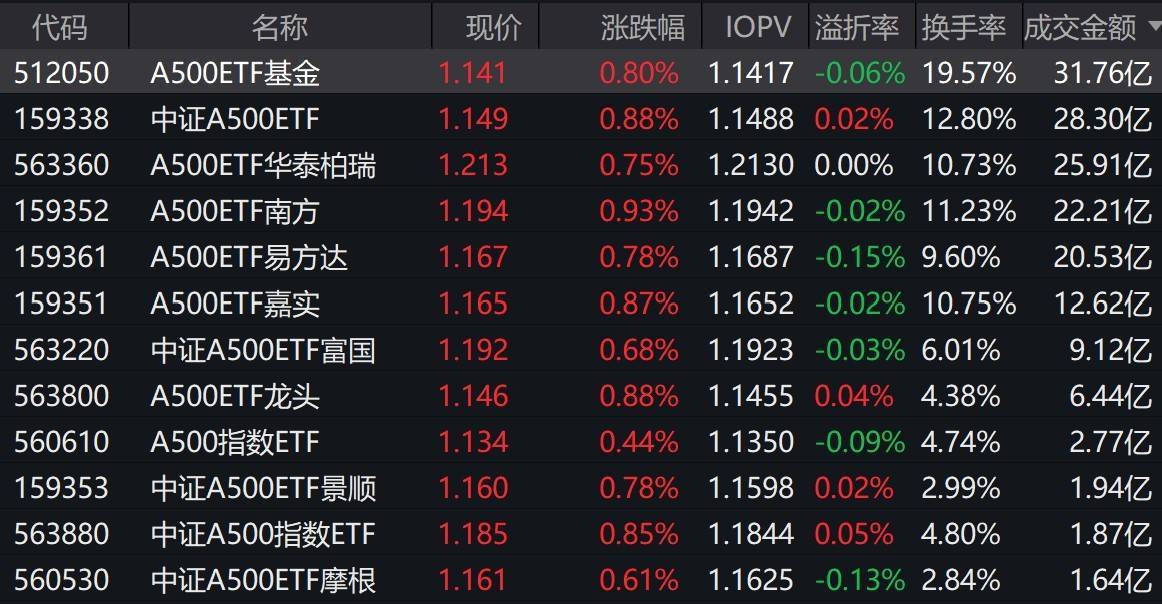
Market Overview - The market showed a strong upward trend in the early session, with the ChiNext Index leading the gains and the CSI A500 Index rising by 0.97% [1] - Various sectors experienced active trading, particularly computing hardware stocks, robotics concepts, and the semiconductor industry, while the coal sector maintained its strength [1] ETF Performance - As of the morning close, ETFs tracking the CSI A500 Index saw slight increases, with 12 related ETFs having transaction volumes exceeding 100 million yuan, and 3 surpassing 2.5 billion yuan [1] - Specific transaction volumes for A500 ETFs included 3.176 billion yuan for A500 ETF Fund, 2.83 billion yuan for CSI A500 ETF, and 2.591 billion yuan for A500 ETF Huatai Baichuan [1] Market Sentiment - Analysts from brokerage firms indicated that the foundation for the current slow bull market remains intact, supported by ongoing global technology investment enthusiasm, "anti-involution" policies, and increased household savings entering the market [1] - There is an expectation that the A-share index has the potential to continue strengthening in the fourth quarter [1]
快速建仓!上百只次新权益基金,大涨超20%
中国基金报· 2025-10-19 14:11
Core Viewpoint - The article highlights the rapid establishment and performance of new equity funds in the A-share market, with over 120 funds achieving returns exceeding 20% since their inception, driven by a favorable market environment and proactive fund management strategies [2][4][6]. Market Performance - Since the second half of the year, the A-share market has shown active performance, with the Shanghai Composite Index rising by 11.48% and the Shenzhen Component Index increasing by 21.25% from July 1 to October 17. The ChiNext Index and the STAR 50 Index have performed even better, with increases of 36% and 35% respectively [5]. New Fund Performance - As of October 17, 122 new equity funds established since the second quarter have recorded net value growth rates exceeding 20%, with 66 of these funds achieving growth rates over 30%. For instance, the Invesco Great Wall Emerging Industry fund, established on April 1, has seen a net value increase of 66.81% [6][7]. Fund Manager Strategies - Fund managers have been aggressive in their investment strategies, quickly initiating positions after fund establishment. This proactive approach has allowed them to capitalize on market uptrends. The article notes that many successful new funds have focused on technology growth sectors and resource areas, benefiting from the strong performance of technology innovation and non-ferrous metal sectors in recent months [7][8]. Continued Optimism - As the market enters the fourth quarter, fund managers remain optimistic and continue to actively build positions. New funds established in late September and October have also shown quick net value changes, indicating a sustained aggressive investment approach [9][10]. Investment Focus - The current market trend favors technology growth and cyclical dividend styles, with fund managers believing that despite potential short-term adjustments, there are still ample opportunities for investment. They emphasize a balanced approach that combines offensive and defensive strategies, focusing on high-growth technology stocks while also investing in stable cyclical leaders to mitigate risks [11].

报名即将截止 | 穿越波动,布局未来:彭博ETF市场展望研讨会
彭博Bloomberg· 2025-10-17 06:04
Core Insights - The trading volume of ETFs in China is expected to continue growing by 2025, attracting more global market makers and enhancing market liquidity and pricing efficiency [2] - The widespread application of quantitative investment research is injecting new growth momentum into the ETF market in China, Asia-Pacific, and globally [2] Group 1: Event Overview - Bloomberg is hosting a seminar focusing on the future growth points of the ETF market in China and other key global markets, as well as practical experiences in quantitative research and risk management [2][3] - The seminar aims to provide insights into the future landscape of ETFs and capture diverse investment opportunities [2] Group 2: Agenda Highlights - The event will feature discussions on customized indices empowering ETF investment strategies and include interactive exchanges [7] - Key topics include the future blueprint of ETFs, opportunities and risks in quantitative research, and strategy optimization through various market cycles [3][7] Group 3: Featured Speakers - The seminar will host industry experts from various financial institutions, including senior managers and directors from major asset management firms [8][9][10]
市场早盘震荡下挫,中证A500指数下跌1.5%,3只中证A500相关ETF成交额超31亿元
Sou Hu Cai Jing· 2025-10-17 03:58
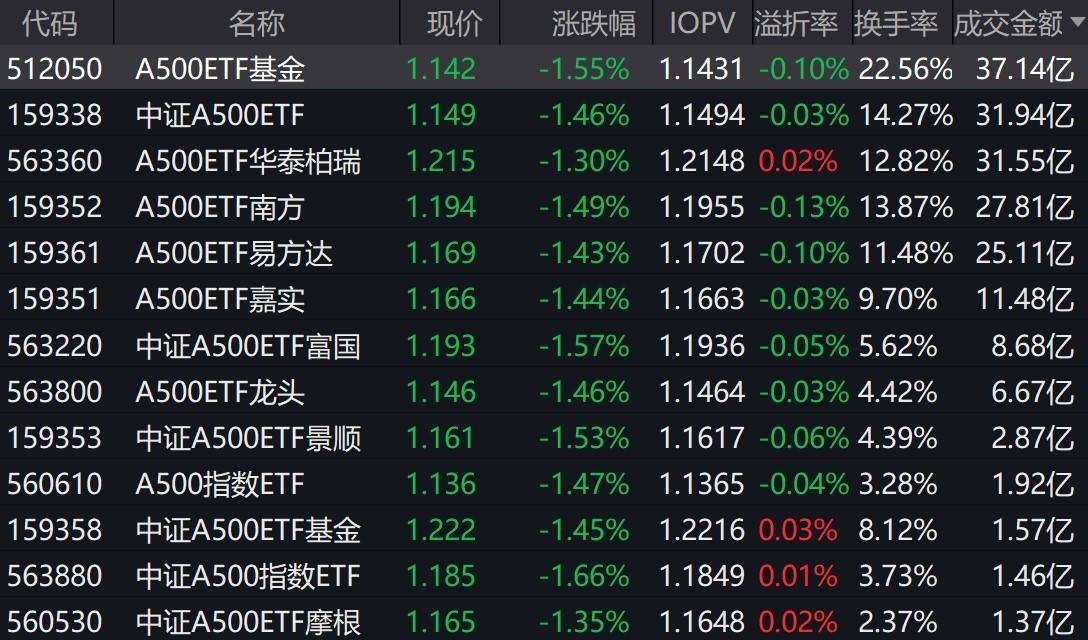
Market Overview - The market experienced a downward trend in early trading, with the Shenzhen Component Index and ChiNext Index both falling over 2%, while the CSI A500 Index declined by 1.5% [1] - The port and shipping sector continued to show strength, with coal and gas stocks also performing well, while the banking sector fluctuated upwards [1] - Conversely, the data center power supply concept saw a significant drop [1] ETF Performance - As of the morning close, ETFs tracking the CSI A500 Index fell over 1%, with 13 related ETFs having a trading volume exceeding 100 million yuan, and 3 surpassing 3.1 billion yuan [1] - Specific trading volumes for A500 ETFs included 3.714 billion yuan for A500 ETF Fund, 3.194 billion yuan for CSI A500 ETF, and 3.155 billion yuan for A500 ETF Huatai-PineBridge [1] Analyst Insights - Analysts indicated that as the impact of tariff shocks diminishes and with expectations of gradual economic improvement in the fourth quarter due to policy support, the market may maintain a steady upward trend, particularly in technology assets [1] - However, it is noted that recent trading volumes have decreased compared to previous periods, suggesting a potential shift towards more cautious and stable investment strategies [1]
ETF观察日志(2025-10-16):麦高视野
Mai Gao Zheng Quan· 2025-10-17 03:03
- The report includes the construction of the RSI (Relative Strength Index) factor, which is calculated using the formula: $ RSI = 100 - 100 / (1 + RS) $, where RS represents the ratio of average gains to average losses over a 12-day period. RSI values above 70 indicate an overbought market, while values below 30 suggest an oversold market [2] - The report also introduces the Net Purchase (NETBUY) factor, calculated using the formula: $ NETBUY(T) = NAV(T) - NAV(T-1) * (1 + R(T)) $, where NETBUY(T) represents the net purchase amount, NAV(T) is the ETF net asset value on day T, and R(T) is the return on day T [2] - The report provides daily tracking of ETF data, segmented into "Broad-based" and "Thematic" categories based on the indices they track, such as CSI 300, CSI 500, and industry-specific indices like non-bank financials and dividends [2][3] - The RSI factor is evaluated as a useful indicator for identifying market conditions, such as overbought or oversold states, aiding in short-term trading decisions [2] - The Net Purchase factor is assessed as a measure of fund flow dynamics, reflecting investor sentiment and activity in ETF markets [2] - RSI values for various ETFs are provided, such as 58.17 for Huatai-PineBridge CSI 300 ETF, 57.53 for E Fund CSI 300 ETF, and 51.89 for Southern CSI 500 ETF, among others [4] - Net Purchase values for ETFs are also listed, including -13.98 billion for Huatai-PineBridge CSI 300 ETF, 0.70 billion for E Fund CSI 300 ETF, and -12.21 billion for Southern CSI 500 ETF, among others [4]