晶科能源

Search documents
光伏组件价格开年持续上涨,光伏ETF(159857)盘中获净申购800万份,成交额暂居深市同标的第一
2 1 Shi Ji Jing Ji Bao Dao· 2026-02-12 04:33
光伏ETF(159857)是深市中跟踪中证光伏产业指数规模最大的ETF。截至2月11日收盘,该ETF最新流 通份额为25.57亿份,最新流通规模为24.18亿元。该ETF还配备了场外联接基金(C类:011103)。 (文章来源:21世纪经济报道) 2月12日,三大指数集体上涨,光伏板块表现活跃。中证光伏产业指数(931151.CSI)上涨1.03%,该指数 成分股中,石英股份、金开新能、科士达涨停,科华数据涨超7%,电投绿能上涨超5%。 消息面上,据中国网,2026年开年,光伏行业暖意凸显。光伏组件价格快速上行,一线企业集体调价释 放出强烈的市场回暖信号。开年以来,天合光能三度上调分布式光伏组件价格,最新中版型、大版型组 件报价为0.88-0.92+元/W,防眩光组件0.95-0.99+元/W,轻质单玻组件1.08-1.12+元/W。与此同时,晶科 能源、晶澳科技等一线企业也纷纷跟进上调报价。 相关ETF方面,据wind金融终端,截至发稿,光伏ETF(159857)盘中获净申购800万份,成交额超1亿元 暂居深市同标的第一。资金流向方面,该ETF上个交易日(2月11日)净流入额为3814.62万元,截至上个 ...
金元证券每日晨报-20260212
Jinyuan Securities· 2026-02-12 03:01
Group 1: Market Overview - The A-share market showed mixed performance with the Shanghai Composite Index rising by 0.09% to 4,131.98 points, while the Shenzhen Component Index fell by 0.35% to 14,160.93 points and the ChiNext Index decreased by 1.08% to 3,284.74 points, with a total market turnover of 2 trillion yuan [10][11] - In the Asia-Pacific market, the Hong Kong Hang Seng Index increased by 0.31% to 27,266.38 points, and the South Korean Composite Index closed up by 1% at 5,354.49 points [10] - The European market saw the FTSE 100 rise by 1.14% to 10,472.11 points, while the DAX 30 fell by 0.53% to 24,856.15 points [10] - In the US market, the Dow Jones Industrial Average decreased by 0.13% to 50,121.4 points, and the Nasdaq fell by 0.16% to 23,066.47 points [10] Group 2: Domestic News - The China Automotive Industry Association reported that in January, the production and sales of new energy vehicles reached 1.041 million and 945,000 units respectively, with exports doubling year-on-year to 302,000 units [11] - A successful test of the Long March 10 rocket system and the crewed spacecraft recovery mission marked a significant milestone for China's lunar exploration program [11] - The State Council issued an opinion on improving the national unified electricity market system, aiming for full establishment by 2035 [13] - The State-owned Assets Supervision and Administration Commission announced an "AI+" initiative to enhance investment in computing power to support the AI industry [13] Group 3: Industry Developments - The low-altitude economy sector is seeing growth with the first flight of the 5-ton eVTOL V5000 and the opening of the first batch of helicopter takeoff and landing points in Dongguan [16] - A strategic cooperation agreement was signed between Guangdian Measurement and Wuhan Economic Development to establish a low-altitude equipment testing and certification center [15]
美股震荡收跌,非农数据亮眼改写降息路径?美光闪迪飙升10%,引爆存储板块,AI应用软件股集体下挫
Jin Rong Jie· 2026-02-12 01:32
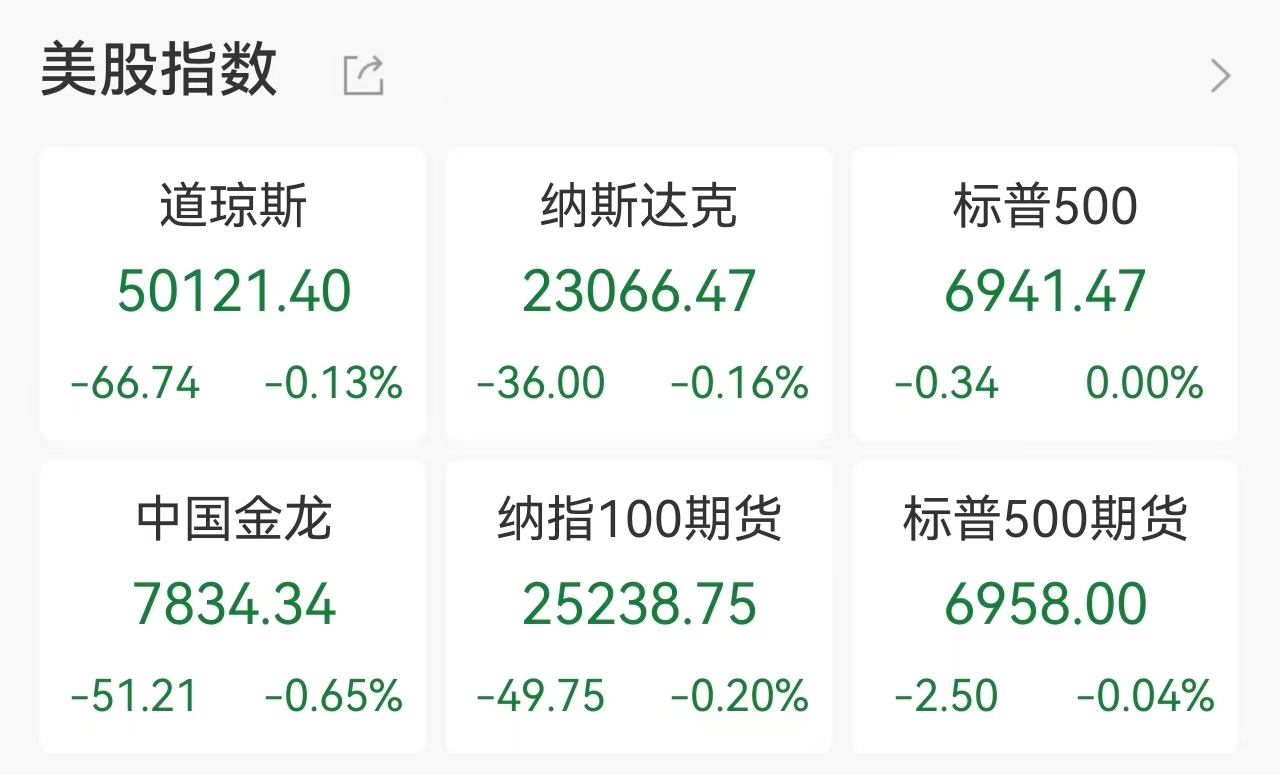
Market Overview - The US stock market experienced a volatile session on February 11, with major indices closing slightly lower after an initial boost from better-than-expected January non-farm payroll data [1] - The Dow Jones Industrial Average fell by 0.13% to 50,121.40 points, the S&P 500 decreased by 0.34% to 6,941.47 points, and the Nasdaq Composite dropped by 0.16% to 23,066.47 points [1] Employment Data - The January non-farm payroll data showed a significant increase of 130,000 jobs, surpassing the market expectation of 55,000, with the unemployment rate dropping to 4.3% [3][4] - The majority of new jobs (124,000) were concentrated in the healthcare sector, which is double the normal growth rate for 2025, while other sectors contributed minimally [3] - Despite the positive headline figures, there are concerns about the labor market's recovery, as previous employment data has been revised downward [3] Federal Reserve Policy Expectations - The strong employment data has led to a shift in market expectations regarding the Federal Reserve's monetary policy, delaying the anticipated rate cuts [4] - The probability of the Fed maintaining rates in March is now at 94.1%, with only a 5.9% chance of a 25 basis point cut [4] - The next expected rate cut has been pushed from June to July, reflecting a cautious outlook on monetary easing [4] Sector Performance - The semiconductor and storage sectors stood out, with the Philadelphia Semiconductor Index rising by 2.28%, and Micron Technology and SanDisk seeing gains of 9.94% and 10.65%, respectively [5] - In contrast, large tech stocks and software companies underperformed, with the major tech index declining by 0.57% [5] - Notable declines were observed in companies like Google and Microsoft, both dropping over 2%, while Apple saw a slight increase of 0.67% despite negative news regarding its AI features [5] Commodity Prices - International precious metals prices surged, with COMEX gold futures rising by 1.53% to $5,107.80 per ounce, and silver futures increasing by 4.6% [11] - Oil prices also climbed, with NYMEX WTI crude futures up by 1.05% to $64.63 per barrel, driven by geopolitical factors and discussions between the US and Venezuela regarding energy cooperation [11] Company News - Meta announced an investment of over $10 billion to build a 1 GW data center in Indiana, enhancing its AI infrastructure [12] - Google introduced a new AI shopping feature integrated into its search engine and Gemini chatbot, aiming to accelerate AI commercialization [12] - Kraft Heinz has paused its spin-off plan, focusing on improving company performance under new leadership [12]

美股深夜巨震,芯片股全线大涨,美光科技涨近10%,金银油价齐涨,特朗普要求与伊朗继续谈判
2 1 Shi Ji Jing Ji Bao Dao· 2026-02-11 23:29
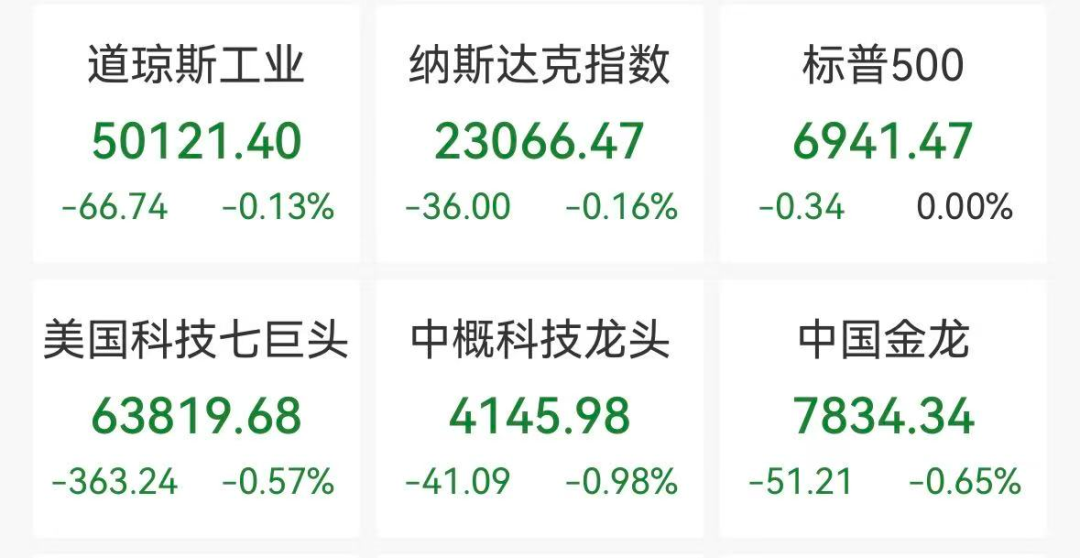
Market Overview - US stock indices opened higher after the latest non-farm payroll data but turned negative during the day, with the Dow Jones down 0.13%, S&P 500 flat, and Nasdaq down 0.16% [1] Technology Sector - Major tech stocks showed mixed results, with Google and Microsoft down over 2%, Amazon down more than 1%, while Nvidia rose 0.78%, Tesla 0.8%, and Apple 0.67% [2] - Semiconductor stocks generally rose, with the Philadelphia Semiconductor Index up 2.28%, GlobalFoundries up over 16%, Micron Technology up nearly 10%, and NXP Semiconductors and Microchip Technology up over 5% [2] - AI application software stocks fell broadly, with Shopify down over 6%, Reddit down over 7%, and Adobe down nearly 3% [2] - There is a divergence in market opinions regarding the recent decline in software stocks, with Citigroup warning that software stocks have not "bottomed out," while JPMorgan suggests that fears of AI replacing software applications are overstated, recommending investors to buy on dips [2] Chinese Stocks - The Nasdaq Golden Dragon China Index fell 0.65%, with notable declines in stocks such as Huya down over 5% and JinkoSolar down over 5% [2] - Conversely, Century Internet rose over 12%, and Kingsoft Cloud rose about 10% [2] Commodities - International gold prices rose over 1% to $5083.7 per ounce, with a peak of $5100 earlier [4] - Silver prices increased over 4% to $84.3 per ounce [4] - WTI crude oil futures rose 1.05% to $64.63 per barrel, while Brent crude oil futures rose 0.87% to $69.40 per barrel [5] Cryptocurrency - Major cryptocurrencies experienced declines, with Bitcoin dropping to $67,000, and over 135,000 individuals liquidated in the past 24 hours [6]

美股深夜巨震,芯片股全线大涨,美光科技涨近10%,金银油价齐涨,特朗普要求与伊朗继续谈判
21世纪经济报道· 2026-02-11 23:11
Market Overview - US stock indices opened higher after the latest non-farm payroll data but experienced a decline during the trading session, with the Dow Jones down 0.13%, S&P 500 nearly flat, and Nasdaq down 0.16% [1] - Major technology stocks showed mixed results, with Google and Microsoft dropping over 2%, while Nvidia and Tesla rose by 0.78% and 0.8% respectively [2] Technology Sector - The Philadelphia Semiconductor Index increased by 2.28%, with notable gains in stocks such as GlobalFoundries up over 16% and Micron Technology nearly 10% [2] - AI application software stocks faced significant declines, with Shopify dropping over 6% and Reddit down more than 7% [2][3] Chinese Stocks - The Nasdaq Golden Dragon China Index fell by 0.65%, with notable declines in stocks like Huya and JinkoSolar, both down over 5% [3] - However, Century Internet saw a rise of over 12%, and Kingsoft Cloud increased by approximately 10% [3] Commodity Markets - International gold prices rose over 1%, closing at $5083.7 per ounce, while silver prices increased by over 4% to $84.3 per ounce [3] - Crude oil prices also saw an uptick, with WTI crude futures up 1.05% to $64.63 per barrel and Brent crude futures up 0.87% to $69.40 per barrel [5] Economic Indicators - The US non-farm payroll report indicated an addition of 130,000 jobs in January, exceeding market expectations, which led traders to adjust their forecasts for the Federal Reserve's interest rate cuts [5] - The probability of a 25 basis point rate cut by March is currently at 5.9%, with a 94.1% chance of maintaining the current rate [5]

中资企业全球化布局落子新加坡
Jing Ji Ri Bao· 2026-02-11 21:59
Core Insights - Singapore attracted 14.2 billion SGD in fixed asset investments in 2025, marking a 5.2% year-on-year increase despite global geopolitical and economic challenges [1] - Chinese investments surged, increasing from 2.5% in 2024 to 20.6% in 2025, surpassing the US to become Singapore's second-largest investment source after Europe [1] Investment Structure - Of the 14.2 billion SGD in fixed asset investment commitments, approximately 12.1 billion SGD came from manufacturing-related projects, accounting for 85% [2] - Semiconductor manufacturing led the investments, contributing 33% of the fixed asset investments, driven by the explosive growth in global AI demand [2] - Investments in biopharmaceutical manufacturing, specialty chemicals, sustainable materials, and aerospace maintenance also saw significant interest from Chinese enterprises [2] Strategic Shifts in Operations - 55% of surveyed Chinese enterprises rated Singapore's business environment as "excellent," with public services and financial systems being key attractions [3] - The strategic positioning of Chinese enterprises in Singapore has evolved from a "springboard" to a "regional headquarters hub," with over 70% viewing the Johor-Singapore Economic Zone as vital for capacity expansion and cost management [3] Full Industry Chain Ecosystem - Chinese companies are establishing a comprehensive industry chain ecosystem in Singapore, with firms like ByteDance and Ant Group setting up regional headquarters [4] - This integrated model of "R&D + manufacturing + sales + financial management" signifies a shift from simple market expansion to global value chain restructuring [4] - Singapore's role as an international financial center facilitates comprehensive financial services for Chinese enterprises, reducing reliance on the US dollar system [4] Regional Economic Integration - The influx of Chinese investments in Singapore reflects the accelerating economic integration between China and Southeast Asia [5] - The model of "Singapore base + ASEAN manufacturing + global sales" is being replicated in countries like Vietnam and Malaysia, reshaping the global supply chain geography [5] Future Outlook - The investment trend from Chinese enterprises in Singapore is expected to continue, driven by factors such as the advancement of the China-Singapore Free Trade Agreement and Singapore's role in digital currency trials [6] - Despite potential challenges, the Singapore model remains a preferred strategy for Chinese enterprises to navigate trade barriers and expand into global markets [6]
或终止项目或剥离资产 部分A股“追光者”止损
Shang Hai Zheng Quan Bao· 2026-02-11 17:57
Core Viewpoint - The photovoltaic industry is transitioning from oversupply to a phase of accelerated capacity clearance, with expectations of a more intense market correction in 2026 compared to 2025 due to weakening demand forecasts [1][4]. Group 1: Company Actions - Several photovoltaic companies, including Mingguan New Materials and Trina Solar, have announced project terminations or fund reallocations to more promising areas due to declining profitability in the industry [2]. - Mingguan New Materials terminated its investment in a solar backplane production project, initially planned with a total investment of 5 billion yuan, citing industry competition and rising operational costs as reasons [2]. - Trina Solar plans to reduce funding for its original project and redirect remaining funds to a new distributed smart photovoltaic power station project, which is expected to contribute a net profit of 94.91 million yuan annually [2]. Group 2: Production Adjustments - Some companies, such as Oujing Technology and Tianyi New Materials, have suspended production due to decreased demand from downstream customers, with utilization rates as low as 14.66% for certain subsidiaries [3]. - Cross-industry companies like *ST Lvkang have completely exited the photovoltaic sector to alleviate financial pressures by selling all assets related to photovoltaic film business [3]. Group 3: Supply and Demand Dynamics - The photovoltaic industry is facing significant excess capacity, with analysts noting that the slowdown in short-term demand exacerbates supply chain pressures [4]. - The China Photovoltaic Industry Association projects a decrease in new photovoltaic installations in 2026, estimating a range of 180 GW to 240 GW, down from 315.07 GW in 2025, indicating a decline of 24% to 43% [4]. Group 4: Future Market Outlook - Global photovoltaic installation growth is also expected to slow, with projections for 2026 ranging from 500 GW to 667 GW, compared to 580 GW in 2025 [5]. - Analysts predict that the era of high growth in the photovoltaic sector may be over, with annual growth rates potentially stabilizing at around 3% after 2027 [5]. Group 5: Industry Resilience and New Opportunities - The competitive environment has fostered resilience and adaptability among Chinese companies, prompting them to seek new growth avenues beyond traditional photovoltaic operations [7]. - Companies are focusing on cost control and efficiency improvements to maintain competitiveness, while also exploring diversification into areas like energy storage and new photovoltaic applications [8][9]. - Trina Solar has set ambitious profit targets for 2026, reflecting confidence in recovering profitability and expanding into energy solutions [8].


光伏行业“反内卷”成效进一步显现
Zheng Quan Ri Bao· 2026-02-11 16:28
Core Viewpoint - The photovoltaic industry is experiencing a clear trend of cost differentiation driven by fluctuations in silver prices and technological advancements, leading to a reduction in industry competition [1][8]. Cost Pressure - The global demand for silver is expected to remain strong through 2026, supported by geopolitical tensions and uncertainty in U.S. policies, despite a projected 17% reduction in global jewelry and silverware demand due to high prices [2]. - The silver price has increased by 11% this year, following its historic rise above $100 per ounce in January [2]. - The global silver market is projected to face a supply shortage of approximately 67 million ounces by 2026, marking the sixth consecutive year of deficit [2]. - The photovoltaic sector, as a major consumer of silver, will continue to face cost pressures due to high silver prices, prompting companies to accelerate the development of silver paste alternatives [2][3]. Technological Breakthroughs - Leading companies in the photovoltaic industry are making significant progress in developing silver paste alternatives, with some planning large-scale production of low-cost metal alternatives [4]. - Longi Green Energy has announced plans to start large-scale production of a copper paste solution in Q2 of this year, which could reduce component costs by approximately 0.02 yuan per watt [4]. - Other major players, including Aiko Solar and JinkoSolar, are also actively pursuing silver paste replacement technologies, with JinkoSolar collaborating with Wuxi Dike Electronic Materials to innovate in low-silver metallization techniques [4][5]. Industry Restructuring - The photovoltaic industry is expected to shift towards high-efficiency and reliable components, with companies possessing technological advantages able to command price premiums [6]. - The new installed capacity of photovoltaic systems in China is projected to reach between 180 GW and 240 GW in 2026, marking a significant turning point after years of growth [6]. - The transition towards high-quality development in the photovoltaic sector will be driven by upgraded end-user demand, which will compel manufacturers to enhance technology and market mechanisms [8].



晶科能源跌1.48%,成交额25.45亿元,近5日主力净流入-6.47亿
Xin Lang Cai Jing· 2026-02-11 07:54
Core Viewpoint - JinkoSolar is focusing on advanced battery technologies, particularly N-type TOPCon, and aims to maintain its leadership in the solar energy sector through continuous investment in innovation and production capacity [2][3]. Group 1: Company Performance - On February 11, JinkoSolar's stock fell by 1.48%, with a trading volume of 2.545 billion yuan and a turnover rate of 3.11%, bringing the total market capitalization to 80.042 billion yuan [1]. - For the period from January to September 2025, JinkoSolar reported a revenue of 47.986 billion yuan, a year-on-year decrease of 33.14%, and a net profit attributable to shareholders of -3.92 billion yuan, a significant decline of 422.67% [7][8]. Group 2: Technological Advancements - The company has successfully mass-produced high-efficiency N-type TOPCon batteries and is actively developing new technologies, including IBC and perovskite batteries [2]. - JinkoSolar's advancements in TOPCon and perovskite technologies have led to a world record in conversion efficiency for their stacked battery technology, showcasing the potential for commercial scalability in the coming years [2]. Group 3: Market Dynamics - The main business of JinkoSolar includes the research, production, and sales of solar photovoltaic modules, battery cells, and silicon wafers, providing high-quality solar products globally [3]. - As of September 30, 2025, the number of shareholders in JinkoSolar increased to 77,300, with an average of 129,456 circulating shares per person, reflecting a decrease of 3.97% from the previous period [7].
16.5亿专利费换行业清净: 光伏"反内卷"进入深水区,龙头企业带头付费和解
Di Yi Cai Jing· 2026-02-11 04:21
Core Viewpoint - The photovoltaic industry is moving towards a "deeper water zone" as companies are ending patent disputes, signaling a shift away from internal competition and towards healthier industry practices [1][5]. Group 1: Patent Agreements - Longi Green Energy and Jinko Solar ended all global patent disputes in September 2022, marking a significant shift in the industry [5]. - Aiko Solar and TCL Zhonghuan recently signed a patent licensing agreement, resolving over two years of patent disputes, with a total licensing fee of 1.65 billion yuan, to be paid in installments from 2026 to 2030 [3][4]. - The licensing agreement allows Aiko Solar access to approximately 1,000 Maxeon patents, with no restrictions on production volumes, thus avoiding lengthy legal processes and focusing on development and innovation [3][4]. Group 2: Industry Implications - The resolution of patent disputes is expected to eliminate uncertainties for overseas clients, leading to price increases for Aiko Solar's products and the introduction of a 0.02 yuan per watt patent fee for downstream customers [4]. - TCL Zhonghuan views the agreement as a means to collaborate with industry partners to build a healthy competitive environment and enhance its market position in the BC battery component sector [4]. - The trend of major companies ending patent disputes is seen as a positive response to the "anti-involution" movement, promoting a more orderly and healthy development of the photovoltaic industry [5]. Group 3: Regulatory Environment - The Ministry of Industry and Information Technology emphasizes that 2026 will be a critical year for addressing internal competition in the photovoltaic industry, focusing on strengthening intellectual property protection and curbing infringement [6]. - The ministry plans to implement measures such as capacity regulation, quality supervision, and price enforcement to achieve a dynamic balance of supply and demand in the industry [6].