越疆

Search documents
港股科网股,集体反弹
第一财经· 2026-01-21 08:38
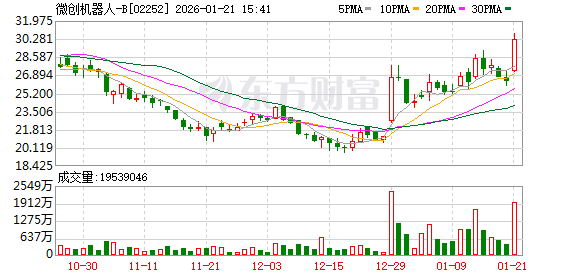
1月21日,恒生指数收涨0.37%,恒生科技指数涨1.11%。 | 代码 | 名称 | 现价 | 涨跌 | 涨跌幅 | 成交额 | | --- | --- | --- | --- | --- | --- | | HSI | 恒生指数 | 26585.06c | 97.55 | 0.37% | 2505亿 | | HSTECH 恒生科技 | | 5746.30c | 62.86 | 1.11% | 662亿 | | HSBIO | 恒生生物科技 | 15873.73c | | 0.83% | 101亿 | | HSCEI | | 恒生中国企业指数 9122.95c | 28.19 | 0.31% | 888亿 | | HSCI | 恒生综合指数 | 4097.20c | 21.38 | 0.52% | 1686亿 | 科网股集体反弹,华虹半导体涨逾5%,商汤涨超4%, 同程旅行、 中芯国际、快手、 百度集团、阿里健康涨逾3%,阿里巴巴、比亚迪股份、哔哩哔哩 等均走高。 机器人股走强,微创机器人涨超17%,卧安机器人涨超10%,越疆涨超9%。 | 微创机器人-B | 30.920 | 17.30% | | --- ...


港股机器人概念股震荡走高,微创机器人(02252.HK)涨近15%,卧安机器人(06600.HK)涨超12%,越疆(02432.HK)涨超8%,高伟电子...
Jin Rong Jie· 2026-01-21 07:43
Core Viewpoint - The Hong Kong stock market is experiencing a surge in robotics concept stocks, with significant gains observed in several companies [1] Group 1: Company Performance - MicroPort Robotics (02252.HK) has seen a nearly 15% increase in its stock price [1] - Woan Robotics (06600.HK) has risen over 12% [1] - Yujian (02432.HK) has gained more than 8% [1] - Gawe Electronics (01415.HK) and Hua Hong Semiconductor (01347.HK) have both increased by over 5% [1]

港股机器人概念股震荡走高,微创机器人涨近15%
Mei Ri Jing Ji Xin Wen· 2026-01-21 07:41
Group 1 - The core viewpoint of the article highlights a significant increase in the stock prices of robotics concept stocks in the Hong Kong market on January 21, with notable gains for several companies [2] Group 2 - MicroPort Robotics (02252.HK) experienced a nearly 15% increase in stock price [2] - Woan Robotics (06600.HK) saw a rise of over 12% [2] - Yujian (02432.HK) reported an increase of over 8% [2] - Gaoweidian Electronics (01415.HK) and Huahong Semiconductor (01347.HK) both rose by over 5% [2]
机器人行业点评报告:机器人密集资本化,产业化有望迎来加速
Shenwan Hongyuan Securities· 2026-01-20 13:45
Investment Rating - The report rates the robotics industry as "Overweight," indicating a positive outlook for the sector compared to the overall market performance [2][8]. Core Insights - The robotics industry is currently experiencing a phase of intensive capitalization, with leading companies preparing for IPOs and existing firms leveraging differentiated capital platforms for expansion. This trend is driven by the industry's transition from zero to one, requiring significant capital for operations, and the favorable regulatory environment creating an optimal window for capitalization over the next 1 to 2 years [2]. - The commercialization of robotics is accelerating, with increased capital expenditure expected to catalyze the development of funding, R&D, industrialization, and application scenarios. The report outlines three stages of commercialization: industrial use, commercial use, and ultimately household use [2]. - Key segments benefiting from the 2026 industrialization of robotics include: 1. The robotics body segment, where leading companies are expected to catalyze market growth through IPOs [2]. 2. The robotics components and modules segment, supported by manufacturing companies in regions like the Yangtze River Delta and Pearl River Delta [2]. 3. The soft technology segment, which may see mergers and acquisitions involving quality startups and unicorns [2]. 4. The application segment, where companies with strong customer loyalty and viable scenarios are likely to launch successful products in collaboration with established robotics firms [2]. Summary by Sections - **Capitalization Phase**: The robotics industry is in a critical phase of capitalization, with numerous companies preparing for public offerings and leveraging existing platforms for growth [2]. - **Commercialization Stages**: The report identifies three stages of robotics commercialization, emphasizing the need for capital and policy support to transition from industrial to household applications [2]. - **Beneficial Segments**: The report highlights four key segments poised for growth, including robotics body, components, soft technology, and applications, each with unique investment opportunities [2]. - **Investment Opportunities**: Recommended stocks include leading companies such as Hengli Hydraulic, Zhejiang Rongtai, and others, indicating a focus on both core and domestic chains within the robotics sector [2].


IDC最新预测:26年人形机器人市场规模将翻倍!机器人ETF基金(159213)微调,连续13日强势吸金超3亿元!小鹏今年将规模量产人形机器人!
Sou Hu Cai Jing· 2026-01-15 06:56
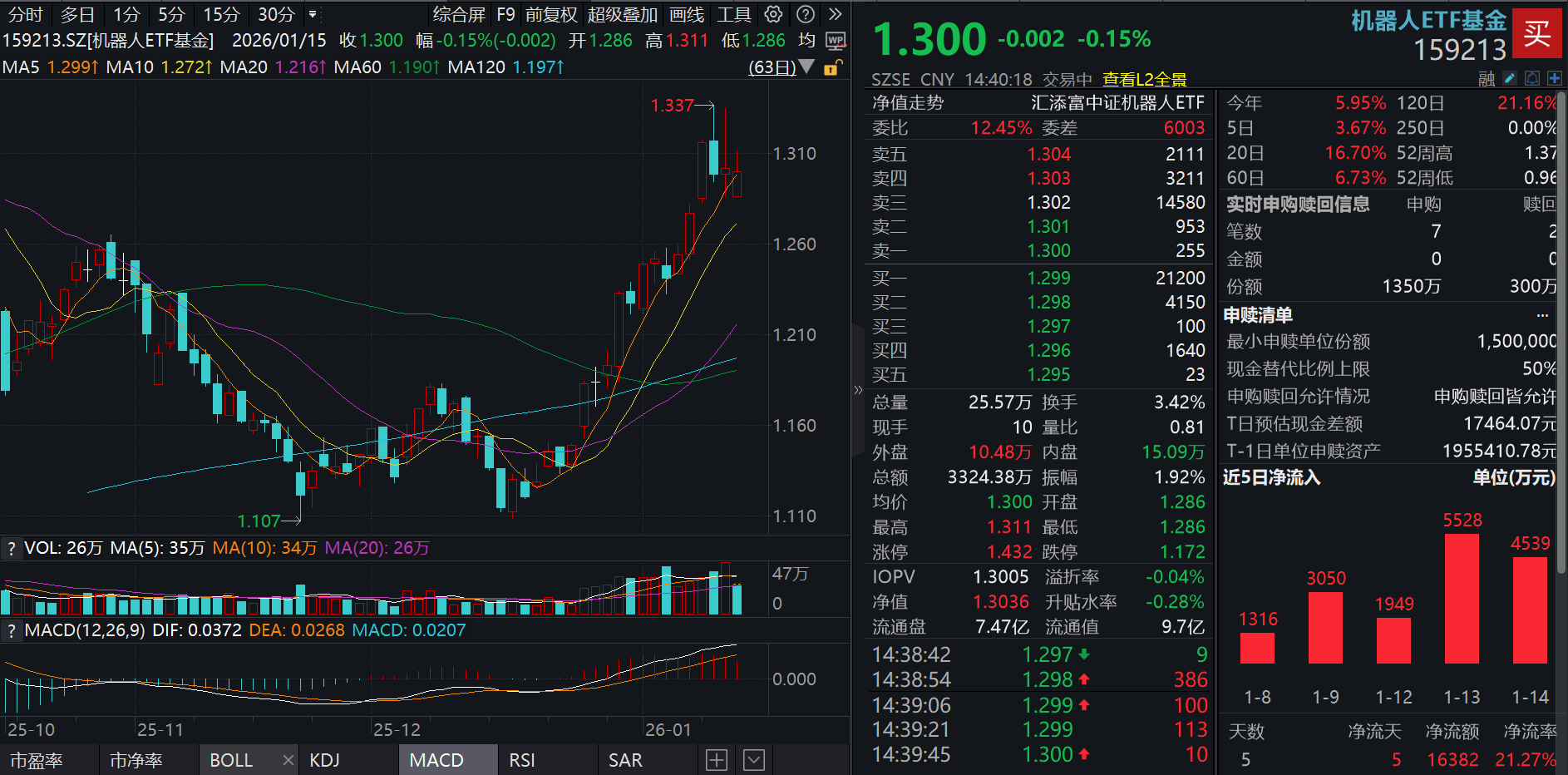
Core Viewpoint - The A-share market is experiencing fluctuations with the robotics sector showing signs of recovery, as evidenced by the continuous inflow of capital into the robotics ETF fund, which has attracted over 360 million yuan in the past 13 days [1] Market Performance - As of 14:39 on January 15, the robotics ETF fund (159213) slightly declined by 0.15%, while it attracted over 13.6 million yuan in capital during the day [1] - The component stocks of the robotics ETF showed mixed performance, with Huichuan Technology rising over 3% and Dazhong Laser and iFlytek increasing by over 1%, while Zhongkong Technology and Dahua Technology experienced declines [2][3] Component Stock Details - The following are notable component stocks and their performance: - iFlytek (002230): +1.13%, estimated weight 11.64% - Huichuan Technology (300124): +3.87%, estimated weight 9.65% - Dazhong Laser (002008): +1.93%, estimated weight 3.99% - Zhongkong Technology (688777): -1.82%, estimated weight 4.86% - Dahua Technology (002236): -0.64%, estimated weight 4.53% [4] Industry Insights - IDC predicts that by 2026, the application scenarios for humanoid robots in China will triple, with a market size approaching 1.3 billion USD, representing over 100% year-on-year growth. User spending on embodied intelligent robots is expected to exceed 11 billion USD [5] - The Chinese robotics and embodied intelligence market is entering a critical inflection point, where the ability to integrate perception, decision-making, control, system integration, and scene understanding into stable, replicable, and scalable solutions will differentiate manufacturers [5] Investment Trends - The global first robot leasing platform, Qingtian Rental, recently completed a seed round of financing led by Hillhouse Ventures, with participation from Fosun, Muhua Innovation, Dafeng Fund, and Zhangjiang Group [5] - Companies like Leju Robotics and Alibaba Cloud are forming partnerships for full-stack AI, while Xiaopeng plans to mass-produce humanoid robots this year [6] Market Outlook - CITIC Securities indicates that the humanoid robot sector is in a rebound phase, driven by Tesla's advancements in the "physical AI" industry, with the upcoming release of the Optimus V3 and Gen3 mass production plans [7] - The domestic supply chain is seeing continuous catalysts, with positive changes from policy, product, and capital fronts, suggesting a focus on quality segments within the sector [7]

四条“战线”齐头并进,港股冲刺AI企业聚集地
证券时报· 2026-01-15 00:17
Core Viewpoint - The Hong Kong stock market is emerging as a key hub for AI companies, with a significant increase in listings from Chinese AI firms, particularly in the GPU and software sectors, amidst the ongoing US-China tech rivalry [1][3][8]. Group 1: AI Companies and Market Dynamics - In 2026, several Chinese AI companies have listed on the Hong Kong Stock Exchange, including GPU leaders like Biren Technology and Tensyn, filling a gap in the GPU sector [1][3]. - The number of Hong Kong-listed companies related to AI has surpassed 40, categorized into four main "battle lines" [3]. - The first "battle line" focuses on the AI computing power industry, with Biren Technology being the first GPU company to list in Hong Kong, and Tensyn being the first to achieve mass production of general-purpose GPUs [3][4]. Group 2: AI Software and Applications - The second "battle line" involves AI software, highlighted by the listing of Zhipu AI, which has become one of the largest independent large model vendors in China, reporting revenue of 190 million yuan in the first half of 2025 [4]. - MiniMax, another AI company, saw its stock price surge by 109% on its first day of trading, with a market capitalization exceeding 100 billion HKD [4]. - Established companies like Meitu are also leveraging their AI technology to enhance their product offerings, indicating a robust presence in the AI software sector [4]. Group 3: AI Hardware and Robotics - The third "battle line" encompasses AI hardware, including smartphones and autonomous vehicles, with predictions that AI smartphone penetration will reach 34% by 2025 [5]. - Companies like BYD and Xiaomi are involved in the automotive sector, while over 30 robotics companies have applied to list in Hong Kong since December 2024, indicating a trend towards robotics firms seeking public funding [5][6]. Group 4: Internet Giants and AI Integration - The fourth "battle line" features major internet companies such as Alibaba and Tencent, which are enhancing their AI capabilities across various domains, including AI computing power and applications [6]. - The collective shift of these internet giants towards AI is establishing a solid foundation for the AI sector in the Hong Kong market [6]. Group 5: Strategic Positioning of Hong Kong - Hong Kong is becoming a crucial offshore hub for Chinese tech companies, providing a platform for international capital access amidst the US-China tech competition [8][9]. - The presence of significant foreign investors, including sovereign wealth funds from the Middle East and Asia, indicates a shift in capital sources towards a "non-US capital alliance" [9]. - The Hong Kong Stock Exchange's regulatory framework has become more accommodating for unprofitable tech companies, facilitating critical financing avenues for AI firms [10]. Group 6: Future Outlook and Challenges - The influx of AI companies is expected to elevate Hong Kong's status as a "hard tech financing hub," with projections indicating that new stock fundraising could exceed 280 billion HKD in 2025 [12]. - However, many AI companies may not achieve commercial viability until 2026 or 2027, posing risks of valuation corrections if revenue growth falls short of expectations [12][13]. - The Hong Kong market must address challenges such as sustaining high-quality asset supply and enhancing liquidity to fully realize its potential as a global tech financing center [13].

AI企业四条“战线”齐头并进 港股硬科技融资高地辨识度飙升
Zheng Quan Shi Bao· 2026-01-14 17:35
Core Viewpoint - The Hong Kong stock market is transforming into a key hub for Chinese AI companies, with a surge in listings from both hardware and software sectors, amidst the ongoing US-China tech rivalry [1][6]. Group 1: AI Hardware Sector - Hong Kong has seen significant activity in the AI hardware sector, with companies like Biren Technology and Tensynse Semiconductor going public, filling the gap in the GPU market [1][2]. - Biren Technology, known as the "first GPU stock in Hong Kong," focuses on high-end general-purpose GPUs and large-scale data center computing platforms [2]. - Tensynse Semiconductor is the first domestic company to achieve mass production of general-purpose GPUs, having delivered over 52,000 units by mid-2025 [2][3]. - Semiconductor manufacturing leader SMIC has become the third-largest foundry globally, with a 5% market share as of Q3 2025 [2]. Group 2: AI Software Sector - The AI software sector is also thriving, with companies like Zhipu AI and MiniMax making headlines. Zhipu AI has become one of the largest independent large model vendors in China, reporting revenue of 190 million yuan in the first half of 2025 [3]. - MiniMax, known as the "first global large model stock," saw its stock price surge by 109% on its debut, with a market capitalization exceeding 100 billion HKD [3]. - Established companies like Meitu are leveraging their AI technology to enhance their product offerings, creating a comprehensive AI application matrix [3]. Group 3: AI Hardware Applications - The AI hardware sector includes applications in smartphones, automobiles, and robotics, which are crucial for the widespread adoption of AI technologies [4]. - The penetration rate of AI smartphones is expected to reach 34% by 2025, with companies like Xiaomi and ZTE leading the market [4]. - In the automotive sector, companies like BYD and Xiaomi are positioned to benefit from the rapid advancement of autonomous driving technologies [4]. - Over 30 robotics companies have applied to list in Hong Kong since December 2024, indicating a trend of robotics firms seeking public funding [4]. Group 4: Internet Giants - Major internet companies such as Alibaba, Tencent, and Baidu are intensifying their AI investments, contributing to the overall growth of the AI sector in Hong Kong [5]. - Kuaishou's self-developed video generation model has achieved significant revenue milestones, showcasing the potential of internet giants in the AI landscape [5]. Group 5: Strategic Positioning of Hong Kong - Hong Kong is emerging as a strategic "buffer zone" for Chinese tech companies, providing a platform for international capital access amidst the US-China tech competition [6][7]. - The presence of Middle Eastern sovereign wealth funds among cornerstone investors in AI companies indicates a shift in capital sources, forming a new "non-US capital alliance" [6]. - The Hong Kong Stock Exchange's listing rules have become more accommodating for unprofitable tech companies, facilitating critical funding avenues for AI firms [7]. Group 6: Future Outlook - The influx of AI companies is expected to elevate Hong Kong's status as a "hard tech financing hub," with projections indicating that new stock fundraising could exceed 280 billion HKD in 2025 [8]. - The AI sector is anticipated to account for over 20% of the Hong Kong stock market within three years, potentially reshaping the traditional valuation framework [8]. - However, many AI companies may not achieve commercialization until 2026 or 2027, which could lead to valuation corrections if revenue growth falls short of expectations [8][9].
爆款“广东造”:“AI时代的新广货”全球进击
2 1 Shi Ji Jing Ji Bao Dao· 2026-01-13 13:22
Group 1 - Guangdong products, known as "广货," have been popular for over 40 years, with significant growth in cross-border e-commerce, expanding 66 times in 9 years and accounting for over one-third of the national total [1] - Guangdong produces 1 out of every 4 express deliveries in China and holds over 70% of the global consumer drone market share through companies like DJI [1][7] - The "广货行天下" spring campaign will kick off in Foshan on January 15, 2026, featuring nearly 30 key events and participation from around 6,000 enterprises [1] Group 2 - Guangdong established its manufacturing advantage through "三来一补" and has evolved to produce products that align with global trends, leading to the popular saying "远看是洋货,近看是广货" [2] - The region's rich labor resources and low operating costs were crucial for the success of local enterprises, such as the Taiping Handbag Factory [2] - Guangdong's local brands have gained national recognition, with products like "珠江水," "岭南衣," and "广东粮" becoming staples [2] Group 3 - Midea, a representative of Guangdong's industrial growth, has transformed from a small plastic production group to a Fortune Global 500 company, expanding its product range significantly [3] - Guangdong has become a global manufacturing hub, especially for consumer electronics, smart home appliances, and new energy vehicles, with companies like Huawei and OPPO contributing to significant global market shares [3][6] - The evolution of Guangdong's manufacturing is marked by a shift from "land and population dividends" to "engineer and innovation dividends," driving high-quality development [3] Group 4 - The rise of the AI era presents new opportunities for Guangdong's manufacturing sector, with a focus on technological innovation [4] - Guangdong leads the smart glasses manufacturing industry, accounting for 40% of the national market, with companies like 雷鸟创新技术 achieving significant sales growth [5][6] - The emergence of embodied intelligent robots, such as Atom, showcases Guangdong's advancements in automation and AI integration in various sectors [6] Group 5 - Guangdong produces 70% of the world's consumer drones, 40% of smartphones, and a significant share of industrial and service robots, highlighting its manufacturing dominance [7] - The region's industrial output includes 44 products with over 10% national market share and 23 products exceeding 20% [7]
6540台订单的背后,消费级具身智能正迎来产业化拐点
机器人大讲堂· 2026-01-12 11:12
Core Viewpoint - The definition of "consumer-grade" in the robotics field is undergoing a significant recalibration, evolving from merely low-cost toy robots to a new category that provides a complete user experience, functioning reliably in unstructured home environments, and meeting safety and aesthetic requirements [1] Group 1: Challenges in Consumer Robotics - The journey of consumer-grade robots entering homes has faced numerous challenges over the past decade, with many products failing to meet user expectations due to their limited functionality and interaction capabilities [4] - The complexity and emotional dimensions of home environments have led to fragmented and implicit demands, causing the industry to struggle with finding effective entry points for consumer-grade robots [4][5] - The industry has seen a shift since the end of 2025, with companies like Songyan, Lexiang, and others making attempts to break into the consumer market from various dimensions [4] Group 2: Vbot's Market Impact - Vbot has emerged as a leading company in bringing consumer-grade products into homes, achieving record sales and engagement metrics, including over 10.5 million live viewers during its launch and sales exceeding 10 million yuan within 19 days [7][8] - The Vbot phenomenon reflects a significant shift in the industry, marking a transition from technology showcases to actual commercial orders, driven by a focus on user needs and real-life applications [11][12][17] Group 3: Technological and Market Trends - The success of Vbot is attributed to the convergence of technological advancements, market readiness, and supply chain capabilities, allowing for the integration of AI and robotics into everyday life [12][14] - The Vbot team, comprising over 60% members from the consumer electronics and automotive sectors, has successfully combined user experience with safety and reliability standards in its product development [16] Group 4: Vbot's Competitive Advantages - Vbot's core selling points include its intelligent features, robust hardware performance, safety and emotional design, and its role as a physical space AI assistant, which collectively create a strong competitive barrier [19][20][22][24] - The product's design prioritizes safety and user interaction, ensuring it is perceived as a trustworthy family member rather than just a tool [22][24] Group 5: User Engagement and Operational Strategy - Vbot's pre-sale success is not only due to its innovative product definition but also its comprehensive user engagement strategy, which includes building a transparent and iterative user feedback loop [26][27][28] - This approach emphasizes long-term user relationships and operational service, moving beyond merely selling hardware to creating a sustainable ecosystem around the product [26][28] Group 6: Industry Outlook - The year 2026 is anticipated to be a pivotal point for consumer-grade embodied intelligence, transitioning from diverse explorations to large-scale commercialization, driven by technological maturity and improved user perceptions [30][31] - Vbot's achievements have set a new benchmark for the industry, highlighting the importance of user experience and clear value propositions in achieving widespread adoption [31][32]

广东机器人开年“赶场忙”:从工厂车间到CES,竞速商业化落地
2 1 Shi Ji Jing Ji Bao Dao· 2026-01-09 10:24
Core Insights - The Ministry of Industry and Information Technology and eight other departments issued the "Implementation Opinions on the Special Action of 'Artificial Intelligence + Manufacturing'," aiming for secure and reliable supply of key AI technologies and maintaining a leading position in industry scale and empowerment by 2027 [1] - The humanoid robotics industry is experiencing significant growth, with companies in Guangdong rapidly advancing production and commercial applications, transitioning from demonstrations to practical productivity tools [1][3] Industry Developments - The CES 2026 showcased numerous Chinese humanoid robot companies, with a focus on practical applications and commercial viability [3] - Companies like Pasiini and Youbixuan are enhancing their production capabilities, with Pasiini aiming for mass production and Youbixuan targeting an annual order of nearly 1.4 billion yuan and a production capacity of 10,000 units by 2026 [5][6] Technological Advancements - The humanoid robots are evolving through a combination of hardware upgrades and algorithm optimizations, with a focus on system-wide innovations rather than isolated improvements [7] - The development of advanced sensory systems and AI capabilities is crucial for humanoid robots to perform complex tasks autonomously, as demonstrated by Youjian's Atom robot, which can operate independently in a cinema environment [8][9] Market Dynamics - The demand for robots in automation and production scenarios is significantly outpacing supply, prompting companies to ramp up production [5] - The Guangdong-Hong Kong-Macao Greater Bay Area has established a complete robotics industry chain, supported by a mature supply chain and favorable policies, fostering innovation and market expansion [6][10] Future Outlook - Analysts view 2026 as a critical year for the humanoid robotics industry, with expectations for commercial value in general application scenarios by 2027 [2][11] - The industry is on a path of evolution, requiring breakthroughs in technology collaboration, data accumulation, and reliability validation to transition from "usable" to "highly usable" products [11]