
江西铜业

Search documents
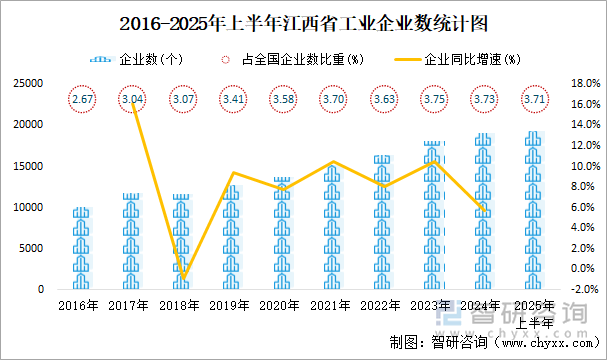
2025年上半年江西省工业企业有19279个,同比增长2.96%
Chan Ye Xin Xi Wang· 2025-08-12 03:23
上市公司:江西铜业(600362),安源煤业(600397),九丰能源(605090),中国稀土(000831), 仁和药业(000650),富祥药业(300497),同和药业(300636),江中药业(600750),煌上煌 (002695),甘源食品(002991),阳光乳业(001318),百胜智能(301083),南矿集团 (001360),江铃汽车(000550) 数据来源:国家统计局,智研咨询整理 2025年上半年,江西省工业企业数(以下数据涉及的工业企业,均为规模以上工业企业,从2011年起, 规模以上工业企业起点标准由原来的年主营业务收入500万元提高到年主营业务收入2000万元)为19279 个,和上年同期相比,增加了554个,同比增长2.96%,占全国的比重为3.71%。 知前沿,问智研。智研咨询是中国一流产业咨询机构,十数年持续深耕产业研究领域,提供深度产业研 究报告、商业计划书、可行性研究报告及定制服务等一站式产业咨询服务。专业的角度、品质化的服 务、敏锐的市场洞察力,专注于提供完善的产业解决方案,为您的投资决策赋能。 相关报告:智研咨询发布的《2025-2031年中国工业云行业市场深 ...

中国钢铁与铁矿石每周更新-China Steel and Iron Ore Weekly Update
2025-08-11 02:58
Summary of Key Points from the Conference Call Industry Overview - **Industry**: Greater China Materials, specifically focusing on **Steel and Iron Ore** sectors [1][4] Key Metrics and Trends - **Weekly Output**: Increased by **3.7%** week-over-week (WoW) for long products [1] - **Inventory Levels**: - Inventory at mills rose by **0.8%** WoW [1] - Iron ore inventory at ports decreased by **1.1%** [3] - **Utilization Rates**: - Blast furnace utilization dipped by **0.6 percentage points (ppts)** [1] - Electric arc furnace utilization increased by **1.6 ppts** [1] - **Crude Steel Production**: Average daily output of crude steel by key enterprises was **1.982 million tons (mnt)**, a decline of **7.4%** compared to early July [1] Iron Ore Shipments - **Total Shipments**: Combined shipments from Australia and Brazil decreased by **1.00 million tons (Mt)** WoW for the period from July 28 to August 3 [2] - Shipments from Australia increased by **0.71 Mt** [2] - Shipments from Brazil decreased by **1.71 Mt** [2] Consumption and Demand - **Apparent Consumption**: - Long products consumption increased by **3.4%** WoW [4] - Flat products consumption decreased by **2.9%** WoW [4] - **Rebar Output**: Increased by **4.8%** WoW and **31.2%** year-over-year (YoY) [7] Weekly Data Summary - **Steel Inventory**: - Traders' inventory at **9,625 kt**, up **2.1%** [3] - Mills' inventory at **4,129 kt**, up **0.8%** [3] - **Operating Rates**: - Steel operating rate at **62.4%**, down **2.1 ppts** [3] - Average daily output of iron ore at **393.8 kt**, down **3.2%** [3] Analyst Insights - **Industry View**: Rated as **Attractive** by Morgan Stanley [5] - **Analyst Contacts**: Multiple analysts involved, including Rachel Zhang and Hannah Yang [4] Additional Notes - **Potential Conflicts of Interest**: Morgan Stanley may have business relationships with companies covered in the research, which could affect objectivity [5] - **Investment Recommendations**: Ratings include Overweight, Equal-weight, Not-Rated, and Underweight, with no direct Buy, Hold, or Sell ratings [22][25] This summary encapsulates the essential insights and data points from the conference call, providing a comprehensive overview of the current state of the steel and iron ore industries in Greater China.
策略周专题(2025年8月第1期):内外利好因素累积,国内市场或将延续强势表现
EBSCN· 2025-08-10 08:07
Group 1 - The A-share market has shown strong performance this week, with major indices such as the Shanghai Composite Index and the Wind All A Index recording significant gains, while the ChiNext Index and the Sci-Tech 50 Index lagged behind [1][14][16] - The market style this week favored small-cap growth and small-cap value stocks, while large-cap growth and mid-cap growth stocks underperformed [1][16] - Most sectors in the Shenwan first-level industry classification saw gains, with defense, non-ferrous metals, and machinery equipment leading the way, while pharmaceuticals, computers, and retail sectors experienced declines [1][16] Group 2 - The overall domestic market is performing well, supported by accumulating internal and external favorable factors, with expectations for continued strong performance in the future [2][22] - The weak U.S. labor market, highlighted by July's non-farm payrolls adding only 73,000 jobs and an increase in the unemployment rate to 4.2%, has raised concerns about the U.S. economy and increased expectations for a Federal Reserve rate cut in September [2][22][23] - Domestic policies are actively supporting the market, with July exports growing by 7.2% year-on-year, indicating resilience in foreign trade despite a complex international environment [4][48] Group 3 - The market is expected to reach new highs in the second half of the year, driven by short-term expectations and liquidity improvements, with a shift from policy-driven to fundamentals and liquidity-driven market dynamics [5][62] - Short-term focus should be on previously lagging sectors and those likely to benefit from improved overseas liquidity, while long-term attention should be on consumption, technological self-reliance, and dividend stocks [5][63][67][68][69] - Specific sectors to watch include machinery equipment and power equipment for short-term gains, and pharmaceuticals, home appliances, and food and beverage sectors for long-term benefits from overseas liquidity improvements [5][63][68]
2025年有色金属标杆企业组织效能报告:价格周期上行,资源瓶颈凸显,智造转型深化,全球产业布局
顺为人和· 2025-08-08 02:40
Group 1: Report Industry Investment Rating - No information provided Group 2: Core Viewpoints of the Report - The non - ferrous metals industry is influenced by macro - economic factors such as global GDP growth, China's economic trends, and the Fed's monetary policy. The industry shows strong cyclicality, and there are opportunities and challenges in different segments like gold and copper [14][24][30] - The industry is experiencing several development trends, including digital transformation, globalization of resource allocation, and safety upgrades [65][70][75] - The performance of benchmark non - ferrous metal enterprises has generally improved, with growth in revenue, profit, and efficiency indicators [84][88] Group 3: Summaries by Relevant Catalogs 3.1 Macro - economic Analysis - Global GDP growth was about 3.9% in 2024, with the top ten countries accounting for 45% and a weighted growth rate of 4%. In 2025Q1, China's economy maintained rapid growth, and the full - year outlook is positive, providing a core driving force for industrial demand [11] - In 2025, the global GDP is expected to continue growing, but the growth rate may slow down. China's local governments are confident in economic growth, with most provincial GDP targets set above 5% [14] - China's CPI showed a mild decline in June 2025, but there are positive signals. The PPI of non - ferrous metal mining and smelting industries maintained positive year - on - year growth [18] - In 2025, China's manufacturing and infrastructure investment maintained growth, while real estate investment declined. High - tech manufacturing and infrastructure investment in areas like water conservancy and transportation are strong [21] - The Fed's expected interest rate cuts in the second half of 2024 led to a rise in non - ferrous metal prices, especially gold, which had a significant annual increase [24] 3.2 Industry Competition Pattern - Non - ferrous metals are basic materials for the national economy, and China has a wide variety of non - ferrous metal mineral resources. The industry is at the upstream of the manufacturing chain and is highly cyclical [25][27] - In 2024, the non - ferrous metal industry in China had good development, with total revenue of 9.0 trillion yuan and a profit of 423.9 billion yuan, both increasing by 14% year - on - year [32] - The production of ten non - ferrous metals in China reached 7,919 tons in 2024, a record high, and is expected to reach 100 million tons in 2026, with aluminum accounting for 56% [38] - The concentration of the non - ferrous metal industry is increasing, with the CR5 of listed companies' revenue and net profit rising to 45% and 49% respectively [42] 3.3 Development Trend Prediction - The digital transformation of the non - ferrous metal industry is promoted by policies, aiming to cultivate more than 15 digital transformation benchmark factories by 2026 [65] - Chinese non - ferrous metal enterprises are accelerating the "going - out" strategy, extending the industrial chain overseas from "mining" to "smelting" [70] - With the rise in metal prices, the industry's production capacity is being released. However, deep - mining safety risks are increasing, and new regulations are promoting enterprise safety standardization [75] 3.4 Industry Organization Efficiency Analysis - The "Five - Efficiency" analysis model is used to analyze the organizational efficiency of non - ferrous metal enterprises from five dimensions: human efficiency, yuan efficiency, cost efficiency, asset efficiency, and market efficiency [82] - The performance of benchmark enterprises has generally improved, with revenue and net profit increasing by 25% and 52% respectively in 2024 [84] - In terms of human efficiency, per - capita revenue and per - capita net profit increased by 23% and 46% respectively year - on - year, and the 3 - year CAGR was 12% and 25% respectively [88] - In terms of yuan efficiency, the labor cost efficiency of benchmark enterprises continued to improve, and there was a gradient differentiation pattern among enterprises [95] - In terms of cost efficiency, the gross profit margin and net profit margin of benchmark enterprises increased by 30% and 27% respectively year - on - year [101]
今日沪铜主力铜市惊现诡异背离:降息狂欢中,铜价为何逆势下跌?
Sou Hu Cai Jing· 2025-08-07 19:54
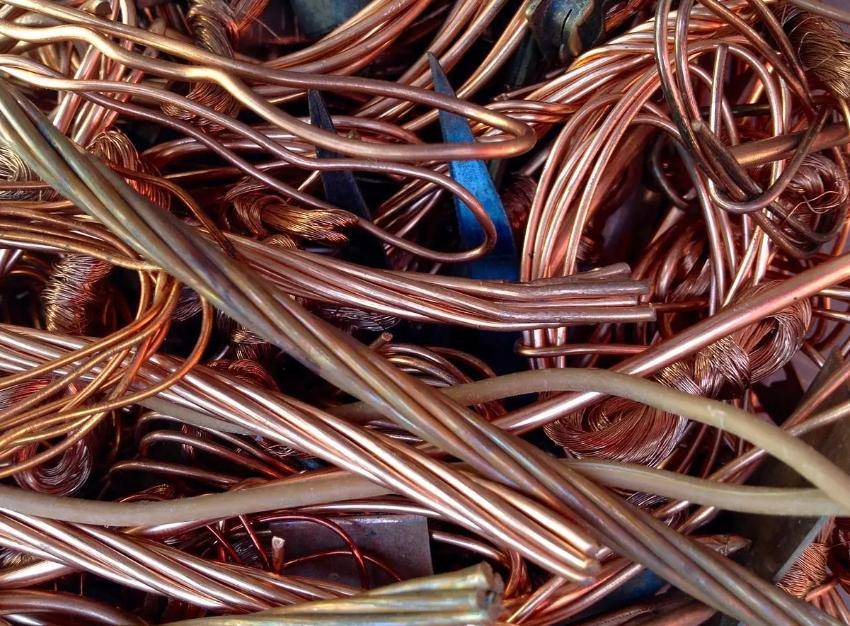
Group 1: Macroeconomic Headwinds - The market is increasingly concerned about "stagflation" in the U.S. economy, with the services PMI nearing the threshold and the price index soaring to 69.9%, a three-year high [2] - Investors are selling industrial metals like copper in favor of safe-haven assets such as gold and government bonds due to fears of stagnant growth and high inflation [2] Group 2: Tariff Policy Impact - The tariff policy from the Trump administration has targeted the copper supply chain, imposing a 50% tax on semi-finished products like copper cables while exempting refined copper [3] - This has led U.S. wire importers to cancel orders and forced Chinese copper processing companies to relocate to Southeast Asia to avoid high tariffs [3] Group 3: Federal Reserve Uncertainty - The sudden announcement of changes in the Federal Reserve's leadership has raised concerns about potential delays in interest rate cuts, prompting copper bulls to exit the market [4] - This uncertainty has contributed to increased market volatility and further depressed copper prices [4] Group 4: Inventory Dynamics - LME copper inventories surged by 14,275 tons (10.23%) on August 5, reaching a five-month high, primarily due to U.S. traders selling off during the tariff exemption window [7] - In contrast, the Chinese market is experiencing a shortage of copper, with significant price discrepancies between regions, indicating an underlying inventory crisis [7] Group 5: Industry Chain Challenges - Copper concentrate processing fees have dropped to -42.09 USD/ton, resulting in losses for smelters [8] - The cost of production for Chilean copper has risen to 2.10 USD/pound, while smelters are struggling to maintain profitability [8] Group 6: Market Reactions - On August 6, stocks of copper companies like Tongling Nonferrous and Jiangxi Copper saw significant price increases, driven by speculation around policy expectations [9] - However, futures markets remain focused on real inventory levels and weak consumption, leading to narrow trading ranges for copper contracts [9] Group 7: Long-term Outlook - Despite short-term challenges, the demand for copper driven by electrification remains strong, with Tesla's Shanghai factory increasing copper cable orders by 35% year-on-year [10] - Strategic stockpiling activities by various entities, including the Chinese state reserves and U.S. military contractors, are also noteworthy [10] Group 8: Conclusion - The short-term fluctuations in copper prices are influenced by a complex interplay of macroeconomic factors, tariff policies, supply chain dynamics, and market expectations [12] - The future trajectory of copper prices will depend on the resolution of these interrelated factors [12]
硅业分会:硅料价格持稳运行 多晶硅供应增量制约后市涨幅
智通财经网· 2025-08-06 08:45
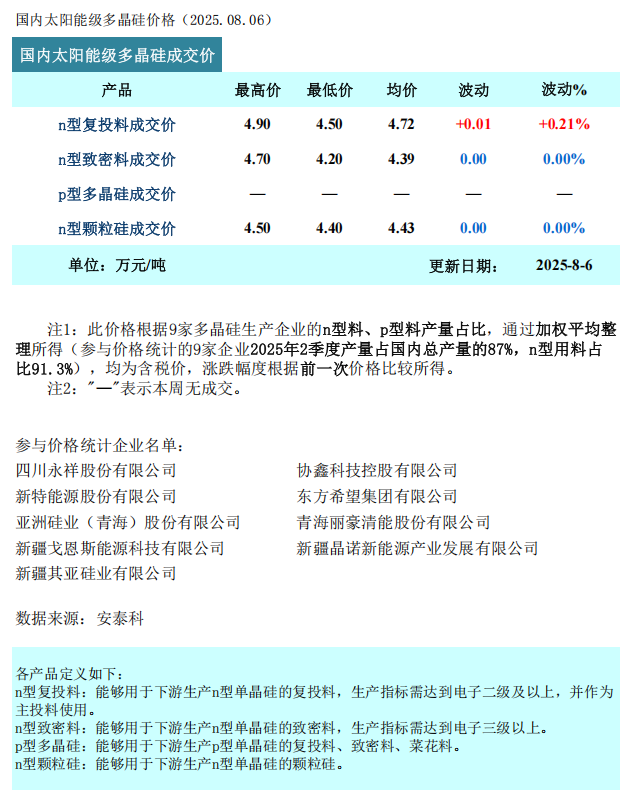
Group 1 - The core viewpoint of the article indicates that the price of polysilicon remains stable, with slight fluctuations in specific orders, influenced by market conditions and inventory levels [1][2] - The transaction price range for n-type recycled polysilicon is reported at 45,000 to 49,000 yuan per ton, with an average price of 47,200 yuan per ton, reflecting a week-on-week increase of 0.21% [1][3] - The number of polysilicon producers currently in operation is nine, with one company gradually ramping up production and another undergoing maintenance [2] Group 2 - The expected polysilicon production for August is approximately 125,000 tons, with increases primarily from certain companies in Yunnan, Xinjiang, and Qinghai, while one company’s output is reduced to zero due to maintenance [2] - Demand from silicon wafer production has slightly increased, leading to a demand of about 108,000 tons for polysilicon, resulting in an excess supply of approximately 16,000 tons for the month [2] - Despite rising inventory levels, the current market environment suggests that supply and demand are not the primary pricing factors, with prices expected to be supported by production costs [2]
恒邦股份(002237.SZ):控股股东江西铜业累计转让“恒邦转债”317.68万张
Ge Long Hui A P P· 2025-08-05 10:54
格隆汇8月5日丨恒邦股份(002237.SZ)公布,公司收到控股股东江西铜业《关于减持山东恒邦冶炼股份 有限公司可转换公司债券比例达到10%的通知》,获悉2024年5月15日至2025年8月5日期间,江西铜业 通过集中竞价交易方式转让其所持有的"恒邦转债"共计3,176,781张,占公司可转债发行总量的10.05%。 ...


恒邦股份:控股股东江西铜业累计转让“恒邦转债”317.68万张
Ge Long Hui· 2025-08-05 10:49
Core Viewpoint - The company, Hengbang Co., Ltd. (002237.SZ), has received a notification from its controlling shareholder, Jiangxi Copper, regarding the reduction of its holdings in the company's convertible bonds, indicating a significant transaction in the bond market [1] Group 1 - Jiangxi Copper will transfer a total of 3,176,781 convertible bonds of Hengbang, which represents 10.05% of the total issuance of the company's convertible bonds [1] - The transfer will occur through centralized bidding from May 15, 2024, to August 5, 2025, indicating a planned timeline for the divestment [1]
美国关税豁免阴极铜及其对中国股市的影响China Materials-US Tariffs to Exclude Copper Cathode - Chinese Equity Implications
2025-08-05 03:20
Summary of Key Points from the Conference Call Industry Overview - **Industry**: Copper and related materials in the Asia Pacific region, specifically focusing on the implications of US tariffs on copper products [1][4] Core Insights and Arguments - **US Tariffs**: The US is set to impose a 50% Section 232 tariff on semi-finished copper and copper-intensive derivative products, while copper input materials such as cathode, anode, concentrate, and scrap will not be subject to these tariffs [7][4] - **Market Reaction**: Following the announcement of tariffs, COMEX copper prices peaked over 30% higher than LME copper prices, indicating market expectations of broader tariff implications. However, with copper cathode exempt from tariffs, COMEX prices have since decreased by approximately 19%, and the premium over LME has fallen to around 6% [2][4] - **Inventory Levels**: There has been a significant increase in onshore copper inventory, with an additional 475,000 tons purchased since mid-March, suggesting that the US market is well-supplied and may see reduced import demand for copper in the near term [2][4] Implications for Chinese-listed Copper Companies - **Investment Recommendations**: Despite expected short-term pressure on companies like Zijin Mining, CMOC, MMG, and Jiangxi Copper, it is suggested that investors should consider accumulating shares of these companies on any price dips [3][4] - **Company Specifics**: - **Zijin Mining Group**: Target price adjustments based on A-share and H-share arbitrage opportunities [14][3] - **CMOC Group**: Valuation based on DCF model with a WACC of 10.7% and projected revenue growth of 2% annually [10][3] - **MMG Ltd**: Valuation reflects high visibility in long-term copper and zinc production with a cost of equity of 16.9% [8][3] Risks and Considerations - **Market Risks**: - Upside risks include stronger copper prices due to robust demand or supply disruptions in key copper-producing countries [12][17] - Downside risks involve potential economic downturns, project execution failures, and geopolitical risks affecting production [12][17] - **Regulatory Changes**: Changes in mining laws in Peru and other regions could impact supply dynamics and pricing [12][17] Additional Important Information - **Investment Banking Relationships**: Morgan Stanley has received compensation from several companies mentioned, which may influence research objectivity [5][24][25] - **Analyst Ratings**: The report includes various stock ratings for companies in the sector, indicating a mix of overweight and underweight positions based on market conditions [81][83] This summary encapsulates the critical insights and implications from the conference call regarding the copper industry and specific companies within the sector, highlighting both opportunities and risks for investors.


中国区原材料周度监测:反内卷进程持续推进-Greater China Materials Weekly Monitor Continued Progress of Anti-Involution
2025-08-05 03:19
Summary of Key Points from the Conference Call Industry Overview - **Industry Focus**: Greater China Materials, specifically in the Asia Pacific region [1] - **Market Sentiment**: The industry view is considered attractive by Morgan Stanley [6] Price Movements and Inventory Changes Base Metals - **Copper**: Prices decreased by 1.5% week-over-week (WoW), with inventories down by 1.2% WoW [2] - **Aluminum**: Prices fell by 1.3% WoW, while inventories increased by 1.5% WoW [2] - **Gold**: Price decreased by 1.4% WoW, settling at US$3,290 per ounce [2] Battery Metals - **Lithium Hydroxide**: Prices for industrial-grade and battery-grade lithium hydroxide rose by 9.4% and 8.5% WoW, respectively [2] - **Lithium Carbonate**: Prices for industrial-grade and battery-grade lithium carbonate increased by 1.5% and 2.1% WoW, respectively [2] Steel - **HRC and CRC Prices**: Shanghai HRC prices increased by 0.9% WoW, while CRC prices decreased by 0.2% WoW [3] - **Rebar**: Prices rose by 2.3% WoW [3] - **Long Steel Inventories**: Increased by 3.3% WoW [3] Cement and Coal - **Cement Prices**: Decreased by 0.6% WoW to Rmb323 per ton [3] - **Coal Prices**: QHD5500 coal prices increased by 0.5% WoW to Rmb665 per ton, with inventories dropping by 10.8% WoW [3] Glass - **Glass Fiber Prices**: Average prices declined by 1.3% WoW to Rmb3,850 per ton [4] - **Float Glass Prices**: Increased by 2.8% WoW to Rmb1,317 per ton [4] Regulatory Environment - **NDRC Initiatives**: The National Development and Reform Commission (NDRC) is promoting a unified national market and aims to eliminate 'involution-style' competition [8] - **CISA Recommendations**: The China Iron and Steel Association (CISA) emphasized the need for regional and product self-discipline, urging enterprises to control production and stabilize prices [8] Analyst Insights - **Analyst Team**: The report includes insights from multiple equity analysts at Morgan Stanley, indicating a collaborative approach to research [5] - **Investment Banking Relationships**: Morgan Stanley has disclosed its investment banking relationships with several companies in the materials sector, which may influence research objectivity [6][18] Stock Ratings - **Coverage Universe**: The report lists various companies within the Greater China Materials sector, with ratings ranging from Overweight to Underweight [62][64] - **Notable Companies**: Companies such as Aluminum Corp. of China Ltd. and Ganfeng Lithium Co. Ltd. are highlighted with their respective ratings [62][64] Conclusion - The Greater China Materials sector is experiencing mixed price movements across various commodities, with regulatory efforts aimed at stabilizing the market. Analysts maintain an attractive outlook for the industry, supported by ongoing price adjustments and inventory management strategies.