
三星电子

Search documents
韩半导体企业2025年销售额上升
Ke Ji Ri Bao· 2026-01-16 00:57
Group 1 - The global semiconductor market is projected to exceed $793 billion by 2025, representing a 21% increase from 2024, driven by the demand for graphics processing semiconductors and high-performance memory for generative AI data centers [1] - Nvidia has become the first semiconductor company to surpass $100 billion in annual sales, achieving $125.7 billion in sales last year, a 63.9% year-over-year increase, with a market share of 15.8% [1] - Samsung Electronics and SK Hynix rank second and third in semiconductor sales, with Samsung projected to achieve $72.5 billion in sales by 2025, holding a 9.1% market share, while SK Hynix is expected to reach $60.64 billion in sales, a 37.2% year-over-year increase, with a market share of 7.6% [1] Group 2 - The significant increase in demand for high bandwidth memory (HBM) and the expansion of sales in the rising price environment of the general DRAM market are key factors driving SK Hynix's performance [2] - Gartner predicts that by 2029, AI semiconductors will account for over 50% of total global semiconductor sales, becoming the core driver of market growth [2]

银联手机Pay,不仅是把银行卡「装」进手机里
36氪· 2026-01-15 13:24
Core Viewpoint - The article emphasizes the need for a universal payment tool that bridges user experience gaps and adapts to various global payment environments, particularly through the promotion of UnionPay's mobile payment services [6]. Group 1: Global Payment Experience - Mobile payment is enhancing the travel experience for users, particularly for Chinese tourists accustomed to QR code payments, who face challenges in regions where contactless card payments are the norm [3][4]. - The disparity in payment habits reflects a fragmented global payment market, with QR code payments dominating in China and Southeast Asia, while contactless card payments are well-established in Europe and Australia [5]. - UnionPay has been actively promoting its mobile payment products, with over 100 countries supporting UnionPay mobile payment services, and a significant increase in cross-border transaction amounts and counts by over 30% and 50% respectively in the first three quarters of 2025 [6]. Group 2: Technology and User Experience - The necessity of mobile payment is underscored by the advantages of NFC (Near Field Communication) technology, which allows for seamless transactions without the need for app activation or stable internet connections, particularly in high-frequency scenarios like subway commuting [9][11]. - UnionPay's mobile payment service has expanded to cover 38 cities' subways and 1,760 public transport systems, with over 200 transportation merchants in more than 10 countries supporting the service [11]. - The service also caters to various daily consumption scenarios, allowing users to make instant payments across multiple platforms, thus changing the domestic payment ecosystem [13]. Group 3: Security and User Trust - Security concerns are addressed through Tokenization technology, which protects users' real card information during transactions, thereby mitigating risks associated with data interception [14][15]. - The requirement for biometric verification (fingerprint, facial recognition, or password) adds an additional layer of security, fostering user trust in mobile payment [15]. Group 4: Market Positioning and Strategy - UnionPay's mobile payment is currently the most mainstream mobile payment product in China, supporting nearly all major smartphone brands and over 400 banks, which provides a competitive edge in understanding local user habits [17][18]. - The "card-code fusion" design allows UnionPay to adapt to both QR code and contactless payment ecosystems, facilitating a smooth user experience across different environments [19]. - UnionPay's strategy includes partnerships with major banks to offer cashback and discounts, enhancing user engagement and transaction frequency [27]. Group 5: Future Trends and Innovations - The payment industry is shifting focus from mere tool efficiency to embedding services throughout the user journey, with predictions of a significant increase in non-cash payment transactions by 2030 [28]. - UnionPay is exploring AI-driven payment solutions, indicating a transition from a simple payment tool to an intelligent service that integrates with various applications, potentially transforming mobile payment into a seamless bridge between the physical and digital worlds [29][30].

存储涨价潮下的“受害者”:消费电子产商陷入成本泥潭,苹果(AAPL.US)、惠普(HPQ.US)等面临利润冲击
智通财经网· 2026-01-15 12:15
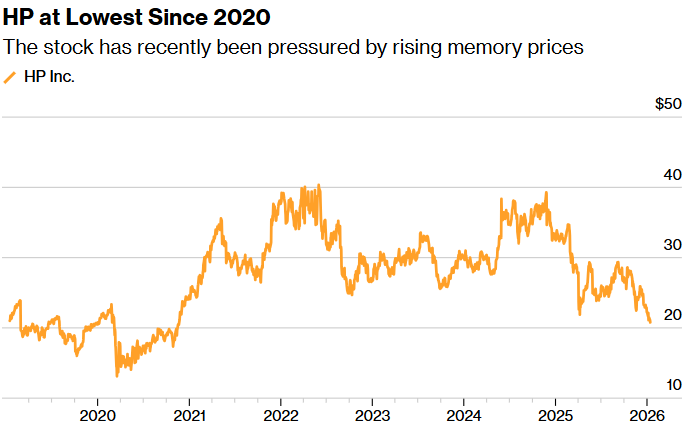
Core Viewpoint - The surge in memory chip prices has made companies like Sandisk, Micron Technology, and Western Digital popular stocks, but it has created significant challenges for their customers, including Apple and HP, as the high costs of memory components pose investment risks that are unlikely to reverse in the short term [1] Group 1: Impact on Hardware Manufacturers - Consumer hardware manufacturers are facing pressure due to high memory component costs, leading to two choices: accept lower profit margins or raise prices, which could harm demand [1] - Apple’s stock has seen only an 8.6% increase in 2025, marking its worst performance since 2022, while HP's stock has dropped nearly one-third in 2025 and hit its lowest level since November 2020 [2] - Dell Technologies' stock has decreased by 28% since reaching a historical high in October [2] Group 2: Semiconductor Manufacturers' Risks - The rising memory prices also pose risks for semiconductor manufacturers like Qualcomm and Arm, with recent downgrades in their ratings by Mizuho Securities and Bank of America [5] - The market is expected to continue pressuring these companies as long as memory prices remain high, driven by demand from artificial intelligence [5] - Dell is viewed positively due to its server business growth, which offsets the negative impact of rising memory prices [5] Group 3: Memory Price Trends and Industry Outlook - Samsung reported a more than 30% increase in average DRAM chip prices and about a 20% increase in NAND chip prices, with expectations that this trend will continue into 2026 or longer [6] - The memory cost for consumer hardware products may account for 10% to 20% of material costs, leading to concerns about profitability for companies like Apple and HP [6] - HP's earnings forecast for 2026 has been lowered by 7.1% due to rising memory costs, while Dell's performance expectations remain relatively stable due to strong demand in its server business [7] Group 4: Long-term Industry Dynamics - Analysts suggest that the current memory chip shortage is not just a cyclical issue but may indicate a permanent strategic reconfiguration of global silicon wafer capacity [6] - The anticipated significant increase in memory component costs over the next two years could impact even large companies like Apple [7] - The cyclical nature of memory prices is acknowledged, but the current supply shortage suggests that prices are unlikely to decrease in the short term [7]


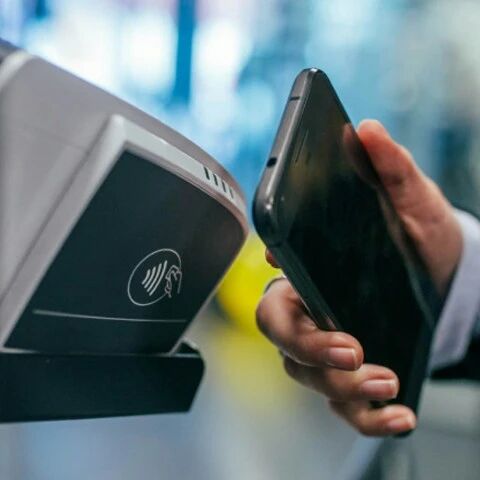
根植中国 联通世界: 银联手机Pay的无界支付生态实践
Sou Hu Wang· 2026-01-15 12:01
Core Insights - The evolution of digital payment tools is not solely based on technological advancements but also on their ability to meet real human needs and integrate into daily life [1] Group 1: Collaborative Ecosystem - UnionPay International and Samsung Electronics will launch a joint payment service based on the "Card-Code Integration" mobile payment solution on January 9, 2026, allowing overseas residents to use NFC or QR code payments flexibly [2] - UnionPay Mobile Pay adopts an "ecological neutrality" and "broad compatibility" strategy, collaborating with major Android manufacturers like Huawei, Vivo, OPPO, Xiaomi, and Meizu, ensuring that most Android smartphone users in China can easily access UnionPay Mobile Pay [2] - This extensive compatibility allows users to choose devices based on personal preferences while enjoying equal access to secure and convenient payment services, reflecting the essence of fintech for good [2] Group 2: Deep Usage Scenarios - The true value of payment tools lies in their ability to provide reliable services in various scenarios, with UnionPay Mobile Pay aiming for deep penetration in domestic markets and a seamless global experience [3] - UnionPay Mobile Pay's service network has expanded to cover over 30 cities' subways and 300 cities' buses, enhancing efficiency and convenience for users [3] - The platform employs Token 2.0 technology for full-chain security, supporting features like "no card number input" and multiple biometric verifications, while several banks have increased transaction limits to accommodate larger purchases [3] Group 3: Global Integration - UnionPay Mobile Pay's value is highlighted by its ability to extend reliable domestic experiences through a global network, allowing users to maintain familiar payment methods abroad [4] - The service is integrated with a network spanning over 100 countries and regions, enabling users to make payments at merchants displaying the UnionPay logo using their bound mobile payment methods [4] - UnionPay collaborates with banks like Agricultural Bank of China, CITIC Bank, China Merchants Bank, and Ping An Bank to offer exclusive benefits such as "1% cashback on every transaction" for cardholders [5] Group 4: Inclusive Payment Ecosystem - UnionPay Mobile Pay is not limited to regional markets but reveals a clear evolution path from local practices to global contributions, embodying UnionPay's global strategy of inclusivity and collaboration [6] - The core value lies in addressing the essence of payment: enabling seamless transitions between domestic and international scenarios, accommodating a wide range of devices, and integrating into the global digital lifestyle [6] - The ongoing exploration focuses on deeper connections and integration, emphasizing open collaboration, addressing nuanced needs, and ensuring security in every innovation [6]
AI浪潮造就欧洲股王!台积电2026年资本支出指引强势带飞 阿斯麦(ASML.US)市值冲破5000亿美元
智通财经网· 2026-01-15 11:03
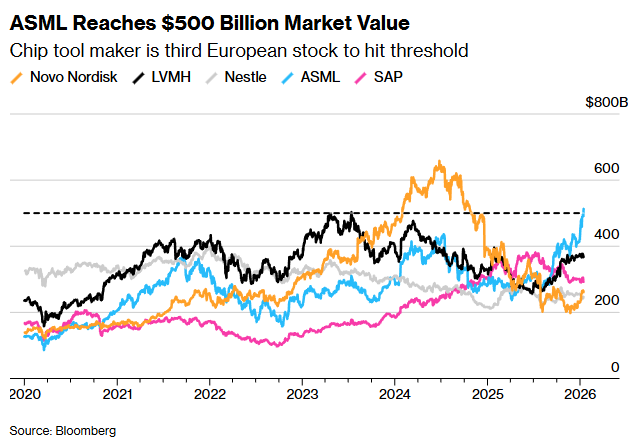
Core Viewpoint - ASML's stock price surged to a record high following TSMC's strong 2026 earnings guidance, pushing its market capitalization above $500 billion [1][3] Group 1: ASML's Market Performance - ASML's stock price increased by 7.6% on Thursday, with a year-to-date gain of 24%, making it the third European company to reach a market cap of $500 billion, following LVMH and Novo Nordisk [1] - As of the report, ASML's stock was up over 4% in pre-market trading [1] Group 2: TSMC's Impact on ASML - TSMC's earnings report indicated a significant increase in capital expenditures for 2026, projected to rise from $40.9 billion in 2025 to between $52 billion and $56 billion, exceeding market expectations of $48 billion to $50 billion [3] - This guidance has generated optimism regarding continued growth in global AI spending, benefiting both TSMC and ASML amid strong demand driven by the AI wave [3] Group 3: Analyst Insights - Barclays strategist Emmanuel Cau noted that ASML's milestone is significant for market sentiment, as its rise can positively influence the overall European market [3] - Quilter Cheviot's Ben Barringer stated that the earnings reports provide a positive start to the earnings season for tech giants, aiding in assessing the performance of chip companies and semiconductor equipment suppliers [3] - JPMorgan's recent report anticipates strong order performance for ASML, projecting fourth-quarter orders to reach €7 billion, approximately 4% above the continually revised market consensus [3]


台积电利润狂飙
Di Yi Cai Jing Zi Xun· 2026-01-15 11:00
本文字数:1126,阅读时长大约2分钟 作者 |第一财经 钱童心 1月15日,英伟达、苹果等人工智能芯片的主要供应商台积电(2330.TW)公布第四季度财报,显示利 润飙升35%,达到约160亿美元,创历史新高,远超市场预期,并连续第七个季度实现两位数增长。 尽管特朗普的贸易政策以及对半导体加征关税的威胁给全球芯片行业带来了诸多不确定性,但这种不确 定性尚未严重影响人工智能热潮推动下的芯片制造商利润飙升的势头。 2026.01.15 台积电预测今年将实现更强劲的增长。该公司称,得益于全球人工智能行业的蓬勃发展,预计今年第一 季度营收将同比增长40%,达到358亿美元,并预计2026年资本支出将增长高达37%,达到560亿美元。 台积电还称,客户发出了强烈的"需求信号",并直接联系公司寻求产能。 台积电是亚洲市值最高的上市公司,截至当天发稿,台积电市值约为1.4万亿美元,是韩国竞争对手三 星电子(005930.KS)的两倍多。台积电股票去年上涨了44%,今年迄今为止,该公司股价已上涨约 9%。 另据一份白宫发布的情况说明书,特朗普近期可能还会对半导体及其衍生产品的进口征收更广泛的关 税,以刺激国内制造业发展。 ...

对华出口H200芯片将征税25%,外交部回应
半导体芯闻· 2026-01-15 10:37
如果您希望可以时常见面,欢迎标星收藏哦~ 外交部:对于美国输华芯片问题,中方已多次表明立场 针对美国政府称将会允许向中国出口英伟达H200芯片,但将会对此出售进行25%的关税征收,外交 部发言人毛宁1月15日在例行记者会上说,对于美国输华芯片问题以及关税问题,中方都已经多次表 明了立场。 美国或将很快提高芯片关税 白宫于 1 月 14 日表示,唐纳德·特朗普总统可能很快会扩大对半导体及其衍生产品的进口关税, 此举因其可能对韩国科技巨头三星电子和 SK 海力士以及该国消费电子产品制造商产生的影响而受 到密切关注。 10万亿,投向半导体 芯片巨头,市值大跌 黄仁勋:HBM是个技术奇迹 Jim Keller:RISC-V一定会胜出 全球市值最高的10家芯片公司 据白宫消息,特朗普总统签署了一项公告,对进口到美国并随后转口到第三国的半导体产品(例如 英伟达的H200芯片)征收25%的关税。去年12月,特朗普曾表示将允许H200芯片出口到中国,但 要求中国将25%的销售收入上缴美国。这项关税旨在通过对经美国从台湾运往中国的H200芯片征 收关税,将英伟达部分与中国相关的收入转化为美国政府收入。 此举源于美国商务部去年1 ...

【美股盘前】存储概念股普涨,闪迪涨近5%;2025Q4净利同比增35%,台积电涨超5%;小摩:维持对阿斯麦“增持”评级,目标价为1518美元;瑞士反垄断...
Mei Ri Jing Ji Xin Wen· 2026-01-15 10:20
Group 1 - Dow futures decreased by 0.04%, while S&P 500 futures increased by 0.19% and Nasdaq futures rose by 0.47% [1] - SanDisk stock surged nearly 5% after Bernstein raised its target price from $300 to $580, with Micron Technology and Western Digital also rising over 3% [1] - UBS raised Intel's target price to $49, citing strong demand for personal computers and servers, and maintained a "neutral" rating [1] Group 2 - TSMC reported a 35% year-over-year profit increase in Q4, exceeding expectations and marking the eighth consecutive quarter of profit growth, leading to a stock increase of over 5% [2] - Nokia's stock rose by 4.4% after being selected as the network operations partner for New Zealand's Connexa, covering over 2,500 sites [2] - JPMorgan maintained an "overweight" rating on ASML with a target price of $1,518, expecting Q4 orders to reach €7 billion, surpassing market consensus by about 4%, resulting in a stock increase of over 5% [2] Group 3 - The Swiss Competition Commission has initiated a preliminary investigation into Microsoft's licensing fee increases, following complaints from private enterprises and government agencies regarding significant price hikes that may indicate anti-competitive behavior [3]
台积电利润狂飙
第一财经· 2026-01-15 10:19
Core Viewpoint - TSMC reported a 35% increase in profits for Q4, reaching approximately $16 billion, marking a historic high and exceeding market expectations, driven by the AI boom [3][4] Group 1: Financial Performance - TSMC achieved a profit of about $16 billion in Q4, a 35% increase year-over-year, and has seen double-digit growth for seven consecutive quarters [3] - The company forecasts a 40% year-over-year revenue growth for Q1, expecting to reach $35.8 billion [3] - TSMC plans to increase capital expenditures by up to 37% in 2026, reaching $56 billion [3] Group 2: Market Dynamics - Despite uncertainties from Trump's trade policies and potential tariffs on semiconductors, TSMC's profits continue to rise due to the AI industry's growth [3] - TSMC is the highest-valued listed company in Asia, with a market capitalization of approximately $1.4 trillion, more than double that of its competitor Samsung [4] Group 3: Investment and Production Strategy - TSMC is increasing investments in U.S. chip manufacturing, with a $100 billion investment plan announced last year, including $65 billion for three factories in Arizona [5] - The U.S. currently produces only about 10% of its required chips, highlighting a significant reliance on overseas supply chains [5] Group 4: Regulatory Environment - Trump's recent announcement includes a 25% tariff on certain AI chips to encourage domestic production, aiming to reduce reliance on foreign manufacturers like TSMC [5][6] - Analysts note that the complex nature of the semiconductor supply chain makes it unrealistic to localize all production processes in one location [6]


台积电利润狂飙 市值已超三星两倍
Di Yi Cai Jing· 2026-01-15 10:01
Group 1 - TSMC reported a 35% increase in profit for Q4, reaching approximately $16 billion, marking a historical high and exceeding market expectations, with double-digit growth for the seventh consecutive quarter [1] - The company anticipates a robust growth trajectory for the current year, projecting a 40% year-over-year revenue increase in Q1, reaching $35.8 billion, and a capital expenditure growth of up to 37% by 2026, totaling $56 billion [1] - TSMC is the highest-valued listed company in Asia, with a market capitalization of about $1.4 trillion, more than double that of its South Korean competitor Samsung Electronics [1] Group 2 - TSMC is increasing its investment in U.S. chip manufacturing, with a plan to invest $100 billion, including a commitment of $65 billion to build three factories in Arizona, one of which is already operational [2] - The U.S. government announced a new national security order imposing a 25% tariff on certain AI chips, aiming to encourage domestic production and reduce reliance on overseas supply chains, which currently supply about 90% of the chips needed [2] - The complexity of the semiconductor supply chain makes it unrealistic to localize all manufacturing processes in one location, and establishing a domestic supply chain will require a lengthy process and face various policy uncertainties [3]