
阿特斯

Search documents
阿特斯太阳能上涨3.0%,报12.01美元/股,总市值8.04亿美元
Jin Rong Jie· 2025-08-11 13:48
Group 1 - The core viewpoint of the article highlights the financial performance and upcoming earnings report of Canadian Solar Inc. (CSIQ), indicating a decline in revenue and net profit [1] - As of August 11, the stock price of Canadian Solar opened at $12.01 per share, with a market capitalization of $804 million [1] - Financial data shows that as of March 31, 2025, Canadian Solar's total revenue was $1.197 billion, representing a year-over-year decrease of 9.97%, while the net profit attributable to shareholders was -$33.971 million, a significant decline of 375.02% year-over-year [1] Group 2 - Canadian Solar is recognized as one of the largest solar photovoltaic product and energy solution providers globally, as well as a leading developer of solar power plants [1] - The company's operations span across North America, South America, Europe, South Africa, the Middle East, Australia, and Asia, indicating a broad international presence [1] - Canadian Solar's business is divided into two segments: CSI Solar and Global Energy [1]


光伏专利大战:TOP10企业专利护城河深度解析
Tai Mei Ti A P P· 2025-08-09 10:02
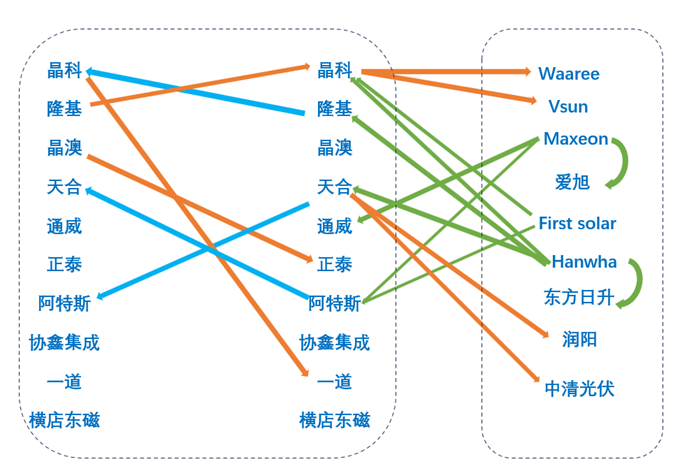
Core Viewpoint - The article discusses the ongoing patent wars in the photovoltaic (PV) industry, emphasizing the shift from an incremental growth phase to a competitive landscape where companies are focusing on retaining advanced production capacity and eliminating outdated capacity. Patents are seen as a crucial tool in this "anti-involution" strategy [1]. Group 1: Patent Litigation Overview - The patent litigation between JinkoSolar and LONGi Green Energy is highlighted as a significant ongoing conflict in the PV sector, with a need to assess the patent situations of the top 10 companies in terms of module shipments [3]. - Since 2019, the patent wars in the PV industry have been continuous, with only two companies, GCL-Poly and Hengdian East Magnetic, not involved in any patent litigation [3]. - Tongwei Co., while rapidly rising in the top 10, has had minimal patent litigation exposure, primarily due to its dual leadership in silicon materials and cells [3]. Group 2: Patent Application Statistics - Trina Solar leads in patent applications with 7,219 patents, followed by JinkoSolar and LONGi Green Energy in second and third places, respectively [7]. - Canadian Solar, despite facing multiple patent infringement lawsuits, has a substantial patent application count of 4,669, placing it among the top tier of PV companies [7]. - GCL-Poly has a relatively low patent application count, while Hengdian East Magnetic has over 3,700 patents, but only 681 are related to PV technology, making it the lowest among the top 10 [7]. Group 3: Patent Validity and Status - LONGi Green Energy holds the highest number of valid patents at 3,900, while Trina Solar has 3,448 valid patents, and JinkoSolar has 2,449 [10]. - The analysis shows that Yida New Energy has the lowest percentage of expired patents at 3%, while GCL-Poly and Canadian Solar have high expiration rates of 40% and 32%, respectively [10]. - The proportion of pending patents indicates that Trina Solar has over 33% pending, while Hengdian East Magnetic and JinkoSolar have around 30% [10]. Group 4: Patent Types and Quality - JinkoSolar and Trina Solar have the highest number of invention patents, with JinkoSolar's invention patents making up 70% of its total applications [12]. - GCL-Poly's patent applications are primarily domestic, with minimal international presence, indicating a focus on the domestic market [17]. - GCL-Poly has a total of 1,138 patent applications, with 519 being valid, but a significant number of low-value patents have been abandoned or rejected [19]. Group 5: Legal Events and Patent Management - GCL-Poly has engaged in various legal events related to its patents, including transfers and acquisitions, indicating active management of its patent portfolio [25]. - Hengdian East Magnetic has also seen significant patent pledges, with over 75 patents pledged for financing, reflecting a strategic approach to leveraging its patent assets [38]. - The company has a relatively high number of invention patents, with 445 out of 681 total patents, indicating a focus on high-quality innovations [35]. Group 6: Strategic Insights and Recommendations - Both GCL-Poly and Hengdian East Magnetic have lower overall patent strengths compared to leading companies like JinkoSolar and LONGi Green Energy, which may impact their competitive positioning [42]. - GCL-Poly's strategy of acquiring external patents could enhance its litigation capabilities, while Hengdian East Magnetic's effective maintenance of patent validity is crucial for future legal defenses [42]. - The article suggests that PV companies should enhance innovation and proactively manage patent risks to minimize litigation exposure [45].





大储如火如荼,户储确立恢复,工商储为新亮点 | 投研报告
Zhong Guo Neng Yuan Wang· 2025-08-08 02:39
Core Viewpoint - The energy storage market is experiencing significant growth, particularly in the US and Europe, while competition intensifies in domestic and Middle Eastern markets [1][2]. Group 1: Market Growth and Projections - Global large-scale energy storage installations are expected to grow by 51% to 205 GWh by 2025, driven by strong demand in the US, Europe, and emerging markets [2]. - In the US, installations are projected to reach 40 GWh in 2025, a 41% increase year-on-year, with a surge in the first half of the year [2]. - Europe is anticipated to see explosive growth, with installations revised up to 18 GWh in 2025, representing over 120% year-on-year growth [2]. - Emerging markets are expected to see a 221% increase in installations to 34 GWh by 2025, with significant projects in the Middle East and Chile [2]. Group 2: Competitive Landscape - The energy storage system prices in the US and Europe are stable at over $0.2/Wh, with profit margins ranging from 0.2 to 3 RMB/Wh, while competition in Asia, Africa, and Latin America is fierce, with new orders priced around 0.6 RMB/Wh and profit expectations around 0.1 RMB/Wh [1][4]. - Tesla leads the market share in the US, while Sungrow holds the top position in Europe [1][4]. - The battery cell market is dominated by CATL, which holds approximately 33% of the global market share, with significant growth from second-tier players [4][5]. Group 3: Emerging Market Opportunities - Distributed energy storage in emerging markets is expected to continue high growth, with household storage installations projected to reach over 20 GWh in 2025, a year-on-year increase of over 14% [3]. - The commercial storage market is also set to grow significantly, with global installations expected to reach 16.6 GWh in 2025, a 62% increase [3]. Group 4: Investment Recommendations - Companies to watch in the overseas large-scale storage sector include Sungrow, CATL, and BYD, while in the household and commercial storage sectors, notable companies include DeYe, Airo Energy, and Jinlang Technology [5].



洞鉴光伏·8月刊:“反内卷”持续发酵,光伏底部反转节点来临
Minsheng Securities· 2025-08-07 11:50
Investment Rating - The report suggests a positive outlook for the photovoltaic industry, emphasizing a shift from price competition to value competition due to government policies aimed at curbing "involution" [4][21][28]. Core Insights - The report highlights the government's strong stance on addressing "involution" in the photovoltaic sector, with multiple high-level meetings and policy announcements aimed at promoting fair competition and phasing out outdated production capacity [4][19][21]. - Prices across various segments of the photovoltaic supply chain are beginning to rise, indicating a potential recovery in profitability. For instance, as of July 30, 2025, the price of polysilicon dense material and granular silicon reached 44 RMB/kg, marking increases of 22.22% and 27.54% respectively since early June [4][32]. - Export data shows a mixed performance, with inverter exports increasing by 7.40% year-on-year in the first half of 2025, while module exports decreased by 23.94% [4][56]. Summary by Sections Industry Chain: Price Increases and Profit Recovery - The report notes that various segments of the photovoltaic industry are experiencing price increases, with polysilicon prices rising significantly due to government interventions and market adjustments [4][30][32]. - The report anticipates that the profitability of the photovoltaic supply chain will improve as prices stabilize and rise, driven by government policies and market dynamics [4][28]. Industry Dynamics: Government Policies and Market Response - The government has issued strong signals to combat "involution," emphasizing the need for quality over price in the photovoltaic sector. This includes new regulations aimed at preventing below-cost pricing and promoting sustainable competition [4][19][21]. - The report outlines a timeline of key policy announcements that have reinforced the government's commitment to addressing "involution" and promoting a healthier market environment [4][20]. Export and Installation Data - In the first half of 2025, domestic inverter exports totaled 30.595 billion RMB, reflecting a year-on-year increase, while module exports saw a decline [4][56]. - Domestic installations reached 212.21 GW in the first half of 2025, a 107.07% increase year-on-year, although June saw a significant month-on-month decline in new installations [4][61]. Investment Recommendations - The report recommends focusing on leading companies in the polysilicon segment, such as Xiexin Technology and Tongwei Co., as well as major players in the photovoltaic supply chain like JinkoSolar and JA Solar [4][69]. - It also highlights the potential for companies involved in high-efficiency TOPCon technology and auxiliary materials to benefit from the ongoing industry adjustments [4][69].
上游原料价升、下游采买增加 硅片价格持续上涨
Mei Ri Jing Ji Xin Wen· 2025-08-06 16:51
Group 1 - The price of silicon wafers has increased due to the rebound in upstream polysilicon prices, with manufacturers setting prices to avoid losses rather than competing for sales [1][2] - In the last week of July, the average price of N-type G10L monocrystalline silicon wafers was 1.2 yuan/piece, up 9.09% week-on-week; N-type G12R wafers averaged 1.35 yuan/piece, up 8.00%; and N-type G12 wafers averaged 1.55 yuan/piece, up 7.64% [2] - The increase in silicon wafer prices is attributed to rising raw material costs and increased downstream orders, with manufacturers adhering to pricing guidelines [1][2] Group 2 - The production cost of silicon wafers has risen due to increasing polysilicon prices, which have gone from 35,000 yuan/ton to 45,000 yuan/ton [3] - The overall operating rate in the industry remained stable, with major companies operating at 50% and 40% capacity [2][3] - From the second half of 2024, pure silicon wafer producers are adopting a strategy of not pursuing high operating rates and focusing on sales-based production [2] Group 3 - The National Energy Administration reported that new renewable energy installations reached 268 million kilowatts in the first half of the year, a 99.3% increase year-on-year, with solar power installations doubling [3] - The Ministry of Industry and Information Technology has issued a notice to implement energy-saving inspections in the polysilicon industry, which may lead to a concentration of production capacity among leading companies [4] Group 4 - Major photovoltaic companies have reported expected losses for the first half of 2025, with Longi Green Energy forecasting a net loss of 2.4 to 2.8 billion yuan [6] - Despite the losses, the domestic component sector has begun to turn a profit, and new markets in the Middle East and Southeast Asia are showing significant growth [6][7] - The industry is expected to see a recovery in prices due to policy impacts on polysilicon, although achieving a balance between supply and demand remains challenging [6][7] Group 5 - The inventory of polysilicon in the industry has decreased by approximately 30,000 to 40,000 tons since the beginning of the year, with some inventory being consumed and some accumulated due to rising prices [8] - Currently, there is no new polysilicon production capacity, and some companies have halted production lines [8]
“反内卷”热情持续升温,鼓励固态电池新技术,科创新能源ETF(588830)上涨近2%
Xin Lang Cai Jing· 2025-08-06 06:50
Core Viewpoint - The strong performance of the Shanghai Stock Exchange Sci-Tech Innovation Board New Energy Index reflects a growing interest in solid-state battery technology, which is seen as a key direction for high-quality development in the energy sector [1][2]. Group 1: Market Performance - As of August 6, 2025, the Shanghai Sci-Tech Innovation Board New Energy Index (000692) rose by 1.74%, with notable increases in constituent stocks such as Electric Wind Power (688660) up 16.55%, Zhenhua New Materials (688707) up 7.98%, and High Measurement Shares (688556) up 7.05% [1]. - The Sci-Tech Innovation New Energy ETF (588830) also increased by 1.75%, with the latest price reported at 1.22 yuan [1]. Group 2: Industry Trends - The enthusiasm for "anti-involution" policies is driving interest in solid-state batteries, which are recognized for their high energy density and safety, contrasting with the severe homogenization of traditional liquid lithium batteries [1]. - According to招商证券, the industrialization process of all-solid-state batteries is accelerating, with expectations for vehicle integration starting in 2026 and large-scale production anticipated around 2030 [1]. - The sulfide electrolyte route has emerged as the mainstream choice in the industry, although high costs and environmental requirements for lithium sulfide preparation remain critical bottlenecks for industrialization [1]. Group 3: Index Composition - The Sci-Tech Innovation New Energy Index comprises 50 large-cap listed companies in the photovoltaic, wind power, and new energy vehicle sectors, reflecting the overall performance of representative new energy industry stocks in the Sci-Tech Innovation Board market [1]. - The battery sector accounts for 38.5% of the index [1]. - As of July 31, 2025, the top ten weighted stocks in the index include JinkoSolar (688223), Trina Solar (688599), and Daqo New Energy (688303), collectively accounting for 47.21% of the index [2].
利空突袭,美股指数集体跳水!医药股逆势大涨→
Guo Ji Jin Rong Bao· 2025-08-06 00:52
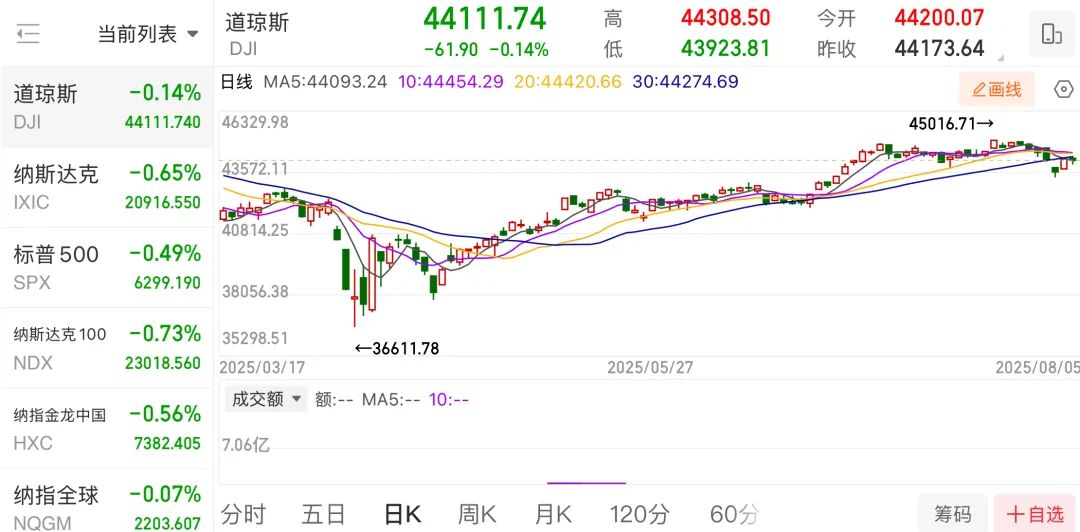
Market Overview - On August 5, U.S. stock indices opened high but closed lower, with the Dow Jones down 61.9 points at 44111.74, a decline of 0.14%; the Nasdaq fell 137.03 points to 20916.55, down 0.65%; and the S&P 500 dropped 30.75 points to 6299.19, a decrease of 0.49% [1] - Major tech stocks mostly declined, with Facebook down over 1%, Microsoft down over 1%, Nvidia down nearly 1%, Apple down 0.21%, Google down 0.19%, Tesla down 0.17%, while Amazon rose nearly 1% [3] Pharmaceutical Sector - Pharmaceutical stocks saw significant gains, with Pfizer closing up over 5% and UnitedHealth Group rising over 4% [4] Chinese Stocks - The Nasdaq Golden Dragon China Index fell 0.56%, with mixed performance among popular Chinese stocks. Tianjing Bio surged over 15%, Zhihu rose over 6%, and Canadian Solar increased over 4%. However, companies like Lingzhong Portal fell nearly 20%, Yum China dropped over 6%, and Atour fell over 4% [4] Bond Market - U.S. Treasury yields generally rose, with the benchmark 10-year Treasury yield closing at 4.218% and the more rate-sensitive 2-year Treasury yield at 3.739% [5] Economic Indicators - The ISM reported that the U.S. services PMI for July was 50.1, below the market expectation of 51.5 and the previous month's 50.8, indicating near stagnation in service sector growth. Employment metrics fell from 47.2 to 46.4, the lowest since the pandemic began [6]




阿特斯太阳能上涨2.31%,报11.755美元/股,总市值7.87亿美元
Jin Rong Jie· 2025-08-05 14:36
Core Insights - The stock price of Canadian Solar Inc. (CSIQ) increased by 2.31% to $11.755 per share, with a total market capitalization of $787 million as of August 5 [1] - Financial data indicates that as of March 31, 2025, the total revenue of Canadian Solar is projected to be $1.197 billion, reflecting a year-over-year decrease of 9.97% [1] - The net profit attributable to shareholders is expected to be -$33.971 million, showing a significant year-over-year decline of 375.02% [1] - Canadian Solar is set to release its fiscal year 2025 mid-term report on August 21, prior to market opening [1] - The company is recognized as one of the largest solar photovoltaic product and energy solution providers globally, as well as a leading developer of solar power plants [1] - Canadian Solar operates in various regions including North America, South America, Europe, South Africa, the Middle East, Australia, and Asia, with its business divided into two segments: CSI Solar and Global Energy [1]
硅片价格持续上涨,专家:多晶硅价格回弹后,硅片制造以不亏本为底线
Mei Ri Jing Ji Xin Wen· 2025-08-05 11:45
Core Viewpoint - The increase in silicon wafer prices reflects a rebound in raw material polysilicon prices, with manufacturers pricing to avoid losses rather than competing for sales [1][2]. Group 1: Price Trends - The average price of N-type G10L monocrystalline silicon wafers increased by 9.09% week-on-week to 1.2 yuan per piece, while N-type G12R and G12 wafers saw increases of 8.00% and 7.64%, respectively [2]. - The overall increase in silicon wafer prices is attributed to rising raw material costs and increased purchasing orders from downstream [1][2]. Group 2: Industry Dynamics - The industry is experiencing a shift where pure silicon wafer manufacturers are focusing on not pursuing high operating rates or accumulating inventory, instead opting for production based on sales [2][3]. - The overall operating rate in the industry remained stable, with major companies operating at 50% and 40% rates, while integrated companies operated between 50% and 80% [2]. Group 3: Cost Implications - The rise in polysilicon prices from 35,000 yuan/ton to 45,000 yuan/ton is expected to increase costs in the component manufacturing sector by only 0.02 to 0.03 yuan/W, which is not significant [3]. - If polysilicon prices were to reach 60,000 yuan/ton, it would raise component costs by approximately 0.05 yuan/W, which downstream manufacturers would struggle to absorb [3]. Group 4: Market Outlook - The National Energy Administration reported that new renewable energy installations reached 268 million kilowatts in the first half of the year, a 99.3% year-on-year increase, with solar power installations doubling compared to the previous year [3]. - The forecast for solar installation capacity in 2025 has been adjusted upward to between 570 GW and 630 GW, indicating continued growth in the sector [7]. Group 5: Policy and Regulation - The Ministry of Industry and Information Technology has initiated energy-saving inspections for the polysilicon industry, which may limit outdated production capacity and concentrate production among leading companies [4]. - Policies are in place to prevent sales below cost, which helps stabilize price floors in the market [4]. Group 6: Company Performance - Longi Green Energy expects a net loss of 2.4 to 2.8 billion yuan for the first half of the year, although it has managed to significantly reduce losses compared to the previous year [6]. - Other major companies, such as Tongwei and JA Solar, also anticipate substantial losses, indicating a challenging market environment despite some segments beginning to show profitability [6][7].


硅片价格持续上涨 专家:多晶硅价格回弹后 硅片制造以不亏本为底线
Mei Ri Jing Ji Xin Wen· 2025-08-05 11:05
Core Viewpoint - The increase in silicon wafer prices reflects a rebound in raw material polysilicon prices, with manufacturers setting prices to avoid losses rather than competing for sales [1][2]. Group 1: Price Trends - The average price of N-type G10L monocrystalline silicon wafers increased by 9.09% week-on-week to 1.2 yuan per piece, while N-type G12R and G12 wafers saw increases of 8.00% and 7.64%, respectively [2]. - The average price of silicon wafers rose by approximately 0.1 yuan per piece due to increased raw material costs and higher downstream orders [1][2]. Group 2: Industry Dynamics - The overall operating rate in the industry remained stable, with major companies operating at 50% and 40% capacity, while integrated companies operated between 50% and 80% [2]. - From the second half of 2024, pure silicon wafer producers are expected to adopt a strategy of not pursuing high operating rates or accumulating inventory, focusing instead on sales-based production [2][3]. Group 3: Cost and Profitability - The price of polysilicon has risen from 35,000 yuan/ton to 45,000 yuan/ton, which could lead to a cost increase of 0.02 to 0.03 yuan/W for component manufacturing [3]. - Despite the increase in polysilicon prices, it is anticipated that prices will not reach 60,000 yuan/ton due to existing inventory levels and production rates, which would make it difficult for downstream manufacturers to absorb the costs [3]. Group 4: Policy and Regulation - The Ministry of Industry and Information Technology has issued a notice for energy-saving inspections in the polysilicon industry, which may limit outdated production capacity and concentrate production among leading companies [4]. - The National Market Supervision Administration has prohibited sales below cost, which helps stabilize price floors in the market [4]. Group 5: Company Performance - Longi Green Energy expects a net loss of 2.4 to 2.8 billion yuan for the first half of the year, while Tongwei and JA Solar also anticipate significant losses [5][6]. - Despite the losses, Longi Green Energy reported an increase in component sales, although the overall competitive environment has led to continued losses [6]. Group 6: Market Outlook - The solar power sector saw a 99.3% year-on-year increase in new installed capacity, with 268 million kW added in the first half of the year, supporting the stabilization of silicon wafer prices [3][6]. - The forecast for solar installation capacity in 2025 has been adjusted upward to between 570 GW and 630 GW, indicating continued growth in the sector [6].