光威复材

Search documents
ETF盘中资讯|化工板块突然拉升,化工ETF(516020)盘中翻红!资金疯狂扫货,布局时机已现?
Jin Rong Jie· 2026-01-09 03:28
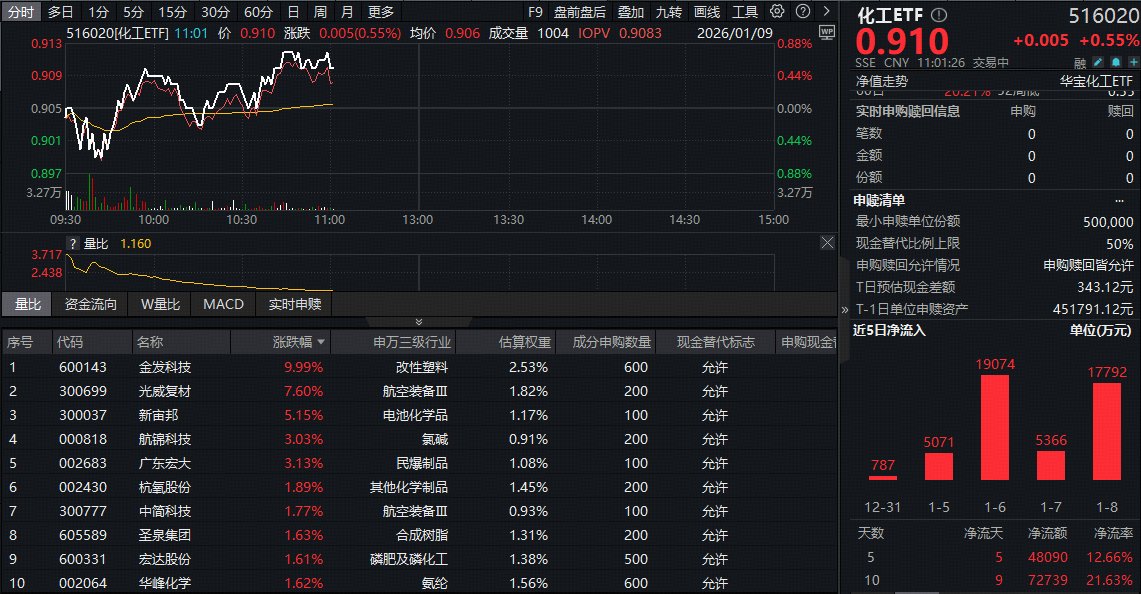
消息面上,工业和信息化部等七部门联合发布《石化化工行业稳增长工作方案(2025—2026年)》,推动行业供需格局修复;同时,新版《绿色工厂评价通 则》国家标准于2025年12月31日起实施,进一步规范化工行业绿色生产标准。 化工板块今日(1月9日)盘中逆转,反映化工板块整体走势的化工ETF(516020)开盘走弱,而后迅速拉升翻红,截至发稿,场内价格涨0.55%。 成份股方面,改性塑料、锂电、氯碱等板块部分个股涨幅居前。截至发稿,金发科技涨停,光威复材飙涨超7%,新宙邦大涨超5%,航锦科技、广东宏大等 涨超3%。 | स्त्रेस्थे | | 多日 1分 5分 15分 30分 | ୧୦સ્ત્ર | 日 | | | | | 4. FIF O | | | | | | F9 盘前盘后 叠加 九转 | | | 51 | 画线 丁目 <> (2 | | 周月 更多 | | --- | --- | --- | --- | --- | --- | --- | --- | --- | --- | --- | --- | --- | --- | --- | --- | --- | --- | --- | --- | -- ...

化工板块突然拉升,化工ETF(516020)盘中翻红!资金疯狂扫货,布局时机已现?
Xin Lang Cai Jing· 2026-01-09 03:13
Group 1 - The chemical sector experienced a reversal on January 9, with the chemical ETF (516020) initially opening weak but quickly rebounding to a gain of 0.55% by the time of reporting [1][7] - Key stocks in the sector included Jinfa Technology, which hit the daily limit, Guangwei Composite rising over 7%, and Xinzhou Bang increasing by over 5% [1][7] - The chemical ETF (516020) has seen significant capital inflow, with a net inflow of 480 million yuan over the last five trading days and over 720 million yuan in the last ten days [1][10] Group 2 - The Ministry of Industry and Information Technology and six other departments released a plan to stabilize growth in the petrochemical industry for 2025-2026, aiming to improve the supply-demand balance [3][9] - Open-source Securities noted that the chemical industry is expected to see a dual uplift in performance and valuation due to policies aimed at reducing competition, with a 10% year-on-year decrease in construction projects for basic chemical companies [3][9] - China Galaxy Securities indicated that capital expenditure in the chemical industry has entered negative growth since 2024, with expectations for a supply contraction and increased demand due to domestic consumption and easing monetary policy in the U.S. [10] Group 3 - The chemical ETF (516020) tracks the CSI segmented chemical industry theme index, with nearly 50% of its holdings in large-cap leading stocks like Wanhua Chemical and Salt Lake Co., allowing investors to capitalize on strong investment opportunities [4][10] - Investors can also access the chemical ETF through linked funds (Class A 012537/Class C 012538) for more efficient exposure to the sector [4][10]


光威复材涨2.02%,成交额9.78亿元,主力资金净流出6589.64万元
Xin Lang Cai Jing· 2026-01-09 02:16
Core Viewpoint - Guangwei Composite Materials Co., Ltd. has shown a significant increase in stock price and trading volume, indicating positive market sentiment despite a decline in net profit year-on-year [1][2]. Group 1: Stock Performance - As of January 9, Guangwei's stock price increased by 2.02%, reaching 41.86 CNY per share, with a trading volume of 9.78 billion CNY and a market capitalization of 34.8 billion CNY [1]. - The stock has risen by 6.08% year-to-date, with a 38.20% increase over the past 20 days and a 39.30% increase over the past 60 days [1]. Group 2: Financial Performance - For the period from January to September 2025, Guangwei reported a revenue of 1.986 billion CNY, reflecting a year-on-year growth of 4.40%, while the net profit attributable to shareholders decreased by 32.55% to 415 million CNY [2]. - The company has distributed a total of 2.261 billion CNY in dividends since its A-share listing, with 1.188 billion CNY distributed over the last three years [3]. Group 3: Shareholder Information - As of December 31, the number of shareholders increased to 76,600, with an average of 10,716 circulating shares per person, a decrease of 0.91% [2]. - The top shareholders include various ETFs, with notable changes in holdings, such as E Fund's ChiNext ETF reducing its stake by 1.9031 million shares [3].
如何看待当前军贸-商业航天的双轮驱动行情
2026-01-08 16:02
Summary of Key Points from Conference Call Records Industry Overview - The conference call discusses the military trade and commercial aerospace sectors, highlighting a significant increase in military spending proposed by the U.S. President, expected to reach $1.5 trillion by FY 2027, a 50% increase from FY 2026, indicating a historic turning point in global military spending and a surge in demand for military equipment [1][3][5]. Core Insights and Arguments - **U.S. Military Spending**: The proposed military budget increase is expected to stimulate U.S. and overseas defense stocks, indicating a substantial rise in global military equipment demand [1][3]. - **International Tensions**: Ongoing geopolitical instability, including U.S. actions in Venezuela and Greenland, as well as tensions in the Middle East, are driving countries to increase their military budgets, leading to a projected surge in military equipment demand [1][5]. - **China's Position in Global Military Trade**: China has significantly enhanced its position in the global military trade market, leveraging its political stance, weaponry capabilities, and cost-effectiveness, which is accelerating demand for Chinese military products [1][8]. - **Investment Recommendations**: Two categories of military assets are recommended for investment: strategic assets like AVIC and Shenyang Aircraft, and low-cost, sustainable order assets like Guangdong Hongda and Aerospace South Lake, which have high order certainty [1][9]. Commercial Aerospace Insights - **Space Investment Boom**: The global space investment trend, ignited by SpaceX, is supported by breakthroughs in domestic reusable rocket technology, national aerospace strategies, and local government policies, with 2026 anticipated as a pivotal year for space investments [1][10]. - **SpaceX Supply Chain**: The SpaceX supply chain is highlighted as a key area of focus, with significant potential for suppliers like Xinwei Communication, and the importance of space photovoltaics for supporting communication satellites and the Starship project [3][13][14]. Market Performance - **Defense Sector Performance**: The defense sector has seen a 10% increase year-to-date, with strong performances from commercial aerospace and military trade stocks, which account for 20-25% of total A-share trading volume [2]. - **Global Military Investment Trends**: The increase in U.S. military spending is positively impacting capital markets, with companies like Lockheed Martin and Raytheon experiencing stock price surges [4]. Future Outlook - **2026 Military Sector Predictions**: The military sector is expected to experience a significant rebound in 2026, driven by military trade and commercial aerospace, with a recommendation to monitor related ETF inflows for investment opportunities [17]. - **Satellite Industry Trends**: The satellite industry is facing cost reduction pressures, but the demand for carbon fiber is rising, indicating a potential value reassessment in the industry [3][16]. Additional Considerations - **Geopolitical Risks**: The increasing geopolitical risks are expected to enhance the long-term growth prospects of military-related companies, making them attractive investment opportunities [6][9]. - **Domestic Manufacturing Challenges**: The U.S. government is addressing domestic manufacturing capacity issues by urging defense contractors to reinvest profits into production capabilities [7]. This summary encapsulates the key points from the conference call, providing a comprehensive overview of the military trade and commercial aerospace sectors, their current performance, and future outlooks.


内外需共振-看好军工板块价值重估
2026-01-08 16:02
Summary of Key Points from Conference Call Industry Overview - The military industry is expected to benefit significantly from the increase in the U.S. defense budget, projected to reach $1.5 trillion by 2027, which will stimulate global military and arms trade market expansion. China, as a major supplier of weaponry, stands to gain from this trend [1][3][4]. - The changing international landscape, including events in Venezuela and the Russia-Ukraine conflict, has heightened the demand for military capabilities, providing opportunities for China's arms trade development [1][5]. Core Insights and Arguments - The gross profit margin for arms trade is significantly higher than domestic sales, as international pricing is market-driven and typically exceeds domestic prices. This suggests that expanding arms trade can optimize financial statements and enhance profitability [1][6]. - The domestic large aircraft manufacturing sector is crucial, with the C919 aircraft steadily improving its delivery capabilities. However, challenges remain in the localization of onboard systems and engines [1][7][9]. - The commercial aerospace sector is entering a phase of rapid growth, with expectations that domestic commercial space will transition from an introduction phase to an early growth phase by 2026, with satellite bidding orders projected to increase by over tenfold compared to 2025 [1][2][8]. Important but Overlooked Content - The U.S. defense budget increase is expected to lead other countries to follow suit, further driving global military spending, which reached $2.4 trillion in 2025, with the U.S. accounting for over one-third of this total [4]. - The domestic aviation manufacturing industry is currently dominated by Boeing and Airbus, with China importing over 200 aircraft annually, totaling over $20 billion. The need for over 9,000 new aircraft in the next 20 years underscores the importance of domestic large aircraft production [7]. - In the commercial space sector, the focus is on the integration of satellite manufacturing and applications, with significant market potential and growth expected in the coming years [11][12]. Recommendations for Investment - Companies to watch in the arms trade include those involved in aircraft, drones, radar systems, and guided equipment, such as Hongdu Aviation and AVIC [1][6]. - In the commercial aerospace sector, attention should be paid to suppliers like COMAC and engine manufacturers like Commercial Aircraft Corporation of China [7][9]. - For satellite manufacturing, recommended companies include XinKong Mobile and China Satellite, with a focus on their technological advantages and market positions [13][14][15]. Conclusion - The military and aerospace industries are poised for significant growth driven by increased defense spending and technological advancements. Investors should focus on companies that are well-positioned to capitalize on these trends, particularly in arms trade and commercial aerospace sectors.
商业航天深度:技术收敛引爆“奇点”,蓝海市场破晓已至(附62页PPT)
材料汇· 2026-01-08 16:01
Group 1 - The article emphasizes the explosive growth of the commercial space industry driven by supportive policies and technological advancements [4][19] - The transition from traditional space (government-led) to commercial space (private sector-driven) is highlighted, showcasing the shift in funding and operational models [10][12] - The U.S. and China are establishing a bipolar competitive landscape in the space industry, with the U.S. leading in commercial launches and satellite deployments [24][28] Group 2 - Key sectors in the space industry include satellites, launch vehicles, ground equipment, and terminal applications, which are experiencing increased demand [3][29] - The competitive landscape is maturing, with significant advancements in technology such as reusable rockets and cost-effective satellite manufacturing [20][23] - Investment recommendations suggest focusing on companies that are well-positioned within the rapidly evolving commercial space ecosystem [3][39] Group 3 - The article outlines the historical development of commercial space, noting critical milestones from the 1980s to the present, including the rise of companies like SpaceX and Blue Origin [11][16] - The U.S. has shifted its procurement model from cost-plus contracts to fixed-price contracts, incentivizing cost reduction and innovation in the space sector [14][15] - China's commercial space sector is rapidly developing, with government initiatives aimed at fostering innovation and investment in the industry [19][27] Group 4 - The article discusses the structure of the space industry supply chain, which includes upstream (manufacturing), midstream (launch services), and downstream (applications) segments [30][32] - The total addressable market (TAM) for the space industry is projected to grow significantly, with commercial space revenues expected to dominate [39][40] - The article highlights the high barriers to entry in the space industry, particularly in the upstream segment, which contributes to high profit margins [41]

光威复材:接受华泰柏瑞基金等投资者调研
Mei Ri Jing Ji Xin Wen· 2026-01-08 15:16
每经AI快讯,光威复材发布公告称,2026年1月6日、2026年1月7日,光威复材接受华泰柏瑞基金等投 资者调研,公司董事会秘书王颖超参与接待,并回答了投资者提出的问题。 每经头条(nbdtoutiao)——独家对话特斯拉FSD跨美第一人:4400公里"零接管",手没碰过方向盘!作 为激光雷达销售员,他为何站队马斯克的"纯视觉"? (记者 曾健辉) ...
光威复材:目前公司是我国航天卫星用碳纤维的核心供应商
Xin Lang Cai Jing· 2026-01-08 14:49
Core Viewpoint - The company Guangwei Composites (300699.SZ) has successfully developed advanced carbon fiber products, establishing itself as a key supplier in China's aerospace satellite industry [1] Group 1: Product Development - In 2014, the company successfully developed M40J grade carbon fiber [1] - In 2018, the company developed M55J grade carbon fiber, which is part of a national 863 project [1] - The M55J grade fiber achieved domestic substitution and mature application in 2021, leading to mass production [1] Group 2: Industry Position - The company's business primarily involves collaboration with domestic satellite-related institutions and companies within the satellite manufacturing supply chain [1] - Guangwei Composites is recognized as a core supplier of carbon fiber for aerospace satellites in China [1] - The company is expected to receive the title of "Manufacturing Industry Single Champion" from the Ministry of Industry and Information Technology by December 2025 for its "high-strength and high-modulus carbon fiber for aerospace use" [1]
光威复材(300699) - 2026年1月7日投资者关系活动记录表
2026-01-08 14:36
Group 1: Product Development and Applications - The company successfully developed M40J and M55J grade carbon fibers in 2014 and 2018, respectively, with M55J being a key product under the national 863 project, achieving domestic substitution and mass production by 2021 [1] - M40J grade carbon fiber has a wide range of applications, including aerospace, 3C electronics, and fishing rods, while M55J is primarily used in satellite structures and solar panels [2][3] - The company is a core supplier of carbon fiber for China's aerospace satellites and received the Ministry of Industry and Information Technology's manufacturing champion title in December 2025 [1] Group 2: Production Capacity and Costs - Current production capacity for high-strength and high-modulus fibers is 80 tons, with one production line each for M40J and M55J grades; capacity expansion will be considered based on market demand [4] - The production cost of equipment-grade fibers is significantly higher than that of civilian fibers due to lower production efficiency and stringent quality requirements [6] - The company’s T700S and T800S grade fibers generated revenue of 212 million yuan in 2024, with the hydrogen bottle application contributing 120 million yuan [14] Group 3: Market Trends and Challenges - The impact of Toray's price increase on the domestic market requires further observation, primarily depending on supply and demand dynamics [7] - The company is working on the certification of GW300 grade fibers for large aircraft, with expected approval in 2024; however, the delivery of large aircraft may not be significantly affected by carbon fiber materials [8] - The T300 grade fiber business is expected to see a decline in long-term demand, but stable demand is anticipated in the near term [9] Group 4: Future Prospects and Strategic Directions - The company is exploring the wind power carbon beam business, which is expected to grow due to favorable material costs, primarily serving overseas clients [13] - The company has established a complete product system for low-altitude equipment, providing a full supply chain from carbon fiber to composite parts [14] - The company is involved in supplying materials for the AV500 drone, completing the entire process from carbon fiber to assembly [14]
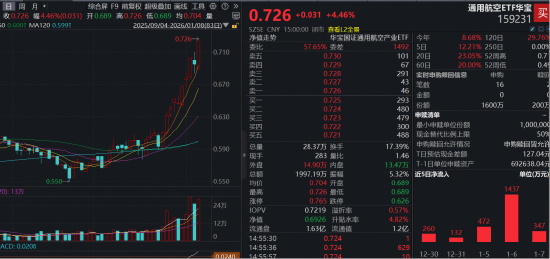
商业航天涨停潮!New Space万亿市场蓄势待发,通用航空ETF(159231)暴力拉升4.46%连续刷新上市新高
Xin Lang Cai Jing· 2026-01-08 11:25
Core Viewpoint - The commercial aerospace and satellite sectors are experiencing significant growth, highlighted by the performance of the Universal Aviation ETF Huabao (159231), which saw a 4.46% increase, marking its largest single-day gain since its launch, with a net subscription of 14 million units on January 8 [1][7]. Group 1: Market Performance - The Universal Aviation ETF Huabao (159231) has shown strong market performance, with a 4.46% increase and a record high in trading volume [1][7]. - Among the 50 constituent stocks, 47 showed positive performance, with five stocks hitting the daily limit up, including Aerospace Nanhu and Aerospace Hongtu [4][10]. Group 2: Industry Developments - The construction of China's first offshore reusable rocket production base by Arrow Yuan Technology marks a significant milestone in the commercial aerospace sector, alongside the unveiling of the "Qiantang" rocket [2][8]. - A report by Guoxin Securities indicates that the commercial aerospace industry is transitioning from a state-led model to a private-led, cost-focused model, which is expected to drive innovation and reduce costs [3][9]. Group 3: Investment Opportunities - The report suggests that the commercial aerospace market is on the verge of a breakthrough, with a focus on high-barrier and high-elasticity sectors within the industry, particularly in rocket engines and satellite manufacturing [3][9]. - Key areas for investment include high-temperature alloys, special stainless steel, and metal 3D printing for rocket engines, as well as advanced satellite payloads and inter-satellite laser communication systems [5][11].